avatarPanos Grigorakakis

Free AI web copilot to create summaries, insights and extended knowledge, download it at here

6636

Abstract

sion</h1><p id="fe88">The climate of euphoria would be abruptly cut short on the ship’s fifth westbound voyage. On September 20, 1911, Olympic suffered a major collision with the British cruiser<b> HMS Hawk</b>.</p><p id="4627">While steaming in the narrow strait of Solent, White Star’s leviathan generated a large suction that pulled the cruiser into her side making the collision unavoidable. Hawk tore two large holes in Olympic’s hull resulting in the flooding of two of her watertight compartments. Olympic did manage to return to Southampton for repairs and fortunately, no one aboard was killed or injured.</p><p id="037b">The liner was found guilty of the collision at the subsequent inquiry, and White Star was forced to pay large legal bills. The incident was a financial disaster for the company which apart from the legal costs had also to pay for repairs. Not having available the ship for six weeks further added to the financial losses.</p><p id="dfcf">Despite the financial blow, the incident gave White Star the chance to promote their vessel’s safety features. HMS Hawke’s bow was designed to sink ships by ramming them, and the fact that Olympic endured the damage further boosted the <b>unsinkable reputation </b>of the new Olympic-class liners. A few months later that reputation will be tragically shuttered with the sinking of the RMS Titanic.</p><figure id="73f1"><img src="https://cdn-images-1.readmedium.com/v2/resize:fit:800/1*Pf_gKsftCch3zASLtUvE3A.jpeg"><figcaption>Olympic (left) and Hawke (right) following their collision (<a href="https://commons.wikimedia.org/wiki/File:Hawke_-_Olympic_collision.JPG">Wikimedia Commons</a>).</figcaption></figure><h1 id="f939">The “New” Olympic -Lessons from the Titanic Disaster</h1><p id="f955">The sinking of the Titanic marked an unexpected and severe setback for the Harland & Wolff shipyard. Olympic was withdrawn from service on 9 October 1912, to undergo modifications that would improve her safety.</p><p id="0bc6">The first step was unsurprisingly the increase in the number of lifeboats to accommodate every person on board. The ship would now carry sixty-eight lifeboats, instead of just twenty.</p><p id="23b7">Five of her watertight bulkheads were raised some 40ft above the waterline, and an additional watertight compartment was added. An inner watertight skin was also constructed in the boiler and engine rooms, to create a double hull. The pumping apparatus underwent modifications too, making it more efficient. The aforementioned improvements made sure that Olympic could survive the damage that compromised her younger sister.</p><p id="fa8c">Although the refit’s main objective was safety, considerable improvements were also made to Olympic’s passenger accommodation areas. More cabins were fitted with private bathing facilities, and new ones were introduced (e.g. the parlor suites). A <i>Café Parisien </i>was added too, offering another dining option to first-class passengers.</p><p id="1431">With these changes, Olympic’s gross tonnage rose to 46,359 tons, surpassing Titanic’s.</p><figure id="2a92"><img src="https://cdn-images-1.readmedium.com/v2/resize:fit:800/1*2Gxpg5GIStmMSx4WobhtfQ.jpeg"><figcaption>Propellers of RMS Olympic in Drydock photographed by Robert John Welch (<a href="https://commons.wikimedia.org/wiki/File:Titanic_rudder_before_launch.jpg">Wikimedia Commons</a>).</figcaption></figure><h1 id="c07b">Olympic on War</h1><p id="b6d2">The outbreak of the <b>First World War</b> and the subsequent shortage of available ships forced the Admiralty to requisition passenger liners for war service. In May 1915 Olympic was converted to a<b> troopship</b>, while the recently-launched Britannic, the ultimate ship of the Olympic-class trio, served as a hospital ship.</p><p id="2178">In 1915 Olympic made several trips to the Mediterranean carrying thousands of troops to Lemnos, Greece for the infamous Gallipoli Campaign. The campaign ended disastrously for the Allies, who decided to abandon the front early in 1916.</p><p id="b655">Olympic’s next mission was to carry Canadian troops from Halifax to Britain. From 1916 to 1917 she completed successfully numerous round-trips from Canada to Europe, becoming an iconic symbol for the city of Halifax.</p><p id="c4b7">Olympic’s highlight at war was undoubtedly the sinking of a German submarine while en route for France on May 12, 1918. Under the command of <b>Captain Bertram Fox Hayes</b>, the ship rammed a <b>U-103 boat </b>slicing its pressure hull with her port propeller. The collision with the submarine dented at least two plates of Olympic’s hull, but she returned safely to Southampton. Olympic’s feat was truly unique — to this day, she is the only passenger liner to ever sink a war submarine.</p><p id="5ff3">During World War I Olympic carried 201,000 troops and other personnel steaming about 184,000 miles (296,000 km). Olympic’s impressive war service earned her the nickname <b>“Old Reliable”</b>.</p><figure id="db4e"><img src="https://cdn-images-1.readmedium.com/v2/resize:fit:800/1*fOcL8PD0iMv9rZkdSUUwYg.jpeg"><figcaption>Olympic in dazzle camouflage while in service as a troopship during the First World War. This painting pattern scheme was used to make it difficult for the enemy to estimate her speed and heading. Her dazzle colors were brown, dark blue, light blue, and white (<a href="https://commons.wikimedia.org/wiki/File:Olympic_WWI.jpg">Wikimedia Commons</a>).</figcaption></figure><p id="1900">Unfortunately, her younger sister did not survive the Great War. The Britannic struck a mine on 21 November 1916 near the Greek island of Kea and sank, killing a total of thirty people. To learn more about the Britannic, read the article below:</p><div id="96aa" class="link-block"> <a href="https://readmedium.com/the-story-of-titanics-doomed-sister-7f03506cb62b"> <div> <div> <h2>The Story of Titanic’s Doomed Sister</h2> <div><h3>HMHS Britannic is the largest ocean liner to ever sink…</h3></div> <div><p>medium.com</p></div> </div> <div> <div style="background-image: url(https://miro.readmedium.com/v2/resize:fit:320/1*jIn4Cvsd5g-Fz9f8_VtRnQ.jpeg)"></div> </div> </div> </a> </div><p id="d774">The loss of the Titanic and Britannic meant that Olympic was yet again the largest British ship afloat.</p><h1 id="99dc">The “Roaring Twenties”</h1><p id="0f69">After the war, Olympic underwent a series of refits and changes to make the ship more modern and cost-effici

Options

ent. For example, she was converted to burn oil instead of coal, a practice that greatly reduced her operational costs. The overhaul did pay off and Olympic reached her career’s peak in 1921, carrying a total of 38,000 passengers.</p><p id="d13c">Times were changing fast though, and a major reduction in the immigrant trade caused by stricter regulations from the United States government forced shipping lines to turn to the tourist trade to survive.</p><p id="290f">Despite the hardships, Olympic remained one of the most popular and fashionable liners afloat, attracting many prominent and important figures of the time. Actors such as Charlie Chaplin, Mary Pickford, Cary Grant, and Douglas Fairbanks, scientists such as Marie Curie, and members of the royal family like Prince Edward VIII were among the celebrities who chose to travel in White Star’s “Old Reliable”.</p><figure id="a887"><img src="https://cdn-images-1.readmedium.com/v2/resize:fit:800/1*04LhJeUDWdLSWKaJz36pOg.jpeg"><figcaption>The foredeck of the RMS Olympic, with the skyline of New York City in the background, photographed in 1911 by William H. Rau (<a href="https://commons.wikimedia.org/wiki/File:Wrau-olympic-foredeck.jpg">Wikimedia Commons</a>).</figcaption></figure><h1 id="dc88">Decline & a Final Mishap</h1><p id="581b">The decline of the immigration trade to the United States, the dramatic effects of the <b>Great Depression</b>, and the emerging competition from newer, larger, and faster liners drew negative prospects for Olympic.</p><p id="8828">At the end of 1932, she was once again withdrawn from service to undergo modifications, returning in March of the following year. Even though her engines performed better than ever, 1933 marked her worst year in business: Olympic carried just over 9,000 passengers in total. From then on the ship would operate constantly at a loss.</p><p id="2cd4">As if these were not enough, Olympic was yet again involved in an accident on May 15, 1934. While approaching New York in heavy fog, <b>Captain John W. Binks </b>failed to see in time the <b>Nantucket Lightship</b> — a lightvessel of the US Lighthouse Service — and sliced through it, killing a total of seven people.</p><figure id="5a1d"><img src="https://cdn-images-1.readmedium.com/v2/resize:fit:800/1*E6GjQMleFCIfufywt5Fr2w.jpeg"><figcaption>RMS Olympic passes Nantucket Lightship 117 close aboard in early January 1934. She sank the lightship four months later. Photo Source: US Coast Guard, (<a href="https://commons.wikimedia.org/wiki/File:SS_Olympic_-_1934.jpg">Wikimedia Commons</a>).</figcaption></figure><h1 id="183c">The End of the Liner</h1><p id="8ea4">In a climate of economic stagnation, White Star and Cunard Line were forced to merge by the British government in 1934. The merger allowed the available funds to be directed to constructing new liners, most notably to the completion of the<b> Queen Mary</b>. The company’s older fleet of liners was decided to be gradually retired.</p><p id="d9b0">Olympic officially ended her transatlantic service on April 5, 1935, when she left New York for the last time. She returned to Britain and was eventually sold to Sir John Jarvis, who agreed to scrap the ship at Jarrow, a town located on the River Tyne. Before the scraping process commenced, Olympic’s fittings were auctioned off.</p><p id="f6e7">Olympic arrived in north-east England on 13 October 1935. After twenty-three months of hard work, the ship’s superstructure was scrapped, and in September 1937, Olympic’s hull was towed to <b>Thos W Ward’s</b> yard at Inverkeithing for final demolition. By the end of the year, the scrapping was completed and the great Olympic was forever gone. It was a sad and inglorious end for one of the most successful ocean liners of the time.</p><figure id="428e"><img src="https://cdn-images-1.readmedium.com/v2/resize:fit:800/1*_RGoRWj8m-rNHs0lOB0A7g.jpeg"><figcaption>Olympic (left) and Mauretania (right) at Southampton in 1935 awaiting their final voyage to the breakers yard (<a href="https://commons.wikimedia.org/wiki/File:Olympic_and_Mauretania.jpg">Wikimedia Commons</a>).</figcaption></figure><h1 id="9bf4">Epilogue</h1><p id="824b">Olympic’s story is one of triumph and success. Even though Titanic and Britannic were originally designed to be better than their older sister, they failed to fulfill their designer’s dreams and expectations.</p><p id="e2e0">None of them completed a single transatlantic voyage, whereas Olympic made a total of 257 round trips across the Atlantic. She transported 430,000 passengers on her commercial voyages, traveling 1.8 million miles. During World War I, she completed 36 trooping voyages, carrying 201,000 military personnel — more than any of her competitors- and sank (!) an enemy submarine.</p><p id="b69e">Olympic had an impressive commercial and military career. She was the only vessel of her class that justified her unsinkable reputation and should be deservedly remembered as one of history’s greatest ocean liners.</p><figure id="81f8"><img src="https://cdn-images-1.readmedium.com/v2/resize:fit:800/1*0eJpSj9yP8MXvrYcUnQy_w.jpeg"><figcaption>Olympic’s fittings were auctioned off before her scrapping. Fittings of her first-class lounge and part of the aft grand staircase can be found in Alnwick, Northumberland, England. (Above) Fireplace in the Olympic Suite of the White Swan Hotel (<a href="https://commons.wikimedia.org/wiki/File:White_Swan_Hotel_Olympic_Suite.jpg">Wikimedia Commons</a>).</figcaption></figure><h1 id="8904">References</h1><p id="a8da"><i>Chirnside M.,(2004), RMS Olympic Titanic’s Sister, The History Press</i></p><p id="d1e3"><i>Chirnside M.,(2012), Olympic * Titanic * Britannic An Illustrated History of The “Olympic” Class Ships, The History Press</i></p><p id="7548"><i>McCluskie T., Sharpe M., Marriott L.,(1998), Titanic & Her Sisters Olympic & Britannic, Parkgate Books Ltd</i></p><p id="ff86"><i>McCutcheon J.&C.,(2014), Titanic & Her Sisters A Postcard History, Amberley Publishing</i></p><p id="6305"><i>“Real footage of RMS Olympic heading to the breakers yard”, YouTube, uploaded by SVCNProductions, 19 December 2008, <a href="https://www.youtube.com/watch?v=Viu2-mtZPsg">https://www.youtube.com/watch?v=Viu2-mtZPsg</a></i></p><blockquote id="cb1c"><p>Panos Grigorakakis is a journalist particularly interest in history, evolutionary biology, anthropology and…ocean liners! Connect with him on <a href="https://www.linkedin.com/in/panos-grigorakakis/?locale=en_US">Linkedin</a> or say hi on <a href="https://twitter.com/PanosGrigor">Twitter</a>.</p></blockquote></article></body>

The Story of Titanic’s Unsinkable Sister

Contrary to the Titanic, Olympic’s story is one of triumph and success…
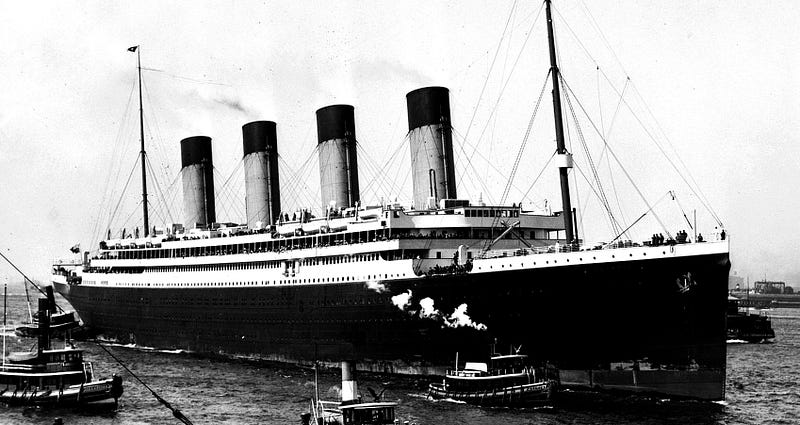
Olympic arriving at New York on her maiden voyage on 21 June 1911 / The Library of Congress (Wikimedia Commons).

“The finest ship in my estimation that has ever been built, or ever will be.”— Bertram Hayes, RMS Olympic Captain

The RMS Titanic is probably the most famous ocean liner of all time and her sinking marks one of the best-documented disasters of the 20th century. Yet, the story of Titanic’s almost identical sister ship remains relatively unknown even though her impressive career -spanning almost a quarter of a century- was far from uneventful.

At the time of her construction, the RMS Olympic was the biggest man-moving object in the world and her luxurious interiors matched the description of a “floating palace”. During the First World War, she served as a troopship and sank an enemy submarine -the only passenger liner ever to have done so. Her successful war service earned her the nickname “Old-Reliable” and during the “Roaring Twenties,” she was a celebrity favorite even though newer and more modern liners were available.

Being constantly overshadowed by her ill-fated sister, Olympic truly deserves more recognition.

This is her story.
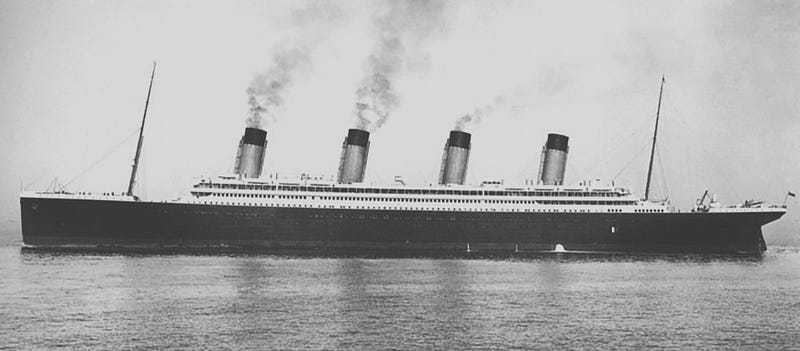
Olympic’s impressive profile (Wikimedia Commons).

Background

Olympic was the first of a new class of liners envisioned by White Star Line to attract more passengers for the transatlantic crossing. While there were faster ships, White Star’s new vessels were to be the biggest in the world. Luxury and comfort would be the trademark selling points of these new mammoth liners which would be promoted as offering “passenger accommodation of unrivaled extent and magnificence.”

They were the Olympic-class liners and would include a total of three ships: the Olympic, the Titanic, and the Britannic.
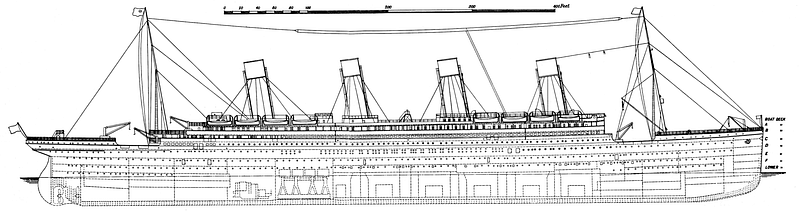
Early plans for the Olympic-class liners RMS Olympic /Titanic printed in The Shipbuilder magazine in 1911 (Wikimedia Commons).

Construction & Launch

Olympic and Titanic would be constructed side by side in the Harland & Wolff shipyard in Belfast. Olympic’s keel was laid on December 16, 1908, with Titanic following three months later. Between 3,00 and 4,000 workers were deployed for the construction of the Olympic alone. It took twenty-two months for the ship’s hull to be fully plated, and by October 1910, Olympic was prepared for her official launch.
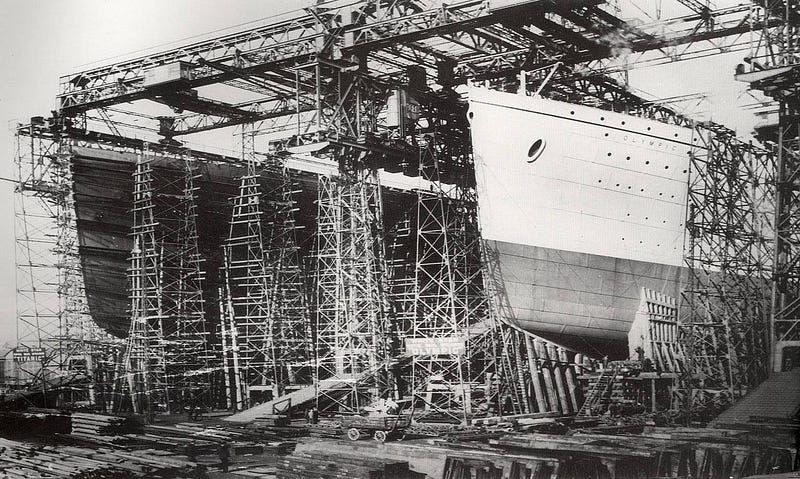
Olympic (right) and Titanic (left) in Harland & Wolff shipyard in 1910 photographed by Robert John Welch. Olympic is ready for its official launch, while Titanic will follow the schedule some months later (Wikimedia Commons)

On the morning of October 20, loads of crowds were gathered in the shipyard to witness White Star’s finest ship entering the water for the first time. The launch was completed successfully, and the ship was then drydocked, ready to be transformed from a practically empty hull to a luxurious ocean liner.

The installation of all her machinery (gigantic triple expansion engines, the boilers, the iconic funnels, the propellers, etc), as well as the fitting out of her interior spaces (indoor paneling, plumbing, electric wiring, passenger and crew areas, etc), required months of hard work, but the result was impressive. Olympic was practically completed by spring 1911 and ready to begin her career as a passenger liner.
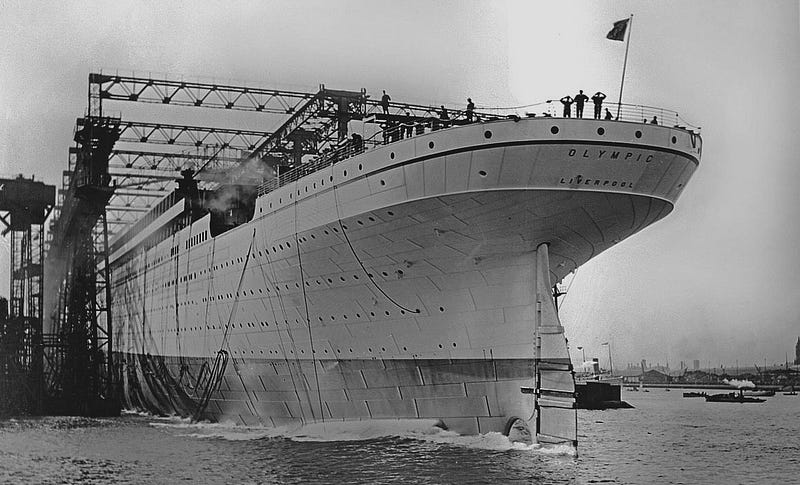
(Above) RMS Olympic during her launch on October 20, 1910, photographed by Robert John Welch. Olympic’s hull was painted in a light grey color for photographic purposes; a common practice of the day for the first ship in a new class, as it made the lines of the ship clearer in the black-and-white photographs. Her hull was repainted black following the launch (Wikimedia Commons).

Maiden Voyage

On May 31, 1911, Olympic left Belfast for the first time arriving in Liverpool, her port of registration. On June 3, she dropped anchor at Southampton to undergo final preparations for her maiden voyage, which was scheduled for June 14, 1911.

Olympic’s maiden voyage began from Southampton, calling at Cherbourg and Queenstown, before heading to New York. On June 21, 1911, Olympic entered triumphantly into New York harbor for the first time “receiving numerous whistle salutes from vessels around her”.

Being not only White Star’s newest flagship but also the largest-moving object in the world, her arrival naturally attracted a lot of press and media attention. More than 10,000 people gathered at White Star docks to witness her departure for the returning eastbound trip to Europe.
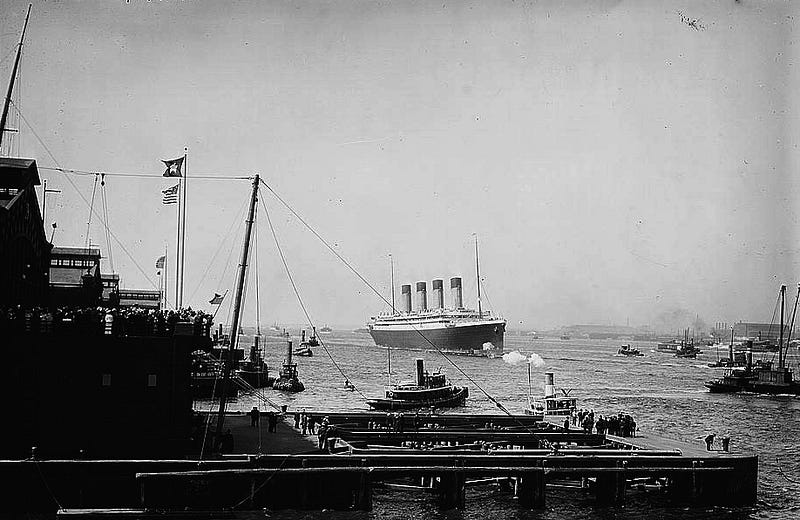
The Olympic approaches the White Star Line Piers in New York/ Chris / CC BY (Wikimedia Commons).

The Hawk Collision

The climate of euphoria would be abruptly cut short on the ship’s fifth westbound voyage. On September 20, 1911, Olympic suffered a major collision with the British cruiser HMS Hawk.

While steaming in the narrow strait of Solent, White Star’s leviathan generated a large suction that pulled the cruiser into her side making the collision unavoidable. Hawk tore two large holes in Olympic’s hull resulting in the flooding of two of her watertight compartments. Olympic did manage to return to Southampton for repairs and fortunately, no one aboard was killed or injured.

The liner was found guilty of the collision at the subsequent inquiry, and White Star was forced to pay large legal bills. The incident was a financial disaster for the company which apart from the legal costs had also to pay for repairs. Not having available the ship for six weeks further added to the financial losses.

Despite the financial blow, the incident gave White Star the chance to promote their vessel’s safety features. HMS Hawke’s bow was designed to sink ships by ramming them, and the fact that Olympic endured the damage further boosted the unsinkable reputation of the new Olympic-class liners. A few months later that reputation will be tragically shuttered with the sinking of the RMS Titanic.
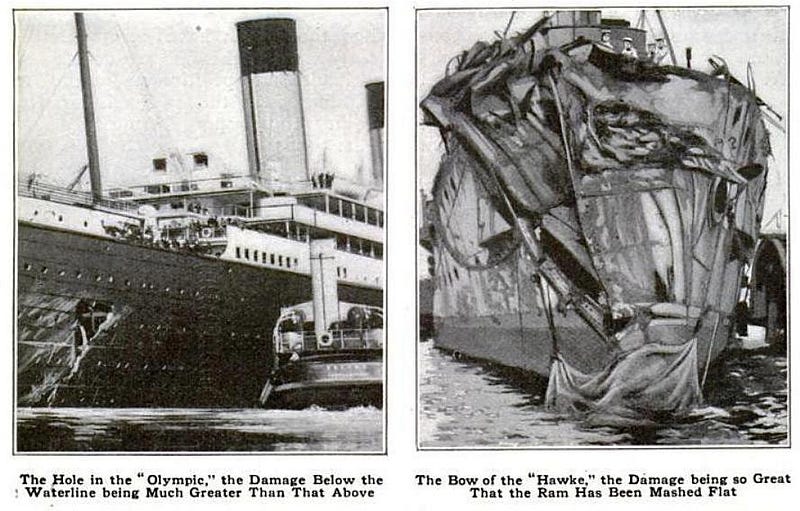
Olympic (left) and Hawke (right) following their collision (Wikimedia Commons).

The “New” Olympic -Lessons from the Titanic Disaster

The sinking of the Titanic marked an unexpected and severe setback for the Harland & Wolff shipyard. Olympic was withdrawn from service on 9 October 1912, to undergo modifications that would improve her safety.

The first step was unsurprisingly the increase in the number of lifeboats to accommodate every person on board. The ship would now carry sixty-eight lifeboats, instead of just twenty.

Five of her watertight bulkheads were raised some 40ft above the waterline, and an additional watertight compartment was added. An inner watertight skin was also constructed in the boiler and engine rooms, to create a double hull. The pumping apparatus underwent modifications too, making it more efficient. The aforementioned improvements made sure that Olympic could survive the damage that compromised her younger sister.

Although the refit’s main objective was safety, considerable improvements were also made to Olympic’s passenger accommodation areas. More cabins were fitted with private bathing facilities, and new ones were introduced (e.g. the parlor suites). A Café Parisien was added too, offering another dining option to first-class passengers.

With these changes, Olympic’s gross tonnage rose to 46,359 tons, surpassing Titanic’s.
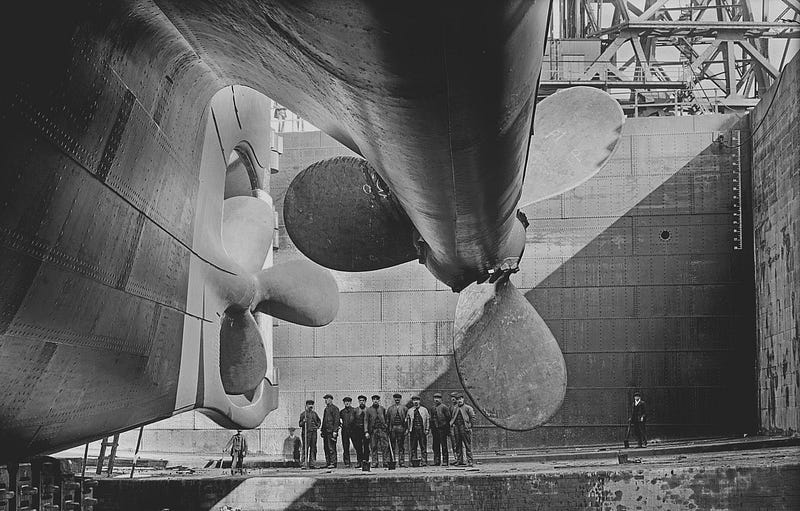
Propellers of RMS Olympic in Drydock photographed by Robert John Welch (Wikimedia Commons).

Olympic on War

The outbreak of the First World War and the subsequent shortage of available ships forced the Admiralty to requisition passenger liners for war service. In May 1915 Olympic was converted to a troopship, while the recently-launched Britannic, the ultimate ship of the Olympic-class trio, served as a hospital ship.

In 1915 Olympic made several trips to the Mediterranean carrying thousands of troops to Lemnos, Greece for the infamous Gallipoli Campaign. The campaign ended disastrously for the Allies, who decided to abandon the front early in 1916.

Olympic’s next mission was to carry Canadian troops from Halifax to Britain. From 1916 to 1917 she completed successfully numerous round-trips from Canada to Europe, becoming an iconic symbol for the city of Halifax.

Olympic’s highlight at war was undoubtedly the sinking of a German submarine while en route for France on May 12, 1918. Under the command of Captain Bertram Fox Hayes, the ship rammed a U-103 boat slicing its pressure hull with her port propeller. The collision with the submarine dented at least two plates of Olympic’s hull, but she returned safely to Southampton. Olympic’s feat was truly unique — to this day, she is the only passenger liner to ever sink a war submarine.

During World War I Olympic carried 201,000 troops and other personnel steaming about 184,000 miles (296,000 km). Olympic’s impressive war service earned her the nickname “Old Reliable”.
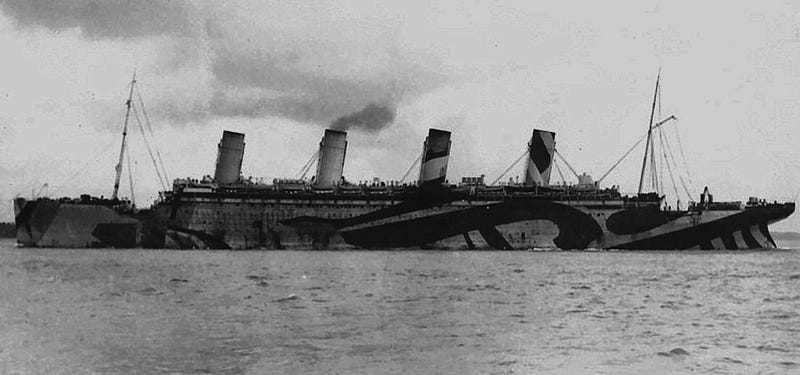
Olympic in dazzle camouflage while in service as a troopship during the First World War. This painting pattern scheme was used to make it difficult for the enemy to estimate her speed and heading. Her dazzle colors were brown, dark blue, light blue, and white (Wikimedia Commons).

Unfortunately, her younger sister did not survive the Great War. The Britannic struck a mine on 21 November 1916 near the Greek island of Kea and sank, killing a total of thirty people. To learn more about the Britannic, read the article below:

The loss of the Titanic and Britannic meant that Olympic was yet again the largest British ship afloat.

The “Roaring Twenties”

After the war, Olympic underwent a series of refits and changes to make the ship more modern and cost-efficient. For example, she was converted to burn oil instead of coal, a practice that greatly reduced her operational costs. The overhaul did pay off and Olympic reached her career’s peak in 1921, carrying a total of 38,000 passengers.

Times were changing fast though, and a major reduction in the immigrant trade caused by stricter regulations from the United States government forced shipping lines to turn to the tourist trade to survive.

Despite the hardships, Olympic remained one of the most popular and fashionable liners afloat, attracting many prominent and important figures of the time. Actors such as Charlie Chaplin, Mary Pickford, Cary Grant, and Douglas Fairbanks, scientists such as Marie Curie, and members of the royal family like Prince Edward VIII were among the celebrities who chose to travel in White Star’s “Old Reliable”.
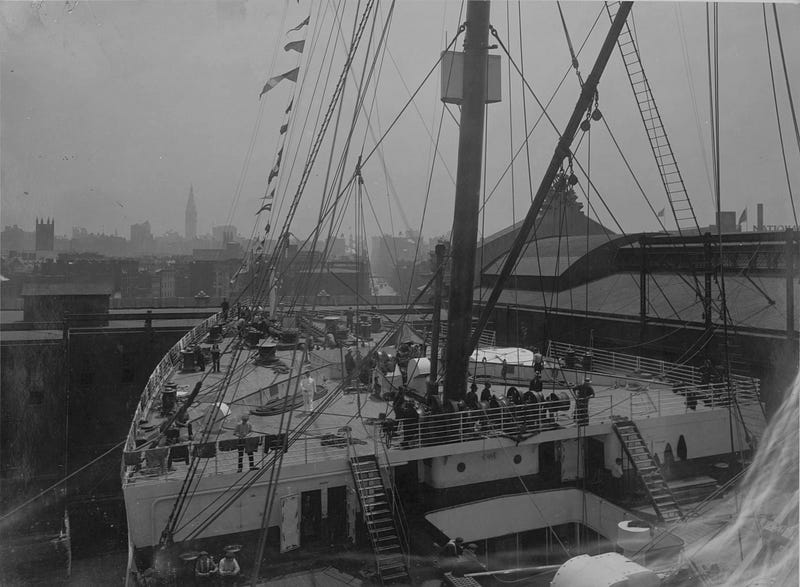
The foredeck of the RMS Olympic, with the skyline of New York City in the background, photographed in 1911 by William H. Rau (Wikimedia Commons).

Decline & a Final Mishap

The decline of the immigration trade to the United States, the dramatic effects of the Great Depression, and the emerging competition from newer, larger, and faster liners drew negative prospects for Olympic.

At the end of 1932, she was once again withdrawn from service to undergo modifications, returning in March of the following year. Even though her engines performed better than ever, 1933 marked her worst year in business: Olympic carried just over 9,000 passengers in total. From then on the ship would operate constantly at a loss.

As if these were not enough, Olympic was yet again involved in an accident on May 15, 1934. While approaching New York in heavy fog, Captain John W. Binks failed to see in time the Nantucket Lightship — a lightvessel of the US Lighthouse Service — and sliced through it, killing a total of seven people.
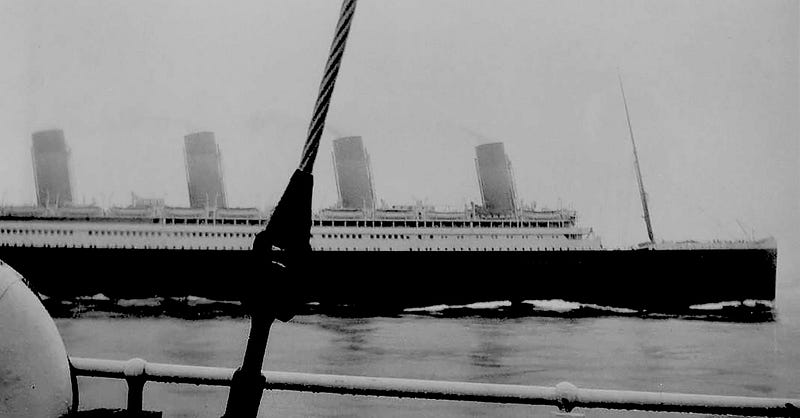
RMS Olympic passes Nantucket Lightship 117 close aboard in early January 1934. She sank the lightship four months later. Photo Source: US Coast Guard, (Wikimedia Commons).

The End of the Liner

In a climate of economic stagnation, White Star and Cunard Line were forced to merge by the British government in 1934. The merger allowed the available funds to be directed to constructing new liners, most notably to the completion of the Queen Mary. The company’s older fleet of liners was decided to be gradually retired.

Olympic officially ended her transatlantic service on April 5, 1935, when she left New York for the last time. She returned to Britain and was eventually sold to Sir John Jarvis, who agreed to scrap the ship at Jarrow, a town located on the River Tyne. Before the scraping process commenced, Olympic’s fittings were auctioned off.

Olympic arrived in north-east England on 13 October 1935. After twenty-three months of hard work, the ship’s superstructure was scrapped, and in September 1937, Olympic’s hull was towed to Thos W Ward’s yard at Inverkeithing for final demolition. By the end of the year, the scrapping was completed and the great Olympic was forever gone. It was a sad and inglorious end for one of the most successful ocean liners of the time.
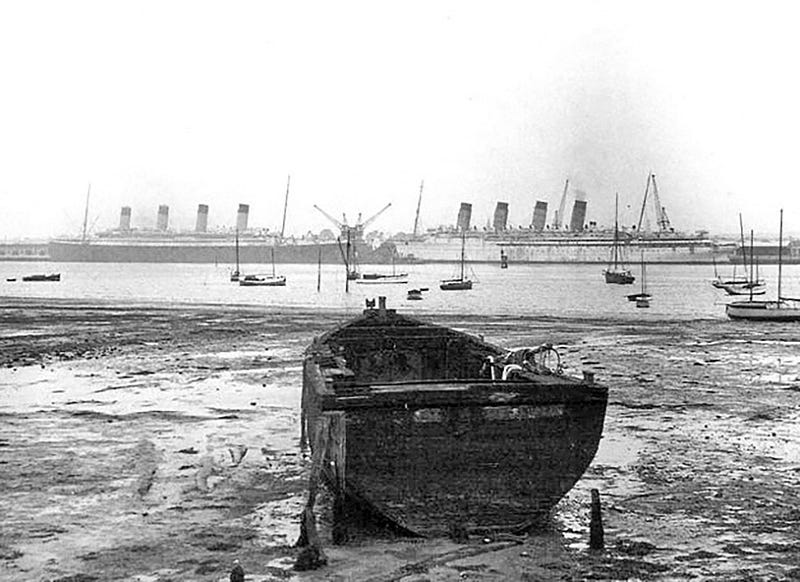
Olympic (left) and Mauretania (right) at Southampton in 1935 awaiting their final voyage to the breakers yard (Wikimedia Commons).

Epilogue

Olympic’s story is one of triumph and success. Even though Titanic and Britannic were originally designed to be better than their older sister, they failed to fulfill their designer’s dreams and expectations.

None of them completed a single transatlantic voyage, whereas Olympic made a total of 257 round trips across the Atlantic. She transported 430,000 passengers on her commercial voyages, traveling 1.8 million miles. During World War I, she completed 36 trooping voyages, carrying 201,000 military personnel — more than any of her competitors- and sank (!) an enemy submarine.

Olympic had an impressive commercial and military career. She was the only vessel of her class that justified her unsinkable reputation and should be deservedly remembered as one of history’s greatest ocean liners.
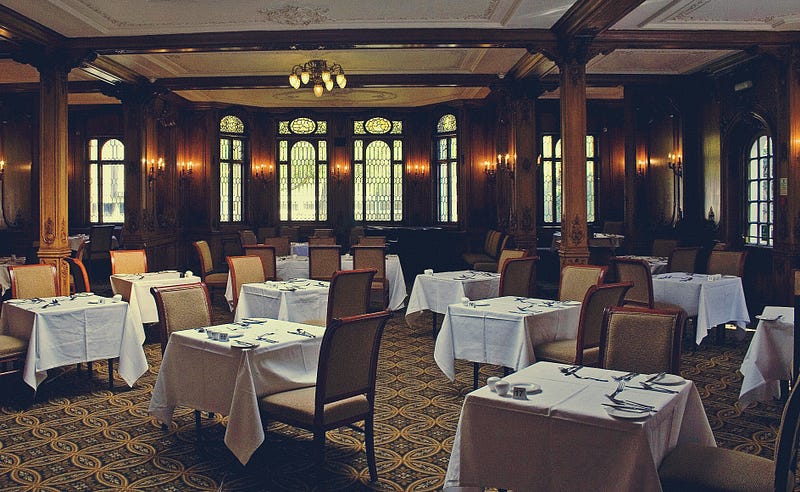
Olympic’s fittings were auctioned off before her scrapping. Fittings of her first-class lounge and part of the aft grand staircase can be found in Alnwick, Northumberland, England. (Above) Fireplace in the Olympic Suite of the White Swan Hotel (Wikimedia Commons).

References

Chirnside M.,(2004), RMS Olympic Titanic’s Sister, The History Press

Chirnside M.,(2012), Olympic * Titanic * Britannic An Illustrated History of The “Olympic” Class Ships, The History Press

McCluskie T., Sharpe M., Marriott L.,(1998), Titanic & Her Sisters Olympic & Britannic, Parkgate Books Ltd

McCutcheon J.&C.,(2014), Titanic & Her Sisters A Postcard History, Amberley Publishing

“Real footage of RMS Olympic heading to the breakers yard”, YouTube, uploaded by SVCNProductions, 19 December 2008, https://www.youtube.com/watch?v=Viu2-mtZPsg

Panos Grigorakakis is a journalist particularly interest in history, evolutionary biology, anthropology and…ocean liners! Connect with him on Linkedin or say hi on Twitter.

Titanic
Ship
Oceans
History
World War I
Recommended from ReadMedium