
The Story of Titanic’s Tragic Twin
HMHS Britannic is the largest ocean liner to ever sink…
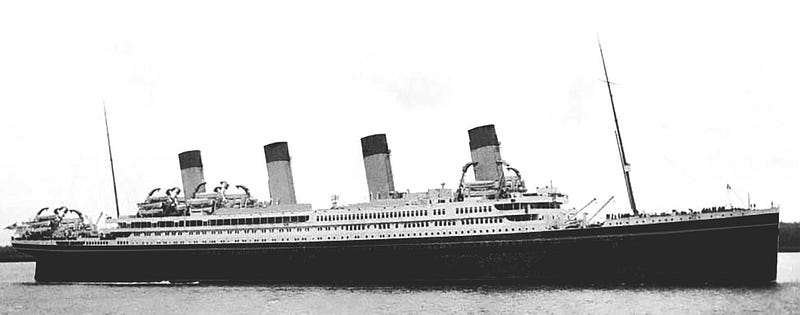
“A fine vessel-the very latest word in everything new and the triumph of all that the science and art of modern shipbuilding could accomplish” — John Beaumont, Britannic’s chief surgeon
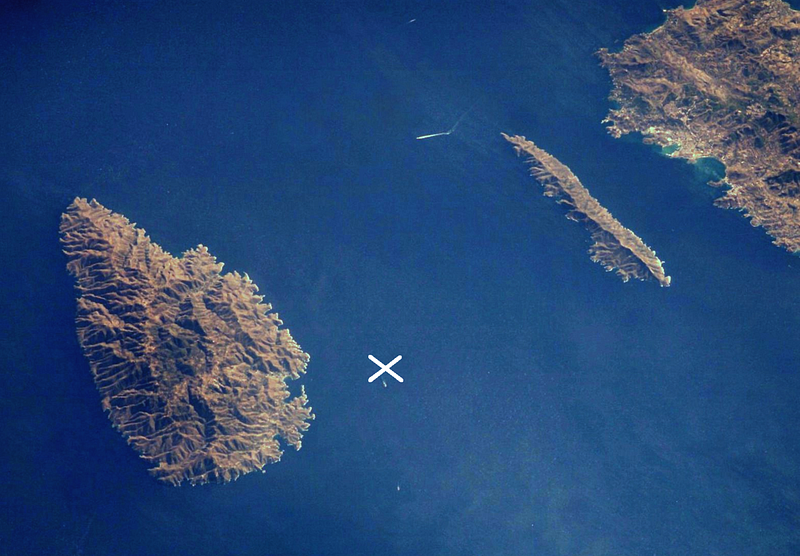
The largest ocean liner to ever sink lies today at the bottom of the Aegean Sea. The waters close to the Greek island of Kea, are home to a vessel originally designed to be Britain’s finest liner. Although she was intended to steam through the harsh North Atlantic carrying thousands of people from Southampton to New York, she never carried a single fare-paying passenger.
Her promising career was interrupted by the outbreak of the First World War. Converted to a hospital ship, she carried the wounded back home, till she struck a mine and sank, in a fate similar to her infamous sister, the RMS Titanic.
She was the wondrous HMHS Britannic, and this is her story.
Background
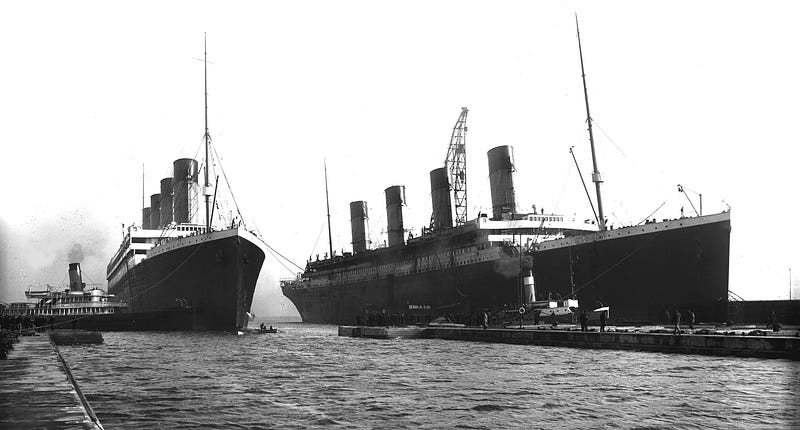
Britannic was the third and final ship of the Olympic-class vessels, following the Olympic and the Titanic. Envisioned by the White Star Line, these ships were intended to provide a reliable weekly service on the North Atlantic route. The transatlantic crossing was booming at the turn of the twentieth century and the competition between rival shipping companies was intense. Designed for passenger comfort, rather than speed, the Olympic-class ships were promoted for offering “passenger accommodation of unrivaled extend”.
Olympic went on to have a successful career with a remarkable 24-year-long service during times of peace and war. You can read Olympic’s full story here:
In contrast, the Titanic struck an iceberg and sank on her maiden voyage, claiming the lives of 1,496 people. The sudden loss of the Titanic meant that White Star would have to rely on two, rather than three ships for their transatlantic service.
The Britannic was in all respects designed to be an enhanced version of her sisters, incorporating the lessons learned from their service, and setting even higher standards of luxury and comfort [1].
Construction & Post-Titanic Design Changes
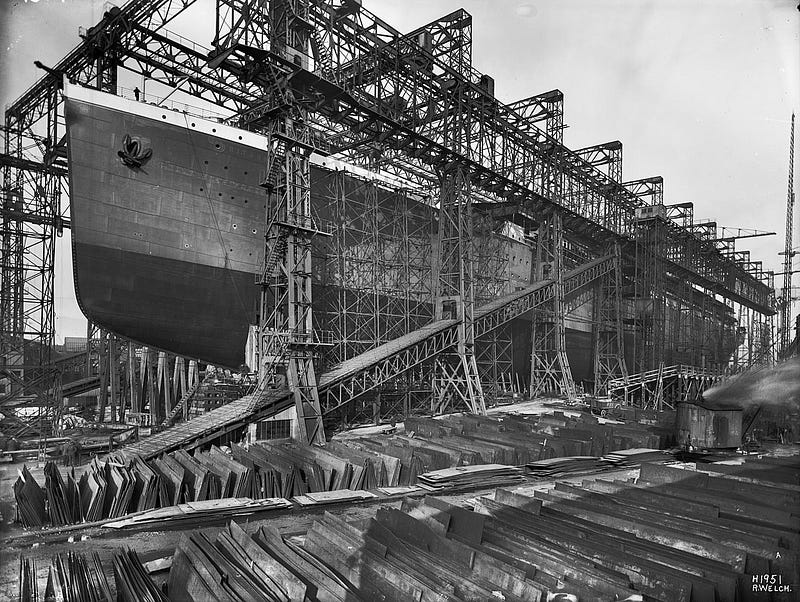
On November 30, 1911, Britannic’s keel was laid in Harland & Wolff shipyard in Belfast, the same place where her sisters were constructed.
Following the Titanic disaster, Olympic and Britannic underwent a series of design changes to improve their safety. In Britannic’s case, these changes took place before the ship’s launch.
Although the Britannic would be identical to her sisters in terms of length (882 ft 9 in /269.1 m), her beam was increased to allow for a double hull along the engine and boiler rooms [2]. Six out of Britannic’s fifteen watertight bulkheads were raised up to B-deck, enhancing her floatation ability. This change would enable the ship to float with up to six compartments open to the sea [3].
The number of lifeboats was increased to accommodate all passengers and crew. The Britannic would carry a total of 55 lifeboats, with a capacity of 3,600 people. For comparison, the Titanic only carried 20. The lifeboats would be stored in gantries and would be launched by large crane-like davits, making the process faster and more efficient.
Britannic was eventually launched on 26 February 1914, with the fitting out process initiating immediately after. Yet, any prospects of commencing a transatlantic service were dissipated when the First World War broke out in August.
HMHS Britannic
The outbreak of war and the subsequent shortage of available ships forced the Admiralty to requisition passenger liners for war service.
The Olympic was converted to a troopship in May 1915. Six months later, it was Britannic’s turn to join the war in response to the increasing demand for hospital ships in the eastern Mediterranean. The Gallipoli Campaign proved disastrous for the Allies — they suffered heavy casualties and the treatment, as well as the evacuation of the wounded, became a matter of critical importance.
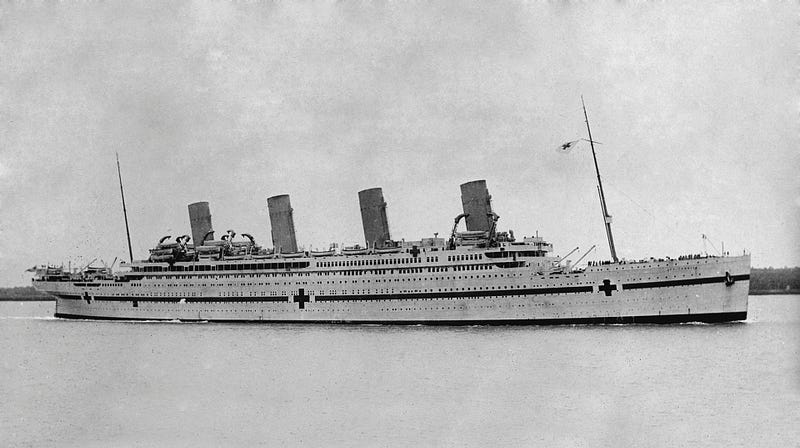
Renamed HMHS (His Majesty’s Hospital Ship) Britannic, the ship would be captained by Charles Alfred Bartlett. She was repainted white with large red crosses and a horizontal green stripe, the classic paint pattern of hospital ships.
The Britannic officially entered service on December 23, 1915, and by November 6, 1916, she had already completed five successful round-trips to the Mediterranean carrying thousands of wounded soldiers back home.
On November 12, 1916, Britannic began her sixth mission to the Mediterranean Sea with 1,066 people on board (673 crew, 315 Royal Army Medical Corps, 77 nurses, and the Captain). Unfortunately, it was going to be her last.
Disaster Hits
On the morning of 21 November, Britannic was heading north-east through the Kea Channel in fine weather and smooth seas. At 08:12 the calmness of the scene was shattered by a ‘tremendous but muffled explosion. The ship trembling and vibrating most violently fore and aft, continuing for some time’.
It didn’t take long for Captain Bartlett to realize what had happened: the Britannic had struck a mine, but the captain’s first impression was that that the ship could survive the blow. Immediately he took all action necessary to notify his crew and contain the damage: he sounded the alarm, ordered the engines stopped, the watertight doors closed, and the transmission of a distress signal. With the Greek island of Kea not far away, he tried to navigate the vessel towards the shore in an attempt to beach it.
The Sinking
The Britannic quickly developed a serious list to starboard, the side where the ship had struck the mine. This, combined with the weight of the rudder, made attempts to navigate the ship under its own power difficult.
Meanwhile, crew members prepared for evacuation. Bartlett had ordered the lifeboats prepared, but he didn’t permit them to be lowered into the water. The ship’s list was growing fast by the minute and some people, fearing that they wouldn’t leave the ship in time, decided to get into a lifeboat without permission. By the time the captain ordered the engines to stop, two lifeboats had already been lowered from the port side. The still-turning partly-surfaced propeller created a sanction, tragically mincing the two lifeboats and their passengers.
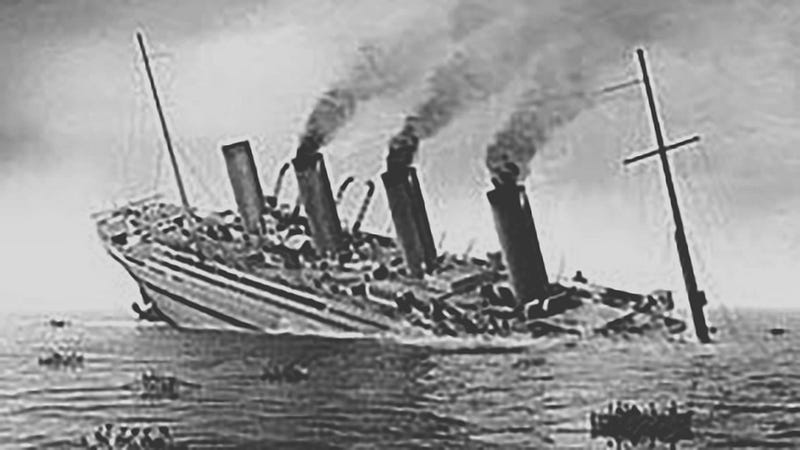
By 08:45, the list was so great that even the gantry davits could not function anymore. At 09:00 Bartlett sounded two final long blasts of the whistle, the signal to abandon ship. The ship capsized to starboard with the funnels collapsing one by one as the sinking accelerated. At 09:07 Britannic disappeared beneath the waves, only 55 minutes after the explosion.
Rescue
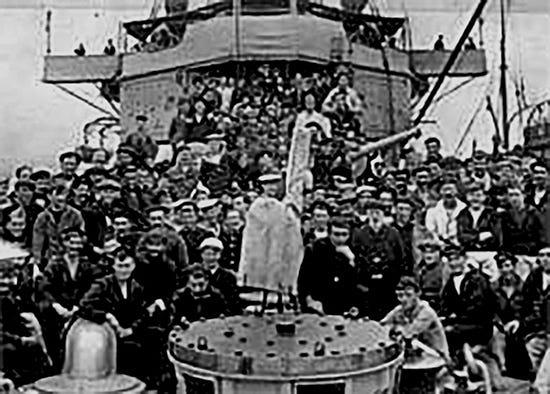
Several ships had received Britannic’s distress call and were coming to the rescue. Yet, the first to arrive on the scene were some fishers from the nearby Kea island. HMS Scourge and HMS Heroic appeared soon after picking up 833 survivors. In total, thirty people lost their lives in the sinking, while 1,035 survived.
Contrary to the Titanic, most people on board the Britannic survived the disaster. Several factors contributed to the smaller number of victims: The Titanic sank in the icy-cold Atlantic, the Britannic in the much warmer Aegean Sea. The Britannic carried more lifeboats than her sister and fewer people on board. Help was also easier to reach and arrived faster.
Could The Britannic Survive The Damage?
It took 2 hours and 40 minutes for the Titanic to sink. Britannic incorporated a series of design advancements that made her a safer vessel, and, in theory, she should have survived the blow. Yet, this wasn’t the case. Even worse, she sank almost three times faster than her older sister. Why did this happen?
The mine had struck the ship on the starboard side, between the second and the third watertight compartment. The explosion immediately damaged the ship’s first four watertight compartments which filled rapidly with water. Water was also flowing into boiler room six through the damaged watertight door of the firemen’s tunnel, while the watertight door between boiler rooms five and six failed to close properly. Thus, water was flowing further aft into boiler room five. With six compartments taking up water, the Britannic had reached her flooding limit. Theoretically, she should have endured the damage and did not sink.
Unfortunately, as the ship’s angle of list increased, water began to enter farther aft between boiler rooms five and four. There were many portholes left open by the nurses along the front lower decks and when the water reached their level, the watertight subdivision was bypassed. With more than six compartments open to the sea, Britannic was doomed. The sinking was also accelerated by the efforts made by the captain to beach the ship, with water entering faster as the vessel was running its engines.
Epilogue
Designed to be the greatest Olympic-class vessel, the Britannic was the epitome of British shipbuilding, envisioned to steam confidently through the North Atlantic for many years. Similar to her older sister, she failed to fulfill her potential, her career cut short by the war. Today she is still remembered as the largest passenger liner to lie beneath the waves, a title quite different from the one originally envisioned by her designers.
Notes
[1] For example, a children’s playroom, a ladies’ barber’s shop, and a manicurist were introduced in First class accommodation. A new reception room was also installed and the à la carte restaurant on B-deck was expanded. A gymnasium and an enclosed promenade were new additions in the Second class area. The third class smoking room was also moved to a new deckhouse above the poop deck, while new staircases provided easy access for Third class passengers to higher decks.
Britannic would also feature a total of 201 assorted private bathroom facilities, a great step forward compared to earlier liners. When the Olympic entered service in 1911, only 42 private bathroom facilities were installed in the First class.
Unfortunately, most of these facilities were not completely installed because the ship sank before she could enter transatlantic service, so the planned facilities were either canceled, destroyed, reused on other vessels (like Olympic), or just never used.
[2] To make up for the increase in hull width, an 18,000 horsepower turbine was added surpassing her sister’s 16,000 horsepower ones. Britannic’s gross tonnage was increased to 48,158 tons — Titanic’s gross tonnage was 46,328 while Olympic’s was measured at 45,324 tons (when she entered service in 1911).
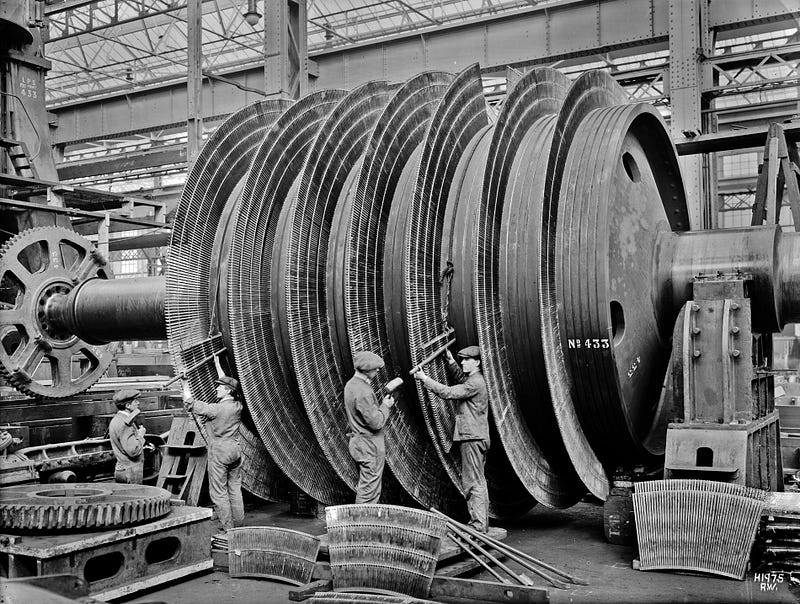
With greater displacement, engine power, and gross tonnage, Britannic was the largest of the “Olympic-class” ships, but not the largest vessel in the world-Hamburg America Line’s Vaterland held this title.
[3] In practice, that meant that the Britannic could survive the damage that compromised her infamous sister. The Titanic could stay afloat with her first four compartments flooded. Unfortunately, the collision with the iceberg caused her first six watertight compartments to flood. Contrary to Britannic, the Titanic was not designed to sustain such extensive damage.
References
Chirnside M.,(2012), Olympic*Titanic*Britannic An Illustrated History of The “Olympic” Class Ships, The History Press
McCluskie T., Sharpe M., Marriott L.,(1998), Titanic & Her Sisters Olympic & Britannic, Parkgate Books Ltd
McCutcheon J.&C.,(2014), Titanic & Her Sisters A Postcard History, Amberley Publishing
Panos Grigorakakis is a journalist, particularly interest in history, evolutionary biology, anthropology and…ocean liners! Connect with him on Linkedin or say hi on Twitter.


