
The Accident that Would Have Averted the Titanic Disaster
A little-talked incident that nearly canceled Titanic’s maiden voyage…
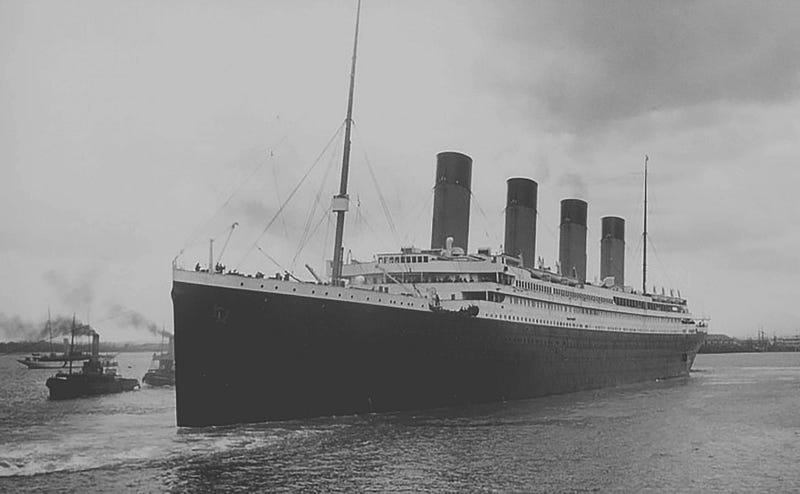
The story of the Titanic has gone down in history as one of the most emotive disasters of all time. Numerous films, books, and even theatrical plays were written about the tragedy keeping the story ever-popular to all generations.
We’ve already addressed the reasons behind Titanic’s everlasting appeal in a past article which you can check below:
While everyone is familiar with the sinking part of the story, little attention is given to the gloomy incident that occurred just as the ship left her berth at Southampton port. Had this event played out in a slightly different manner, Titanic’s maiden voyage would have been canceled and the disastrous sinking, as well as the tragic loss of 1,496 lives, would have been averted.
This is the story of the event that would have dramatically altered the fate of the most famous liner of all time.
Leaving Port
Titanic’s maiden voyage was scheduled to commence from Southampton. The ship would then call at Cherbourg and Queenstown, before heading west to New York.
April 10, 1912, 12.00 pm
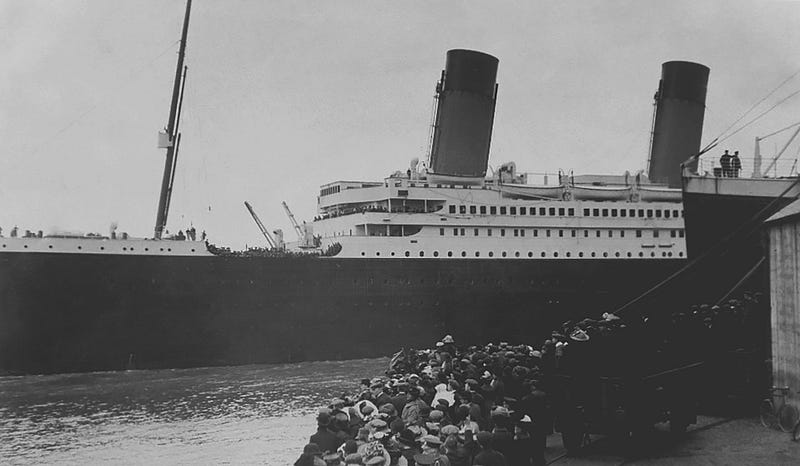
At the stroke of noon, the sound of the Titanic's horns fills the city of Southampton, signaling the beginning of her voyage. The thick hawsers splash into the water, freeing the enormous liner from the land. Five tugs gently start to edge the Titanic out into the channel. On the quayside, crowds are cheering and waving the ship goodbye.
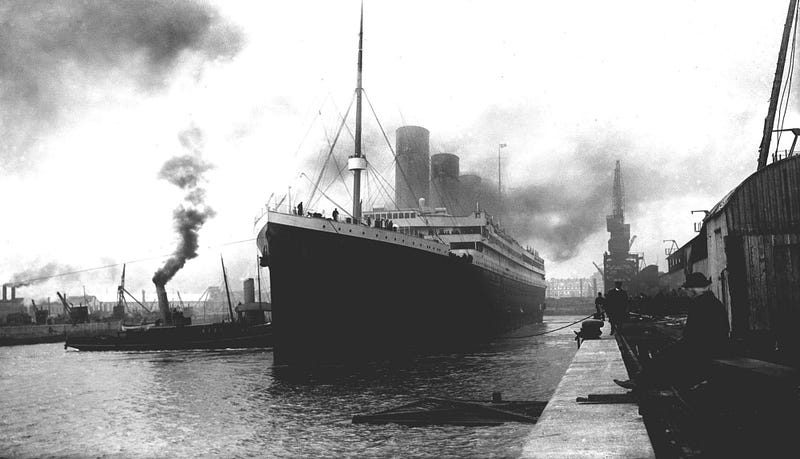
From the Bridge, the order “Slow Ahead” is telegraphed to the Engine Room. The ship’s engines come to life, turning the propellers with gathering momentum. The building force is immediately felt on everybody on board the liner. First Class passenger Elmer Taylor recalls:
“The signal was then given to go ahead. Those powerful engines began to pile water up astern, creating a swift current, more than the entire length of the steamer, without perceptibly overcoming the inertia of the great mass.”
From the shore, the crowds marvel at the largest man-moving object as it sets itself in motion for the first time. With the words of one observer:
“It doubtful whether the Olympic (Titanic’s sister ship) has ever cleared the new dock in such a splendid manner as did the Titanic on this occasion. From the moment she began to move from her berth in that dock she was under absolute control, and she passed out of the dock not only majestically, but also smoothly and calmly.”
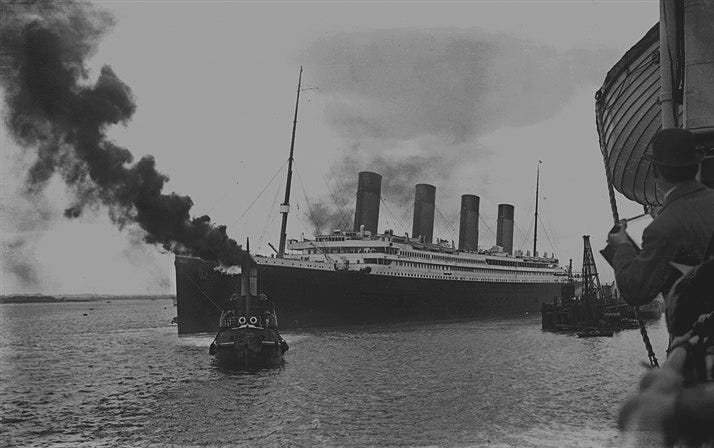
The Titanic begins to gather speed turning to port. While doing so, the enormous liner passes near a cluster of smaller vessels, laid up in the nearby berths [1]. Suddenly a series of gunshot-like sounds fill the air. Many passengers rush to the port-side railing of the ship and immediately realize that something is terribly wrong.
“Hold Fast For The Shock!”
The White Star’s giant creates so much turbulence in the water that nearby ships are shaking loose and breaking free. One vessel, in particular, the SS New York breaks free from her moorings and is sucked in by the displacement generated from the Titanic’s giant propellers.
First Class passenger May Futrelle has a perfect view of the emerging situation. Standing with her husband in the port-side rail, they witness the American liner moving away from her berth and dangerously approaching the Titanic:
“Jacques and I stood by the rail nearest to the New York as we got headway. Suddenly we saw the New York shiver and move, then her cable nearest us snapped, and the stump whipped back on deck, knocking over some people. I saw her begin to swing toward us. Jacques shouted: “Hold fast for the shock!” I gripped the rail.”
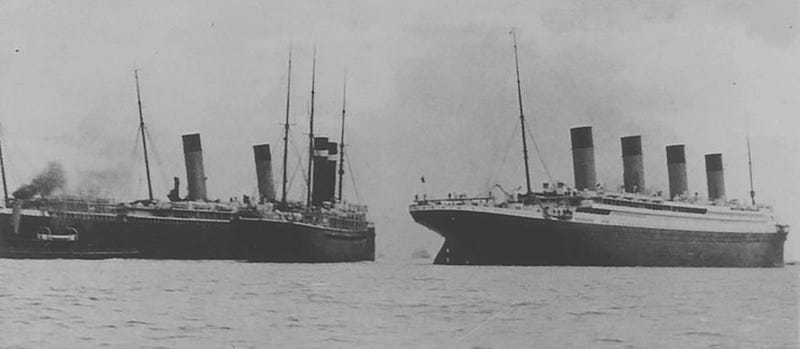
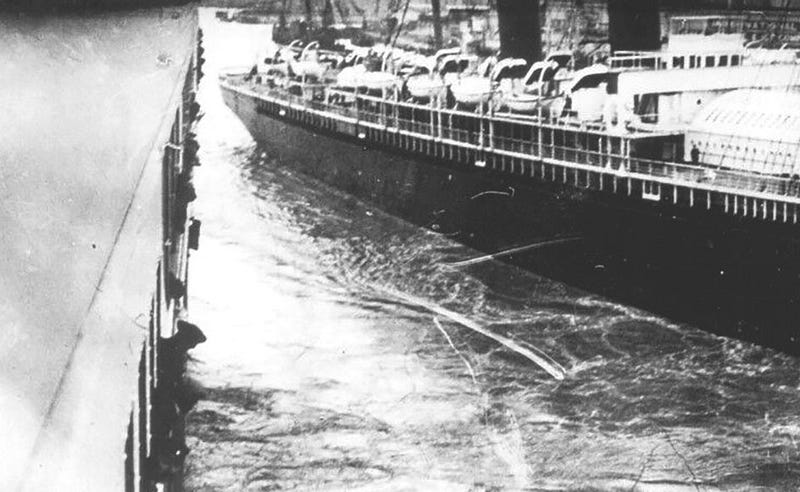
The New York is adrift, her stern moving uncontrollably towards the port side of the Titanic. Panic spreads among the passengers and the people watching ashore. Captain Edward J. Smith takes quick action and orders the Titanic’s port engine reversed. The tug Vulcan, driving at full speed, tries to get a line on the port stern of the New York in an effort to slow and then stop the American vessel. Despite commands being barked left and right, the collision between the two vessels seems unavoidable.
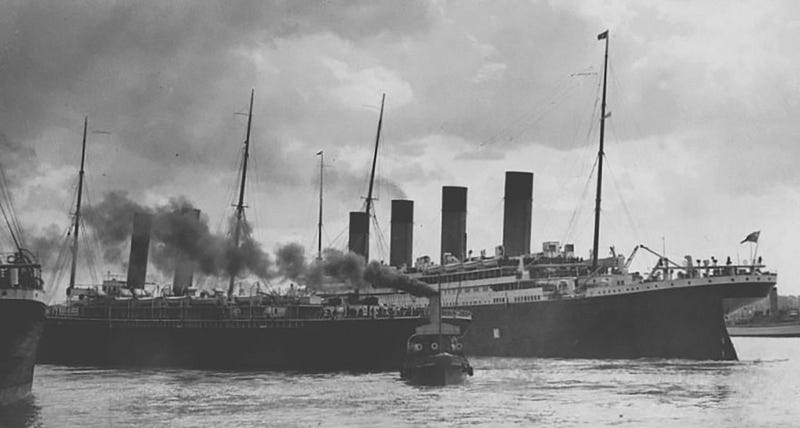
Yet, and thanks to the tug’s frenzied attempt, combined with the reverse wash from Titanic’s port propeller, the New York stops her forward advance. At the last moment, and to the relief of everyone watching, the collision is averted.
The captain of the Vulcan later swore that by the point New York’s stern stopped drifting, only four feet were separating the two hulls. A Titanic Saloon Steward named John Butterworth thought the two ships were “so close that one could have tossed a penny onto the New York from the Titanic”.
The Fateful Voyage Continues
The Titanic is reversed far back at the entrance to the pier while the tugs maneuver New York to a more secure location. The incident delays Titanic’s departure by almost an hour. With the New York safely out of the way, Titanic begins going ahead once more. Although she had only just begun her maiden voyage, she is already behind schedule.
The incident gave an eerie feeling to some people on board who interpreted it as a terrible sign. First Class passenger Norman Chambers recalled it as “an evil omen.” Another passenger, Mrs. Harris, found herself suddenly addressed by a stranger: “This is a bad omen. Do you love life?” he told her. She simply replied, “I love it”. “Then get off this ship at Cherbourg. That’s what I'm going to do.”
Eventually, most passengers settle down, trying to familiarise themselves with the ship, and do not give further commentary on the incident.
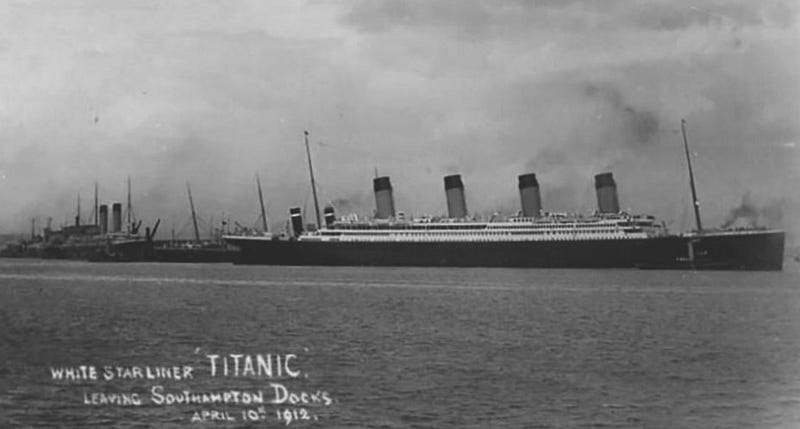
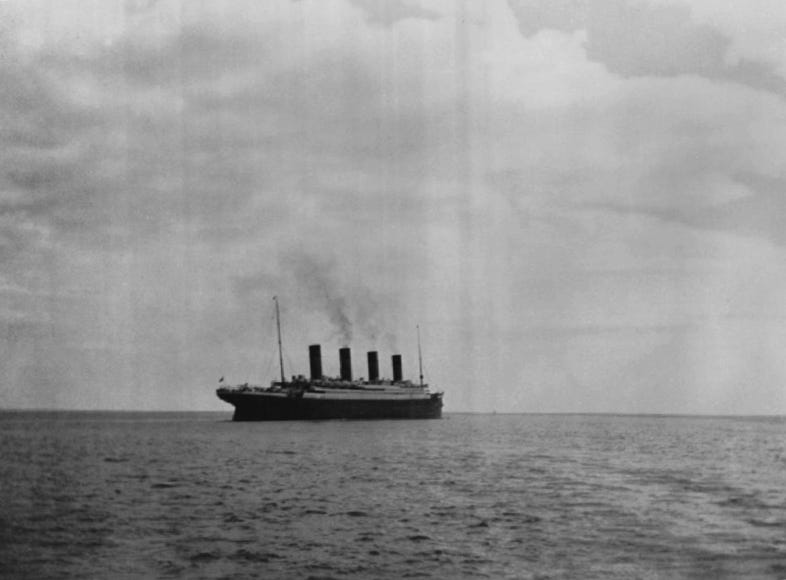
Unfortunately, the series of events that would ultimately lead to the unprecedented tragedy and the loss of 1,496 lives have been irreversibly set in motion: the Titanic left Southampton waters behind, and by the evening of April 10, she reached Cherbourg, her first port of call.
The next day she arrived in Queenstown, the final location to be seen afloat. After a brief stop in Ireland and with Europe finally behind her, Titanic steamed confidently ahead. Two days later she would collide with an iceberg and meet her end at the bottom of the Atlantic ocean.
Epilogue
Had the collision between the Titanic and New York taken place, the maiden voyage of the White Star’s flagship would have been canceled. Depending on the extent of the damage, the Titanic would have been drawn back to the shipyard for repairs. Her career would have begun in an inauspicious way accompanied by bad press.
However, one can safely assume that the aforementioned accident would also have averted the fatal collision with the iceberg that occurred four days later. The sinking would have been prevented and the Titanic, when finally repaired, would possibly have enjoyed a successful career as a passenger liner.
If you’re wondering what would have been the Titanic’s story had she not sunk, you can check the article below:
Notes
[1] A coal strike that lasted for almost six weeks had disrupted most of the scheduled ocean liner departures. Many ships, not having enough coal to operate were being laid-up in clusters at the Southampton harbor. Since coal was hard to find the White Star Line come up with a solution: the company’s ships such as the Oceanic, would contribute their load of coal to the Titanic for her maiden voyage. Since the Titanic was not filled to her capacity, the company agreed to transfer the passengers from those liners to her. A tragic decision considering that many of Titanic’s victims weren’t even supposed to cross on her.
References
Halperin S., Akers-Jordan C., Behe G., Beveridge B., Chirnside M., Fitch T., Gittins D., Hall S., J.Mitcham L., Weeks C.C., Wormstedt B., (2016), “Report Into The Loss Of The SS Titanic”, The History Press
Fitch T., Kent Layton J., Wormstedt B., (2012), “On a Sea of Glass The Life & The Loss of the RMS Titanic”, Amberley Publishing
Lord W., (1956), “A Night To Remember”, Longmans Green & Co
Klistorner D., Hall S.,(2011), “Titanic in Photographs, The History Press


