
The Story of the So-Called “Ship of the Century”
Oceanic was the pinnacle of 19th-century shipbuilding…
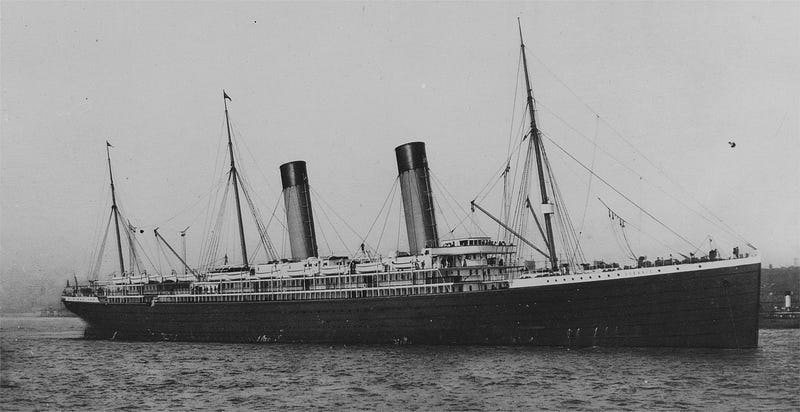
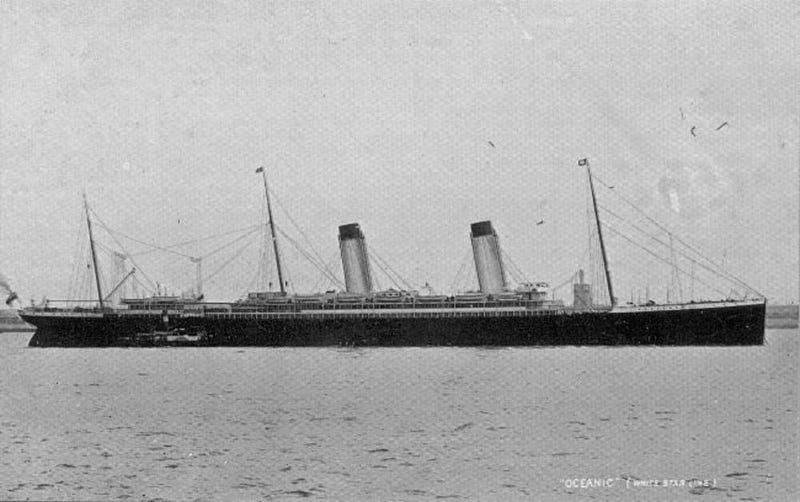
The RMS Oceanic was the largest ocean liner of the 19th century. Launched in 1899, the ship incorporated in her design the most important technological advances of the previous decades and was notably more luxurious than her contemporary competitors.
The Oceanic immediately proved popular among passengers and became the most fashionable and successful ship of her time. She was deservedly praised as the pinnacle of 19-century shipbuilding, earning the privileged nickname the “ship of the century”.
This is her story.
Construction
The Oceanic was constructed in Harland & Wolff shipyard in Belfast and was operated by the White Star Line, one of the most prominent shipping lines in the world during the late 19th and early 20th centuries [1].
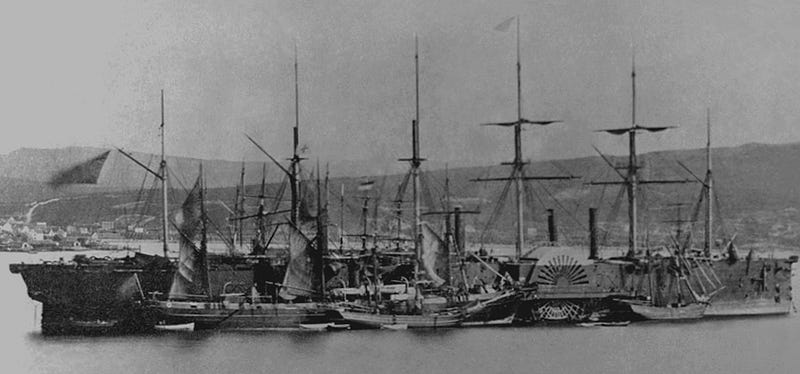
The name of the new liner was inspired by the first and highly popular ship of the shipping company, the RMS Oceanic, which had entered service in 1871 and was powered by a combination of steam and sail. Measuring over 704 ft (215m) and spotting two iconic funnels, the second Oceanic was a special vessel too. She was the first ship to exceed the SS Great Eastern in length, the legendary iron sailing steamship designed by Isambard Kingdom Brunel in 1858.
Designed for a six-day crossing and with an average speed of 19 knots, the Oceanic would not be the fastest ship on the Atlantic. Yet she would be remarkably steadier than her competitors, which constantly suffered from vibrations. The ship could accommodate a total of 1,710 Passengers: 410 in First Class, 300 in Second Class, and 1,000 in Third Class.
The ship marked a turning point for the White Star Line: from then on the company would aim to compete on passenger comfort rather than speed by designing ships of great size, exceptional steadiness, and luxury [1].
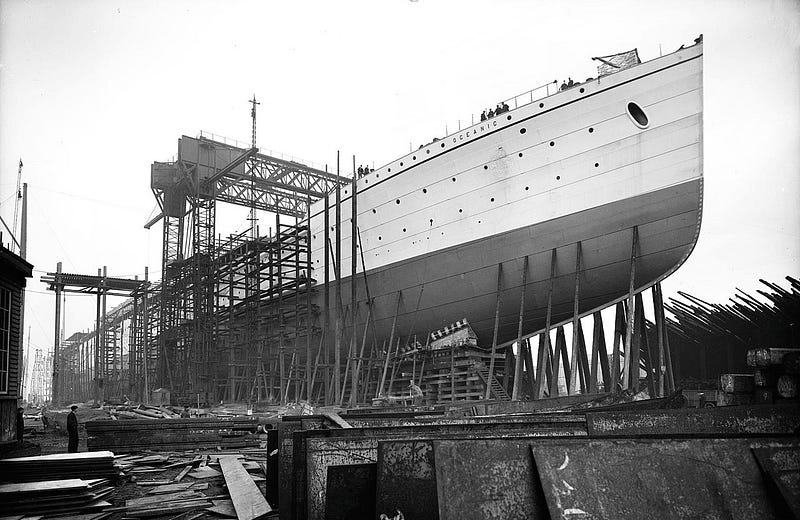
Commercial Service
Following her fitting out and sea trials, Oceanic left Belfast for the first time on 26 August 1899. Arriving in Liverpool, she was opened to the public where she was received with great fanfare.
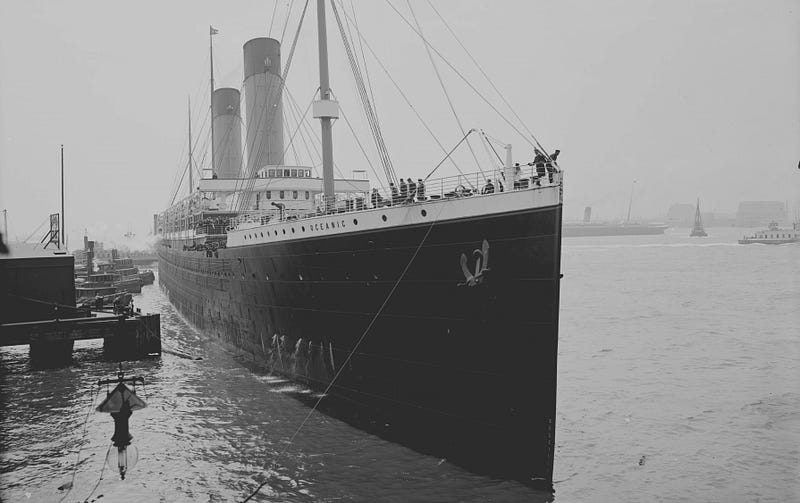
On September 6, the Oceanic left Liverpool for her maiden voyage with 1,456 passengers on board. The ship called to Queenstown before arriving at New York, where she received a rapturous welcome.
It didn’t take long for the ship to become a favorite among passengers. Her luxurious and spacious interiors, reliable service, and comfortable crossing immediately made her one of the most popular ships in the Atlantic. During her early years of service, Oceanic was sailing relatively full, making good profits for the White Star Line.
The Oceanic’s success made the White Star consider the order of a sister ship, an almost identical running mate that was to be called Olympic. However, following the death of the company chairman Thomas Ismay in November 1899, the order was postponed and then canceled.
The White Star Line opted to deploy resources for a set of larger liners, which would be known as the “Big Four” class. The name Olympic was not forgotten though, as it would be bestowed upon the sister ship of the ill-fated Titanic.
On April 10, 1912, Oceanic was involved in the near-collision of Titanic with the American liner SS New York in Southampton port. The Oceanic was laid up with New York as the latter broke free from her mooring because of the large wake caused by Titanic’s size and speed. The two vessels nearly collided with each other, marking an auspicious start for Titanic’s maiden and only voyage.
For a detailed account of the incident, read the article below:
In mid-May 1912, a full month after Titanic’s tragic sinking, Oceanic spotted in the middle of the Atlantic a drifting lifeboat containing three bodies. The bodies were decomposed and unfit for removal so they were buried at sea. The crew later identified the lifeboat as being the Collapsible A boat carried by the Titanic.
War Service
In July 1914 the First World War broke out and the Oceanic was quickly commissioned for naval service by the Admiralty. Renamed HMS Oceanic, “the greatest liner of her day” was converted to an armed merchant cruiser. After over two weeks of preparations, the ship departed Southampton to begin her military service.
Oceanic was assigned to patrol the waters from the North Scottish mainland to the Faroe Islands. She was also empowered to stop shipping at her Captain’s discretion and to check cargoes and personnel for any potential German connections.
The End of the Liner
Because of an inaccurate fix of the ship’s position on the night of 7 September, the Oceanic was sailing about thirteen miles off her assigned course. Worse still, the ship was heading directly to the notorious Shaalds of Foula. The particular location poses a major threat to ships since the reef comes within a few feet of the surface and gives no warning sign in calm weather.
Unbeknownst to the ship’s crew until too late, the Oceanic was steaming well into the danger zone. A disaster was soon to follow: on the morning of 8th September, the ship ran aground on the Shaalds approximately 2.5 nautical miles east of Foula’s southern tip. Oceanic was wrecked in flat calm and clear weather.
Immediately nearby ships were called in to assist the rescue operation that followed. The Oceanic’s crew were safely ferried to the waiting rescue vessels, with Oceanic remaining stranded on the reef. It would take a heavy gale to finally break up the liner after she was twisting in the sea for nearly two weeks. After long negotiations, the British government agreed to pay the White Star a compensation of 310,000 pounds for the loss of the vessel.
Epilogue
The Oceanic was the first Allied passenger ship to be lost in the First World War and proved in the most dramatic way that ocean liners were ill-equipped to serve as armed merchant cruisers. From then on, passenger liners would be exclusively used as hospital ships or troopships during warfare.
Despite her dishonorable end, the RMS Oceanic is remembered for her comfortable and reliable service, as well as for the great affection it evoked to the thousands of passengers who traveled aboard her. Thus, it is no surprise that the “ship of the century” constitutes an important chapter of early 20th-century ocean liner history.
Relevant Reads:
Notes
[1] Officially known as the Oceanic Steam Navigation Company, the White Star Line is famous for operating a variety of well-known ocean liners, including the legendary RMS Titanic. The company fell into decline during the Great Depression and in 1934 it was merged with its chief rival, the Cunard Line. The merged company operated as Cunard-White Star Line until 1950 when Cunard purchased White Star’s remaining share.
[2] A third Oceanic would be proposed and designed for the White Star Line during the interwar period. She was originally intended to be the world’s first 1,000 ft-long liner but the project never came to fruition.
To find out more about the most famous of the uncompleted ocean liners check the article below:
References
R.M.S. Oceanic (II)”. Jeff Newman. Retrieved 18 January 2010.
Kerbrech, Richard De (2009). Ships of the White Star Line. Ian Allan Publishing. pp. 81–86. ISBN 978 0 7110 3366 5.
“Oceanic”. The Great Ocean Liners. Retrieved 28 March 2008.
Haws, Duncan (1990). White Star Line (Oceanic Steam Navigation Company). pp. 52–53. ISBN 0 946378 16 9.
RMS Oceanic”. Darrel R. Hagberg. Retrieved 12 December 2008.
The Great Big Move (2020), RMS Oceanic (1899) | The Pinnacle of 19th Century Shipbuilding, Youtube, Link: https://www.youtube.com/watch?v=ctdDApOar3Y&ab_channel=TheGreatBigMove


