
The 96th Academy Awards: Who Should Win (Part II)

On March 10, the Academy of Motion Picture Arts and Sciences will hold the 96th Academy Awards and reveal their selections for the best in film from the past year. In this article, I rank the contenders in four key categories: Best Picture, Best Director, Best Adapted Screenplay, and Best Original Screenplay.
To find out who I think should win in the four acting categories, click here to check out Part One of this article
To find out who I think will win in all 23 categories, click here for my article previewing the ceremony
Although I unabashedly adore the glitzy ceremony, behind-the-scenes drama, near-century of statistics and milestones, and fun of predicting the eventual winners, I care about the Oscars each year primarily because I love movies. I love watching movies, reflecting on movies, and debating the merits of movies. I believe that the art of filmmaking has shaped my life — and our culture — in profound ways.
Each year I make sure to see each film nominated in the “top eight” categories (Best Picture, Best Director, the four acting categories, and the two screenplay categories), along with as many of the others as I can squeeze in. Below, I rank the nominees in the categories of Best Original Screenplay, Best Adapted Screenplay, Best Director, and Best Picture.
Click here to read my reactions to this year’s Oscar nominations
BEST ADAPTED SCREENPLAY
5.) Jonathan Glazer, The Zone of Interest (for his Oscar history, also nominated for directing the film this year). Martin Amis’s 2014 novel may have featured multiple narrators and a love triangle, but Glazer’s adaptation fascinatingly strips away virtually all aspects of plot and individual character. What’s left is a profoundly haunting portrait of complicity and willful ignorance in the face of immense evil that is told almost entirely through visual storytelling and brilliant sound design. As good as the film is, its screenplay is purposefully simple and intentionally not the focus.
4.) Cord Jefferson, American Fiction (1st nomination; also nominated for producing the film this year). When I watched American Fiction, I was surprised to learn that the novel it was based on (Percival Everett’s Erasure) was published over two decades earlier in 2001. The fact that the film feels so current is a testament to the (unfortunate) timelessness of the plot and to the skillfulness of Jefferson’s adaptation. As much as I liked Fiction, I found that it often felt like two separate films with markedly different themes and distinct tones spliced together. One story is about a middle-aged man in the grips of a midlife crisis as he reconnects with his family while another is a sharp satire of how black lives are represented in mass media. I found this weakness, which is rooted in the screenplay, to be the film’s main flaw.
3.) Tony McNamara, Poor Things (1 prior nomination — Original Screenplay for The Favourite). McNamara’s adaptation of Alasdair Gray’s 1992 novel is bizarre, witty, and thought-provoking. It goes to utterly foreign and unprecedented places while maintaining its core focus on a woman’s journey to liberation. With so much attention going to the film’s stunning, unique visuals and inspired, passionate performances, its easy to overlook the many impressive strengths of the screenplay. With that said, I found that the film’s second half was hindered slightly by the insistence on relentlessly exploring sexual exploitation and liberation at the expense of other aspects of Bella’s journey and development. I can’t help but think this is what happens when a bold, feminist message is delivered by a straight white male writer and a straight white male director.
2.) Christopher Nolan, Oppenheimer (see above in Best Director). American Prometheseus, Kai Bird and Martin J. Sherwin’s biography of J. Robert Oppenheimer, is so dense and mammoth that many wondered how it could be satisfyingly distilled into a single film. It is a testament to Nolan’s profound skills as a writer, which often get overlooked in favor of his directing skills, that he was able to create a coherent and compelling film. Impressively, his screenplay for Oppenheimer largely avoids biopic trappings, creates over a dozen clearly defined and vivid characters, and poses thought-provoking moral questions. It is a remarkable feat.
1.) Greta Gerwig and Noah Baumbach, Barbie (Gerwig — 3 prior nominations for directing and writing Lady Bird and writing Little Women and Barbie; Baumbach — 3 prior nominations for writing The Squid and the Whale and writing and producing Marriage Story). Last year when doing my screenplay rankings, I lamented that Glass Onion was labeled an Adapted Screenplay. My reasoning was that even though it was based on a prior work it was a wholly original story developed by Rian Johnson. I apply this same logic to the Academy’s ruling that Gerwig and Baumbach’s screenplay for Barbie is adapted. Yes, the dolls pre-existed the movie. But the characters, plot, and themes were entirely created by the writers from scratch. (This to me makes the screenplay much more original than say, Maestro, which took the events of Leonard Bernstein’s biography and put them into a film.) In fact, I would go so far as to consider it by far the most original screenplay nominated in recent years. To take a child’s toy, which has virtually no established narrative universe to lean on, and transform it into a film as thematically rich, clever, and witty as Barbie is an incredibly impressive achievement. I would also argue that no film this year had a higher degree of difficulty to pull off, because to succeed it had to work on multiple levels. It skillfully managed to satisfy little girls, adults of all ages who had nostalgia for the toys, and film lovers looking for something innovative and thought-provoking. And as its record-shattering box office shows, it succeeded in doing so. The film has moments of brilliant satire and hilarious comedy, but ultimately pivots into an exploration of gender, society, and self-actualization that is equally profound as to Gerwig’s Oscar-worthy work on Lady Bird and Little Women. Fun Fact: Gerwig and Baumbach are one of six (!) married couples both nominated for Oscars this year. The others are Justine Triet and Arthur Harari (nominated in Original Screenplay for Anatomy of a Fall), Samy Burch and Alex Mechanik (also nominated in Original Screenplay for May December), Margot Robbie and Tom Ackerley (nominated for Best Picture for producing Barbie), Christopher Nolan and Emma Thomas (nominated for Best Picture for producing Oppenheimer), and Jerusha Hess and Jared Hess (nominated for Best Animated Short Film for Ninety-Five Senses).

BEST ORIGINAL SCREENPLAY
5.) Bradley Cooper and Josh Singer, Maestro (Cooper — also nominated this year for starring in and producing the film; 9 prior nominations — 4 for acting, 4 for producing, and 1 for writing; he now has 12 nominations and has yet to win; Singer — 1 prior nomination and win for co-writing Spotlight). Of all of the nominees in the top 8 categories this year, this is the one I dislike the most. Maestro had some strong acting and some intriguing and effective directorial choices that went a long way toward overcoming the substantial weaknesses of the screenplay. I could have forgiven it for leaning too hard on biopic conventions, but what I can’t forgive is how it examines an artist and public figure as brilliant and complex as Leonard Bernstein and leaves the audience with such little understanding of him and such little connection to him.
4.) David Hemingson, The Holdovers (1st nomination). I liked The Holdovers significantly more than Maestro, but I found that it similarly was hindered by a weak screenplay. Here, though, the problem is not characterization. The characters of Paul Hunham, Angus Tully, and Mary Lamb are vivid and memorable ones. The problem is that it is all so strikingly familiar and predictable. The film is a joy and a comfort to watch, but it treads virtually no fresh and interesting narrative or thematic ground whatsoever. This is only the 2nd film in acclaimed director Alexander Payne’s filmography that he didn’t write himself and I can’t help but wonder if the film would have been better if he had.
3.) Justine Triet and Arthur Harari, Anatomy of a Fall (Triet — also nominated for producing this year; Harari — 1st nomination). As with Maestro and The Holdovers, I found the screenplay to be the weakest aspect of Anatomy of a Fall. The acting, led by a marvelous Sandra Hüller, is exceptional and Justine Triet proves herself a skillful director. The screenplay covers well-trodden ground (i.e., a prickly and complex woman is mistreated by a sexist and deeply flawed justice system) and overly relies on cliches (e.g., the comically villainous prosecutor, the flirtation between the defendant and her lawyer). Furthermore, the film’s most lauded twists — the recording of the explosive fight she had with her husband and the poisoning of the dog — are achieved through remarkably convoluted means. I understand the admiration for the film as a whole, but I am a bit baffled by the fact that its main Oscar win is likely to be for its weakest element.
2.) Samy Burch and Alex Mechanik, May December (1st nomination for both). Based on the awards that precede the Oscars, I knew that May December stars Julianne Moore, Charles Melton, and Natalie Portman would not be receiving Oscar nominations this year. But that did not make their absence any less abominable. They brilliantly bring to life an intelligent and bold screenplay that tells a deeply uncomfortable story with squirm-inducing themes related to grooming, pedophilia, and statutory rape. There are elements of dark comedy and high camp injected into the film that give it a unique feel (one that undoubtedly turned off many viewers and Oscar voters), but I found that these elements enriched the film and made the third act shift in focus to the utter tragedy of it all even more compelling. I will remain annoyed at the Academy’s decision to overlook the cast of May December for some time, but I am thrilled that they at least recognized the brilliance of its screenplay.
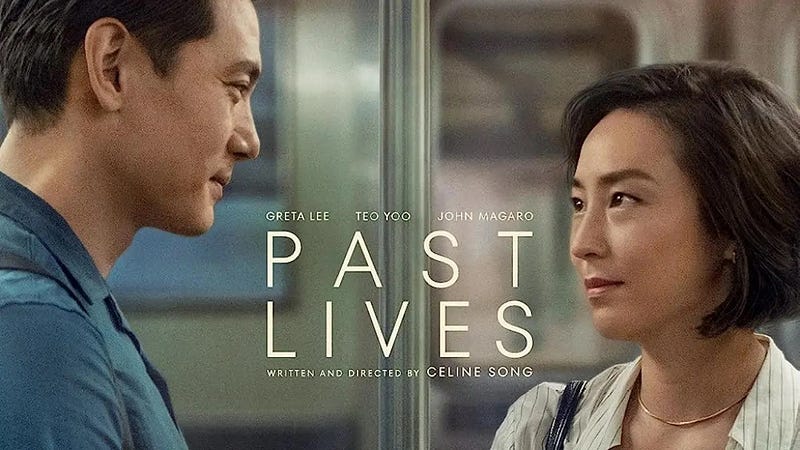
1.) Celine Song, Past Lives (1st nomination). Once every few years, a movie about human connection comes along that is moving and profound that it stops me dead in my tracks. Previous examples include Before Sunrise and its 2 equally brilliant sequels, Eternal Sunshine of the Spotless Mind, and Lady Bird. Celine Song’s Past Lives is the latest entry into that small group. The story concerns a Korean woman who has largely acculturated to the U.S. after immigrating as a child who is unexpectedly visited by her childhood love who never left Korea. They have a brief period of time together, during which they reconnect and both reflect on the impact of the choices we make and the deep and ultimately futile longing for what could have been. The film is a masterwork in all regards, but the core of what makes it brilliant are the complex and authentic dynamics, themes, and emotions Song wrote in the pages on which the film is based. The idea that it is almost certainly going to lose this category sends me reeling. Fun Fact: Song is the first Asian woman nominated for screenwriting.
Click below to check out my rankings of the Oscar nominees in the screenplay, directing, and Best Picture categories at the last 5 ceremonies.
BEST DIRECTOR
5.) Justine Triet, Anatomy of a Fall (1st nomination; also nominated this year for Original Screenplay). As I mentioned above, I admired many aspects of Anatomy of a Fall despite my frustration with its screenplay. One of these aspects was Triet’s direction. Although the film is overly long and drags in sections, it is generally compelling thanks to Triet’s uniquely staged scenes, clever camerawork, fully realized sense of place, and — most notably — the brilliant performances she so skillfully captures. I remain a bit perplexed that the Academy chose her over the superior work of un-nominated directors Greta Gerwig and Celine Song, but it is certainly not a weak directorial effort. Fun Fact: Triet’s nomination marks only the 9th time a slot in Best Director has been claimed by a woman, following Lina Wertmüller (Seven Beauties), Jane Campion (The Piano), Sofia Coppola (Lost in Translation), Kathryn Bigelow (The Hurt Locker), Greta Gerwig (Lady Bird), Emerald Fennell (Promising Young Woman), Chloe Zhao (Nomadland), and Jane Campion again (The Power of Dog). Zhao and Campion are the only women to win this award.
4.) Martin Scorcese, Killers of the Flower Moon (14 prior nominations for directing Raging Bull, directing The Last Temptation of Christ, writing and directing GoodFellas, writing The Age of Innocence, directing Gangs of New York, directing The Aviator, directing The Departed, producing and directing Hugo, producing and directing The Wolf of Wall Street, and producing and directing The Irishman; also nominated for producing this year; 16 total nominations as of this year; he has 1 win for directing The Departed). Over his half-century of filmmaking, Scorcese has raised the bar so high by directing so many classic and iconic films that it has become hard for me to be objective when evaluating his new films. Sure, they are brilliant, but are they Raging Bull or Taxi Driver or GoodFellas brilliant? I recognize that this is not a fair standard and tried to reflect on Killers of the Flower Moon through the lens of the following question — how would I be evaluating it if it was the work of a relatively unknown director? Even through that lens, Flower Moon only ranks 4th here despite its numerous superb elements. I ultimately found that the decision to tell this particular story through the lens of the oppressors rather than the oppressed to be a major detractor and simply don’t believe that the story justified its exceptionally long running time. Those factors aside, Scorcese proves that despite his advanced age he has not lost any of his ability to authentically and vividly recreate times and places in history, direct brilliant performances from Hollywood’s most seasoned veterans and untested newcomers, and deliver a riveting epic.
3.) Jonathan Glazer, The Zone of Interest (1st nomination; also nominated for screenwriting this year). Simply put, Glazer’s work on The Zone of Interest is the most innovative and thought-provoking directorial work of the year. His decision to strip away much of the novel’s plot and mount the film as primarily a sensorial experience expounding a particularly challenging and important theme is genuinely inventive and ultimately captivating. Nevertheless, there were a handful of moments while watching the film (e.g., the night vision shots of the woman hiding food, the final shift to the present day) when I was frustratingly taken out of my mesmerization by directorial choices that did not entirely work for me.
2.) Christopher Nolan, Oppenheimer (5 prior nominations for writing Memento, producing and writing Inception, and producing and directing Dunkirk; also nominated for producing and writing this year; 8 total nominations as of this year; he has yet to win). Although I find the cult around Christopher Nolan to be a bit exhausting, I can’t really argue with the immense admiration so many film lovers have for him. His body of work is a stunning array of modern classics like Memento, The Dark Knight, Inception, and Dunkirk. Hell, even the more flawed entries in his filmography like The Dark Knight Rises, Interstellar, and Tenet are better than the vast majority of modern films. Now more than 2 decades into his illustrious career, he has created his best film to date. His biography of J. Robert Oppenheimer is simultaneously a technical marvel, a complex character study, a riveting history lesson, and a profound morality tale. The directorial flourishes he injects into the film mange to always enhance and never detract from the narrative or performances. Anyone who can turn a profoundly depressing, cerebral, and morally thorny depiction of one of the greatest tragedies in world history into one of the most popular blockbusters in Hollywood history is clearly a master of his craft.
1.) Yorgos Lanthimos, Poor Things (3 prior nominations for writing The Lobster and producing and directing The Favourite; also nominated this year for producing Poor Things; 5 total nominations as of this year; he has yet to win). Up until a few minutes before I published this piece, I had Lanthimos ranked 2nd and Nolan ranked 1st. But I ultimately swapped the two after reflecting on how few films in recent years have surprised me like Poor Things and how much of that had to do with Lanthimos’s vision and his execution of it. I had a general sense of the plot and had seen a handful of images from the film before walking into the theater, but nothing prepared me for the story, characters, themes, or universe that he brought to the screen. The film is a visual marvel of the highest order with otherworldly production design, innovative visual effects, and all-around top-notch technical wizardry. Yet, it also manages to tell a coherent, compelling, and thought-provoking story about the relentless desire of men to control women and how our ability to achieve self-actualization are stymied by social mores. It is rare that a director can make a visually inventive film that also features jaw-droppingly good acting and has a story interesting and original enough to send viewers off debating. His ability to successfully juggle all three of these things simultaneously is utterly masterful.

BEST PICTURE
10.) Maestro (7 nominations). I won’t repeat all of the issues I had with Maestro, which I found to be a mystifying step down in quality from Bradley Cooper’s bold and brilliant directorial debut (his 2018 remake of A Star is Born). Although Cooper makes some skillful and genuinely interesting directorial choices and Mulligan delivers a particularly strong performance, it ultimately falls into too many biopic traps and left me with little understanding of, or interest in, who Leonard Bernstein was. It must be said, however, though even though I had significant issues with the film, the fact that it ranks last here is actually more reflective of how exceptional this year’s Best Picture lineup is than how weak a film Maestro is.
9.) American Fiction (5 nominations). Cord Jefferson’s clever and sensitive film about a black intellectual whose attempt at satire backfires in surprising ways is a highly entertaining one. It features uniformly superb performances from a talented ensemble that has never gotten such a rich opportunity to prove their talent on the big screen and it successfully works as both a character drama and a satire of society and media. What didn’t work for me, and thus why it ranks so low on my list, is in blending those two elements. As I stated above, there were times when it felt like two tonally and thematically distinct films spliced into one and this discordance prevented me from truly falling for the film.
8.) The Holdovers (5 nominations). Alexander Payne’s slice-of-life character studies like Election, Sideways, The Descendants, and Nebraska have generally been exceptionally strong and unique films. While The Holdovers has a great deal of merit, particularly the superb performances of its core trio and Payne’s rich and authentic recreation of early 1970s New England, the film decidedly lacks the edge and freshness of his prior films. In fact there are times it felt so ordinary and predictable that I kept second guessing whether there was another shoe yet to drop or some deeper layer I was missing. There is certainly nothing wrong with straightforward, heartwarming filmmaking, but such films are hard-pressed to rise to the top in such a competitive year.
7.) Anatomy of a Fall (5 nominations). Audiences, critics, and Oscar voters certainly fell harder for French auteur Justine Triet’s Anatomy of a Fall than I did, but that does not imply I did not thoroughly enjoy and deeply respect the film. The story of a German bisexual writer living with her depressed and resentful French husband and precocious blind son in a remote French village is a thought-provoking character study and generally compelling courtroom drama that is skillfully executed. I ultimately found that the story contained a few too many elements that were familiar, cliched, and convoluted and that the (lack of) resolution rang more hollow than artful. However, the film’s strengths greatly outweigh its flaws. Fun Fact: This year marks the first time that 3 films nominated for Best Picture were directed by women. The other two are Barbie and Past Lives.
6.) Killers of the Flower Moon (10 nominations). As I have mentioned before, the decision to focus the film on the white male oppressors rather than the marginalized people being oppressed is in line with both legendary filmmaker Martin Scorcese’s longstanding fascination with criminality and Hollywood’s well-documented complicity in the marginalization of Native Americans. Nevertheless, it was a creative choice that significantly detracted from the potential power of the film for me as I kept yearning to know more about the inner lives and interrelationships of the film’s indigenous characters. That and the film’s unnecessarily laborious 206-minute running time aside, Flower Moon is an exceptional work of art. It expertly recreates a time and place in history that few are familiar with. It tells a fascinating and thought-provoking story about power, racism, and evil. And it features a stunning array of performances, including an all-timer from Lily Gladstone.
5.) The Zone of Interest (5 nominations). The experience of watching The Zone of Interest is a profoundly unique and powerful one. Glazer’s film ostensibly tells the story of Rudolph and Hedwig Höss, a German couple who are working tirelessly to establish a life of joy and stability for their family in the new town they have moved to for Rudolph’s work. The plot is intentionally simplistic and idyllic so that it can be juxtaposed with Glazer’s true purpose of immersing viewers in the banality of evil. See, the job that the Höss family moved to town for is the one of “architect” of Auschwitz, the most notorious of all of the Nazi concentration camps. The family’s beautiful home abuts the camp and as their lives unfold peacefully and mundanely day in and day out, the fires of the human incinerators burn, the screams of victims roar, and gunfire sporadically erupts. Glazer’s vision for the film is a bold, innovative, and profound one and the visual storytelling and rightfully-lauded sound design that he has overseen is truly stunning. If only a handful of directorial choices made by Glazer that I described earlier had landed a bit better for me, this film would rank at or near the top of my list.
4.) Barbie (8 nominations). Even though I was disappointed by the omission of Greta Gerwig in Best Director and Margot Robbie in Best Actress, I was frustarted that these “snubs” dominated this year’s discourse surrounding the Oscar nominations for a few reasons. First, Gerwig and Robbie were both nominated in other categories for the film (Gerwig for writing and Robbie for producing). Second, it detracted from the film’s stellar showing of 8 nominations. Third, it largely treated Barbie’s strong showing at the Oscars as an inevitability rather than something exceptionally rare. Historically, it is very rare that the Academy fetes films that center on the experiences of women, films that emphasize comedy, films made for mass audience consumption, and films based on brands and franchises, let alone a film that falls into multiple of these categories. The fact that Barbie scored 8 nominations, including Best Picture, Best Adapted Screenplay, and 2 acting nominations is actually a stunning and genuinely surprising accomplishment that underscores what an ambitious and successful film Gerwig has crafted. In the film, the feminist paradise that exists in “Barbie World” is shaken when “Stereotypical Barbie” (Robbie) starts experiencing existential depression. At the behest of “Weird Barbie” (Kate McKinnon) she travels to the “real world” to find Gloria (America Ferrera), the woman whose own emotional crisis has prompted the rift. She succeeds, but her love interest Ken (Ryan Gosling) finds something different when he joins her in the real world — the power of the patriarchy. The film works equally well on numerous levels — fun blockbuster, witty comedy, feminist rallying cry, and rich social commentary. It’s a masterwork that only Gerwig could have crafted.
3.) Poor Things (11 nominations). The fact that a film I love and respect so much could rank only 3rd on my list is a testament to what a wonderful year this was for film. Lanthimos’s audacious and original tale concerns a woman named Bella Baxter (Emma Stone) who is brought to life in the laboratory of genius inventor Godwin Baxter (Willem Dafoe) and sheltered from the real world. When sleazy rake Duncan Wedderburn (Mark Ruffalo) meets her, he becomes enamored and whisks her away for an exciting journey into the real world. What follows blends hilarious hijinks, breathtaking visuals, and a nuanced examination of difficult themes about misogyny and liberation. After seeing thousands of movies in my lifetime, it is increasingly rare that I watch one and can genuinely say, “I have never seen anything like it!” But I did with Poor Things and that is something very special.
2.) Past Lives (2 nominations). If I were an Oscar voter, I would have nominated Celine Song’s deeply affecting directorial debut in far more categories than the 2 it ended up landing in. But if it was going to show up in only 2 categories, I’m glad it was cited for its searing screenplay and for being one of the overall Best Pictures of the year. As described above, its a tale of acculturation, reconnection, and the futile longing for what could have been that is brilliantly acted by Greta Lee, Teo Yoo, and John Magaro. It is an emotionally authentic and fully realized character study that touches on themes rarely depicted on the big screen. I have a strong feeling that years from now when many of the films nominated alongside it are long forgotten, Past Lives will endure as a classic.
1.) Oppenheimer (13 nominations). As much as I loved this year’s Best Picture lineup (particularly the films I have ranked in the top 5), no artistic achievement this year surpassed Oppenheimer for me. For all the reasons I have expounded upon and more, I think the film is a masterpiece. It tells a vital slice of history without sacrificing important nuance and moral complexity. It tells a riveting character drama brought to life by at least a dozen brilliantly cast actors delivering sterling performances. It is utterly captivating for its well-earned 3 hour run-time. On top of all that, it singlehandedly proved that there is still a deep hunger for intelligent original adult dramas among global moviegoing audiences. I could go on, but Oppenheimer’s virtues have already been expounded upon by me and countless others. Simply put, I found it to be the best film in a year with an exceptional number of challengers for that title. Fun Fact: Oppenheimer joins an elite group of 11 other films to get 13 or more Oscar nominations. All About Eve, Titanic, and La La Land scored 14 nominations, while Oppenheimer joins The Shape of Water, The Curious Case of Benjamin Button, The Lord of the Rings: The Fellowship of the Rings, Chicago, Shakespeare in Love, Forrest Gump, Mary Poppins, and Gone with the Wind.

Follow the author of this article on Medium and Twitter.
Read recent articles about past Oscar nominees and winners written by this author:


