
“Promising Young Woman” and “Nomadland” Boldly Confront Toxic American Beliefs
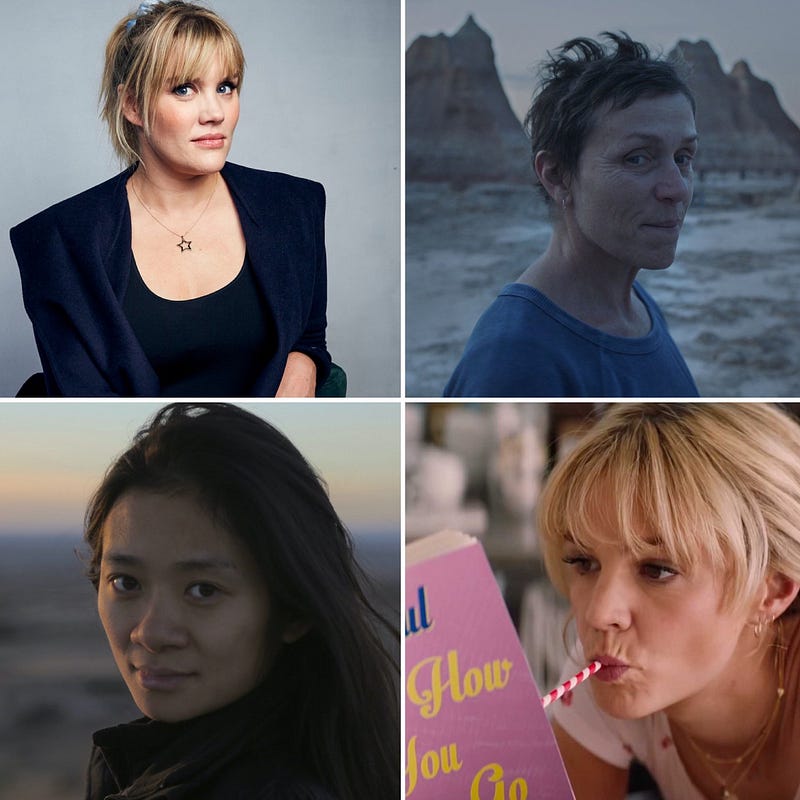
Emerald Fennell’s Promising Young Woman and Chloe Zhao’s Nomadland are remarkably different films in terms of genre, tone, aesthetic, and subject matter. But they do have a few things in common. For example, they are both masterpieces that challenge long-held and destructive beliefs that are deeply ingrained in the American psyche.
[Author’s Warning: The following article reveals key plot points and themes of two movies currently in wide release. Although the endings are not revealed, readers are strongly advised that if they intend to see either of these filme they should no read this article until after doing so.]
It is difficult to imagine two movies in recent memory that were more diametrically opposed than Promising Young Woman and Nomadland. The former is an electrifying revenge tale that defies expectations at every turn whereas the latter is an atmospheric, naturalistic meditation on a forgotten sector of the American populace. But despite their vast differences in genre, tone, aesthetic, and subject matter, they actually do have a few things in common.
- Both are directed by brilliant female auteurs. Promising Young Woman is the feature film debut of Emerald Fennell, a Brit best known for her superb performance as Camilla Parker-Bowles on Netflix’s The Crown and her inspired work taking over the creative reins of Killing Eve from Phoebe Waller-Bridge as the show entered its second season. Nomadland is the third feature film helmed by Chloe Zhao, a Chinese filmmaker whose first two independent films Songs My Brother Taught Me and The Rider were huge hits with critics and earned her Independent Spirit Award nominations.
- Both are major awards contenders. The 2020 awards season has been drawn out to an unprecedented degree due to COVID-19 and there is still enormous unpredictability. The state of the race will become much clearer after the Golden Globe and Screen Actors Guild Awards unveil their nominations later this week, but it seems highly likely that both films will be major players. Both have significant critical backing (although Nomadland is more universally adored with its 95/100 Metacritic rating as opposed to Promising Young Woman’s 72/100) and both have done well with the slew of regional critics’ groups that announce their picks for the best of the year prior to the big awards shows (Nomadland has won a number of awards for Best Picture and Best Director whereas Promising Young Woman has picked up a number of awards for Best Actress and Best Screenplay).
- Both challenge deeply ingrained and profoundly toxic beliefs that are prominent in American culture. Promising Young Woman is an aggressive treatise on America’s rape culture, challenging the hypocrisy, toxicity, and outright cruelty of the “boys will be boys” and “she was asking for it” mentalities that perpetuate it. Nomadland, on the other hand, brings profound empathy to poverty and homelessness and challenges the idea that if the poor just worked harder they could attain the American dream. Not only do the films take on very different aspects of the American experience, they do so with remarkably different styles that are equally effective.
Below, I take a closer look at each film and then reflect on what makes them such powerful and effective challenges to American orthodoxies.
PROMISING YOUNG WOMAN
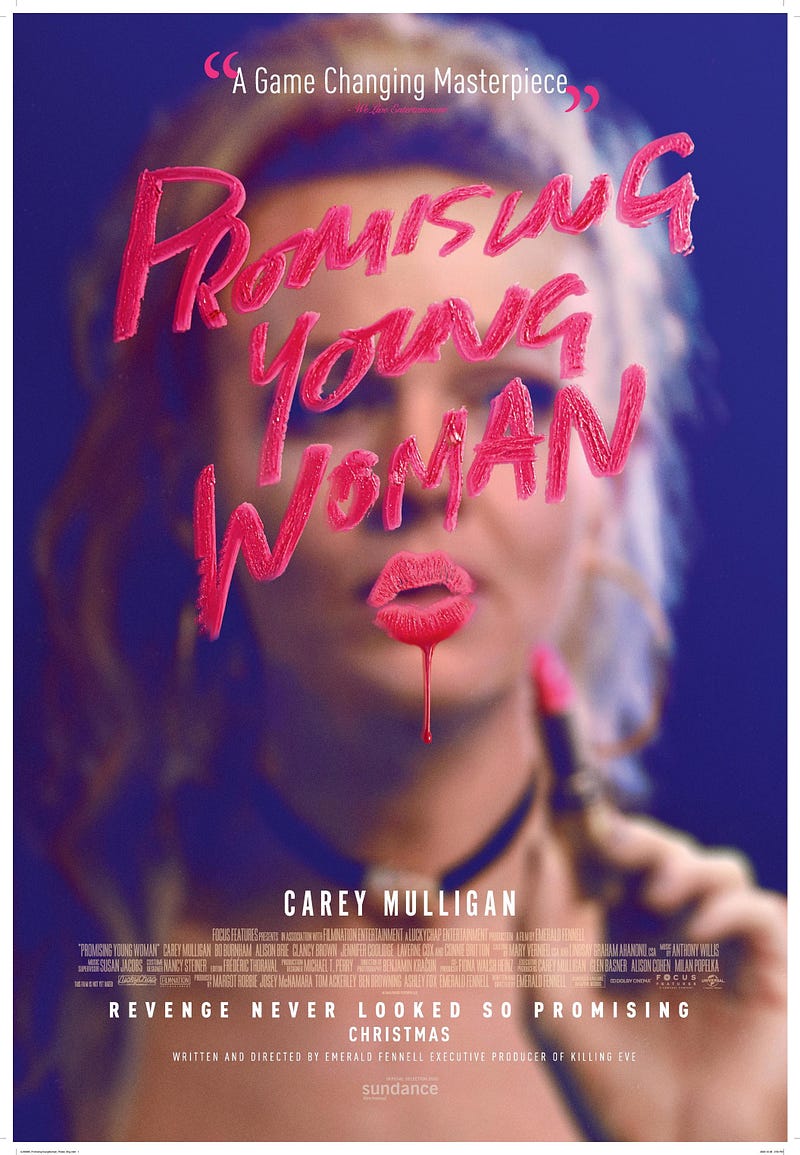
To begin, it should be noted that Promising Young Woman is not an easy watch. It delves into issues of rape, mental illness, and suicide with little restraint. It is never particularly graphic, but it is provocative and will undoubtedly be a triggering watch for many. And as hard as it may be to watch for some, it is an important watch for all.
The story centers on Cassie Thomas (Carey Mulligan, a Best Actress Oscar nominee for 2009’s An Education). She is a 30-year-old woman who dropped out of medical school and has returned home to live with her parents. By day, she halfheartedly works at a coffee shop. By night, she ventures out to bars and clubs with the goal of teaching the local misogynists a lesson or two about consent.
As the movie unfolds, Cassie is pulled by two competing forces. The first is her charming new boyfriend Ryan Cooper (Bo Burnham, who recently won acclaim for writing and directing the independent film Eighth Grade), who reawakens some of the joy and hope that she has lost. The second is the return of the man who raped her lifelong best friend Nina, leading to Nina’s eventual death by suicide. Cassie sets the ball rolling on a plan to finally get justice for her Nina, leading to… well, I won’t spoil anymore than I already have.
Cassie’s campaign for justice doesn’t just target rapists but all of the misogynists who promulgate the idea that many female sexual assault victims were “asking for it” and that we need to be just as concerned (if not more concerned) with the potential damage to a man’s reputation that a sexual assault allegation could bring as we are about the suffering of the woman who survived the attack. This group includes a number of seeming “good guys” who directly and indirectly facilitate the evil of their brethren, the lawyers who defended rapists, the educators and administrators who fail to investigate sexual assault properly, and the women who turn their back on other women when they allege rape.
The fact that Cassie (and by extension, writer-director Emerald Fennell) takes such a broad aim is critical, as it underscores that America’s rape culture is not just a product of the action of rapists. Rather, it is a product of thousands of years of deeply ingrained misogyny that impacts us all and the resultant actions that make so many of us complicit in maintaining it. The movie makes it exceedingly clear that the myriad betrayals Cassie and Nina experienced from those in their lives cut almost as deep as the attack itself.
Rest assured that Promising Young Woman is not a film so hellbent on revenge that it becomes a feature-length lecture. It is actually deeply interested in its characters, particularly the profound emotional and interpersonal toll that Nina’s attack and death have taken on Cassie. It also never presents Cassie’s actions as particularly heroic or fulfilling. The movie exists in a deep moral gray area in which you egg Cassie on, but often feel guilty doing so. The guilt comes not only because you question the ethics of her methods, but also because you can see all too vividly how the fight for justice is destroying her.
The acting in the film is uniformly superb, with Carey Mulligan turning in an Oscar-worthy performance as Cassie. I have no doubt that even after multiple viewings there will be layers to her work that I cannot even begin to comprehend. As Ryan, Burnham is exceedingly charming and perfectly cast. The rest of the ensemble is intentionally filled with very familiar and very likable actors in the roles of the villains, including Connie Britton (Friday Night Lights), Alison Brie (GLOW), Max Greenfield (New Girl), Adam Brody (The OC), and Christopher Mintz-Plasse (American Pie). This cleverly puts viewers in the uncomfortable position of having to challenge their preconceived notions. (The film also features excellent supporting turns by Orange is the New Black’s LaVerne Cox, Legally Blonde’s Jennifer Coolidge, Spider-Man’s Alfred Molina, and Saturday Night Live’s Molly Shannon.)
Fennell makes bold artistic choices throughout the film that allow it to pop visually and sonically. She uses bold color schemes and richly detailed sets throughout. She deliberately makes the camera linger at times to make the viewer sit with their own discomfort for a few moments longer than more conventional films would dare. The film is superbly edited, never flagging throughout its 113 minute run time. And much has rightfully been made of the inspired soundtrack, which mainly feature the bold reimagining of several classic pop tunes from the past few decades (with The Weather Girls’ “It’s Raining Men,” Britney Spears’s “Toxic,” and Paris Hilton’s “Stars are Blind” being prominently featured).
Many will undoubtedly be turned off by Promising Young Woman, either due to their discomfort with the subject matter, rage over Fennell’s finger pointing, or disapproval of several artistic choices. But I found it to be perhaps the most creative, fully realized, thrilling, and socially important film I have seen in ages (at least since Parasite).
Grade for Promising Young Woman: 5/5 Stars
NOMADLAND
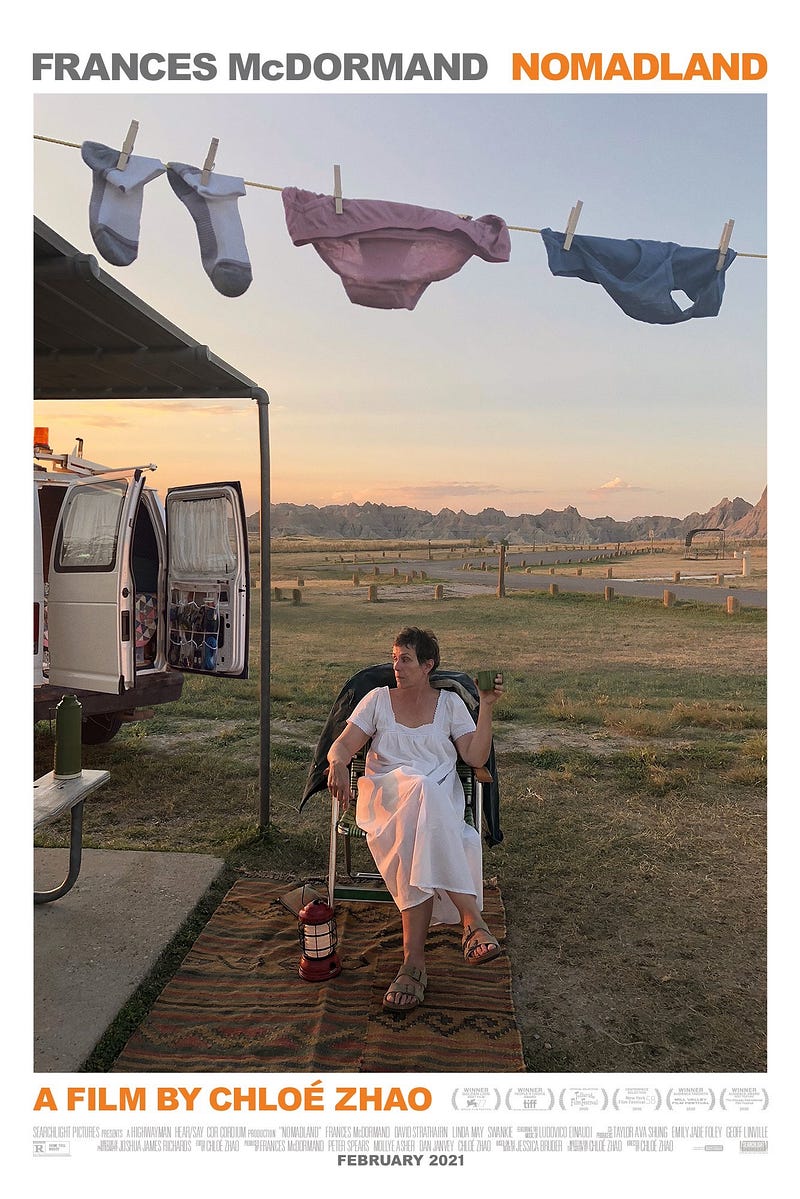
Nomadland is based on the 2017 nonfiction book of the same name by Jessica Bruder. It chronicles a woman named Fern who lived in the mining town of Empire, Nevada up until 2011 when the mine closed and the town ceased to exist. Recently widowed and stripped of her job and home, Fern takes the advice of a coworker that she meets while doing some seasonal work at an Amazon fulfillment center and drives the van that has become her home down south to Arizona.
Fern’s destination is a commune run by Bob Wells, who popularized a minimalistic, nomadic lifestyle that was embraced by thousands as the Great Recession set in. Fern cautiously makes some friends (including a potential love interest), but she soon comes to realize that nomads don’t stick around long by their very nature. As a result, the film is full of aching goodbyes and tentative reunions that ring painfully true.
Nomadland relies more on atmosphere, themes, and characters than it does on a traditional plot arc. It’s not that nothing happens. Quite a bit does occur and much is revealed about its characters. But it’s not the unfolding story that really hooks the viewer or propels their continued investment. Rather it’s the extraordinary craftsmanship of what’s on screen and the moving, heartbreaking stories of its characters and all of those that they represent.
As was the case with her first two films, Chloe Zhao went for authenticity with Nomadland. Zhao and much of the cast lived out of vans during the filming that occurred across the American West and the result is something so raw that at times it feels like watching a documentary. To enhance this naturalism further, Zhao incorporated numerous nomads with no prior acting experience into significant roles. Two in particular — Swanky and Linda May — are utterly superb.
Fern is played by two-time Oscar winner Frances McDormand, who also produced the film, and her friend and love interest David is played by Oscar nominee David Strathairn. Despite being well known, both McDormand and Strathairn are gifted character actors who have a tendency to disappear into the roles they inhabit. Their skill and acting style prevents their presence from becoming distracting. Both are superb, with McDormand shining in a subdued role that feels in some ways a direct counterpoint to her recent Oscar winning turn in Three Billboard Outside of Ebbing, Missouri.
As the film progresses, Fern receives offers from both David and her estranged sister that would allow her to break free of the nomadic lifestyle. Fern declines, decisions that are frustrating to the viewer but exceedingly true to the character. She is a fiercely independent woman who eschews what she perceives as charity. She nobly refuses to play the victim, but also is prideful and stubborn. Through being a nomad she found a way to be self-sufficient and she is reluctant to give that up.
By portraying Fern’s situation as so clearly out of her control (the shutdown of the mine is one of the many great working class tragedies of the past few decades) and Fern as so disciplined, hard working, and rejecting of charity, Zhao is able to subtly but effectively challenge many viewers beliefs regarding poverty and homelessness. It is a common belief held among Americans that poor choices are primarily what beget destitution and the idea that anyone can pull themselves up by their own bootstraps and achieve the “American Dream” is embedded deep in the marrow of our society. Fern presents a challenge to those who hold those beliefs. By asking the viewers to rethink their preconceived notions and empathize with Fern and her fellow nomads, Zhao works to slowly chip away at these toxic beliefs that keep our economy so imbalanced and our social services system so underdeveloped.
Nomadland is seamlessly edited in a way that provides enough structure to engage viewers but enough looseness to serve its themes and Zhao’s vision. It features striking and indelible imagery that should make it a frontrunner for the Oscar for Best Cinematography. And at 108 minutes it doesn’t outstay its welcome.
It is an extraordinary film that has rightfully been hailed as a modern masterpiece.
Grade for Nomadland: 5/5 Stars
Conclusion
To truly experience Promising Young Woman and Nomadland viewers are required to sit with topics that are supremely uncomfortable to many — rape culture and economic injustice. But the films guide the viewer to this experience via different tactics. Promising Young Woman is aggressive and provoking, while Nomadland quietly compels the viewer to empathize with people whose behavior they may struggle to understand. Neither approach is inherently better than the other and both work perfectly for their respective subject matter.
To me, these two films represent the true potential of cinema: the union of bold and innovative aesthetics, compelling characters and conflicts, and deeply complicated and socially relevant themes into one compelling, moving, and thought-provoking experience. Regardless of how both films do throughout the upcoming awards season, I would bet a significant chunk of money that their cultural and artistic impact will be felt for decades.


