
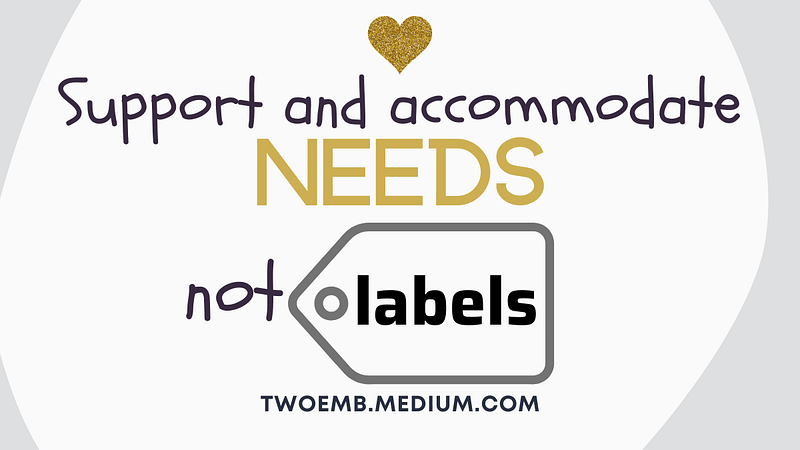
Support Needs, Not Labels
Diagnostic groups (a.k.a. human beings) are not homogenous
My son and I both have the exact same diagnoses: twice exceptional, gifted with ADHD and anxiety. We are similar in a lot of ways. We both love reading and sports. We are both energetic, intense, passionate, forgetful, distractible, impulsive, introverted, and good problem-solvers.
We also differ in a lot of ways too. My son is creative and artistic, I am not. He loves and excels in math, I do not. He loves video games, I most decidedly do not. He hates writing, I love writing. He is mostly a sensory-seeker, I am mostly a sensory avoider.
If my 8 year old self were in the same class as him, we would look very similar on paper, yet very different in person. I masked my then-undiagnosed ADHD throughout my school years and performed very well academically. My son’s presentation is different. He is bored in school and doesn’t care about getting good grades. I love science now, but hated it in school. My son has always loved science, especially doing experiments.
I was socially isolated, bullied, and had very few friends. My son has a strong personality and has had his share of conflict, but generally tends to get along well with other children, and is well-liked by most of his peers.
Similar yet very different
My point is two people will not have the same accommodation or support needs just because they share a diagnosis. Conversely, two people with different diagnoses (or none at all) can have similar needs.
I was reading a conversation online where a parent agreed that labelling children can be harmful, but diagnoses are how we get funding for supports when they are needed, they are how we can advocate for accommodations for our children in their schools.
I have made similar arguments in a previous article, A Diagnosis is More Than Just a Label.
Why is this the case?
Because our public school system is formed on a deficits-based model.
When a child isn’t thriving within our rigid, one-size-fits all approach, we ask “what’s wrong with this child?” and “how do we fix this child’s problems?” rather than “what’s wrong with their environment?” or “what’s not working for them, and how can we change that?”
“While labels can theoretically be used to provide support that allows each child to flourish, the desire for standardized outcomes tends to guide the form and goals of support in education systems as they currently exist.”
— Mitzi Waltz
Imagine if we could identify a need and seek out ways to meet that need, instead of having to apply for funding with a tidy little label attached, in order to validate the fact that we are struggling and need supports.
Instead of forcing disabled people to justify their needs with a diagnosis, providing personal medical information, let’s just believe and support our fellow human beings, and provide reasonable accommodations.
Receiving a diagnosis is a highly flawed process in the first place, especially when it comes to behaviourally-based diagnoses, like Autism, ADHD, and O.D.D. So because someone does not have the necessary “paperwork” or label attached to their needs does not mean they do not deserve or require accommodations.
Because racism, gender bias, sexism, and classism
When compared to white children, Black and Latino children had lower odds of having an ADHD diagnosis and of taking ADHD medication, even after controlling for socio-demographics, ADHD symptoms, and other potential comorbid mental health symptoms”.
Autistic and ADHD females are much less likely than their male counterparts to receive a formal diagnosis, despite the fact that the prevalence rates are thought to be relatively similar.
Researchers have concluded females with ADHD may be more easily missed in the ADHD diagnostic process and less likely to be prescribed medication unless they have prominent externalizing problems, and females who meet criteria for ASD are at disproportionate risk of not receiving a clinical diagnosis.
Additionally, it is believed that there is a higher prevalence of both Autism and ADHD in the transgender community, and likewise greater gender variance amongst neurodivergent individuals, yet most psychological studies focus on cis-gendered groups and people and exclude those who identify as non-binary and transgender.
For more on how being neurodivergent and genderqueer are inseparable identities for some, I highly recommend Jesse Meadows’s piece on overlapping Autism and gender identity.
For more writing on critical disability studies, transphobia, gender biases, and neurodiversity, I very highly recommend anything by Devon Price.
Lastly, it is much more difficult for families living in low-income areas to access mental health and psychological services (Hodgkinson et al., 2017).
Unfortunately receiving a diagnosis is a privilege often reserved for white, middle- and high-income, cis-gendered males — this is certainly not always the case, but our current system makes it more difficult for certain demographics to access psychological services, mental health care, diagnostics, and treatment.
Address Needs, not Labels
For these reasons, and many others, this is why we should focus on accommodating and supporting diverse needs. Regardless of diagnosis, label, or “proof”, we should just treat people in the way that they wish to be treated, and in the way that helps them do their best.
“Rather than putting kids into separate disability categories and using outmoded tools and language to work with them, educators can use tools and language inspired by the ecology movement to differentiate learning and help kids succeed in the classroom” — Thomas E. Armstrong
While diagnoses can help us understand people’s behaviour and needs better, they can end up being prescriptive rather than descriptive. What I mean is, we end up expecting or anticipating certain behaviour and needs from a person based on their label, rather than getting to know them beyond their diagnosis.
There are a plethora of myths, assumptions, and stereotypes about different neurotypes. When people are ill-informed about neurodiversity — which is much of the general public, unfortunately — they tend to draw upon these misconceptions, which end up doing more harm than good.
If, instead, we simply explain what a person’s needs are, and how they can be accommodated, then each person can be treated as an individual.
“In the old [current] model, kids are made to approximate the norm. Instead, teachers should seek to discover students’ unique requirements for optimal growth, and then implement differentiated strategies to help them bloom” — Thomas E. Armstrong
A Diagnosis IS More Than Just a Label
I have come to accept, and even like, my diagnosis. My neurodivergence is part of who I am, and understanding my diagnosis helps me understand myself better. It has validated my experiences. Continually educating myself allows me to better understand and support my son, and to better support other children and families in my work as well.
My son’s diagnosis has allowed him to receive accommodations and supports at school, and has enabled me to advocate for him. The problem is that his diagnosis is a privilege not everyone has. He is a middle-class hyperactive white boy with a crazy-high IQ. He is the epitome of a stereotypical ADHD kid, which is part of the reason he was diagnosed when he was only 6 years old.
Many families do not have access to the same resources, many people are treated differently because of systemic racism and classism, gender bias, and sexism.
Something’s gotta give.
Either the system needs to change to make it equally accessible for all peoples, remove all diagnostic biases, and eradicate systemic racism, classism, sexism, and gender biases…
Easy, right?
…Or we just support people’s needs, rather than requiring that they come with an official diagnosis, so they can fit neatly into our little boxes to make our lives and jobs easier.
Y’know what, actually? Both would be great.
© Jillian Enright, Neurodiversity MB
Related Stories
When you join medium, as a member you’ll have access to unlimited reads for only $5 per month. If you use my referral link, I’ll earn a small commission, and you’ll earn my undying gratitude.
If you’d prefer give a one-time tip, you can support my writing on Ko-Fi — also, it’s free to follow me on Facebook!
References
Armstrong, T. (2012). Neurodiversity in the Classroom: Strength-based strategies to help students with special needs succeed in school and life. ASCD.
Bargiela, S., Steward, R. & Mandy, W. (2016). The Experiences of Late-diagnosed Women with Autism Spectrum Conditions: An Investigation of the Female Autism Phenotype. Journal of Autism and Developmental Disorders 46, 3281–3294. https://doi.org/10.1007/s10803-016-2872-8
Coker, T. R., Elliott, M. N., Toomey, S. L., Schwebel, D. C., Cuccaro, P., Tortolero Emery, S., Davies, S. L., Visser, S. N., & Schuster, M. A. (2016). Racial and Ethnic Disparities in ADHD Diagnosis and Treatment. Pediatrics, 138(3), e20160407. https://doi.org/10.1542/peds.2016-0407
Hodgkinson, S., Godoy, L., Beers, L. S., & Lewin, A. (2017). Improving Mental Health Access for Low-Income Children and Families in the Primary Care Setting. Pediatrics, 139(1), e20151175. https://doi.org/10.1542/peds.2015-1175
Loomes, R., Hull, L., Polmear, W., Locke, M. (2017). What Is the Male-to-Female Ratio in Autism Spectrum Disorder? A Systematic Review and Meta-Analysis. Journal of the American Academy of Child & Adolescent Psychiatry, 56(6), 466–474. https://doi.org/10.1016/j.jaac.2017.03.013
Mowlem, F.D., Rosenqvist, M.A., Martin, J. et al. (2019). Sex differences in predicting ADHD clinical diagnosis and pharmacological treatment. European Child & Adolescent Psychiatry 28, 481–489. https://doi.org/10.1007/s00787-018-1211-3
Strang, J.F., Kenworthy, L., Dominska, A. et al. (2014). Increased Gender Variance in Autism Spectrum Disorders and Attention Deficit Hyperactivity Disorder. Arch Sex Behav 43, 1525–1533. https://doi.org/10.1007/s10508-014-0285-3
Thrower, E., Bretherton, I., Pang, K.C. et al. (2020). Prevalence of Autism Spectrum Disorder and Attention-Deficit Hyperactivity Disorder Amongst Individuals with Gender Dysphoria: A Systematic Review. Journal of Autism and Development Disorders 50, 695–706. https://doi.org/10.1007/s10803-019-04298-1
Waltz, M. (2020). The production of the ‘normal’ child: Neurodiversity and the commodification of parenting. In Bertilsdotter Rosqvist, H., Chown, N., & Stenning, A. (Eds). Neurodiversity Studies: A new critical paradigm. Routledge.
Yildirim, B., Fis, N. P., Akgul, G.Y., & Ayaz, B. A. (2017). Gender dysphoria and attention problems: possible clue for biological underpinnings. Psychiatry and Clinical Psychopharmacology, 27(3), 283–290, https://doi.org/10.1080/24750573.2017.1354417
Young, S., Adamo, N., Ásgeirsdóttir, B.B. et al. (2020). Females with ADHD: An expert consensus statement taking a lifespan approach providing guidance for the identification and treatment of attention-deficit/ hyperactivity disorder in girls and women. BMC Psychiatry 20, 404. https://doi.org/10.1186/s12888-020-02707-9
For more of the good stuff, follow Fourth Wave, where we’re changing the world for the better, one story at a time. Got one of your own? Submit to the Wave!


