
Life Discovery: “Points of Observation” and “Significant Insights”
I SEE IT and I WANT IT

This morning I shared the above picture on Linkedin and discussed “Points of Observation” and “Significant Insights”.
Why did I write the post?
Because I wanted to reinforce the notion of “Points of Observation” and a related Significant Insight: “changes in Points of Observation in Thematic Space.”
After sharing the post on Linkedin, I even made the diagram below:
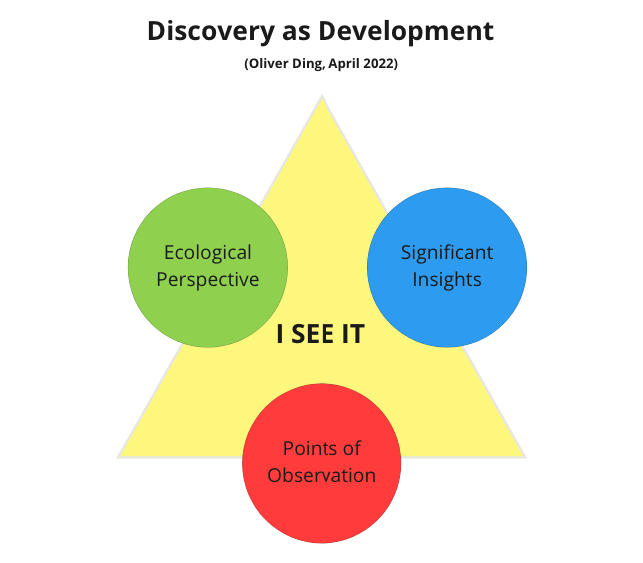
The technique behind the action is called Objectification of Concept.
The Hide-and-Seek Game
One day I played the hide-and-seek game with my son several years ago. I took the following pictures.

Look at the above picture and think about my Point of Observation at that time.

From the point of the last picture, I moved several steps and saw my son! Look at this picture and think about my Point of Observation again. Once I moved, my point of observation changed. Once my point of observation changed, my ambient optic arrays changed.
In June 2020, I used the above pictures for an article that is an introduction to Ecological Physics Method.
Now we can use the hide-and-seek game as a metaphor to understand the Life Discovery Activity. Sometimes, it is easy to see IT. Sometimes, it is hard to see IT because we need to find a particular Point of Observation in order to take a Particular Perspective.

If you are an experienced photographer, you know the Point of Observation is critical for taking a good photo. Moreover, you might need to consider more things such as Time, Weather, etc.

Several steps are tiny, but they make a huge difference in the hide-and-seek game. I believe that the Life Discovery Activity is a long-term game because we need to try more than one step and try more than one Point of Observation.
Sometimes, we need to take a long journey to play the hide-and-seek game.
A Significant Insight
I also mentioned the significant insight of “Curated Mind” in the last section of the article. I use the insight as an example of “changes in Points of Observation in Thematic Space.”
Though I had a theoretical perspective on Curated Mind, I changed my Points of Observation from the “Proximal Mind” to the “Pervasive Mind”.
This change was caused by the conversation with Maurizio Goetz and some interactions with friends who are passionate about ecosystems. For example, I made Optimal Context Canvas to respond to some friends’ needs about perspectives on ecosystems on March 3, 2022.
Where are the changes in Points Observation? I’d like to claim that it happens in Thematic Space, not the physical environment.
In fact, I had a call with a friend and we discussed Activity Theory, Lifesystem Framework, and the Theory-Practice connection on April 3, 2022. This conversation changed my perspective on the concept of “Supportance”.
Originally, the concept of “Supportance” was developed from the “Taking” perspective. My friend works in the field of Charity. From our conversation about her practice and my theory, I realized that the “Giving” perspective on the concept of “Supportance” is pretty cool too.
I published the article about the above typology of perspectives on April 10, 2022. Later, I realized that my change of perspective on the concept of “Supportance” is also an example of “changes in Points of Observation in Thematic Space.”
This is a Significant Insight too!
A Typology of Perspectives
Inspired by James J. Gibson’s ecological psychology, I use the term “Points of Observation” to build a typology of Perspectives:
- Theoretical Perspectives: they are based on theoretical approaches. They are not based on our practical interests and points of observation.
- Practical Perspectives: they are determined by our practical interests, not by theoretical approaches and points of observation.
- Ecological Perspectives: they come from the changes in our points of observation.
This idea is an expanded version of the following idea which is part of my 2018 DEKIN framework.
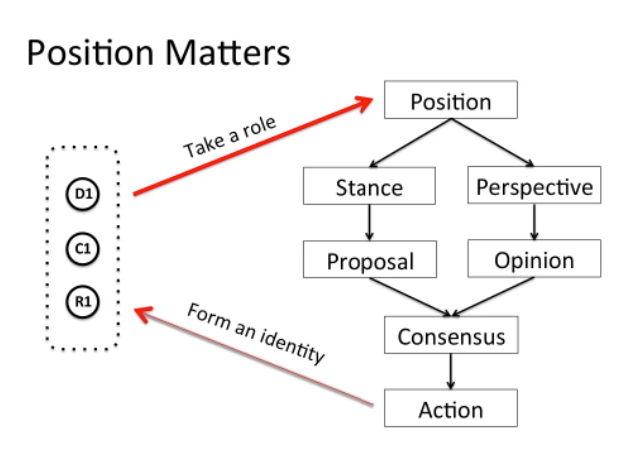
This DEKIN framework was developed with a 3P focus: People, Position, and Practice. The above slide is part of the framework and focuses on communication. Each social position can be
- Stance: It is based on our practical interests around the social position.
- Perspective: It doesn’t depend on our practical interests but on our cognitive skills and knowledge.
If we compare these two versions, then we can roughly consider the “Stance” (2018) as the “Practical Perspectives” (2022). The “Perspective” (2018) is divided into the “Theoretical Perspectives” (2022) and the “Ecological Perspectives” (2022).
I SEE IT and I WANT IT
There are three aspects behind the above typology of perspectives. If we reorganize these ideas and consider two stages such as I SEE IT and I WANT IT, we can develop a new heuristic tool.
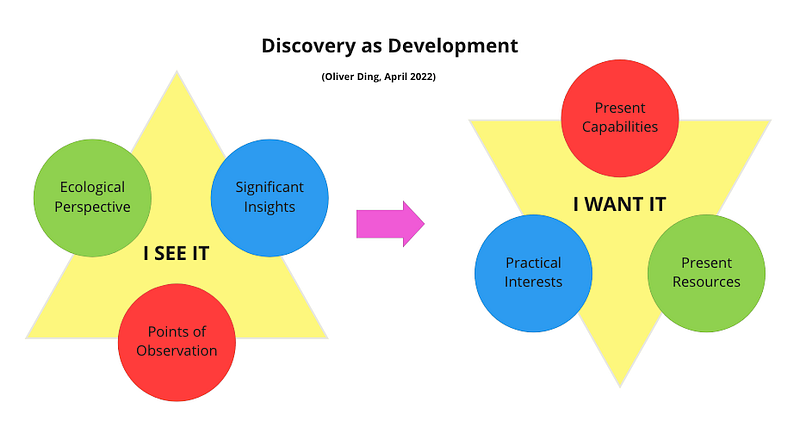
The I SEE IT stage is about Discovery while the I WANT IT stage is about Decision.
The I SEE IT stage focuses on the Life Discovery Activity and its primary outcome is the Significant Insights.
How does a Significant Insight lead to a new action or a new activity?
This question indicates the I WANT IT stage where we consider Practical Interests, Present Capabilities, and Present Resources for our present decisions.
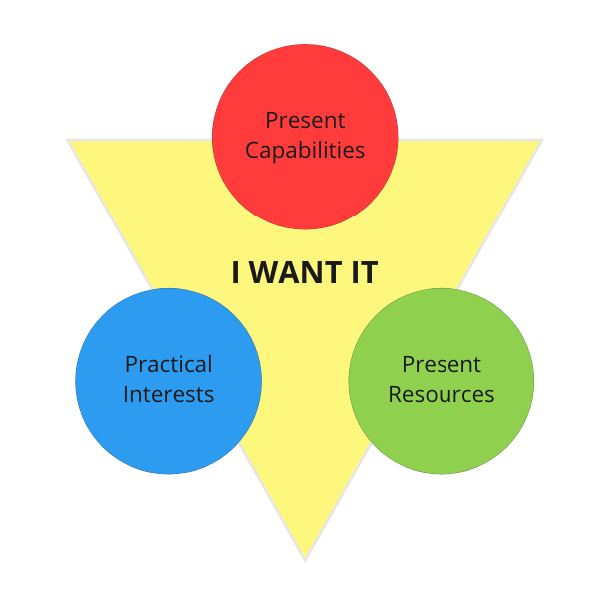
A friend of mine tells me that the typology of Perspectives is critical for connecting Theory and Practice because it points out the importance of the Point of Observation.
So, what’s the value of the above new heuristic model?
Connecting Second-order Activity and First-order Activity
We can use this heuristic to understand the connection between Second-order Activity and First-order Activity.
These two terms are part of the Ancitiparty Activity System (AAS) framework. See the diagram below.
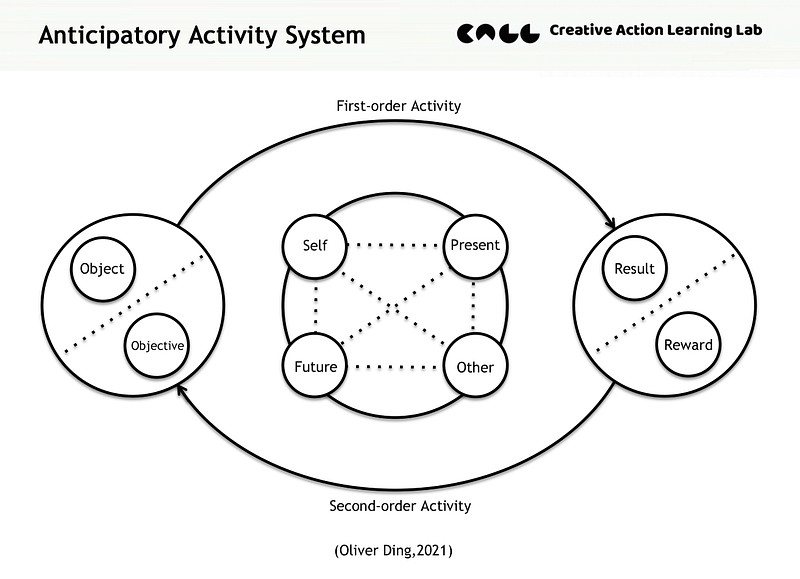
The Anticipatory Activity System framework is a hybrid theoretical framework that curates the following two theories together:
- Activity Theory
- Anticipatory System Theory
The above diagram is the standard model of the Anticipatory Activity System framework. It was formed by the following pairs of concepts:
- Present — Future
- Self — Other
- Object — Objective
- Result — Reward
- First-order Activity — Second-order Activity
You can find more details from D as Diagramming: Strategy as Anticipatory Activity System.
The major difference between First-order Activity and Second-order Activity is the latter only focuses on producing “Objectives” for the former. For example, I applied the AAS framework to Life Transitions and developed a new framework called AAS4LT. See the diagram below.
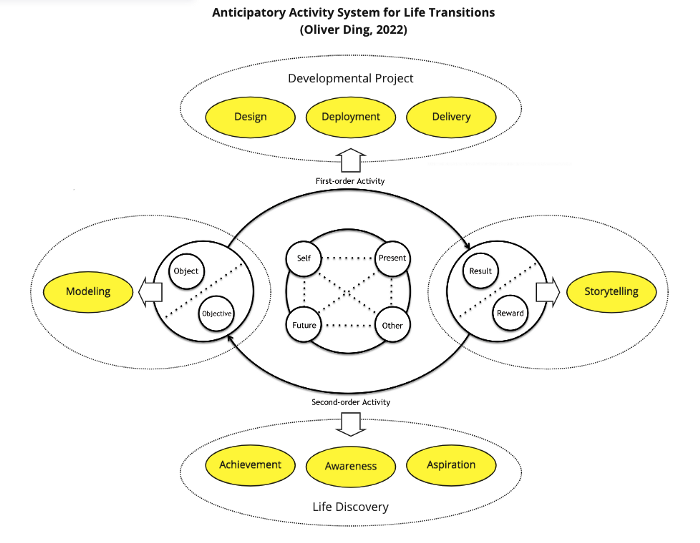
The Second-order Activity is a specific type of activity in which subjects aim to define objectives and goals for their further activities. For the AAS4LT framework, I choose the Life Discovery Activity as the Second-order Activity.
The second half of the AAS4LT framework is First-order Activity which refers to normal activities. I choose the Developmental Project model to design and develop First-order Activities for the duration of Life Transitions.
The AAS4LT framework aims to offer life coaches a new tool for dealing with life transitions from the perspective of the Anticipatory Activity System framework. It considers the following 8 steps:
- Aspiration
- Awareness
- Achievement
- Design
- Deployment
- Delivery
- Modeling
- Storytelling
There is an ideal sequence of the process between these eight steps. If everything goes well, we can pass these steps one by one. However, real life is not a simple linear model. We might need to jump between these steps. The real process is iterative, taking many cycles through the process.
Today I’d like to add a new step to the AAS4LT framework. See the diagram below.
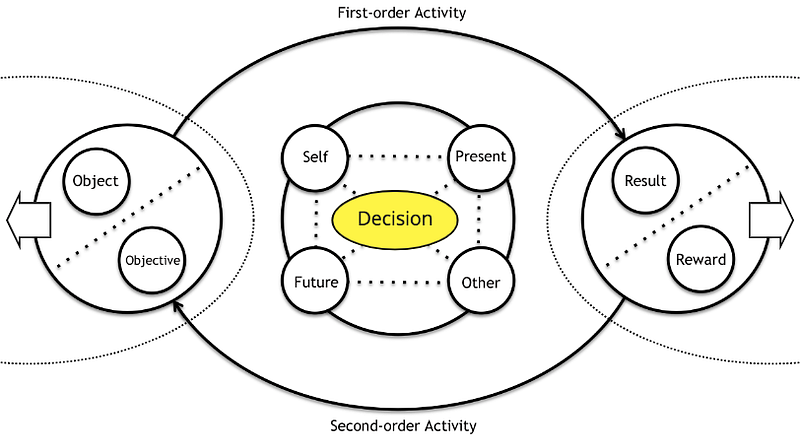
We can consider “Decision, Modeling, Storytelling” as a group of actions for the AAS4LT framework.
The “Decision” action decides the connection between Object and Objective, and the connection between Results and Reward. The “Decision” action is also embedded in the context of “Self, Other, Present, Future”.
We might need to give a name to the “Decision, Modeling, Storytelling” group since they work at the meta-level.
Third-order Activity? Do you like this term?
Related Articles
- Knowledge Discovery: The “Perspectives — Views” Mapping
- The Project Engagement Toolkit (2022)
- Life Discovery: The Life-as-Project Approach
- The Life Discovery Toolkit (v1)
- The Life Discovery Canvas (v1.0) — Part 1: Theoretical Background
- The Life Discovery Canvas (v1.0) — Part 2: Spatial Structure
- The Life Discovery Canvas (v1.0) — Part 3A: Concepts (THINK and LEARN)
- The Life Discovery Canvas (v1.0) — Part 3B: Concepts (SAY and DO)
- The Life Discovery Canvas (v1.0) — Part 4: Inspirations
- Life Discovery: The “Being by Doing” Principle
- Life Discovery: The “Performance as Experiment” Principle
- Life Discovery: The “Engagement as Projection” Principle
- Life Discovery: The “Discovery as Development” Principle
- CALL for LIFE: Anticipatory Activity System for Life Transitions
- CALL for LIFE: Modeling A Developmental Project
- CALL for LIFE: Oliver Ding @ 2021 and Second-order Activity
- Life Discovery: Twelve Significant Insights from Four Months
I am also working on building a new website for the Platform Ecology project. You can save the following links:
- PlatformEcology.org
- Twitter: @PlatformEcology
- Linkedin: @PlatformEcology
You are most welcome to connect via the following social platforms:
Linkedin: https://www.linkedin.com/in/oliverding Twitter: https://twitter.com/oliverding Polywork: https://www.polywork.com/oliverding Boardle: https://www.boardle.io/users/oliver-ding


