
Medium Writing Tips
Medium Article Views: Long-Term Growth in Views Without Curation
The 10 month journey of a Medium story from 0 to 250K views
Depending on why you write on Medium, hitting 250,000 cumulative views on a single story over 9 months may not be that interesting.
There are a number of viral articles which have hit even larger milestones. And based on Medium’s Partner Program payment calculation system, an article with views from predominately external sources could have generated next to nothing in profit.
But this article’s milestone stands out to me, not because of extraordinary earnings, but because it offers a glimpse of hope to writers.
- This article was not curated.
- This article was never featured in any of of Medium’s publications.
- This article was only featured in my own small publication with less than 10 stories.
- This article did not go viral.
- There was little or no external promotion of this article.
Today, however, the article has accumulated 250,000 views!

***Update (10/2020)***
Article has is now approaching 500,000 views!
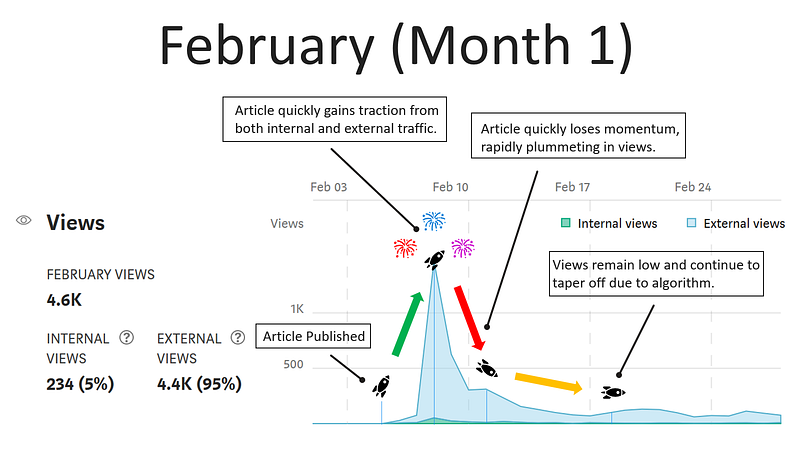
This article initially followed the normal blog post trajectory of:
- Getting some initial views in the first day.
- Being picked up in a couple of small sites/search engines, giving it enough momentum to briefly spike for a few more days.
- Rapidly losing momentum and settling at a much lower amount of views per day, just above 0.
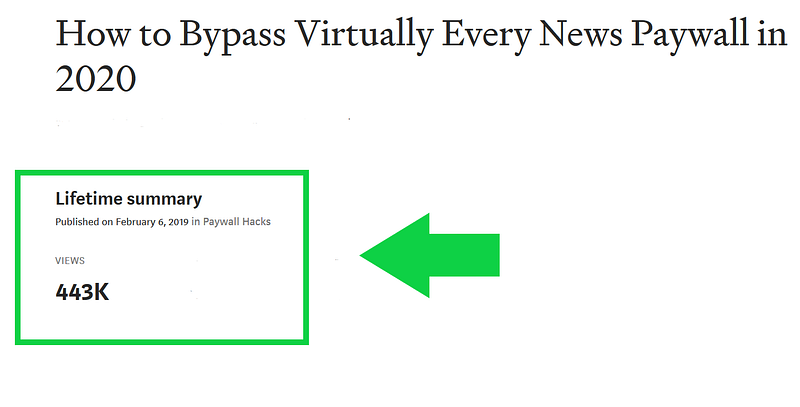
The article this analysis focuses on is How to Bypass Virtually Every News Paywall:
It would have been easy to write this article off as a failure. Another article that would never resurface due to Medium’s strong algorithmic rate of decay.
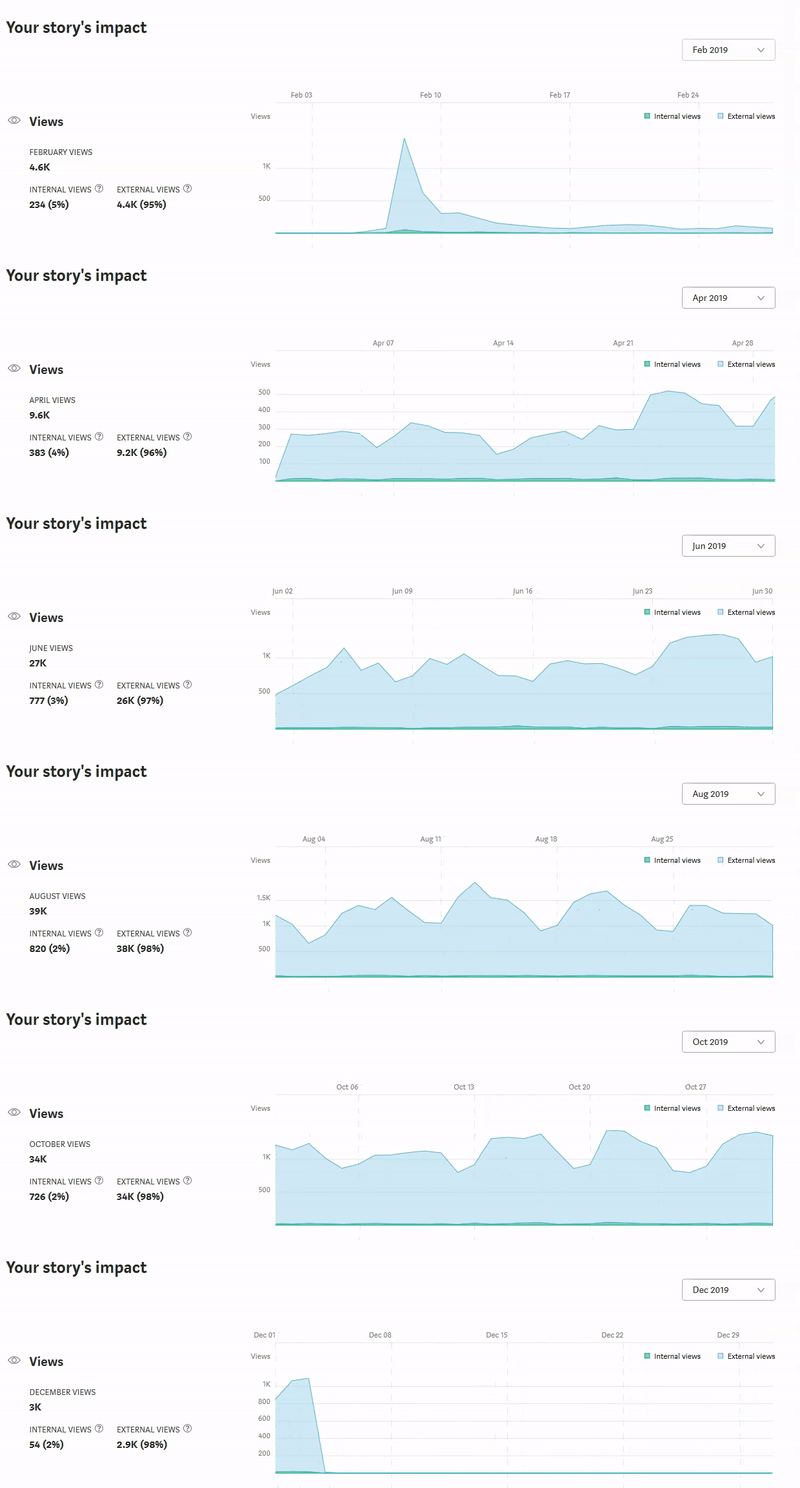
The first month (February 2019) in which this article was published follows this pattern closely:
But I kept making small edits, both in terms of content, images, and limited on-page SEO.
But perhaps most important of all — I waited.
I believed the content was original and useful. I continued to monitor this article, while I worked on subsequent posts.
Eventually, nearly 50 days after its initial publication, traffic nearly quadrupled from 50 to 200 daily views.
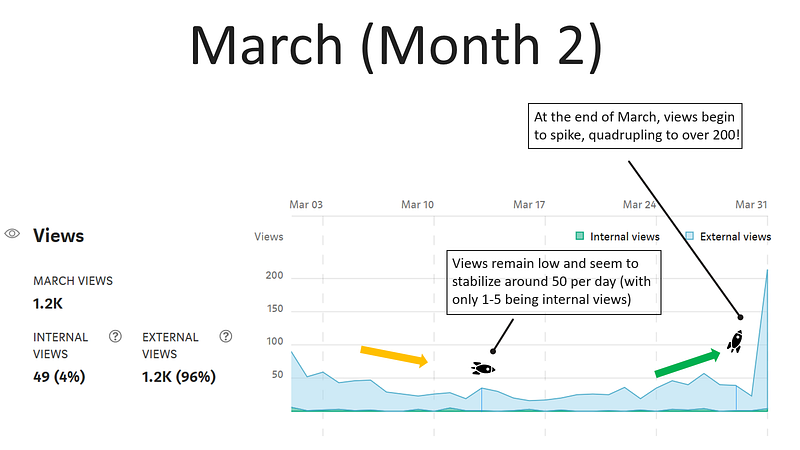
It’s important to keep in mind that at this point, in March, my total views for the month (1,200) are still less than the first 1–2 days combined when it was published the previous month (~1,500).
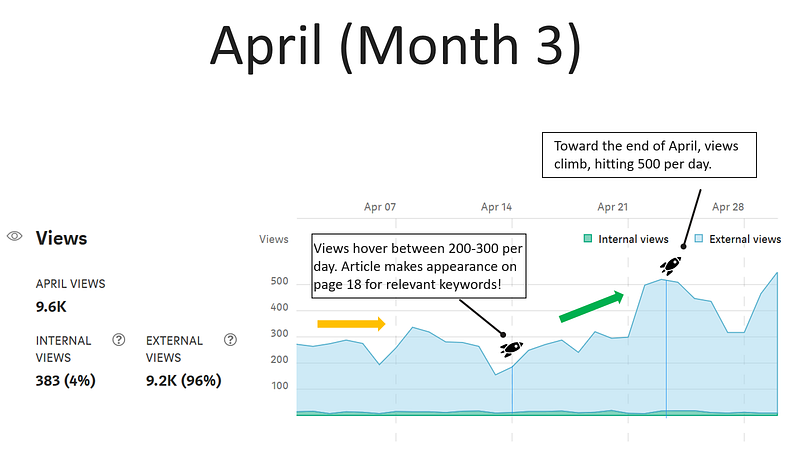
Although my article was likely indexed by Google quickly (most Medium articles are), I could not locate it in the search results until mid April, where it appeared on page 18 for 2 keyword searches. Consequently, views begin to climb a few weeks later.
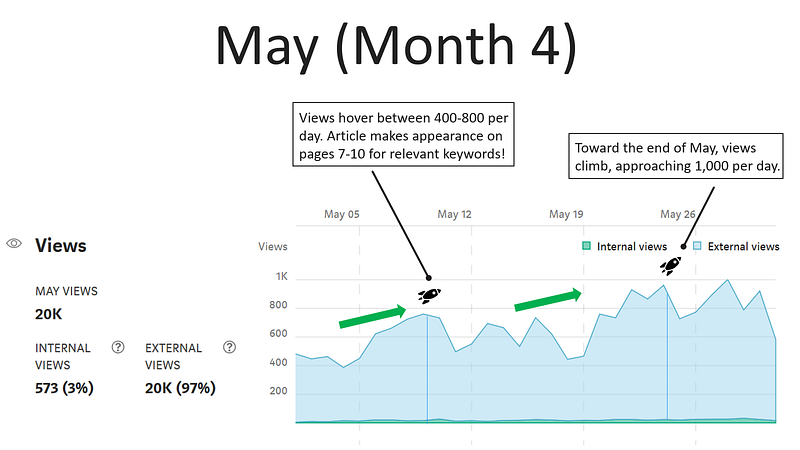
Readers must have searched deep in to the Google search results and validated my article, because a month later, it started to appear on pages 7–10 of the Google search for numerous key words and phrases.
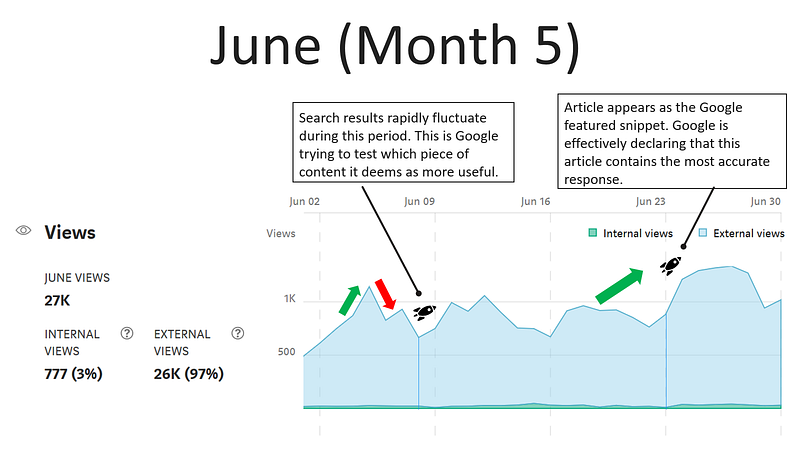
In June, the views become extremely erratic. This is likely due to Google “testing” my content, trying to determine its usefulness to readers, by frequently adjusting the page rank. My article briefly appears as Google’s featured snippet for several related key word searches:
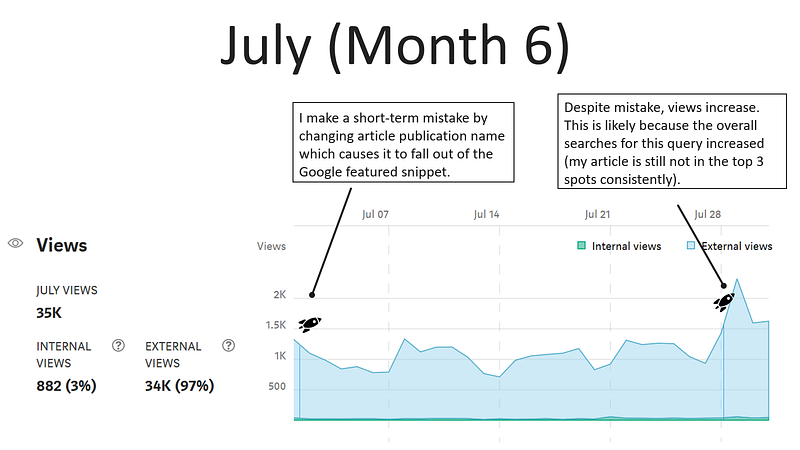
In July, I made an SEO mistake. I created a new publication to organize my Medium articles, relating to Paywall Hacks, and the result was my article disappearing about every other day, which dramatically lowered my views.
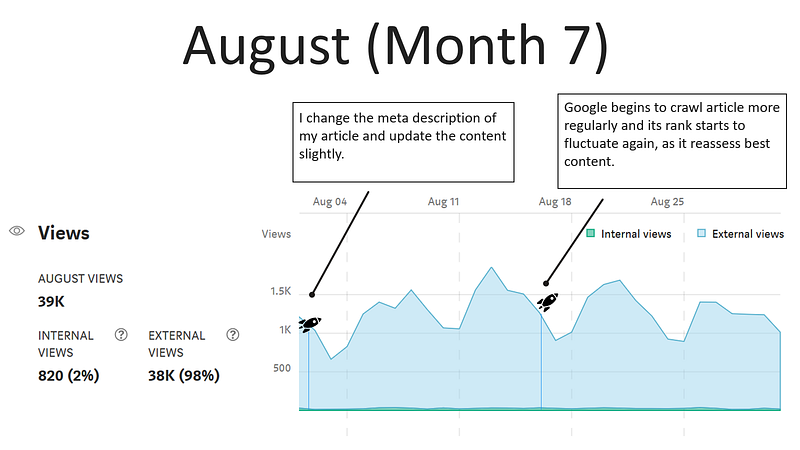
In August, determined to get my article back into the top 5 pages for good, I experimented with different meta-descriptions for my article. Meta descriptions are vastly underutilized by many Medium authors.
A good meta description can dramatically increase your click-through rate and attract a higher value reader.
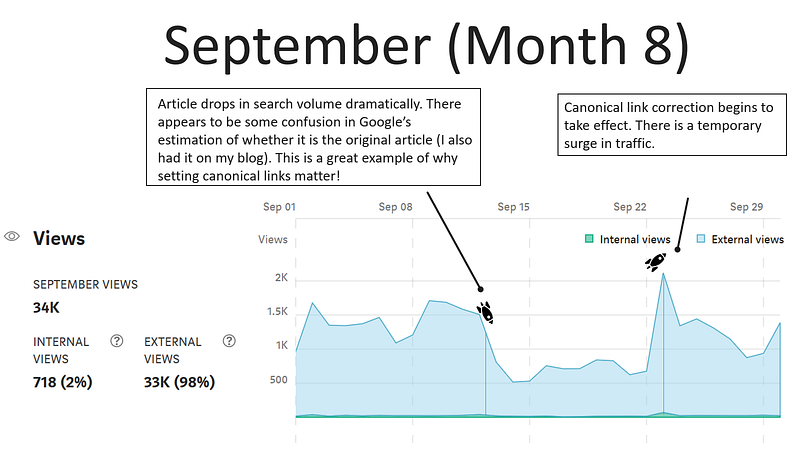
In September, my article experienced its biggest drop almost overnight. The issue was that I had posted this article on my personal website (several months ago).
While not technically a penalty, duplicate content can still sometimes impact search engine rankings. When there are multiple pieces of, as Google calls it, “appreciably similar” content in more than one location on the Internet, it can be difficult for search engines to decide which version is more relevant to a given search query.
When duplicate content is present, content publishers can suffer rankings and traffic losses. These losses often stem from two main problems:
- To provide the best search experience, search engines will rarely show multiple versions of the same content, and thus are forced to choose which version is most likely to be the best result. This dilutes the visibility of each of the duplicates.
- Link equity can be further diluted because other sites have to choose between the duplicates as well. instead of all inbound links pointing to one piece of content, they link to multiple pieces, spreading the link equity among the duplicates. Because inbound links are a ranking factor, this can then impact the search visibility of a piece of content.
The net result?
A piece of content doesn’t achieve the search visibility it otherwise would.
That is why it is crucial that authors use canonical links (which Medium does allow). Fixing duplicate content issues all comes down to the same central idea: specifying which of the duplicates is the “correct” one.Whenever content on a site can be found at multiple URLs, it should be canonicalized for search engines.
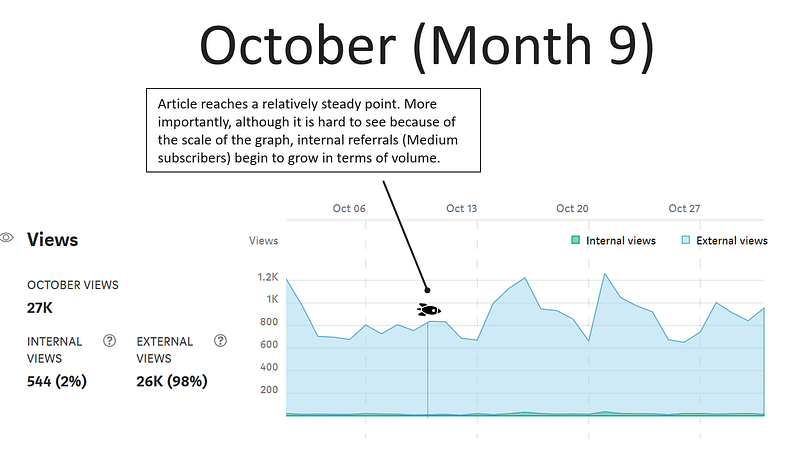
Article begins to stabilize in terms of views. More importantly, the feedback loop of the high ranking for a top search terms is now consistently bringing in 25+ unique internal views per day!
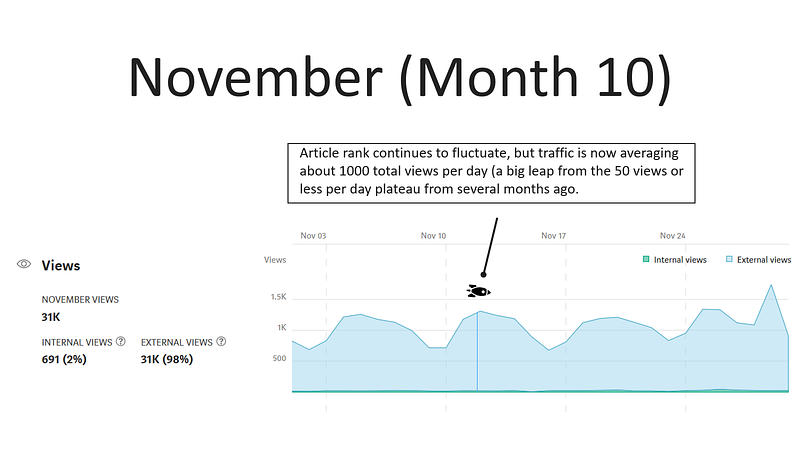
And that takes us to present day where the article is still doing fine…
Visualizing Medium Article Growth by Views Over Time
Below is a GIF of the article growth. Not only is it interesting to watch the views fluctuate over time but it also is a good reminder that often times we need to adjust our perspective when evaluating article success.
When you “zoom in” and focus on the initial drop in views, the steep downward trajectory can be demoralizing. But in many cases, this is too small of a data sample.
Looking at the larger trajectory of an article, and fine tuning that article based on user and search engine “feedback” can be a useful guide.
Key Takeaways
- Your Medium article does not need to “go viral” for it to be successful — you can still achieve massive exposure by creating useful content that is boosted through Google’s search engine organically.
- Medium articles can recover after initially declining in views. This may require fine tuning your article title, meta description, featured image, tags, or publication.
- There is hope for articles that are not curated. While the vast majority of the traffic this article received was external, internal traffic steadily increased over time.
- Creating useful content that can help many people is always a good strategy for traffic. The content of this article was extremely useful to a wide audience. The niche was already saturated with content, but leveraging Medium's high domain authority, and by creating the original content that Google craves, I was able to surpass many guides.
- Do not just post and market an article for just a few minutes and then forget about it or simply hope that it succeeds — update and edit it over time! Pick a single social media platform, master it, and use this to promote both new and old articles. Most content is not evergreen, so you need to commit to keeping it updated and current over-time. If you plan to post an article and never revisit it, there is little chance of this strategy working. It is an ongoing process.

Thanks for reading this article! Leave a comment below if you have any questions. Be sure to sign up for the Blogging Guide newsletter, to get the latest tips, tricks, and news about writing on Medium and to join our Facebook group, Medium Writing, to share your latest Medium posts and connect with other writers.
If you liked this article, here are some other articles you may enjoy:

Casey Botticello is a partner at Black Edge Consulting. Black Edge Consulting is a strategic communications firm, specializing in online reputation management, digital marketing, and crisis management. Prior to founding Black Edge Consulting, he worked for BGR Group, a bipartisan lobbying and strategic communications firm.
Casey is the founder of the Cryptocurrency Alliance, a Super PAC dedicated to cryptocurrency and blockchain advocacy. He is a graduate of The University of Pennsylvania, where he received his B.A. in Urban Studies.
You can connect with him on LinkedIn, Twitter, Facebook, or by following his Medium publication, Blogging Guide.


