
Optimizing Your Content to Become the “Featured Snippet” in Google Search Results
What is the Google featured snippet and why is it important

3.5 billion Google searches are made every day. Every year, somewhere between 16% and 20% of Google searches are new — they’ve never been searched before. The average Google search session lasts just under a minute.
It is essential for internet marketers, entrepreneurs, and small businesses to dominate the first page of Google search results for their relevant key word search. Ideally, you will rank as close to the top of the first page as possible. And increasingly, to achieve this number one spot, you need to understand rich snippets.
Rich Snippets
In the early days of Google’s algorithm, a typical SERP displayed results that included a title, a URL link, and a brief description.
Things, you may have noticed, have changed a lot. Now, we see paid ads, “People also ask” questions, and see plenty of rich results. These rich snippets, rich cards, and enhanced snippets are a growing segment of search results across the board.
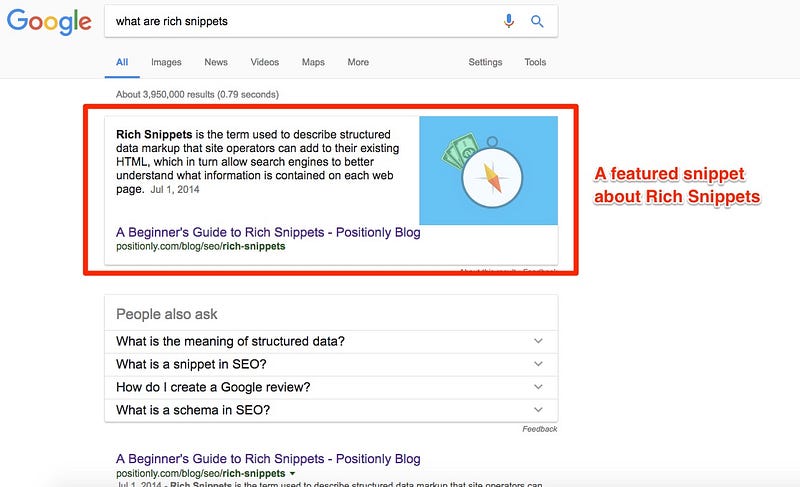
Featured snippets — the direct answer appearing at the top of the results — are a bit different. Google creates them by directly accessing content on the page. But that doesn’t make them any less valuable. One study found a 516% increase in sessions, the CTR quadrupled from 2% to 8%, and organic visitor revenue went up by 677% after getting a consistent featured snippet.
Unfortunately, it can be difficult to make your website/product the featured snippet. With companies spending thousands of dollars per month the dominate a particular key word or key phrase search, it can seem impossible to compete as an individual or small business. However, with some effort, planning, and a little bit of luck, an individual can dominate the search results for a popular key word search, in Google.
I have listed below an example that worked for me that will hopefully help you optimize your digital content and claim the rich featured snippet. While I cannot guarantee success for specific search, it is definitely possible to become the featured snippet without being an SEO professional.
Example: Winning the “Featured Snippet”
The first article I wrote on Medium was How to Form a Super PAC (Political Action Committee).
This article is a good example because:
- it’s a niche I understand well through personal experience;
- a “Super PAC” is a valuable/difficult key word to “own” any of the associated phrases;
- and it organically became the featured snippet (I did not publish this article with that goal in mind).
In hindsight, there are many things I could have done to improve this article if my sole goal was to become the featured snippet for this topic. Nonetheless, this article was a major success for my keyword phrase/search questions:
- “how do I/you form a super pac”
- “how to start a super pac”?
- “how to form a super pac”
Let’s take the example: “how to form a super pac”
Below is a screenshot of the search results for “how to form a super pac.” This is a good search term to own because it is an introductory and illustrative search terms that is conducive to organized steps or process. In my experience, Google’s search algorithm loves clearly delineated steps or processes.
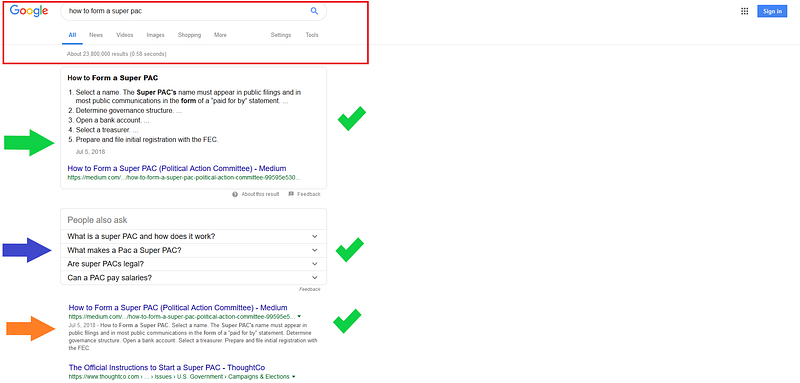
In the image above, the green arrow points to the featured snippet which contains excerpts from my article on Medium. This is obviously valuable because Google is giving your content credit by featuring it as the single featured answer to a search query.
The blue arrow points to the “people also ask” section. While it is good to touch on these related questions in your article, Google will typically try to pick unique sources for these — so focus on one key word phrase first as opposed to trying to get all of them (you will likely end up with none).
The orange arrow points to the first link, which is again my article. As you can see, the featured snippet is also valuable because, on a typical screen, my content or articles are occupying at least half of the space. And given that 91% of people do not click past the first page of Google search results, this is a tremendous advantage in boosting my content.
If you scroll down the page further, looking beyond my own content, you will see an article from ThoughtCo, and remarkably, the FEC. This illustrates two important points — medium has extremely high domain authority/seems to be favored in general by Google’s search algorithm and that Google’s search bots are always on the lookout for new content on a particular topic. So while someone who answered this search query first will have some advantage, if Google decides this question may evolve over time, it is possible to outrank and surpass an entrenched top search result with relatively recent content.
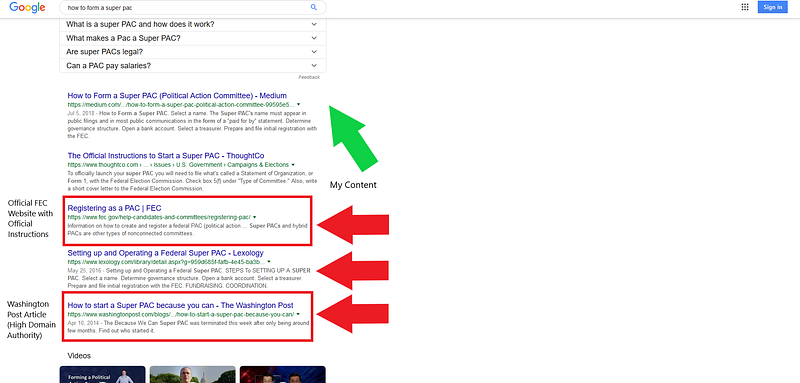
This is a great example because my content ultimately outranks the instructions on how to start a super pac provided by the Washington Post (which has very high domain authority) and even more incredibly, ahead of the official Federal Election Commission (FEC) .gov Website, which addresses the exact same question.
So what are some tips for ranking your content ahead of high authority sources in Google?
- It is OK to have some duplicate content in your article, but strive to have more original content than existing articles. The articles listed after mine are full of copy and pasted content from the same 1–2 sources. They also offer little additional insight, which is important when giving someone instructions.
- Carefully choose what you title your article and make sure all metadata fields point to this search term. Part of what makes Medium so great is that it eliminates some of that guess work by allowing you to choose the article title, a unique subtitle, and five content tags.
- Include section headers and expand upon stated steps (if giving instructions). Article section headers help the readers follow along and identify information within your article that is relevant to them. Having long-form content is great for SEO but your bounce rate will increase if readers feel overwhelmed and do not bother looking through your article for their specific answer.
- Try to address topics in your article that align with Google’s “searches related to” section at the bottom of the first page.
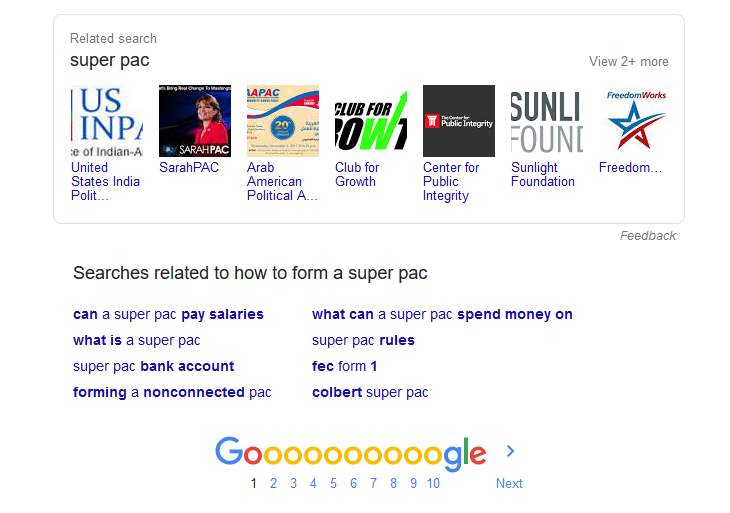
As seen in the image above, google gives eight related searches. While you do not need to address all of these, incorporating a few of these in your article will likely help.
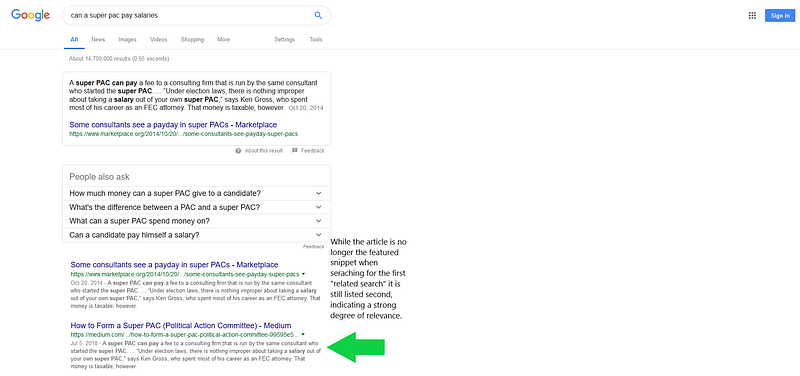
As seen in the image above, if we select the first of Google’s “searches related to”(can a super pac pay salaries), you will notice that my article is no longer the featured snippet. But it is the second result after the Marketplace article. If I wanted to improve my SEO, I could add a section with unique content addressing this search terms.
5. Include unique images in your article. If you look at the screenshot below, you can see that if we run a Google Image search for our original term “how to form a super pac” the first image is that of the Cryptocurrency Alliance, which is the Super PAC referenced in the article.
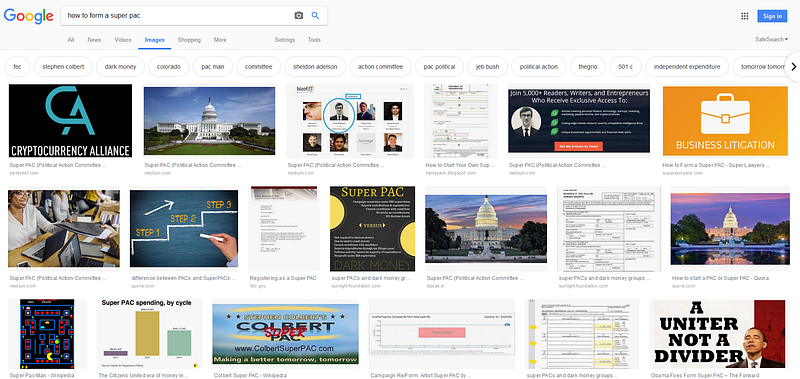
In fact, about half of the first 20 results are directly from my article. Many high authority sources that are competing for the top result lacked unique images or simply linked to forms. Unique images are essential, and in my opinion, vastly underutilized by authors. Having some experience as a stock photographer, I am very familiar with both Google’s and general internet users’ desire to see relevant images and infographics. Also, these unique images tend to be subsequently cited in other articles, and if given proper attribution, should link back to your article, providing an additional SEO boost.
Ultimately, there are many ways to boost your content in Google, so do not be discouraged if the above methods work for you. It’s also important to give Google’s search bots ample time to crawl and compare your article. Winning the featured snippet box will not happen overnight.
Thanks for reading this article! Leave a comment below if you have any questions, and if you want to learn more about blogging, content marketing, or subscription newsletter strategy, be sure to sign up for the Blogging Guide Newsletter!
If you liked this article, here are some other articles you may enjoy:

Casey Botticello is an internet entrepreneur and the founder of Blogging Guide, an online community of writers with an award-winning newsletter. He is also the creator of the popular Medium Writing Course and the Substack Newsletter Course.
Casey previously worked at several tech startups, a lobbying & strategic communications firm, and has created several businesses of his own. He is a graduate of The University of Pennsylvania, where he received his B.A. in Urban Studies.
You can connect with him on LinkedIn, Twitter, Facebook, follow his Medium publications, Digital Marketing Lab and Medium Blogging Guide, or reach out to him directly on his personal website.


