
Meaning Discovery: The “Framework — Context — Situation” Thematic Space
A Case Study
This post is part of the “Meaning Discovery” series. You can find more related posts below:
- The Thematic Matrix Canvas and Meaning Discovery Canvas
- Meaning Discovery: The “Moment — Present — Future” Thematic Space
- Meaning Discovery: The “Object — Self — Other” Thematic Space
- Meaning Discovery: Two Thematic Triangles
- Meaning Discovery: The “Journey — Challenge — Response” Thematic Space
- Meaning Discovery: The “Perspective — Opportunities — Resources” Thematic Space
- Oliver Ding: My Twelve Creative Moments of 2023
- Life Discovery: Significant Insights Analysis
- The Art of Situational Note-taking (Introduction and Index)
- The Curated Mind Toolkit (v1.0)
Oct 25, 2023, I made the first version of the Meaning Discovery Canvas. On Dec 12, 2023, I used “Value — Truth” to replace “Individual — Collective”. I also started collecting some materials for case studies.
This post aims to introduce the “Framework — Context — Situation” Thematic Space.
1. Materials and Models
Materials are pieces of experiences from my real-life events for my case studies.
The Meaning Discovery Canvas is a knowledge framework or knowledge Model.
Each case study happens within a Thematic Space between Materials and the Model.
How to represent the Thematic Space?
I selected one theme from the Materials and two from the Model to make a thematic triangle to frame the thematic space. The diagram below is an example. You can find more details in Meaning Discovery: The “Moment — Present — Future” Thematic Space.
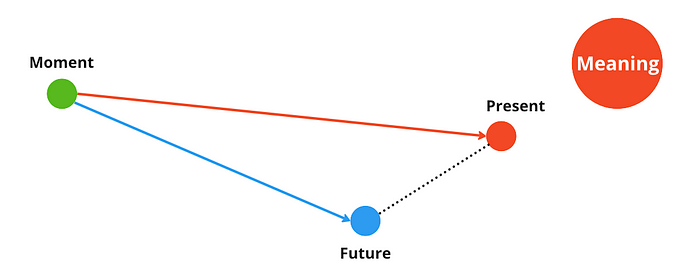
“Moment” refers to a short indefinite period. I used it to refer to the Immediate Situational aspect of Materials.
“Present” and “Future” are two blocks of the Meaning Discovery Canvas.
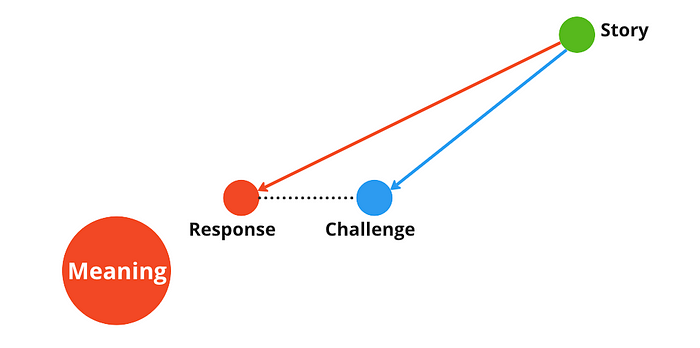
For some case studies, the immediate situational aspect is not the primary focus. For example, Life Meaning Discovery tends to engage with the long-term development of stories and themes. We could use “Story” to frame a new thematic space. See the example below.
This article focuses on the “Framework — Context— Situation” Thematic Space.
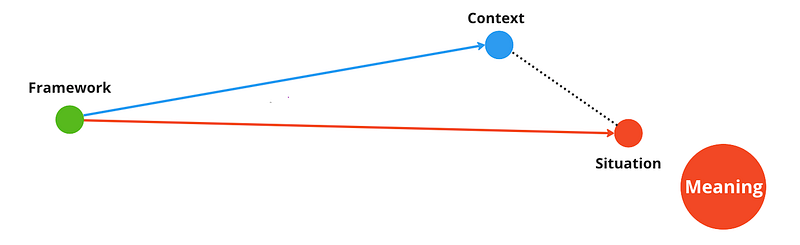
The “Context — Situation” Mapping is located in the REFERENCE Area.
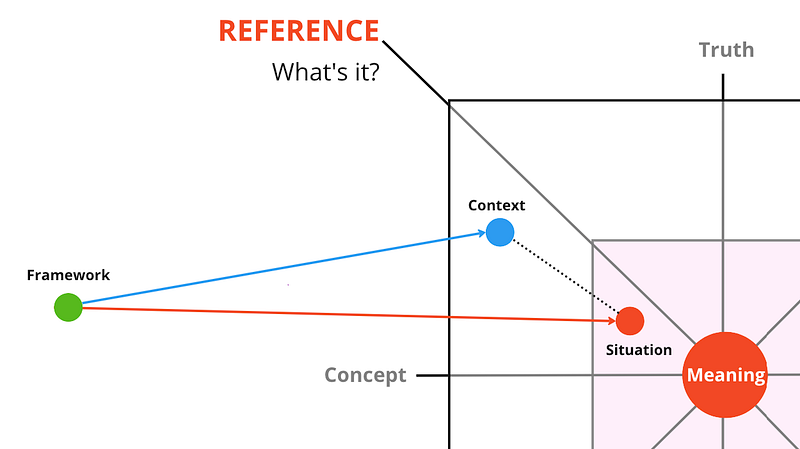
The “Context — Situation” Mapping can be used for everyday life meaning discovery. I define two types of “Context — Situation” mapping:
- #1: Without using Knowledge Frameworks
- #2: Using Knowledge Frameworks
For Type #1, we could use the “Moment — Context — Situation” Thematic Space and focus on the meaning of some concepts we used for our projects.
For Type #2, we have to consider the knowledge framework we used for our projects too.
In other words, Type #2 is the advanced version of Type #1.
Today I will use a real-life experience to conduct a case study of Type #2.
2. The Story
From March 2023 to July 2023, I worked on the Mental Moves project. The outcome is a book (draft) titled The Attachance Approach to Ecological Creative Cognition.
On August 24, 2023, I started the “Social Moves” knowledge project which uses “Social Territory” as the primary concept.
On Oct 17, 2023, I wrote a short post and mentioned some ideas about the Social Moves project. You can find more details in TALE: A possible theme called “Social Moves”.
On Nov 30, 2023, I edited a book (draft) titled Grasping the Concept: The Territory of Concepts and Concept Dynamics (Introduction, Table of Contents)
On Dec 3, 2023, I wrote a personal note titled Situational Note-taking: Creative Life, Thematic Space, and the Social Moves Project.
On Dec 19, 2023, I edited a book titled Social Moves: The Attachance Approach to Social Cognition.
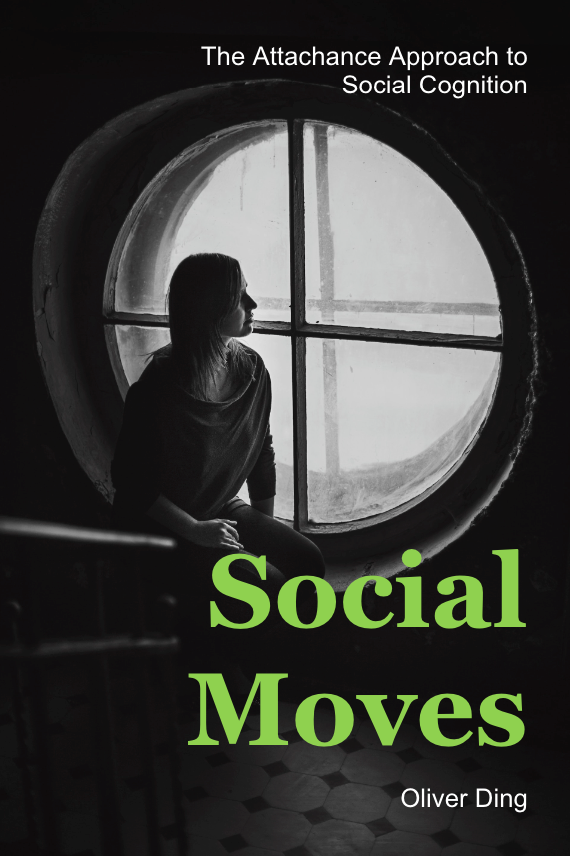
Today we will focus on the situation note I wrote on Dec 3, 2023.
Why did I write the note on that day?
What was the Situation behind the note?
What was the Context behind the note?
What was the Framework behind the note?
3. The Situation
In Nov 2023, we planned a trip to New Mexico from Dec 21 to Dec 28. I considered Dec 20, 2023, as the deadline for the Social Moves project.
The trip was wonderful. We visited Ski Santa Fe. See the pictures below. I also captured an insight about the Developmental Project Model and edited a new possible book about it on Dec 31, 2023.




However, I was struggling with the Social Moves project on Dec 1, 2023.
On Nov 30, 2023, I edited a book (draft) titled Grasping the Concept: The Territory of Concepts and Concept Dynamics (Introduction, Table of Contents)
Then, I moved to the Social Moves project.
At that time, I had conducted several case studies about the theme of “Social Moves”, but I didn’t have enough content to edit a new possible book.
It could be fine to close a project without editing a possible book. However, I didn’t give up.
On Dec 1, 2023, I made a diagram titled “Thematic Space Theory: An Ecological Approach to Social Cognition”. See the diagram below.
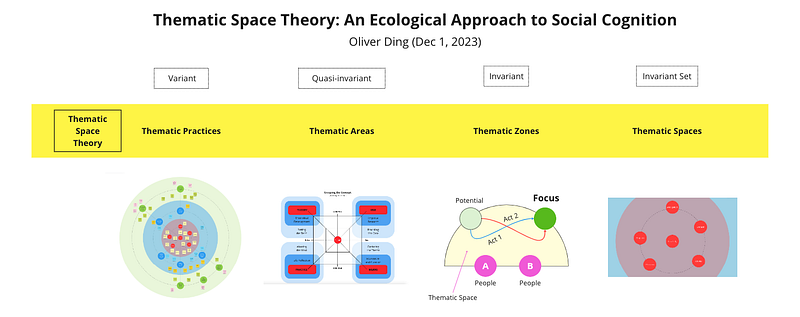
On Dec 2, 2023, I sent an email to Ping-keung Lui and introduced my ideas about “Thematic Space Theory” to him. I also mentioned the newest development of the Social Moves project. Lui is the founder of the Trojan Society for Theoretical Sociology. The Social Moves project adopted some ideas from his theoretical sociology.
On Dec 3, 2023, I wrote a personal note and curated several related ideas together.
Based on this personal note, I wrote a long article and developed the integrated ecological approach to social cognition on Dec 5, 2023.
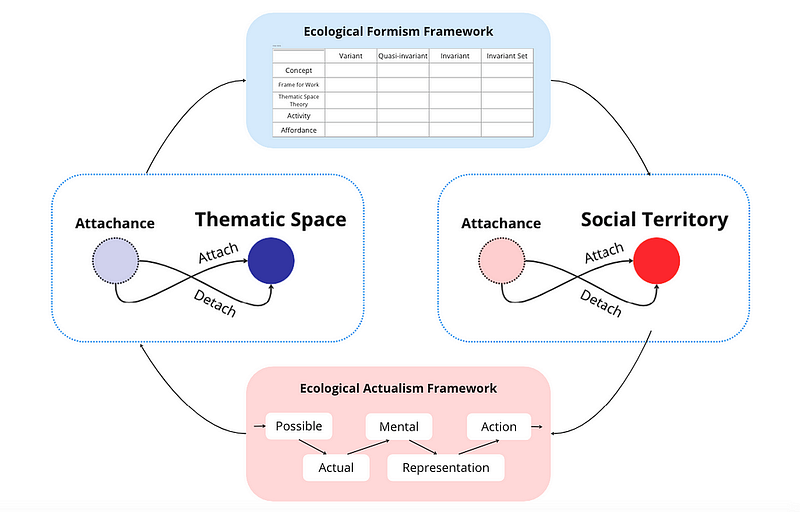
The outcome is amazing! I didn’t expect it!
It also led to a series of articles about the details of the new approach.
Finally, I edited a book Social Moves: The Attachance Approach to Social Cognition on Dec 19, 2023.
4. The Context
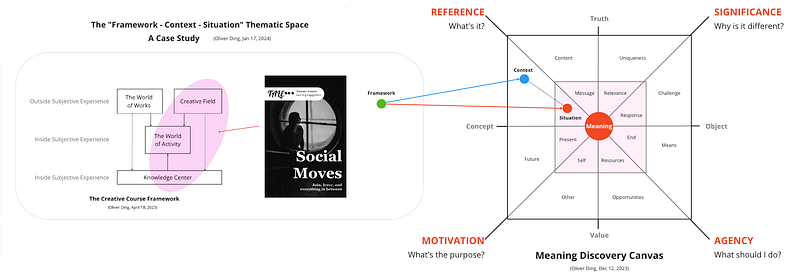
On Dec 2, 2023, I used the Creative Course Framework to make two diagrams for Meaning Discovery.
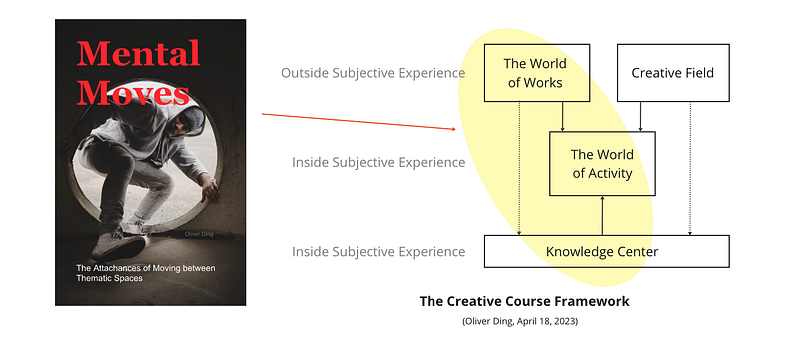
The Creative Course Framework was inspired by Ping-keung Lui’s Theoretical Sociology. It was developed on April 18, 2023.
From March 2023 to July 2023, I worked on the Mental Moves project. The outcome is a book (draft) titled Mental Moves: The Attachance Approach to Ecological Creative Cognition.
If we use the Creative Course Framework to frame the Mental Moves project, then it is about the connection between “World of Works” and “Knowledge Center”. It is all about cognitive thinking and creativity.
On August 24, 2023, I started the “Social Moves” knowledge project which uses “Social Territory” as the primary concept.
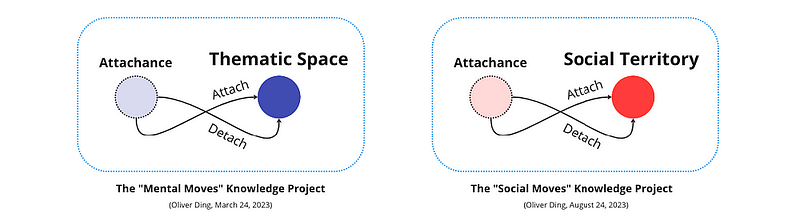
The term “Social Territory” was inspired by Ping-keung Lui’s term “Social Territory” and his Subjectivist Structuralism which is part of his theoretical sociology.
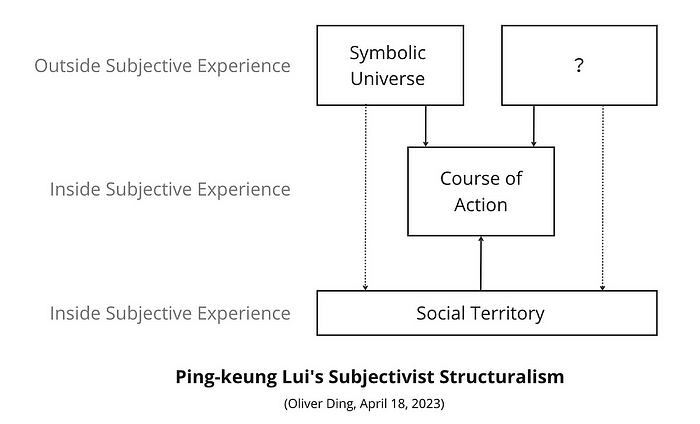
I have claimed that “Knowledge Center” is a type of Social Territory. You can find more details in Knowledge Engagement: The Creative Course Framework.
I generally use “Social Territory” in the “Social Moves” knowledge project.
If we put “Mental Moves” and “Social Moves” together, we see a new unit of analysis of Social Cognition. While “Social Moves” are about Social Actions, “Mental Moves” are about related Mental Activities.
Social Cognition = Social Moves (Mental Moves)
This is the basic unit of the Social Moves project.
Though the Social Moves project was designed to develop Attachance Theory, we could use the Creative Course framework to frame the project. See the diagram below.
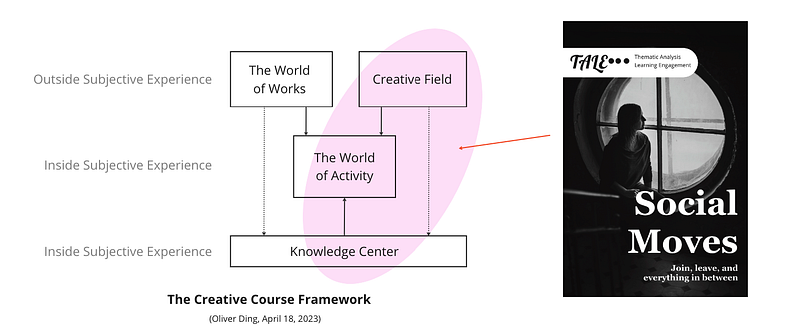
The Social Moves project is about the connection between “Knowledge Center” and “Creative Field”. It is all about social actions, not cognitive thinking.
As mentioned above, the concept of “Thematic Space” is related to the concept of “Attachance” and the concept of “Social Territory”.
For the Social Moves project, I needed to find a way to connect “Thematic Space” and “Social Territory”.
Moreover, the concept of “Thematic Space” is not only about creative cognition but also social cognition.
5. The Framework
In this case, I needed to figure out the relationship between the following three concepts:
- The concept of “Thematic Space”
- The concept of “Knowledge Center”
- The concept of “Social Territory”
These three concepts belong to different knowledge frameworks.
- “Thematic Space” is part of the Ecological Practice Approach
- “Knowledge Center” is part of the Creative Life Theory
- “Social Territory” is part of Lui’s Theoretical Sociology
For the Mental Moves project, I conducted several case studies. The concept of “Thematic Space” was associated with knowledge frameworks.
Some case studies of Mental Moves are about moving mental elements between two or more knowledge centers. I considered these case studies as examples of “Social Moves” too.
From August 2023 to Nov 2023, I also found some examples that are not related to the concept of “Knowledge Center”. Eventually, I realized that these examples are related to the concept of “Social Territory”.
My new ideas about “Thematic Space Theory” offer a solution to connect the concept of “Social Territory” and the concept of “Thematic Space”.
On Dec 20, 2023, I sent an email about the new possible book Social Moves (v1, 2023) to Lui. In the email, I made the following statement:
- Thematic Spaces are mental spatial projections of Social Territory.
The concept of “Social Territory” is a core concept of Lui’s Subjectivist Structuralism which is part of his theoretical sociology.
Lui’s Subjectivist Structuralism is very abstract because it is a general theory of sociology. It was developed to curate sociological theories, not to support empirical sociological research.
Inspired by Subjectivist Structuralism, my Creative Course Framework was developed to guide empirical research about knowledge creators’ life course and creative actions.
The Social Moves project is not only about knowledge creators but also about other types of actors. This is the reason that I need to find a way to connect the concept of “Thematic Space” and the concept of “Social Territory”.
I also used this experience to conduct a case study. See more details in Social Moves: Weaving the Mind and Clarifying the Order.
6. The Insight
What kind of insight can we learn from this case study?
I used the Creative Course Framework as a Framework for the “Context — Situation” mapping on Dec 2, 2023, and sent two related diagrams to Lui.
The Social Moves project was very complicated because it was related to several knowledge frameworks. Each framework has a network of concepts.
In this situation, I had to figure out the meaning of each concept for my project.
Related Articles
- Situational Note-taking: The idea of “Meaning Matrix” — Oct 17, 2023
- Situational Note-taking: The Thematic Matrix Canvas and Meaning Discovery Canvas — Oct 25, 2023
- Situational Note-taking: The idea of “Thematic Matrix +” — Nov 19, 2023
- [Creative Diagramming] Graphic Space Affordances, Thematic Space, and Possible Paths — Oct 31, 2023


