
Meaning Discovery: The “Journey — Challenge— Response” Thematic Space
A Case Study
This post is part of the “Meaning Discovery” series. You can find more related posts below:
- The Thematic Matrix Canvas and Meaning Discovery Canvas
- Meaning Discovery: The “Moment — Present — Future” Thematic Space
- Meaning Discovery: The “Object — Self — Other” Thematic Space
- Meaning Discovery: Two Thematic Triangles
- Oliver Ding: My Twelve Creative Moments of 2023
- Life Discovery: Significant Insights Analysis
- The Art of Situational Note-taking (Introduction and Index)
- The Curated Mind Toolkit (v1.0)
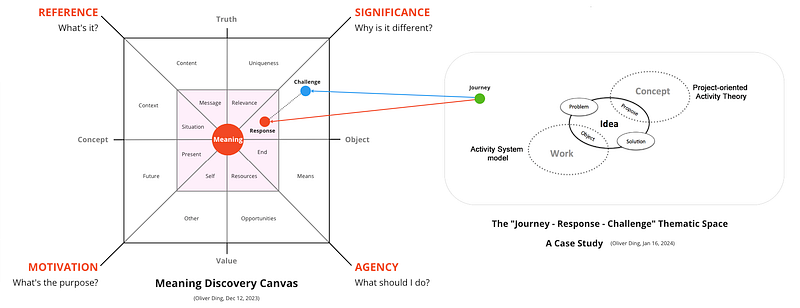
The above diagram is a case study of the Meaning Discovery Canvas which was made on Oct 25, 2023.
On Dec 12, 2023, I used “Value — Truth” to replace “Individual — Collective”. I also started collecting some materials for case studies.
On Dec 19, 2023, I made a case study about the “Moment — Present — Future” Thematic Space.
Today I will use a case study to introduce the “Journey— Challenge— Response” Thematic Space and the “Moment — Challenge — Response” Thematic Space.
1. Materials and Models
Materials are pieces of experiences from my real-life events for my case studies.
The Meaning Discovery Canvas is a knowledge framework or knowledge Model.
Each case study happens within a Thematic Space between Materials and the Model.
How to represent the Thematic Space?
I selected one theme from the Materials and two from the Model to make a thematic triangle to frame the thematic space. The diagram below is an example. You can find more details in Meaning Discovery: The “Moment — Present — Future” Thematic Space.
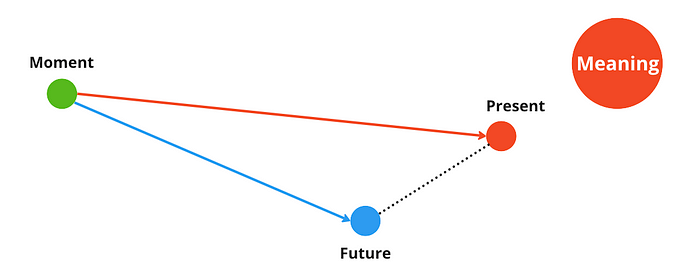
“Moment” refers to a short indefinite period. I used it to refer to the Immediate Situational aspect of Materials.
“Present” and “Future” are two blocks of the Meaning Discovery Canvas.
For some case studies, the immediate situational aspect is not the primary focus. For example, Life Meaning Discovery tends to engage with the long-term development of stories and themes. We could use “Story” to frame a new thematic space. See the example below.
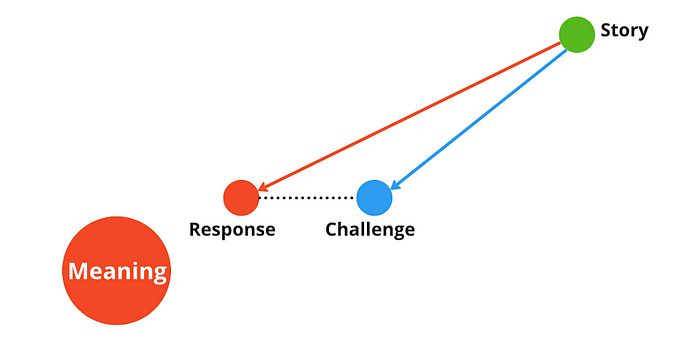
This article will use the “Challenge—Response” mapping as the basic object and discuss two thematic spaces:
- The “Journey — Challenge — Response” Thematic Space
- The “Moment — Challenge — Response” Thematic Space
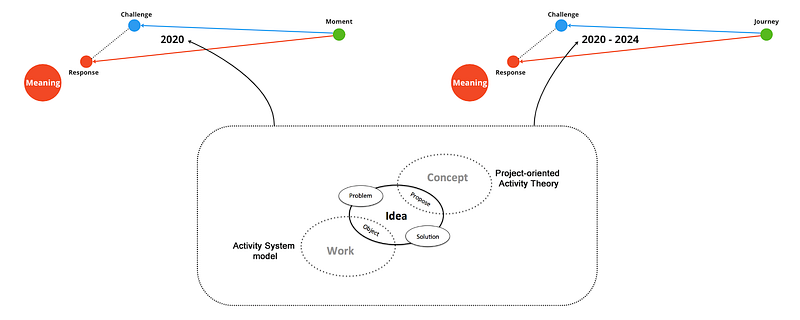
The difference between these two thematic spaces is the time. The “Moment” refers to one timestamp, while the “Journey” refers to two timestamps.
I will use the work of connecting the Activity System Model with Project-oriented Activity Theory as a case for the present discussion.
Why don’t I use “Story” and the “Story — Challenge — Response” Thematic Space in this case?
I used the following five units of analysis for the Creative Life Curation framework. “Journey” is one of the units of analysis.

The “Journey” unit of analysis refers to a multi-project creative journey. For example, the diagram below shows a four-project journey.
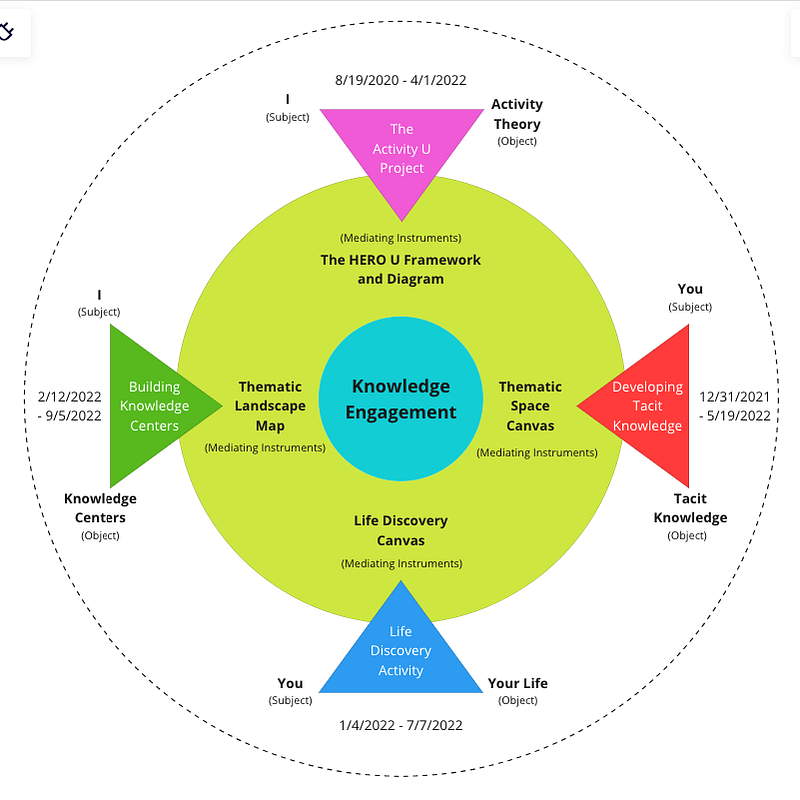
From 2020 to 2022, I worked on several projects about Activity Theory. I selected four and considered them as a journey.
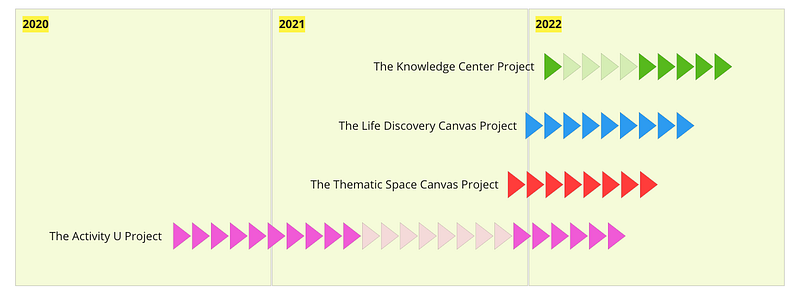
You can find more details in Slow Cognition: Mapping Thematic Journey (Engaging with Activity Theory, 2020–2022).
2. The “Moment — Challenge — Response” Thematic Space
The diagram below is the primary diagram of the Project Engagement Toolkit which is based on my 2021 book Project-oriented Activity Theory (draft).
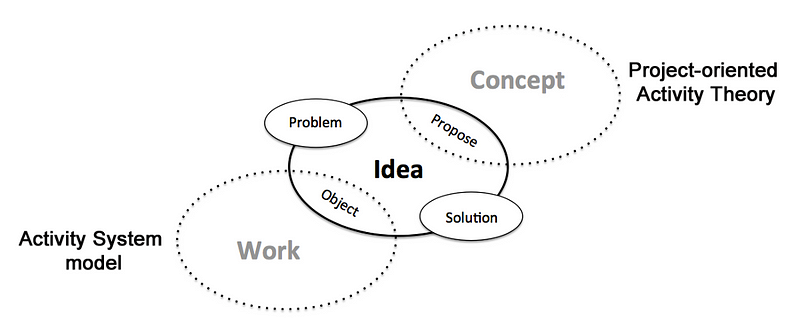
The Project Engagement Toolkit is a project-oriented toolkit for theory-based reflection and study. A significant aspect of the toolkit is it connects the following two theoretical approaches of Activity Theory and offers a series of tools for practitioners in the age of projectification.
- The Activity System Model (Yrjö Engeström, 1987)
- Activity as Formation of Concept (Andy Blunden, 2010, 2012, 2014)
While Engeström’s model is perfect for dealing with traditional work projects, Blunden’s approach considers collaborative projects as the foundation of social movements and cultural innovation.
By curating the above two approaches together, the toolkit offers a cross-boundary solution for achieving a balance between individual impact and collective impact. In this way, the toolkit could lead us to an innovative way of connecting personal life themes and cultural themes to build a sustainable society together.
On August 19, 2020, I started a knowledge curation project: the Activity U project.
Initially, I just made a diagram called “Activity U” which is a test of the “HERO U” framework. I wrote a post to explain the diagram “Activity U”. The original title of the post is Activity U: The Landscape of Activity Theory. Later, I added “(Part I)” to the end of the title. It was expanded from one post to a series of articles.
During the writing process, I found a book review on Clay Spinuzzi’s blog. Since then, I started to read Andy Blunden’s books and papers and created a branch of the Activity U project to introduce Blunden’s Project-oriented theoretical approach.
Eventually, I finished a book (draft) titled Project-oriented Activity Theory.
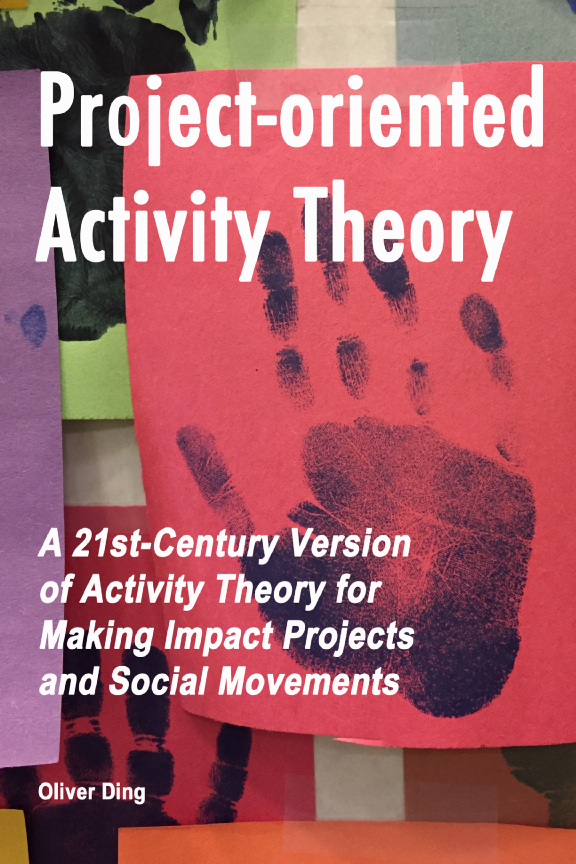
Andy Blunden didn’t use “Project-oriented Activity Theory” as an official name for his approach. Originally, I used this term to refer to Blunden’s approach. Later I realized the name became an issue because my articles presented my interpretation of Blunden’s approach.
Blunden’s original approach didn’t adopt the Activity System model. I claimed that it is possible to keep Blunden’s approach and the Activity System model within a theoretical framework by distinguishing between Idea and Concept. In this manner, we can grow Activity Theory without discarding the Activity System model since it is an established branch of Activity Theory.
If we only consider the story in 2020, then we can consider the “Moment — Challenge — Response” Thematic Space.
3. The “Journey — Challenge — Response” Thematic Space
In Sept 2023, I read a book titled Theoretical Research Programs: Studies in the Growth of Theory. The authors discuss various ways of growing a theory in the field of sociology. I found several case studies of “Theoretical Integration” in some chapters.
I also found a similarity between “Theoretical Integration” and my term “Knowledge Curation”. To test it, I did an exercise and wrote a long article:
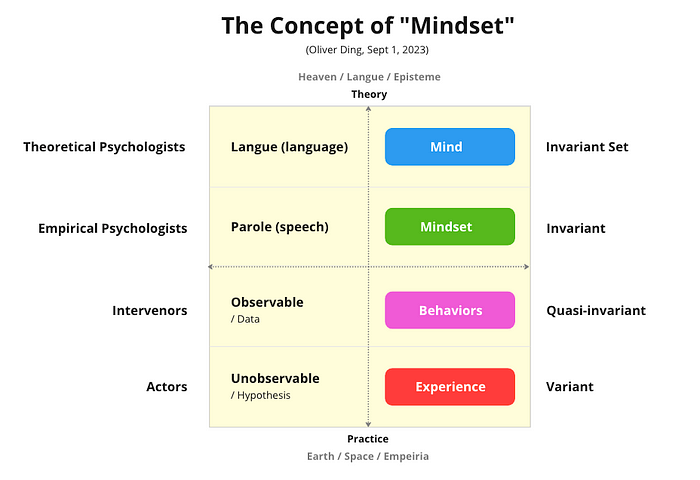
The article focuses on Theoretical Psychologists and makes a demo of theoretical integration by curating Carol S. Dweck’s version of Mindset theory and Peter Gollwitzer’s version of Mindset theory together.
The by-product of the project is the Mental Tuning Framework. See the diagram below. Later, I used the framework to curate more psychological theoretical approaches.
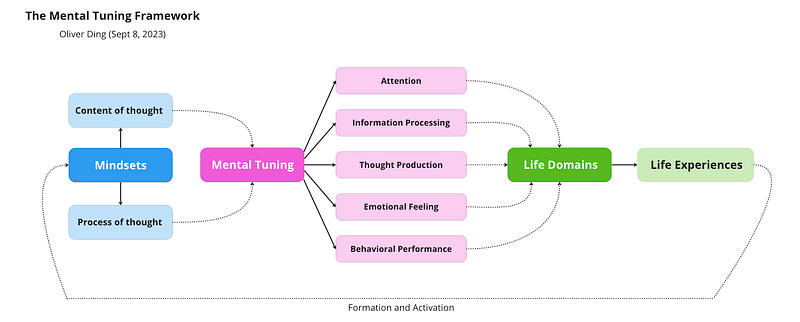
The experience was amazing!
In the early of Oct 2023, I realized that I did the same thing in 2020.
In 2020, I didn’t know that I was doing a “Theoretical Integration” project.
If someone asked me to do a “Theoretical Integration” project at that time, I wouldn’t accept the challenge because I should believe I couldn’t do it.
In Oct 2023, I was not a Theoretical Psychologist.
I just did an exercise of playing with some techniques of theoretical integration.
I learned these techniques from theoretical sociologists and applied them to a project about curating psychological theories.
Why did I do it?
On April 23, 2023, I made the attached diagram and used it to frame a creative space for “Creative Life Theory”.
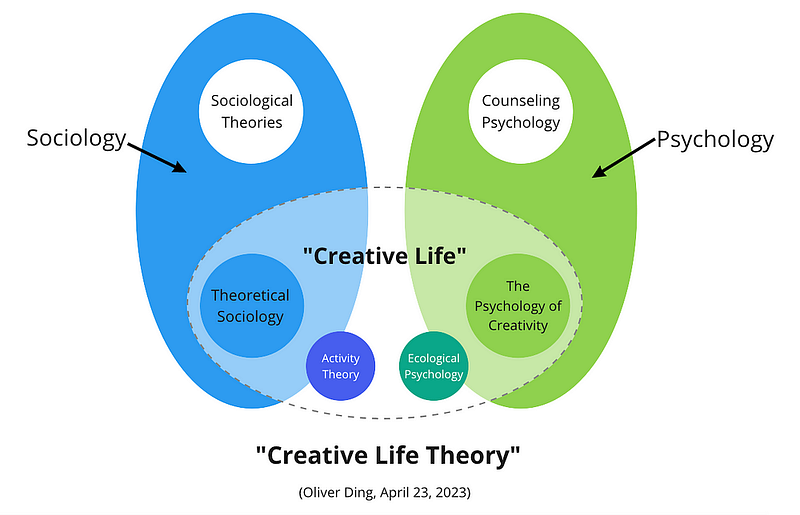
In the past years, I worked on projects about the following four things:
1. The Psychology of Creativity 2. Ecological Psychology 3. Activity Theory 4. Theoretical Sociology
I consider the “Creative Life” thematic space as a creative space for connecting Sociology and Psychology.
I’d like to claim the uniqueness of “Creative Life” approach is its view on “Life” which refers to both individual life and social life. In other words, there is no boundary between sociology and psychology in the creative space of “Creative Life”.
You can find more details in Advanced Life Strategy: The Microdynamics of Creative Identity.
On Oct 20, 2023, I wrote a short post to record this insight on Linkedin.
Today I’d like to find more projects to form a Creative Journey of “Theoretical Integration”.
- 2020: The “Project Engagement” project
- 2022: The “Creative Life Curation” project
- 2023: The “Mindset” project
- 2023: The “Social Moves” project
The “Creative Life Curation” project used a meta-framework to curate several theoretical frameworks about creative life development into a Semiotic System Diagram. You can find more details in Three Paths of Creative Life and A Semiotic System.
The “Social Moves” project developed an integrated ecological approach to social cognition. It was formed by two sub-frameworks: the Ecological Formism framework and the Ecological Actualism framework. You can find more details in Social Moves (book, v1, 2023).
4. The Insight
What kind of insight can we learn from this case study?
We could perceive different meanings of a life event at different times.
The new meaning could connect other life events in a new way.
Related Articles
- Situational Note-taking: The idea of “Meaning Matrix” — Oct 17, 2023
- Situational Note-taking: The Thematic Matrix Canvas and Meaning Discovery Canvas — Oct 25, 2023
- Situational Note-taking: The idea of “Thematic Matrix +” — Nov 19, 2023
- [Creative Diagramming] Graphic Space Affordances, Thematic Space, and Possible Paths — Oct 31, 2023


