
Meaning Discovery: The “Object — Self — Other” Thematic Space
A Case Study
This post is part of the “Meaning Discovery” series. You can find more related posts below:
- The Thematic Matrix Canvas and Meaning Discovery Canvas
- Meaning Discovery: The “Moment — Present — Future” Thematic Space
- Oliver Ding: My Twelve Creative Moments of 2023
- Life Discovery: Significant Insights Analysis
- The Art of Situational Note-taking (Introduction and Index)
- The Curated Mind Toolkit (v1.0)
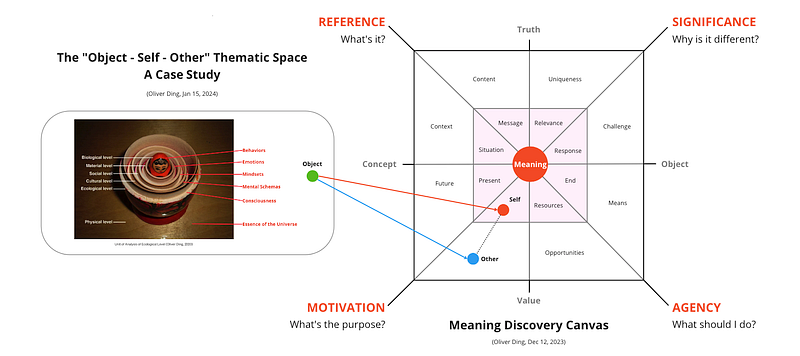
The above diagram is a case study of the Meaning Discovery Canvas which was made on Oct 25, 2023.
On Dec 12, 2023, I used “Value — Truth” to replace “Individual — Collective”. I also started collecting some materials for case studies.
On Dec 19, 2023, I made a case study about the “Moment — Present — Future” Thematic Space.
Today I will use a case study to introduce the “Object — Self — Other” Thematic Space.
1. Materials and Models
For my case studies, Materials are pieces of experiences found from my real-life events.
The Meaning Discovery Canvas is a knowledge framework or knowledge Model.
Each case study happens within a Thematic Space between Materials and the Model.
How to represent the Thematic Space?
I selected one theme from the Materials and two themes from the Model to make a thematic triangle to frame the thematic space. The diagram below is an example.
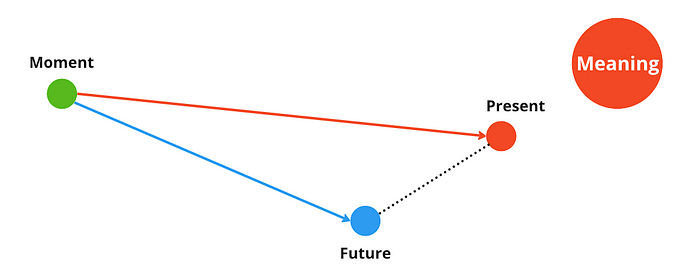
“Moment” refers to a short indefinite period. I used it to refer to the Immediate Situational aspect of Materials.
“Present” and “Future” are two blocks of the Meaning Discovery Canvas.
For some case studies, the immediate situational aspect is not the primary focus. For example, Life Meaning Discovery tends to engage with the long-term development of stories and themes. We could use “Story” to frame a new thematic space. See the example below.
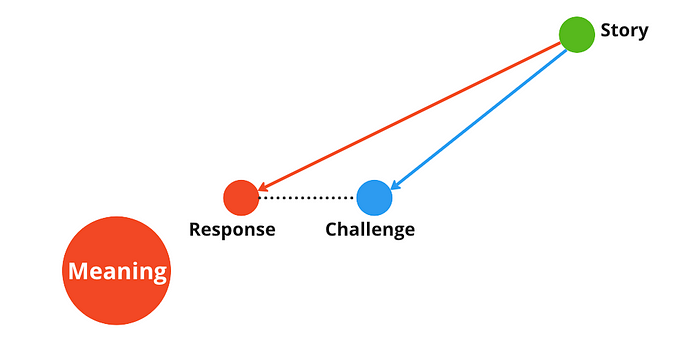
This article will use “Object” as an example.
2. A Thematic Triangle
Today I will focus on the “Object — Self — Other” Thematic Space.
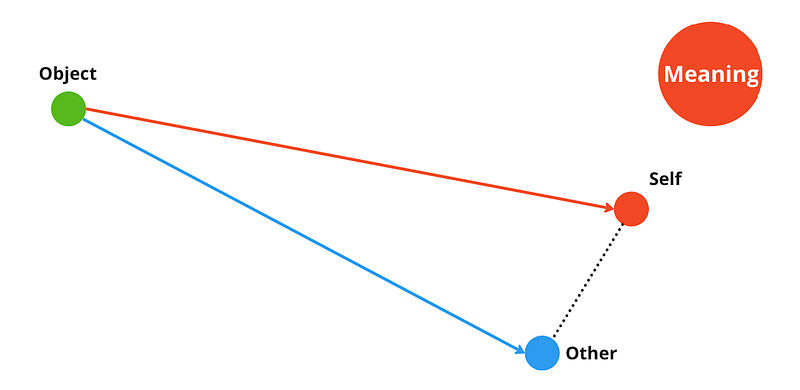
The “Self” block and the “Other” block are located in the MOTIVATION Area.
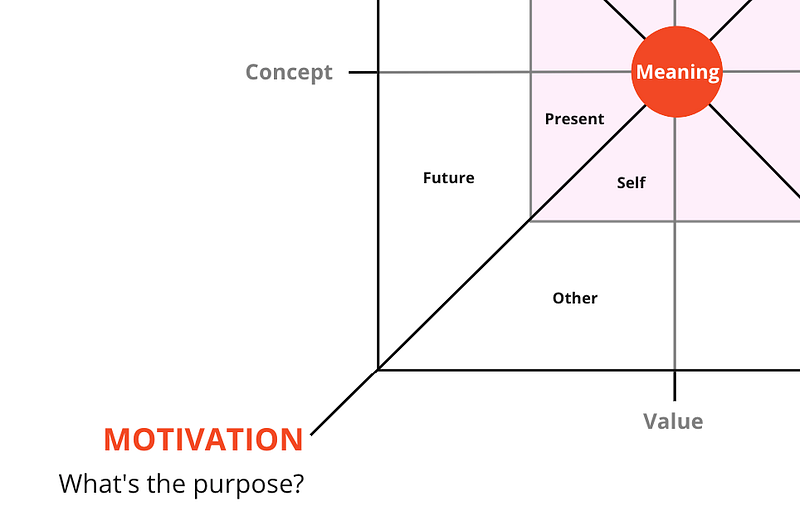
I will use an example to discuss the change of motivation in the “Object — Self — Other” Thematic Space.
An Object can be used for a Motivational Action for Others.
The same Object can be used for a Motivational Action for Self.
In this case, we will see the change between “For Others” and “For Self” in an action chain.
3. An Object
On Dec 12, 2023, I made the diagram below and sent it to a friend of mine.
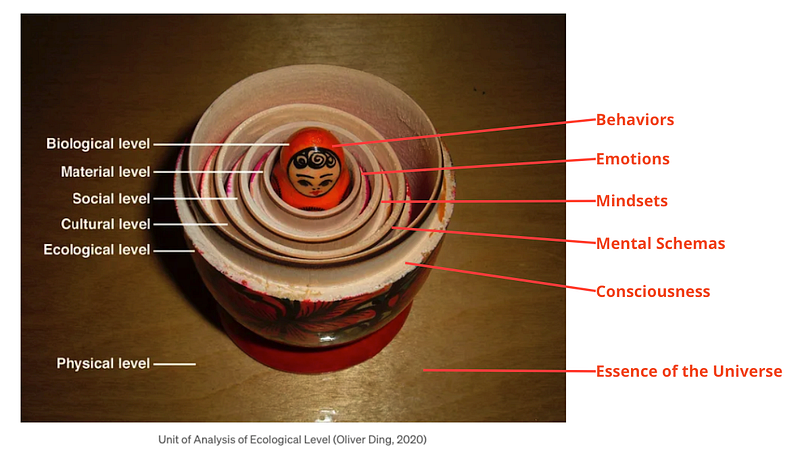
What does it mean?
From Sept 2023 to Dec 2023, I worked on building a Joint Knowledge Center called “Mental Engagement Center”. The above diagram was designed to represent a general theory called “Intelligent Life” which is about Mindsets, Emotions, and Wellbeing.
My friend developed the theory and used nested circles to represent it. I used the above diagram for our email discussion.
7. Two Worldviews
For the nested diagram “Potential — Life — Consciousness and the Inner Workings of the Human Mind”, I think your diagram is fine.
It represents a specific worldview as the foundation of your theory about mindsets, emotions, and well-being.
In 2020, I did a similar thing.
In order to find a creative space for the Ecological Practice Approach which was inspired by James G. Gibson’s Ecological Psychology, I used Matryoshka dolls to make a diagram.
Mapping Thematic Space #7: The Center of the “Ecological Interaction” Thematic Space Introduce the concept of Ecological Complexity
At that time, I wanted to figure out the future direction of the Ecological Practice Approach. I used the concept of “Ecological Complexity” to define it.
However, I didn’t work on the direction. I moved to work on the Knowledge Curation project.
I just now added your general theory to the right side of the diagram.
What does my original diagram look like? See below.
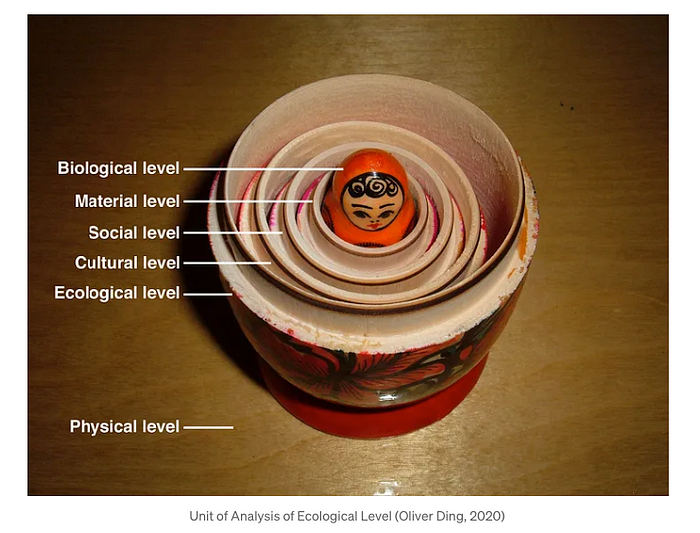
I didn’t find the original picture, so I just added my friend’s general theory to my diagram.
The by-product is a comparison between my theoretical worldview and my friend’s theoretical worldview.
My original motivation for using the picture was to represent my friend’s view by using Matryoshka Dolls.
Later, my mental focus moved to the original picture. On Dec 16, 2023, I used the picture to write a case study about using buzzwords. You can find more details in The Art of Situational Note-taking: Be Careful of Using Buzzwords.
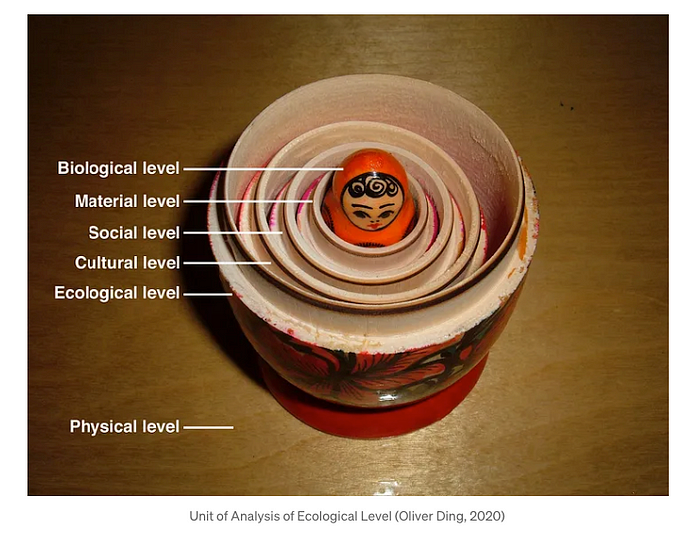
The above picture is the Unit of Analysis of Ecological Interaction which is a method I developed in July 2020. The ecology view focuses on the “organism — environment” relationship. It suggests every living organism has its specific surrounding medium of environment called niche. An organism is also part of other organisms’ environment. Following this general view, I consider “ecological interaction” as “people interacting with their surrounding context” and see “social interaction” as a subset of “ecological interaction” because we can consider other people as social context.
I also found its original picture on Wikipedia.
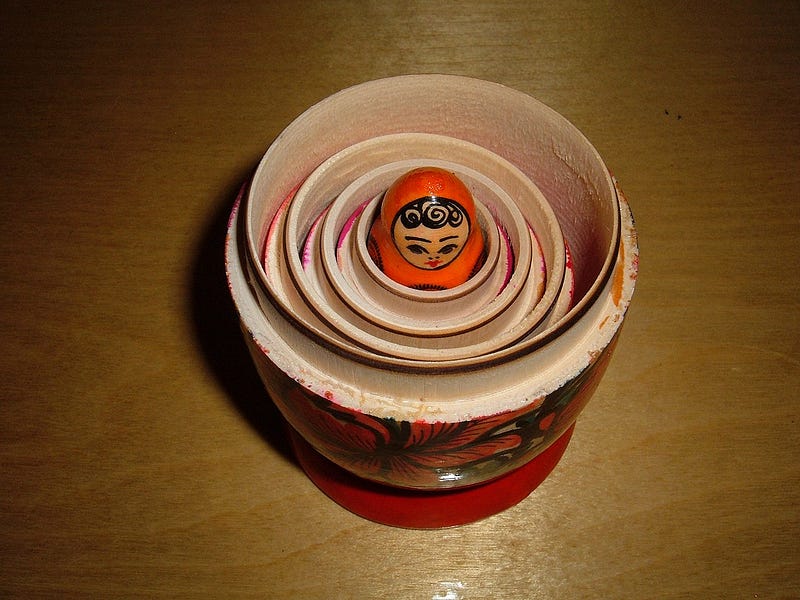
On Dec 18, 2023, I used it to represent the idea of “Container Thinking” for explaining the Ecological Formism Framework. See the diagram below.
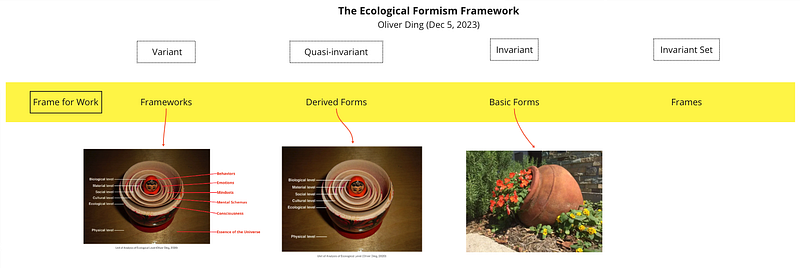
The above diagram uses “Container Thinking” as an example to showcase the differences between “Basic Forms”, “Derived Forms”, and “Frameworks”.
- Basic Forms are abstract foundational forms of life world. For example, “Container” is a Basic Form of human life and social practices.
- Derived Forms are based on Basic Forms. For example, a Nested Structure is based on the above basic form “Container(Containee)”.
- Frameworks, or Knowledge Frameworks, are used by actors in their real-life world. The Ecological Formism framework considers Frameworks as Variants because Frameworks are made, selected, and modified by normal people for various purposes.
- For example, one Derived Form such as “Nested Structure” could lead to many Frameworks.
You can find more details in Frame for Work: The Hermeneutics of Knowledge Frameworks and Ecological Formism.
On Dec 19, 2023, I also used it to design a draft of a cover image for a possible book titled Social Moves: The Ecological Approach to Social Cognition.
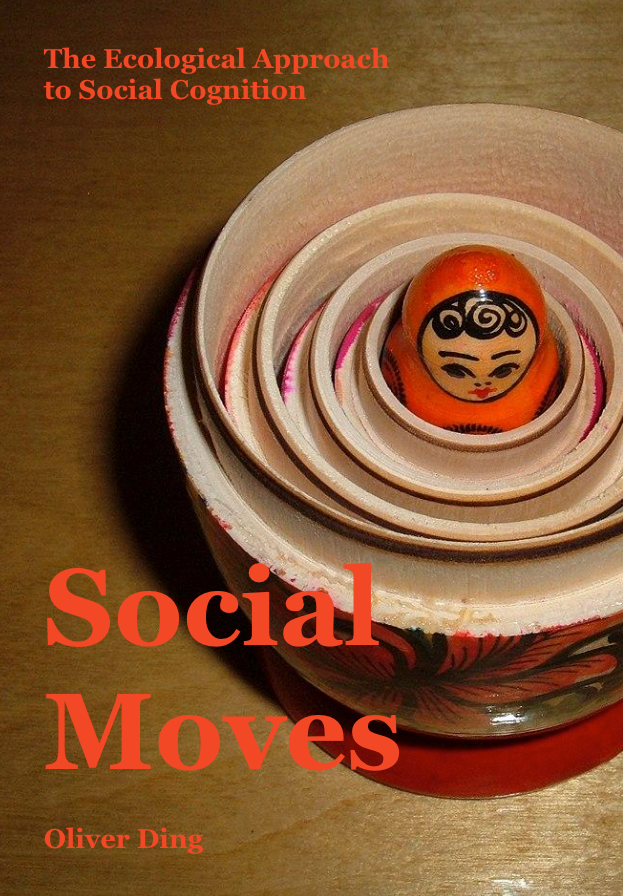
I didn’t use it as the final one.
4. Change of Motivation
In the above case, we see three actions:
- Dec 12, 2023: Use the picture as a new diagram to represent my friend’s general theory
- Dec 16, 2023: Use the picture for writing an article about buzzwords
- Dec 18, 2023: Use the picture to explain a knowledge framework
- Dec 19, 2023: Use the picture to design a cover image for a possible book
There is a motivation change within the “Object — Self — Other” thematic space.
- Dec 12, 2023: my motivational action is about “For Other”
- Dec 16, 2023: my motivational action is about “For Self”
- Dec 18, 2023: my motivational action is about “For Self”
- Dec 19, 2023: my motivational action is about “For Self”
5. The Insight
What kind of insight can we learn from this case study?
Our motivational actions of using a particular object are related to both our situations and the aspect of the object.
The Self — Other interactions always bring some objects into the “Object — Self — Other” thematic space. An object could move from Past to Present.
Related Articles
- Situational Note-taking: The idea of “Meaning Matrix” — Oct 17, 2023
- Situational Note-taking: The Thematic Matrix Canvas and Meaning Discovery Canvas — Oct 25, 2023
- Situational Note-taking: The idea of “Thematic Matrix +” — Nov 19, 2023
- [Creative Diagramming] Graphic Space Affordances, Thematic Space, and Possible Paths — Oct 31, 2023


