
Meaning Discovery: The “Perspective — Opportunities— Resources” Thematic Space
A Case Study
This post is part of the “Meaning Discovery” series. You can find more related posts below:
- The Thematic Matrix Canvas and Meaning Discovery Canvas
- Meaning Discovery: The “Moment — Present — Future” Thematic Space
- Meaning Discovery: The “Object — Self — Other” Thematic Space
- Meaning Discovery: Two Thematic Triangles
- Meaning Discovery: The “Journey — Challenge — Response” Thematic Space
- Oliver Ding: My Twelve Creative Moments of 2023
- Life Discovery: Significant Insights Analysis
- The Art of Situational Note-taking (Introduction and Index)
- The Curated Mind Toolkit (v1.0)
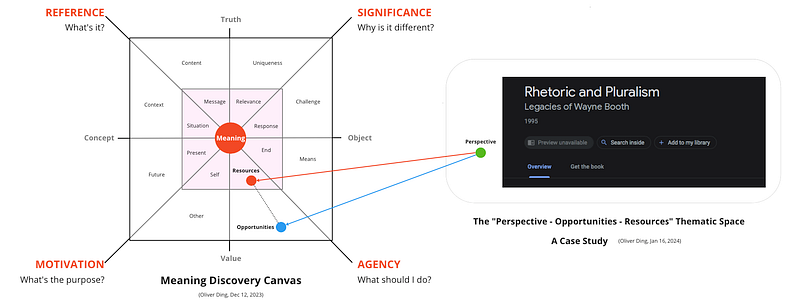
The above diagram is a case study of the Meaning Discovery Canvas which was made on Oct 25, 2023.
On Dec 12, 2023, I used “Value — Truth” to replace “Individual — Collective”. I also started collecting some materials for case studies.
This post aims to introduce the “Perspective — Opportunites — Resources” Thematic Space and a related heuristic tool: The Opportunity Formula.
1. Materials and Models
Materials are pieces of experiences from my real-life events for my case studies.
The Meaning Discovery Canvas is a knowledge framework or knowledge Model.
Each case study happens within a Thematic Space between Materials and the Model.
How to represent the Thematic Space?
I selected one theme from the Materials and two from the Model to make a thematic triangle to frame the thematic space. The diagram below is an example. You can find more details in Meaning Discovery: The “Moment — Present — Future” Thematic Space.
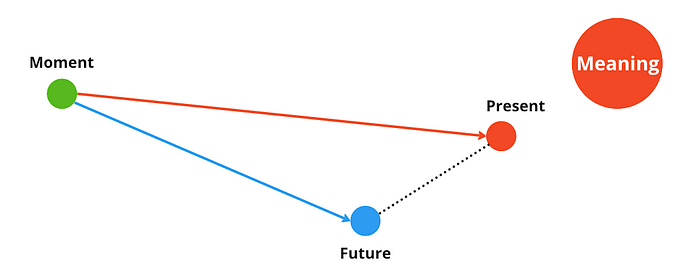
“Moment” refers to a short indefinite period. I used it to refer to the Immediate Situational aspect of Materials.
“Present” and “Future” are two blocks of the Meaning Discovery Canvas.
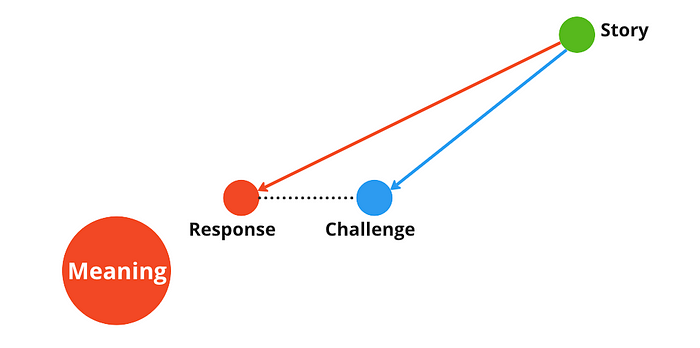
For some case studies, the immediate situational aspect is not the primary focus. For example, Life Meaning Discovery tends to engage with the long-term development of stories and themes. We could use “Story” to frame a new thematic space. See the example below.
This article focuses on the “Perspective — Opportunities — Resources” Thematic Space.
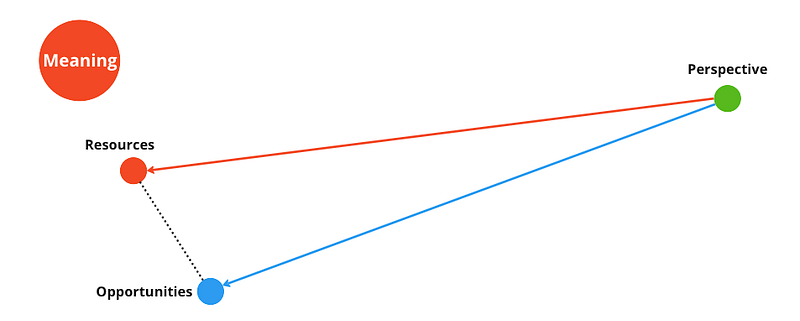
The “Opportunities — Resources” Mapping is located in the AGENCY Area.
2. The Perspective: The Creative Course Framework
On July 30, 2023, I wrote a private note about a book. See the screenshot below.
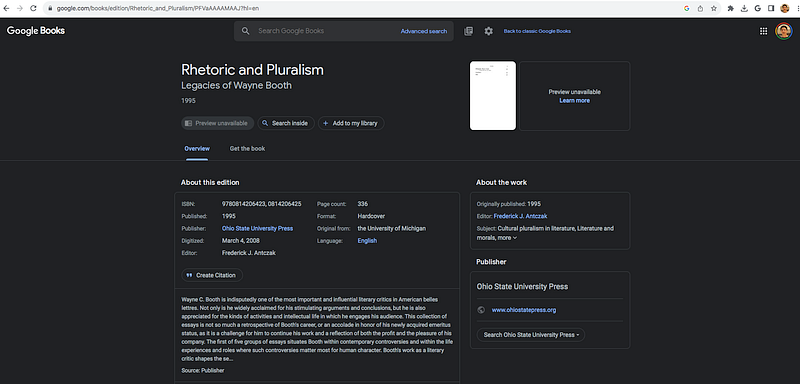
I just accidentally discovered Rhetoric and Pluralism: Legacies of Wayne Booth (1995).
Though I was not familiar with Wayne Booth and the field of literary criticism, I immediately recognized the book’s value for my project.
In April 2023, I developed the Creative Life Theory (v2.0) with several frameworks. The core of the approach is the Creative Course Framework. See the diagram below.
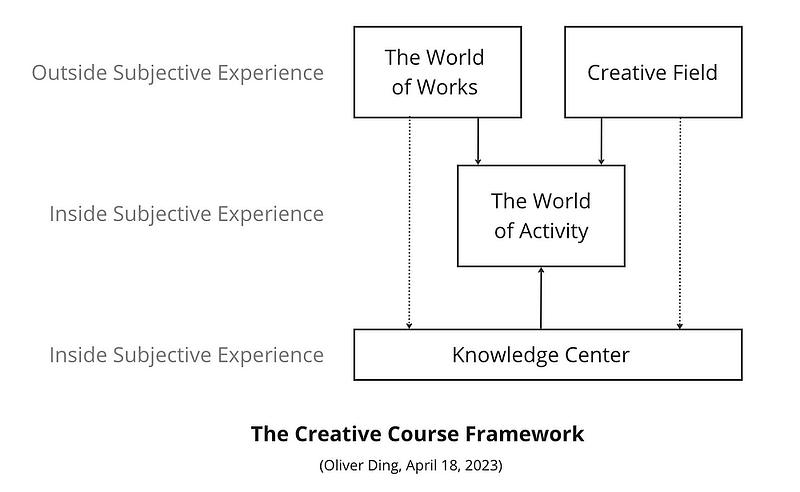
I use the term “World of Activity” to refer to the course of action of creators. The term was inspired by social phenomenologist Alfred Schutz’s term “The World of Working”. You can find more details in Lifescope: The World of Activity for Creative Life Curation.
I use the term “World of Works” to describe knowledge creations such as theories, concepts, frameworks, books, papers, etc.
I started working on the concept of “Knowledge Center” one year ago. Each knowledge center refers to a unique knowledge enterprise.
A knowledge center is a collective project that aims to develop certain unique knowledge. A “center” should have its uniqueness to establish its identity and theme. Otherwise, there is no need to build a “center”.
The term “Creative Field” was inspired by 1) French social theorist Pierre Bourdieu’s Field theory, and 2) Creativity research scholar Mihaly Csikszentmihalyi’s Social Systems Model of creativity.
The Creative Course Framework was born on April 18, 2023. Since then, I started collecting Materials for case studies.
On July 30, 2023, I perceived the Value of Rhetoric and Pluralism: Legacies of Wayne Booth (1995) for my projects from the Perspective of the Creative Course framework.
Wayne C. Booth is indisputedly one of the most important and influential literary critics in American belles lettres. Not only is he widely acclaimed for his stimulating arguments and conclusions, but he is also appreciated for the kinds of activities and intellectual life in which he engages his audience. This collection of essays is not so much a retrospective of Booth’s career, or an accolade in honor of his newly acquired emeritus status, as it is a challenge for him to continue his work and a reflection of both the profit and the pleasure of his company. The first of five groups of essays situates Booth within contemporary controversies and within the life experiences and roles where such controversies matter most for human character. Booth’s work as a literary critic shapes the second section, which focuses on what the authors see as Booth’s key ethical questions about literature and literary criticism. The third section of essays is concerned with the implications of Booth’s writing, particularly in its connection with politics. Booth’s influence in fields other than literary studies provides the theme for the fourth section. The final section explores the problematic but promising relation among assent, ethics, and pluralism. In the afterword, Booth himself reflects on these essays, demonstrating firsthand the critical and ethical qualities he brings to his arguments.
I realized that the book offers me an Opportunity to conduct a case study about the relationship between “World of Works” and “Knowledge Center”.
Moreover, I also realized that the format behind the book inspired me to pay attention to similar books. This insight could help me discover more Resources for running case studies of Creative Life Theory (V2.0).
3. A Related Heuristic tool: The Opportunity Formula
I have introduced a three-layer structure to understand Thematic Spaces for the Creative Life Curation project. See the details in Creative Life Curation: Discover Thematic Spaces of Creative Life
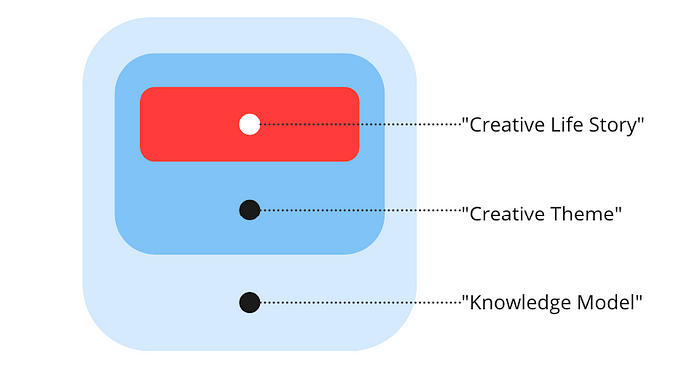
- Creative Life Story refers to an interesting real-life story from a person’s creative life.
- Creative Theme refers to a theme behind a creative life story. Each story is associated with a theme that defines a thematic space.
- Knowledge Model refers to a knowledge framework for understanding the thematic space.
In the above case, discovering the book is a “Creative Life Story”, the “Perspective — Opportunities — Resources” is a “Creative Theme”.
What’s the “Knowledge Model”?
I’d like to recommend a related heuristic tool: The Opportunity Formula.
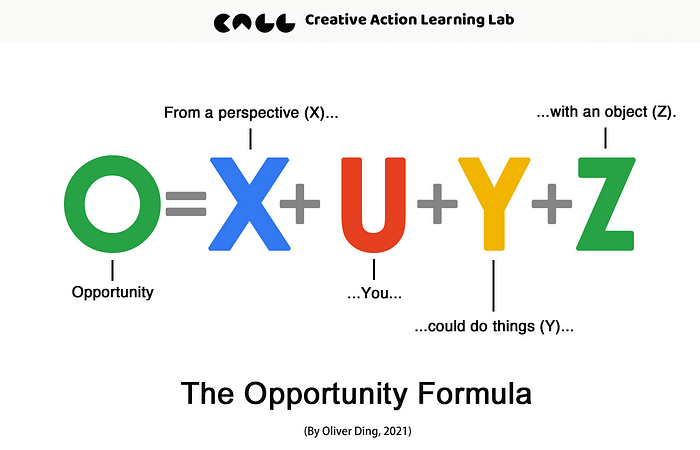
On Oct 5, 2021, I adopted the concept of Opportunity as mediation and redefined it as the formula below:
Opportunity = From a perspective (X), You (U) could do things (Y) with an object (Z).
You can find more details in D as Diagramming: The Opportunity Formula.
4. The Insight
What kind of insight can we learn from this case study?
The Thematic Triangle is a new layer of the Meaning Discovery Canvas.
It also connects to Materials and other knowledge Models.
In this way, we see a large space of Meaning Discovery + which is similar to Developmental Project Model +.
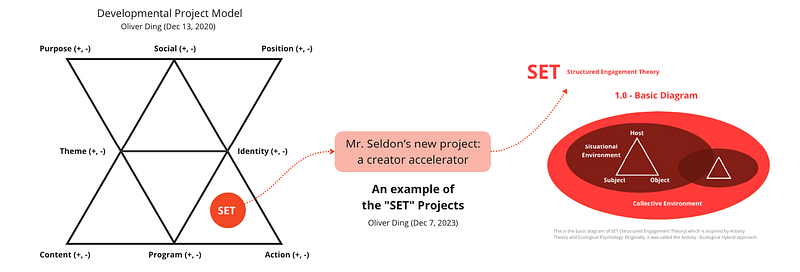
I also used the “Diagram Blending” technique to connect the Developmental Project Model and other knowledge frameworks. For example, the above diagram shows a connection between it and the “SET” (Structured Engagement Theory) framework. More details are in The “Identity — Program — Action” Thematic Space and the “SET” Projects.
We can apply the same idea to develop Meaning Discovery +.
Related Articles
- Situational Note-taking: The idea of “Meaning Matrix” — Oct 17, 2023
- Situational Note-taking: The Thematic Matrix Canvas and Meaning Discovery Canvas — Oct 25, 2023
- Situational Note-taking: The idea of “Thematic Matrix +” — Nov 19, 2023
- [Creative Diagramming] Graphic Space Affordances, Thematic Space, and Possible Paths — Oct 31, 2023


