
If Inclusive Education Month Granted Wishes
As an advocate for children, these would be my three wishes

February is inclusive education month
It’s just around the corner.
Anyone happen to see a blue genie with a big singing voice around lately?
If inclusive education month were like a genie in a lamp that could grant me three inclusion-related wishes, these would be the top three things I would change about our public education system.
Curriculum goals would align with child development
Our current public education system puts way too much emphasis on getting students to do things earlier and earlier: read earlier, start formal schooling earlier, take standardized tests earlier.
We can’t force a child’s brain to develop more quickly. Brains are incredibly complex, which is why it takes an average of 25–30 years for our brains to fully mature. Trying to “educate” a child into having an 8-year-old’s brain at age 6 is pretty ridiculous, but it’s what we’re doing right now in a lot of schools.
There is significant variation in how those brains develop. Although most will meet the same benchmarks within a certain window, what happens in between those times can vary wildly from one child to the next.
One child may start to read independently as early as 5 years old, whereas another may be 8 before they are a confident reader. Another student might be a math wiz, easily adding and subtracting in their head at the age of 7, while another struggles with mental math throughout elementary school.
By the time these students reach middle school, they’ll have mostly evened out. Of course every child will have their strengths and weaknesses, but overall, those differences become less apparent as they get older.
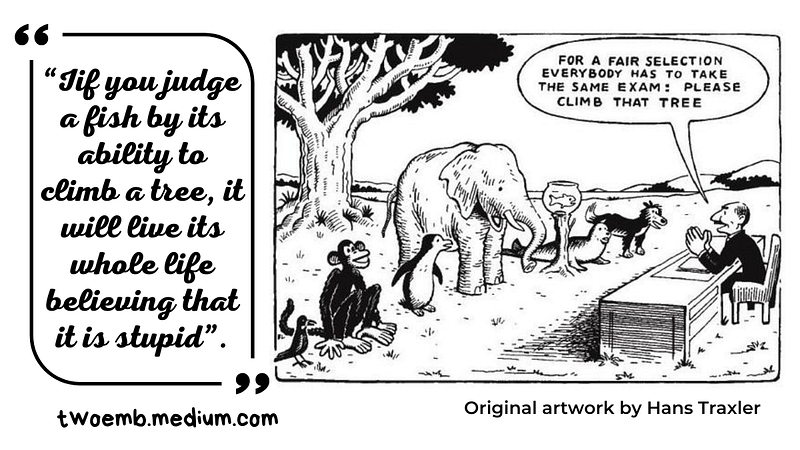
The problem is, public education has become so standardized, we expect all children to learn and grow at a very similar pace. Not only is this unrealistic and unfair, it’s potentially harmful.
Why this is so damaging
The most concerning parts about trying to hurry childhood along are twofold. One, childhood is supposed to be fun. The more we pressure children to mature, piling on unrealistic expectations before they’re ready, the more joy we extract from their childhoods.
Secondly, children internalize everything. It’s part of how children make sense of their world, and it’s a normal part of their development which stems from egocentricity.
When an adult has an unreasonable expectation of a child which the child can’t meet, a child does not have the neurological or social maturity to think, “perhaps they are not being fair, maybe they are expecting too much of me.”
Instead, they think things like, “I’m stupid, why can’t I get this right?” or “I’ll never figure this out, it’s too hard!”
Sometimes these are signs of the child needing additional supports, but sometimes this is just a sign they’re not quite ready. Given a year or two, they’ll have caught up with their peers. Those are two very different scenarios, but we treat them the same.
Learning happens through doing
My second wish would be for adults, especially those responsible for curriculum planning and education policy, would remember this.
“Play is how a child learns about risk, problem-solving, consequences, and getting along with others.” —Bruce McLachlan
When I wrote the article I don’t care what my son learns in elementary school, I got a few comments suggesting this made me a negligent parent (I think those sentiments came from people who didn’t actually read what I wrote, however).
I’ll summarize my main point. I do care about my son’s development. I care about his future, and I want him to learn important skills. I care more about his sense of self and his happiness.
If kids go to school and their experiences are absolutely dreadful — whether due to mistreatment, bullying, unmet needs, and a myriad other reasons — then what are they actually learning?
Do you know what my son learned at school in grades one and two? That he was a “bad kid who does bad things”. That’s what he thought of himself at age six, thanks to our public education system, and a school with a particularly toxic culture (he no longer attends that school).
If students are forced to go to school when it doesn’t feel like a safe or welcoming place, they sure as hell aren’t going to learn what we want them to. We can’t learn under stress, and the traumatic experiences will do more harm than good.
We need to remember children are learning all the time. Every interaction and experience they have creates new pathways in their brains, and teaches them something new about the world.
Children learn a lot more when they’re being active and having fun than they do when being forced to complete boring worksheets, or projects they had no choice about.

My final wish
If I only had one wish it would be to revamp the entire education degree, changing how teachers are educated and trained. In particular, I would remove all forms of behaviourism from their curriculum.
PBIS, rewards charts, classroom management programs, behaviour contracts, all of these things should have gone the way of the dodo — they should have been tossed out with the trash decades ago, like, 70 years ago when B.F. Skinner (the “father” of behaviourism) recognized its flaws.
It’s unsurprising, then, that I’ve written extensively on this very topic. I am very passionate about modernizing how we interpret and address behaviour, especially in schools.
These are my wishes for national inclusive education month. I’ve been working for years towards these types of changes, and will continue doing so. It would be so great if our government could get on board and listen to the experts.
I won’t hold my breath though. Being dead would make me a lousy advocate.
If you had three wishes for Inclusive Education Month, what would they be?
© Jillian Enright, Neurodiversity MB
Related Articles
When you join medium, as a member you’ll have access to unlimited reads for only $5 per month. If you use my referral link, I’ll earn a small commission, and you’ll earn my undying gratitude.
If you’d prefer give a one-time tip, you can support my writing on Ko-Fi — also, it’s free to follow me on Facebook!

References
Fisher, N. (2021). Changing Our Minds: How children can take control of their own learning. Robinson.
Kohn, A. (2000). The Case Against Standardized Testing: Raising the scores, ruining the schools. Heinemann.
Sahlberg, P., & Doyle, W. (2019). Let the Children Play: how more play will save our schools and help children thrive. Oxford Press.


