
Stress And Anxiety Impede Learning
Seems obvious, doesn’t it? Yet people inflict stress and anxiety every day under the guise of “teaching”.
Trigger warning
This article discusses the use of electric shock on human beings. No graphic details are described, however the content may be upsetting for some — In fact, it should be upsetting for everyone.
Let’s play a game, shall we?
Let’s pretend you’re learning French and you’re quite new to the language. Perhaps you know how to say “bonjour” and “au revoir” (hello and goodbye), and ask “où sont les toilettes?” (where is the bathroom?).
You’re a new student at a school where they only speak French and you’re trying your best to pick it up as quickly as you can.
There is a catch, however.
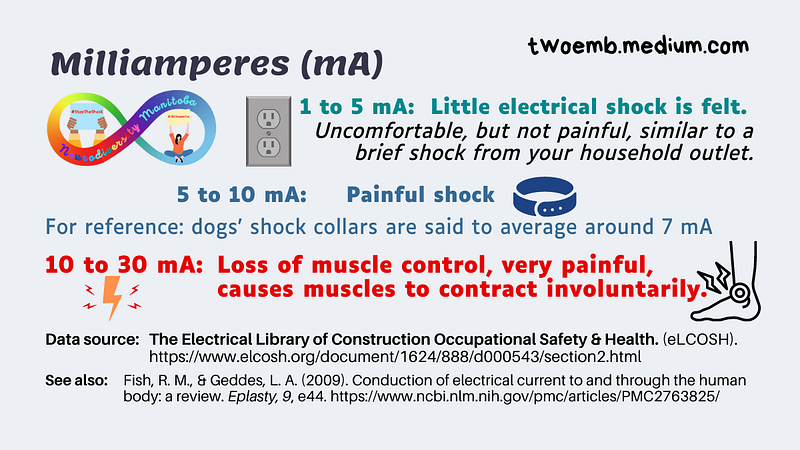
All students in this school wear skin-shocking devices around their calf muscles and you’re also required to wear one. It gives a “mild” shock, enough to make your muscle contract briefly, so it hurts a bit — but just for a second.
For today’s lesson, you must follow the direction you’re given within three seconds, or you will receive a brief shock at 30 mA.
Ready?
Actually, you have no choice in the matter, so it really doesn’t matter if you’re ready or not. In fact, your parents paid good money to send you to this prestigious, well-resourced private school, so you’d better make them proud.
Simply follow the instruction and avoid the shock. Begin.
Asseyez-vous.
1…
Asseyez-vous!
2…
ASSEYEZ-VOUS!
3.
Stressed yet?
Does knowing the risk of misunderstanding or not following the directions is a painful shock help you better learn and understand a new language?
No?
No.
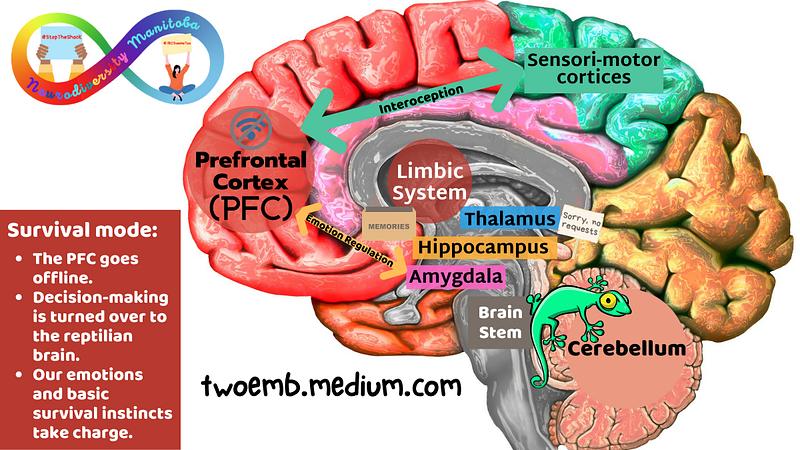
It makes you more stressed and anxious, causing your brain to go into fight-or-flight mode — Your brain is screaming “emergency”: you begin to sweat, you feel a bit nauseous, your body starts to tremble slightly from the adrenaline as cortisol and other stress hormones flood your body.
Your prefrontal cortex (PFC) powers down and your survival brain takes over. All you can think of is getting out of this threatening situation. You can’t possibly mentally review your rudimentary French vocabulary in search of clues as to what you’ve been asked to do.
No requests
Your memory centres are not taking requests, their current directive is to only sort through any memories that might help you avoid harm. Your PFC, which is the logical, reasoning part of your brain has essentially relinquished control to your survival instincts. You’re on your own.
“Traditional discipline can inadvertently escalate negative behaviours because survival brains cannot process rewards, consequences, or reason.” — Dr. Lori Desautels
Let’s try one more
What’s your anxious habit? Do you bite your nails? Twirl your hair? Drum your fingers on the desk?
The school has decided you’re no longer allowed to bite your nails, as it’s considered “self-harming” behaviour. Any time you’re caught biting your nails you’ll receive a “mild” shock.
You’re working on a particularly difficult math equation, and unconsciously start biting your nails as you’re concentrating, you don’t even realize you’re doing it.
Suddenly.
Zap.
A brief jolt of electricity causes your calf muscle to contract painfully for a second and then it’s gone.
You try to go back to your math work, but now you’re worried about getting another shock. You start to feel anxious and stressed… And what do you do when you’re nervous?
That’s right.
Zap.
It’s a vicious cycle: the more anxious you feel, the more you want to bite your nails in order to self-soothe. It’s a natural human response, yet the one thing that helps you comfort yourself is now being taken away — not just taken away, but punished to the point of causing you pain.
Shock is (not even) for the dogs
I spent 10 years as a dog trainer railing against the use of shock collars on dogs. Not just because they’re cruel and inhumane (which, they are), but also because they’re both painful and ineffective.
Using a painful stimuli on a non-human animal — let alone a vulnerable human being — with no positive effect, is abuse. Doing so repeatedly to disabled and autistic people is torture in every sense and meaning of the word.
This is exactly what they do at the Judge Rotenberg Centre, a place designed specifically for, in their own words:
“emotionally disturbed students with conduct, behavior, emotional, and/or psychiatric problems, as well as those with intellectual disabilities or on the autism spectrum.”
This doesn’t even account for the fact that what they’re trying to “teach” is really an attempt to force disabled and autistic people to pretend to be neurotypical and not disabled as much as they possibly can.
Those are the “skills” being taught, and the entire reason for shocking vulnerable people into submission.
JRC Sue Me Too
How would you respond if someone came up to you and asked, “can I strap this electronic skin-shocking device around your calf muscle, and shock you when you don’t do what I want?”
You’d probably tell them where to shove their lovely device and then shock them in a very sensitive area, right?
Right.
Why, then, is it okay to do this to disabled and Autistic people who may or may not be able to agree to this torture? Because we’re disabled? Because we’re considered faulty humans in need of correction?
This is how autistic and disabled people, primarily young children, are treated every single day right in your own communities, including your children’s schools. ABA, behaviourism, and similar approaches are the prevailing way most school staff gain compliance from children on a daily basis.
The only difference is it’s typically done using less undeniably abusive methods under the guise of “helping” the child fit in to neurotypical society.
If this is how the majority of society wants to treat people, and if that’s what it takes to “fit in”, then count me right the hell out.
© Jillian Enright, Neurodiversity MB
Related Stories
When you join medium, as a member you’ll have access to unlimited reads for only $5 per month. If you use my referral link, I’ll earn a small commission, and you’ll earn my undying gratitude.
References
Delahooke, M. (2019). Beyond Behaviors: using brain science and compassion to understand and solve children’s behavioral challenges. PESI Publishing.
Desautels, L. (2020). Connections Over Compliance: Rewiring our perceptions of discipline. Wyatt-MacKenzie Publishing.
Fish, R. M., & Geddes, L. A. (2009). Conduction of electrical current to and through the human body: a review. Eplasty, 9, e44. https://www.ncbi.nlm.nih.gov/pmc/articles/PMC2763825/
Greene, Ross, W. (2021). Lost & Found: Unlocking collaboration and compassion to help our most vulnerable, misunderstood students, and all the rest. (2nd ed.). Jossey-Bass.
Harris, N. B. (2019). The Deepest Well: Healing the long-term effects of childhood adversity. First Mariner Books.
Shanker, S., & Barker, T. (2017). Self-Reg: How to help your child [and you] break the stress cycle and successfully engage with life. Penguin Random House LLC. https://www.goodreads.com/book/show/27774752-self-reg
Vogel, S., Schwabe, L. (2016). Learning and memory under stress: implications for the classroom. npj Science of Learning, 1, 16011. https://doi.org/10.1038/npjscilearn.2016.11
Wei, J., Zhong, P., Qin, L., Tan, T., and Yan, Z. (2017). Chemicogenetic restoration of the prefrontal cortex to amygdala pathway ameliorates stress-induced deficits. Cerebral Cortex 28, 1980–1990. https://doi.org/10.1093/cercor/bhx104


