
I Don’t Care What My Son Learns in Elementary School
I care a lot more about the environment than I do the content
For the record: I do value my son’s education.
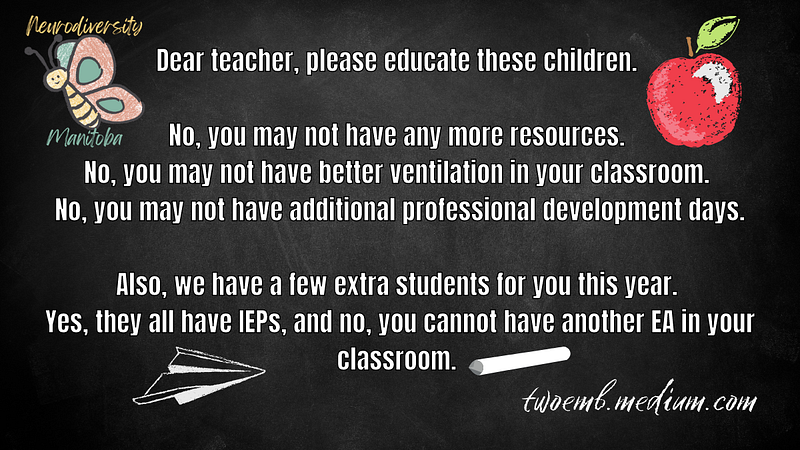
I appreciate teachers and the near-impossible task they are handed every single day: Please, educate these children. No, you may not have more resources. No, you may not have better ventilation in your classroom. No, you may not have additional professional development days.
Also, we have a few extra students for you this year. They all have IEPs, and no, you cannot have another EA in your classroom.

Whenever I write a smart-assed article about public education, I want to make very clear that I’m not here to knock teachers. As in any profession, there are amazing teachers and terrible teachers, and most are somewhere in between.
This is not about teachers. (Not really, anyway).
I meant what I said: I don’t care what my son learns in elementary school.
Y’know why?
Because he’s going to forget about 75% of what he “learns” anyway.
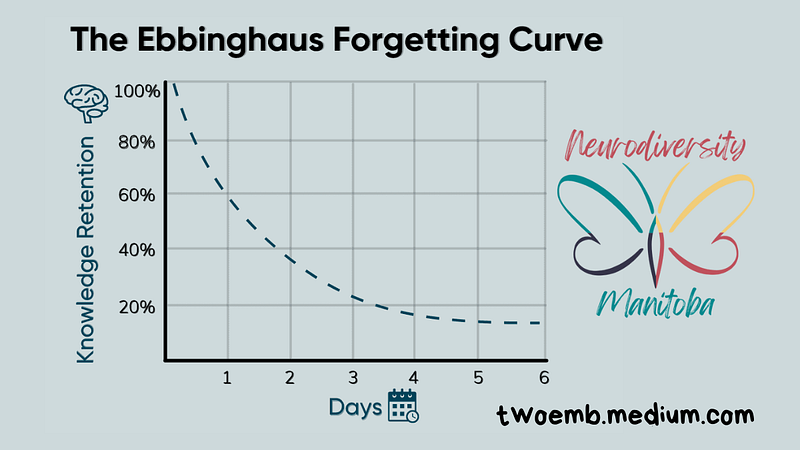
I put the word learns in quotation marks because there is a significant difference between retaining specific details and developing one’s ability to comprehend, critique, and analyze.
Compulsory schooling
If children are going to forget most of what they learn in school, then why do even they go?
Good question.
Compulsory schooling dates all the way back to the first world war. Men went off to battle, meaning women had to work, so someone had to care for the children.
You’re not here for a history lesson though (and if you were, you’d forget three quarters of it anyway!).
Aside from learning facts and figures, children go to school to socialize with other children. My son is an only child, so it’s important he has opportunities to make friends and learn how to get along well with his peers.
The two most important things I want my son to get out of his education are:
- To escape elementary school with his self-esteem, creativity, and curiosity (mostly) intact.
- To learn how to learn.
The first point could be an entire book in and of itself, so I’ll focus here on the second.
Learning how to learn
What skills are important for learning how to learn? In our current public education system the qualities most valued seem to be obedience and the ability to memorize facts.
Those are not the skills I care about, nor are they the skills important for a successful future.
“…authentic learning [includes] children’s social and moral development — building a sense of community, allowing time for creative play, developing conflict resolution skills, etc.” — Alfie Kohn
The five most desired qualities employers are looking for in potential employees are:
- Teamwork
- Time management
- Self-management
- Communication & interpersonal skills
- Problem-solving
Notice rote memorization is not on the list. The advent of the Internet and search engines rendered the ability to retain and regurgitate information more or less obsolete.
I searched multiple sources and the two qualities which came up in every single one were communication and problem-solving skills. Those are the skills I want my son — and all future adults — to be learning at home, in the community, and in school.
Love of learning
Elementary school and high school nearly killed my love of learning. I am so fortunate I was able to go to College and University. These higher-learning institutions, while imperfect, succeeded in reigniting my passion for inquiry.
Post-secondary education is much more flexible, allowing students to pursue (for the most part) subjects about which they are passionate and curious. Two extremely important skills often fostered in university are critical thinking and deep analysis.
Compulsory education in the younger years runs the risk of killing any enthusiasm for inquiry through the use of standardized curriculums and testing, way too many worksheets, and not nearly enough student-led hands-on projects and outdoor education.
“The most skillful educators tend not to rely very much on pencil-and-paper tests, even of their own devising… parents should be worried about teachers who need to give a lot of tests because they may lack a feel for how kids’ minds work.” — Alfie Kohn
I don’t care what my son learns in elementary school, I just want him to get out of there with his curiosity and love for learning intact. He’s only in grade four and is already disillusioned and disenchanted with the whole idea of school.
Rather than concern myself with whether he can memorize terms like translucent and transparent, I’d much prefer he and his classmates go outside and actually look at things that are translucent, transparent, opaque, etc. and discuss the differences. I want them to see, touch, feel, and investigate the differences.
“…superior learning and motivation arise from playful, as opposed to instructional, approaches to learning in children.” — Sahlberg & Doyle
Instead of filling out quizzes and worksheets, I’d much rather students spent time playing games that encourage teamwork, collaboration, and cooperation. There seems to be this idea that if children are having fun they aren’t learning, when in fact it is the exact opposite.
“Learning takes place best when children are engaged and enjoying themselves.” — Kathy Hirsh-Pasek
I wish more classes would have discussions and conversations about whatever piques their curiosity. They’d gain much more from learning how to respectfully disagree, to debate on an intellectual level without making their counterpoints personal.
In fact, a lot of adults would benefit from developing those skills.
It would appear decades of “sit still, be quiet, do what I say, and learn what I tell you to learn” have not produced adults who can hear differing points of view, contemplate and evaluate them, then offer a respectful and intelligent response.
Shocker.

I want my son to learn and practice critical thinking skills. I want children to be invited to ask ‘why’, and then to question the answer. I want students to be welcome to explore, to follow where their own curiosity leads them.
Most of all, I want them to recycle those damn worksheets and get outside and play. Play doesn’t just improve learning, it is learning.
© Jillian Enright, Neurodiversity MB
Related Stories
When you join medium, as a member you’ll have access to unlimited reads for only $5 per month. If you use my referral link, I’ll earn a small commission, and you’ll earn my undying gratitude.
References
Hirsh-Pasek, K. (2009). A Mandate for Playful Learning in Preschool: Presenting the Evidence. Oxford Scholarship. https://doi.org/10.1093/acprof:oso/9780195382716.001.0001
Kohn, A. (2000). The Case Against Standardized Testing: Raising the scores, ruining the schools. Heinemann.
Murre, J. M. (2015). Replication and Analysis of Ebbinghaus’ Forgetting Curve. PLoS One, 10(7). https://doi.org/10.1371/journal.pone.0120644
Sahlberg, P., & Doyle, W. (2019). Let the Children Play: how more play will save our schools and help children thrive. Oxford Press.


