
The New Earth Consciousness Spiritual Explainer Series
Spiritual Explainer: The Truth About Our 5 Types of Ego
[Updated January 28, 2024] When you see the word “ego” do you know what it means? — Here are 33 definitions revealing 5 ways that people use that word.

Contents
[1] 33 Definitions of the Ego (grouped in 5 types) — [1.1]Multiple Egos: (1) Working & Thinking Mind Egos, (2) Left & Right Brain Egos, (3) Inner & Outer Egos, and (4) Mind, Heart & Gut Egos — [1.2] Ego Growth & Maturity
[2] 5 Types of Egos = 1 Ego — [2.1] Type I — The “I Am” Ego — —[2.1.1] Ramana Maharshi’s “I Am” — [2.2] Type II — The “I Am My Story” Ego — [2.3] Type III — The “Autopilot” Ego — —[2.3.1] Free Will & the Autopilot Ego — —[2.3.2] How To Temporarily Stop Your Autopilot Thoughts — [2.4] Type IV — The “Thinking & Deciding” Ego — —[2.4.1] Freud’s Egos — [2.5] Type V — The “Physical Reality” Ego — [2.6] Ego as the Interface Between Reality & The Absolute — —[2.6.1] Ego as a Tool to Express Our Personalities — —[2.6.2] Ego as a 3D Prison or a Gateway to Ascension? — —[2.6.3] Expanding the Ego as a Spiritual Path
[3] Spiritual Ego Traps — [3.1] Spiritual Egos & Spiritual Bypassing; [3.2] Confirmation Bias; [3.3] Ego Power: Charisma & Siddhis; [3.4] Egoism, Egotism, Egocentrism, & Narcissism; [3.5] Collective Egos & Racism [4] Do We Need an Ego? — [4.1] What is Your Definition of “Ego”? [5] Related Resources — [5.1] Awakening From the Story (a poem) — [5.2] Other Articles
[1] 33 Definitions of the Ego
BELOW are 33 definitions of the ego that I have come across from spirituality, psychoanalysis, and social media sources. I have grouped these into 5 broad categories, each of which is described in more detail below.
Type I — The “I Am” or “I Am Real” Ego
- Your Sense of Being Separate (from everything else)
- Your Individuality (opposite of everything else)
- Your Sense of “I”-ness (opposite of everything else)
- Your Awareness of Being a Human
- The Center of Your Consciousness in the Physical World
Type II — The “I Am My Story” Ego
- Your Identity (“I am ____”)
- Your Personal Life Story & Experiences (physical, emotional, mental, & spiritual)
- Your Social Selves (such as family, nation, race, politics, & career)
- Your Beliefs About Yourself (and what you think others believe about you)
- The Mask or Front that Hides Your True Self
- Your Justification for Existing
Type III — The “Autopilot” Ego
- Your Conditioned Autopilot Reactions & Thoughts
- Your Less Conscious Monkey Mind or Busy Mind; When You are “Consumed by Emotions” or by social media
- Your Desires, Wants, Needs, & Demands (for, example, food, sex, drugs, things, money, power, prestige — which we can never fulfill permanently)
- Your Self-Value (whether positive, Self-Loving, or negative, Self-Loathing) and Self-Importance (the part of you that thinks it is more important and better than anyone or anything else); your Egotistical and even Narcistic Self
- Your Protective Programming (automatic “fight-or-flight reaction”, for example; relate to Type IV-3)
- Your “Inner Critic” which is your Restricted, Resistant, Self-Critical, Complaining, and Forever Commenting Mind (often clinging to stability in a changing world; easily hurt when criticized) (related to Type IV-4)
- Your “Inner Voice”, like the Inner Critic, is often repeating what others have said about you; some feel they have no control over the Inner Voice and Inner Critic, which can be a severe psychological disturbance
Type IV — The “Thinking & Deciding” Ego
- Your Conscious Thinking / Intellectual / Doing Self (opposite of Intuition & Feeling)
- Your Analyzing, Comparing, Interpreting, Discriminating, Controlling, Second Guessing, & Deciding Mind; When You are “Lost in Thoughts”
- Your Sense of Doing Things and Being a Doer
- Your Curious, Gossiping, Scheming, Lying, Intimidating, Destroying Mind
- Your Protecting (to keep you safe & out of trouble) and Fixing Mind (trying to fix your many problems) (related to Type III-5, but at a more conscious level)
- Your Judging, Judgmental, and Opinionated Mind (related to Type III-6)
- Your Time and Space Mind; the part of you that most believes in the limitations of time and space, and behaves that way
Type V — The “Physical Reality” Ego
- Your Body, Mind, and Emotions (opposite of your Soul or Spiritual Self)
- Your Outer Self or 3rd Dimension (3D) Self, Acting in the Physical World (opposite of your Inner Self, Soul Self, or Higher Dimensional Self)
- Your 3D Operating System (processing and acting upon all the information you need to function in physical reality; similar to Type V-2)
- Your Temporary, False, Illusory, or Pseudo Self (opposite of your True Self, Authentic Self, or Eternal Self; similar to type V-2)
- The part of you that thinks “It” is Consciousness, Awakened, Enlightened, your Soul, etc. (similar to Type II-2 & II-4; the problem is too much “thinking”)
- Your Individual Soul in its Earliest Stages of Development
- The Part of You that Intentionally Keeps You Ignorant of You Higher Self (the “veil” that hides your True Self and True Reality)
- The Connection or Interface between Manifest Reality and The Absolute (Source/God/True Self) — This could be a 6th type of ego
[1.1] Multiple Egos
Do you have more than one ego? According to many theories, yes, you do. I will introduce these theories here. But in the remainder of the article, I will assume that only one of those egos is present at any given time.
[1.1.1] Working Mind & Thinking Mind
In relation to the ego, we have two minds: the Working Mind and the Thinking Mind. The Working Mind is the mind that does what it needs to do the navigate and survive in our 3D physical reality. For example, it makes and keeps our appointments for us.
The Thinking Mind is the one that is judgmental about what we do and experience. Using that approach, the Thinking Mind (in this definition) is our ego.
The Working Mind is not an ego for the Type II, Type III, and Type IV ego definitions in this article. But it is part of the Type I and Type V ego definitions, which are all-inclusive of our 3D existence.
[1.1.2] Left Brain & Right Brain
Another line of thinking considers differences between our Left Brain and Right Brain. Popular culture sees the left half of our brain as judging, analyzing, and logical. The right half of our brain is creative, intuitive, and sensitive to feelings.
Brain scans have shown that we use both halves of our brain for all these functions. But these two distinct aspects of the human psyche hold some validity. In this approach, Left Brain characteristics are our ego. Right brain characteristics offer some promise of overcoming a bothersome ego.
[1.1.3] Inner Ego & Outer Ego
Similarly, Seth (channeled by Jane Roberts from the mid-1960s to 1984) introduced the terms “Inner Ego” and “Outer Ego”. Most of the ego types in this article are versions of the Outer Ego. It is how we manage the physical reality that we are experiencing.
The Inner Ego, also known as the “Inner Self”, is how we create and navigate our inner reality, which includes our subconscious mind and dreams. That is also an ego (self) identity, though seldom discussed this way by modern psychology. Like the Working Mind, the Inner Ego would only be a part of the all-inclusive Type I and Type V ego definitions, and not the others.
For more on the “Inner Ego” vs “Outer Ego”, see:
[1.1.4] Head, Heart, & Gut Egos
There is a theory that defines our 3 Brains: Head, Heart, and Gut, associated with our chakras. Thinking about who we are and who we want to be and applying labels to that is our Head Ego. Ego Types II, III, and IV are mostly Head Egos. This is the ego that we engage with when we do “ego work”.
Being energetically driven to express our self-identity is the Heart Ego. It is the emotional desire to be known and to impact the world. As an aspect of the energetic/astral/emotional body, the Heart Ego (and Heart Chakra) is a backdrop to most all the other egos. Having a heart awakening is a sign that this ego is more aligned (some say it disappears).
Our core or essential identity and sense of an independent self is our Gut Ego. The Gut Ego develops starting at about 6 months through 2 years of age. It is the initial sense of “I Am” (Type I ego). This is our deepest ego and is often unconscious until it disappears as part of the awakening process. When that happens, it can be a very noticeable experience.
[1.2] Ego Growth & Maturity
Some suggest that we mature through different egos as we grow up as humans:
Stages 1—We start with the “I Am” (Type I ego) in infancy 2—We then create our Story (Type II ego) in childhood 3—We are consumed by Autopilot societal expectations (Type III ego) in adolescence and early adulthood 4 — We become fully mature and independent Decider (Type IV ego) in our adulthood (in an ideal world) 5—We turn to spirituality to understand our “Physical Reality” self (Type V ego) as we mature — well, at least some of us do 6—And we end up either by becoming spiritually enlightened beings or by passing on and leaving our physical body behind (both are “Beyond the Ego”)
Jane Loevinger famously proposed a set of “psychological stages of ego development” that we mature through in life. These also align with the 5 Types of egos in this article. They are:
- Childhood Stages: 1-Impulsive, 2-Self-Protective, 3-Conformist, 4-Self-Aware — This is moving from the “I Am” (Type I) ego to the “I Am My Story” (Type II) and the “Autopilot” (Type III) egos
- Adulthood Stages: 5-Conscientious, 6-Individualistic, 7-Autonomous — This is being the “Autopilot”(Type III) and the “Decider” (Type IV) egos that we have for much of our adult lives
- Rare Higher Stages: 8-Integrated, 9-Flowing — This is putting the ego in perspective (Type V), which is an awakening Beyond the Ego
Seth/Jane Roberts suggested individuals are born on our planet at various levels of ego development, based on past incarnations. There are some people on Earth who are experiencing egos for the very first time, meaning this is their first incarnation in human form. And there are others who are experiencing an ego (incarnation) for the last time.
Some of those within your reality are having their first experience with an ego as you think of it. Others are returning to it, the system, in an effort to learn more. There are guardians, so to speak, within your system, reincarnated for the last time to help keep it in some kind of order while the others mature. There are also some, not physical, who keep an eye out over the whole proceedings. — Seth/Jane Roberts, The Early Sessions, Book 9, session 498, August 25, 1969
First-time ego incarnations are more likely to show the Type I, II, and III forms of egos (the I Am, the Story, and the Autopilot Monkey Mind). Those toward the end of their incarnations are more likely to show the Type 5 ego (Beyond the Ego), listed below. (Also see Seth/Jane Roberts description of multiple egos below in section [2.6.3] on the Ego’s Spiritual Path.)
It is impossible to destroy or kill our ego. But we can kill our attachment to (or identity with) our ego. That happens when we stop identifying with our ego as a separate individual. Instead, we identify with (or awaken to become) who we are beyond the ego. That is often called “Self-Realization”. Self-Realization is who we really are, no matter which of the following definitions of the “ego” we adopt.
For more on that, see…
[2] 5 Types of Egos = 1 Ego
These 5 ways of talking about the ego build upon each other, as in this diagram. Type II builds on Type I, meaning it makes the same assumption as Type I, that I Am (or I exist), and then adds multiple stories to it.
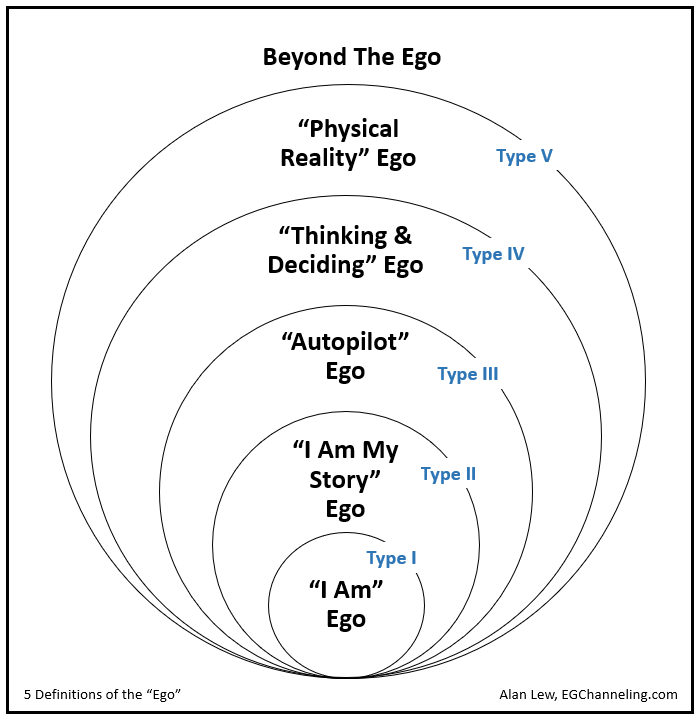
Similarly, the Type III ego builds on the Type II ego. Here, the conscious story in Type II becomes an unconscious story (or belief) in Type III. Being unconscious, we are more likely to treat the story/belief as a “universal truth” and it becomes part of our taken-for-granted daily life. (See the section on “racism” below.)
The Type IV ego uses our story (Type II) and our assumed “truths” (Type III) to make and justify its decisions and actions.
The Type V ego sees all the other definitions as aspects of the 3D manifest reality and calls all of that the “ego”. The main purpose behind that approach is to define the spiritual “true self” as beyond the ego in all its forms. That “true self” is the same as the Type I ego — pure awareness.
We are everything in the four walls of the box in the diagram above.
The five definitions each represent distinct aspects of the ego. The problem is that people focus on only one of these five definitions of the ego and forget about the others.
It is OK to focus on only one type of ego if we are trying to understand that one aspect. But we should not lose sight of the wider complexity, role, and usefulness of the different “egos”.
[2.1] Type I — The “I Am” Ego
Your Sense of Being Separate (from everything else)
FOR SOME, “ego” is simply what makes us a unique individual who is separate from other unique individuals and things. There is nothing inherently bad or wrong with the ego because it is simply what “I Am”. It is simply knowing that “I Exist” and “I Am Real”. Nothing needs to be fixed, spiritually or psychologically.
“Wherever I go, egos.” — anon. Vedanta (Hindu) monk
Our individuality extends from our outer physical being (sometimes called the outer ego) to our personal soul (sometimes called the inner ego or the inner self). These are both significant and valuable because they allow “God” or “Source” to experience and know itself in physical form.
Our ego is the part of us that is all about separation, difference, and comparison (see Type IV, below). If we focus on the outer ego, then the focus is on our physical body and personality as being separate from other physical objects and mental objects.
If we focus on the inner self, then we are in the deeper realm of “I Am-ness”, which is required for experience. Without that sense of “Am-ness” there would be no experience. There would be no “I” to experience being in a room, eating a meal, or seeing a tree.
The ego is God’s greatest creation because it is through the ego that God/Source experiences the universe it created and comes to know itself in that unique way.
The inner self’s sense of “I Am” is getting closer to our soul. Our soul is like the opposite of the ego. It is the part of us that sees the unity and oneness of everything (see Type V, below). But there is no obvious line that divides the ego and the soul — they are like two sides of the same coin. (There is also an “individual soul” and a “Universal Soul”, but again, dividing lines are fuzzy.)
The Hindu Sanskrit word for ego is ahamkara (meaning “self maker”). Swami Sarvapriyananda (on YouTube) says it is the part of us that integrates experiences. It brings all the experiences (gross and subtle) of our mind/body system together under a single sense of “I”. Without it, our mind/body system would be a mass of seemingly separate and unrelated experiences (and consciousnesses), like the mass of humanity on our planet.
Swamiji further suggests that “quantum entanglement” might be how our multiple points of experience/consciousness come together to create a single sense of “I Am”. Each of us is a mind/body system entangled within itself to create a single ego — well, at least that is how it is supposed to work most of the time.
Many, however, consider this Type I (“I Am”) definition of the ego too broad because it seems to boil down to simple awareness/consciousness. They agree that the sense of individuality underlies our personal experiences. But they feel that something more is going on than just that. And that something more is our “ego”.
[2.1.1] Ramana Maharshi’s “I Am”
The “I Am” is often associated with the teachings of the Advaita Vedanta (nonduality) teacher, Ramana Maharshi. His perspective on that is somewhat different from what is described above. For him, the ego arises when the pure awareness of “I Am” becomes aware of things other than itself, including objects, thoughts, and stories.
In other words, if you are aware of anything, then you are an “ego” and not your true self. For Ramana, the ego is fully dependent on, and actually is, all those other things, which he also called “maya” (illusion). The ego maintains its existence by forever grasping and identifying with things outside of itself.
That is also how the infinite diversity of duality experiences arises.
When awareness (or grasping) of other things subsides, then the ego subsides (disappears or ends), and only nondual pure awareness remains. There is no body, no mind, no thoughts, and no world. For Ramana, that is who we really are — the one pure awareness without a second.
“When the ego arises, everything arises. When the ego subsides, everything subsides. Therefore, the ego is everything.” (And the true self is ‘no-thing’.) — Ramana Maharshi, translated by Michael James (the last sentence was added by me.)
[2.2] Type II — The “I Am My Story” Ego
Your Identity (“I am ____”)
A COMMON definition of ego is that it is our identity — it is how we describe and talk about ourselves. Every time we use the phrase “I am ___” (fill in the blank), we are building up, constructing, shaping, and expanding this type of ego story. This takes the definition one step beyond simply being the “I Am” of “I Am Me” (Type I ego).
From our individual “I Am”, we create a personality by applying adjectives, such as ‘I am smart’, ‘I am tall’, ‘I am an extrovert’, ‘I am generous’, ‘I am a parent’, ‘I am a teacher’, ‘I am fun’, ‘I am…’ — a nationality, ethnicity, gender, zodiac sign, and on and on. If you have a name, if you have a business card, you have this type of ego.
We also collect more elaborate stories of the “I am ___” through the unique life experiences we have. This includes physical, emotional, and mental experiences that we have collected.
Some of those experiences were intentional and others were random synchronicities. Some were forced on us against our desires, while others were welcomed by us. Some were life-forming, some were life-changing, and others were just interesting.
“As soon as you label yourself, you are setting limitations, putting up boundaries and defining the reality of your psyche — usually according to quite limited beliefs.” — Seth/Jane Roberts, The Unknown Reality, volume 2, section 6, session 729, January 13, 1975
If we say, “I am spiritual”, that is another story, as is “I am awakened”, and worse, “I am enlightened”. We sometimes call that the “Spiritual Ego” (discussed more in section 10, below).
Our stories also come from what we think others say about us, or what we want others to say about us. We tell these stories to others, often seeking their approval, but we are really talking to ourselves more than anyone else. Some say we have a physical story, an emotional story, and a mental story. Each of these has a different ego perspective.
This type of ego is not necessarily bad or negative. If we can watch our thoughts and our story, we can learn much about our past. The story ego can be not so good if we have a bad or negative story or experience to tell. It can also be negative if we identify too strongly with our story and rely too much on external definitions of who we are or should be.
This is a challenge for many of us. We accumulate these stories and experiences over time, and for some, that is our ego. With proper teachings and practices, we can change our stories and change our lives. (See also the poem at the end of this article, which talks about “stories” at various levels of our being.)
When we embed our stories (especially the negative ones) in our subconscious, then they overlap with the Type III-Autopilot Ego, below. If our stories are conscious judgements that we make about ourselves, then they overlap with the Type IV-Deciding Ego, below.
[2.3] Type III — The “Autopilot” Ego
Your Conditioned Autopilot Reactions & Thoughts
FOR MANY, the ego is that part of us that “we” (our deeper consciousness) feel have no control over. We sometimes call it our “Monkey Mind”. From this perspective, we associate the ego with our subconscious memories, including the many traumas and stresses that we have accumulated in our life.
There is a “Working Mind” version (see definition above) of the autopilot that is normal and useful for our 3D physical experience. The sympathetic nervous system’s response to danger is an example of this. That is still part of our ego, but is usually not what people think of when criticizing their autopilot mind.
The autopilot ego also contains our social conditioning about what is acceptable and unacceptable behavior. This is especially what society taught us in early childhood. We can think of social conditioning as the “stories” that we hold in our subconscious. These also overlap with our conscious stories.
Because of the importance we put on social conditioning, we are drawn to social media (like Facebook) and the news to make sure our stories are up to date. Those sources (and others) feed and strengthen our autopilot ego, especially when we see ourselves in them. They are also externalization or societal level versions of the Autopilot Monkey Mind.
When our reality does not match the stories, our autopilot can become an “Inner Critic” criticizing and blaming us for not living up to ideals set by others. And it is critical for both us and the world. It gets easily triggered by things, making us angry, sad, hurt, and ashamed.
And while it is quick to criticize, it is also quick to resent any criticisms of itself. It also does not like to lose a competition or game, and it does not like to feel left out of something that others are a part of.
We can feel this version of the ego as an intruder, bringing up thoughts and memories that interfere with what our conscious mind is trying to focus on. This is a big challenge when we are trying to meditate, for example.
This ego is also the part of you that seeks stability, tries to prevent change, and tries to protect us at our most basic level of fight or flight. It is a subconscious desire to cling to the known past (Type II ego).
Our world, however, is constantly changing. Many spiritual teachers consider resisting the natural course of change as the most common source of human suffering.
And the ego-mind loves to suffer. Judging things as good or bad is the tool it uses to keep itself separate from everything else. Suffering is how it confirms that it is indeed separate and unique — it’s me against the world!
The “autopilot ego” is often a part of us we want to change. Our conditioned ego includes shadow behaviors, our inner child, and other thoughts and emotions that come up and which we may reject, resist or feel shame over.
These are embedded in our physical body: our chakras, nervous system, and brain. With some work, we can identify and change these conditioned aspects of the ego. Or perhaps even “kill” the ego, as some say. Others see our spiritual practice as convincing the ego to let go of control and allow the universe to unfold our life.
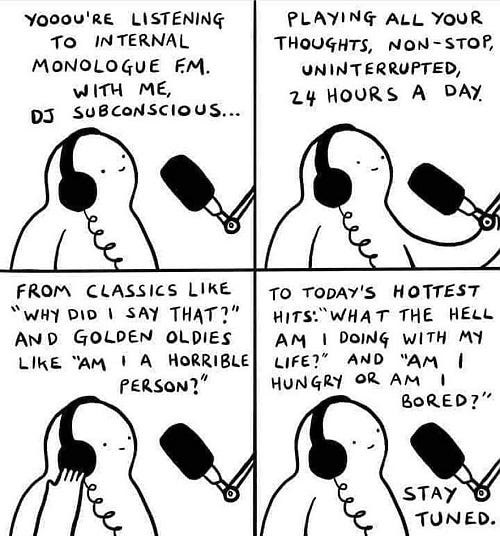
This Facebook meme ⬇ shows how most people view the ego as what I am calling the “Autopilot Ego”. But this is just 1 of 5 general ways we define and use the world ego.
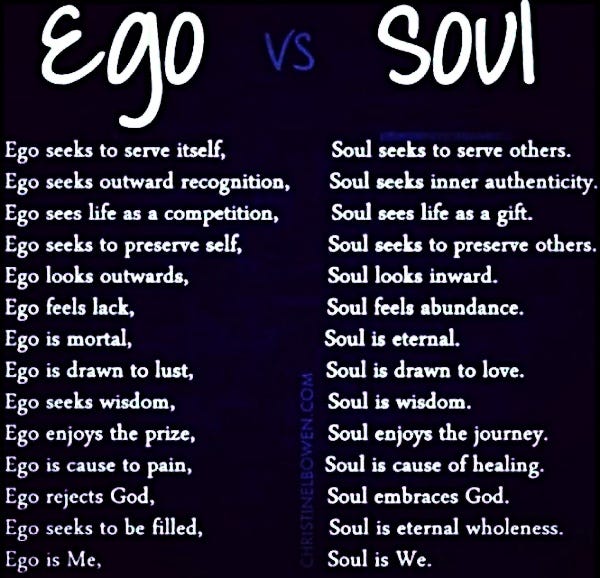
Many of us seem to know innately that the less ego we have, the less suffering we will experience. That drives many people on the path of spiritual awakening. Circumstances remain the same, but what used to be called “suffering” gradually becomes the “infinite diversity of life experiences”. As the famous Zen saying goes…
Before enlightenment, chop wood, carry water. After enlightenment, chop wood, carry water. — Zen/Chan Buddhism
[2.3.1] Free Will & the Autopilot Ego
The Nonduality teacher, Ramana Maharshi, said that if there is a sense of individuality (ego), there is a sense of free will (even though it is false). On the other hand, Shunyamurti (who also claims to teach Nonduality) suggests that no matter how you define it, the ego never has free will.
Our autopilot’s automatic and uncontrollable responses are a primary reason we question free will. When we are the autopilot ego (when we define ourselves as that), we feel we have no free will.
One definition of the spiritual awakening process is that it is expanding our inner self (or soul) to replace our conditioned ego responses (autopilot) with conscious responses. It is only when we have done this that we can experience “free will” and independence from that autopilot ego.
This process, however, is different for each ego. That is because each ego exists in its own unique and separate universe. (No one else experiences exactly the same universe that you experience.) Those universes overlap with others, but they are still unique — all 7.9 billion of them.
So from the ego’s experience, every awakening / enlightenment / self-realization is unique. But when an ego awakens, its entire universe awakens because of the overlap and the ultimate oneness of everything. And in this way, free will grows.
“…the personality is always in a state of becoming, and forever changes… ” — Seth/Jane Roberts, “The Early Sessions, Book 3”, session 146 on April 14, 1965
For more on Free Will, including its relationship to the ego, see:
[2.3.2] How To Temporarily Stop Your Autopilot Thoughts
(1) Focus your concentration on your forehead or face. This will temporarily remove your focus from your brain area, where your subconscious thoughts arise. The autopilot thoughts will return when you lose your focused awareness, which is closer to your true self, beyond your thoughts. — For more on autopilot thoughts and our true self, see: Lincoln Gergar, Mind Mastery: Why Do We Have Thoughts? (YouTube)
(2) Put your thoughts in a “Thought Box”. Imagine a lock box located under your chair or in the Earth below you. Connect it to your body with a cable. Close your eyes and take some deep breaths to relax. As you become aware that a thought has entered your mind, immediately send it down the cable and into the thought box with the intention that you will allow it to return later. Do this over and over with each thought. Gradually, your mind will become empty for longer periods of time. (This is like the neti-neti or “not this, not that” meditation practice, if you are familiar with that.)
“The ego is a jealous god, and it wants its interests served. It does not want to admit the reality of any dimensions except those within which it feels comfortable and can understand. It was meant to be an aid, but it has been allowed to become a tyrant. Even so, it is much more resilient and eager to learn than is generally supposed. It is not natively as rigid as it seems. Its curiosity can be of great value.” — Seth/Jane Roberts, Seth Speaks, Chapter 1, Session 512, January 27, 1970
[2.4] Type IV — The “Thinking & Deciding” Ego
Your Conscious Thinking / Intellectual / Doing Self (opposite of Intuition & Feeling)
ONE OF the major side effects of having a large human brain seems to be that we think too much. Our identity (Type II ego, above) and our autopilot mind (Type III ego, above) are both ways of defining the ego as thinking and thoughts.
This definition (Type IV ego) expands those two to include more complex and reflexive (self-reflection) forms of thinking and thoughts in which we try to interpret and act upon our many stories of ourselves.
This is a very common definition of the ego. It is how we use our conscious thinking to navigate our world by constantly comparing and judging what we see and experience — calling things right or wrong, good or bad, better or worse.
It then tries to figure out what to “do” about those judgments. It will often try to fix them, and possibly even try to fix the world. It is our sense of doing things and of being a doer (this is also called “personal doership”).
This is what “the ego” is supposed to do. It is the “tool” we use to interpret and understand our sensory and emotional experience of the world. It is also the “Working Mind” that helps us function properly in our 3D physical experience. It helps us make and keep our daily tasks and appointments, for example, as defined above.
We also associated this ego with our “will” (“will power” and “free will”) and our efforts to control consciously our lives. This is the definition that is closest to the Freudian concept of “ego”.
This type of ego engages in thought before taking action, which distinguishes it from our autopilot mind (Type III ego). “Second-guessing” is a feature, and fault, of this ego-mind, and sometimes it gets confused.
The problem is that the thinking mind ego is too good at what it does, and so we have turned over control of our entire lives to its analyzing, discriminating, and judging. And we think that is who we are. Some suggest that even this thinking and analyzing mind is entirely pre-determined by our genetic make-up and life-experiences. This makes it no different from the autopilot ego, except that we “think” it is different.
Spiritual teachings address this problem in two ways:
- One teaching is that we stop all our ego thinking and to just “be here now”, in the present moment, directly experiencing ourselves and our environment. This is the idea of “ego death”.
- A second teaching is that we allow the ego its role as the analyzer, trying to understand our sensory experiences, and to protect us when cannot do so consciously. But we should not allow it to replace our inner self (intuition or soul) as the decider controlling our lives. This is more like “taming the ego”.
For both, the goal is to identify more with our True Self, and less with our outer ego-self, which is also called our “pseudo-self” and even our “pseudo-ego”. The question is who or what is your self (your “I”) identifying with (see the Type II ego, above on identity).

I have heard that we have 50,000 thoughts a day (I don’t know how they measure that). Those thoughts are what we most identify with as our ego. But those thoughts only represent 1% of everything that we experience in a day (according to David Bingham).
We experience most of the rest through our body and senses, which we pay little attention to. However, our body (but perhaps not the senses) can also be a significant part of our ego identity.
[2.4.1] Freud’s Egos
Sigmund Freud’s concepts of Id, Ego, and Superego align somewhat with the egos presented in this article.
As a simplification, I like to think of the Superego (our “I should” thinking) as the angel on one shoulder, and the Id (our “I want” thinking) as the devil on the other shoulder of characters in many movies and cartoons. Spiritually, the Superego is the part of us that knows “better” than we do. Freud saw it as our parents when we were young, and society in our adulthood. Spiritually, it may be our Higher Self or Spirit Guides. The Id is our more animalistic survival instincts. In some New Age spirituality, it is as our “reptilian ET” influences.
The Superego and Id are both aspects of the Type III-Autopilot Ego in the approach described above. They are both giving advice based on the conditioned responses we have adopted through our life experiences.
From Freud’s perspective, the Ego (the “Ich” in the original German) is the person in the middle who has to decide between the angel and the devil shoulders. This reflects the Type IV-Thinking Ego and its association with using our “will power” consciously to decide and control how we express ourselves.
“the ego is a monkey catapulting through the jungle; totally fascinated by the realm of the senses….if anyone threatens it, it actually fears for its life. Let this monkey go. Let the senses go… Recognize that everything you see and think is a falsehood, an illusion, a veil over the truth” — Lao-Tzu
[2.5] Type V — The “Physical Reality” Ego
Your Body, Mind, and Emotions (opposite of your Soul or Spiritual Self)
“The ego is merely the tiny pinhead that sticks up and pierces physical reality. It is the tiniest portion of YOU.” — Seth/Jane Roberts, The Early Sessions, Vol. 3, ESP class on February 9, 1971
and
The ego is the only part of the self that regards physical objects as anything but symbols. It is highly difficult for other parts of the self to experience the ego for this reason. The ego, while always changing, is one of the most rigid aspects of identity. To the inner self, neither house nor walls exist. They are perceived only as vague self-limiting ideas on the ego’s part. — Seth/Jane Roberts, The Early Sessions, Book 7, session 301 on November 16, 1966
and
“When the ego arises, everything arises; when the ego subsides, everything subsides.” — Ramana Maharshi
and
“That which comes and goes, rises and sets, is born and dies is the ego. That which always abides, never changes, and is devoid of qualities is the Self.” — Ramana Maharshi
THIS VERSION of the ego is defined by what is not the ego. From a spiritual perspective, we are not your body, mind, and emotions. These are all part of the phenomenal world (or manifest reality) and are our ego. Our greater Self exists beyond manifest reality. The more we identify with that greater Self, the less we are our ego-self.
By this definition, when we are “consumed by emotions”, such as anger or grief (Type III-Autopilot), or when we are “lost in thought” (Type IV-Thinking Mind) we are fully within our ego. We have lost even our most remote connection or awareness of anything beyond our phenomenal experience.
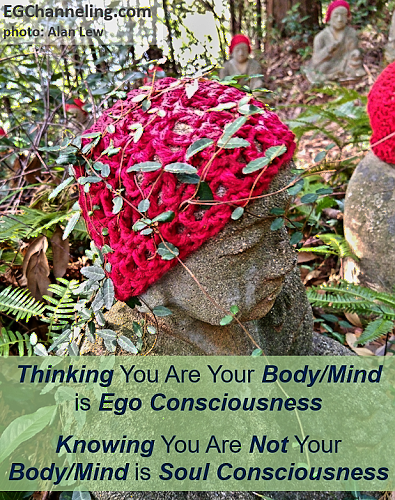
There are two ways of defining our “body/mind”. There is a narrow definition that is limited to the apparent boundary of our skin. That is our ego identity, and we are clearly not that in this Type V ego definition.
But there is a broader definition of “body/mind” that includes everything that we experience through our senses and mind. It includes everyone and everything in our lived experience (our entire perceived universe). That, too, is our Type V ego identity. And we are also not that.
Your true self is greater than all of that. It is your “pure awareness”, with no thoughts. It is the part of you that has always been there, from your birth to the present, and through your deepest sleep (when there is no ego). And it will be there still after your body (and ego) dies — at least according to some teachings.
You are intentionally taking on these phenomenal characteristics to experience 3D physical reality temporarily. But because it is all temporary, including your ego sense of “I Am” (Type I ego), it is an illusion. It is like watching a movie where your body, mind, and ego are center stage (from your perspective, at least). When the movie ends, it will end.
That isn’t necessarily bad, because it is the reason “you” are here in the way you are right now. We are Consciousness (God/Source), but
…since the Consciousness is not a form itself, it cannot be identified with. So we choose to find ourselves in that which we see, that which we hear, that which we feel. We find ourselves from that which comes in through the senses and is gathered and interpreted by the mind. — Lincoln Gergar
[2.6] Ego as the Interface Between Reality & The Absolute
Lincoln Gergar’s comment shows how we can think of the ego as the connection or interface between manifest reality and Source/God/The Absolute that is beyond all phenomenal (experienced) forms.
In the list of 33 definitions of the ego, I put the “interface” idea under the Type V ego because all reality is on one side and The Absolute is on the other side. But it can almost be considered a different type of ego. There are many ways to approach this perspective.
[2.6.1] Ego as a Tool to Express Our Personalities
Some say that your 3D Self is your “personality”. That personality is embedded in your lower chakras and your nervous system. It is also structured by the position of the stars and planets (astrology) at your birth.
When you leave your physical body, you leave those chakras (and your astrology) behind, and so you separate from your 3D ego personality. Instead, you become your “true self” or “soul personality” — which is also considered a form of “ego” by some.
In this Type V ego, all the previous definitions of ego are combined on one side of the duality — the ego side. I heard this described as: “Edging God Out” — it is everything that is not God/Source. This is also the teaching of “nonduality” (emptiness).
Your true Self (your eternal “I”) is on the opposite side of the duality. It is beyond duality and is the source of duality. It is that deepest part within you where you are one with God/Source/The Absolute. Everything else is the illusion of ego. This is also beyond the Type I (“I Am”) ego, because there is no “I” left.
That is a goal of meditation — to quiet the ego mind so we can know and become our truth. To reach that deepest truth, we not only quiet our mind, but we need to transcend all of manifest reality. Some call this “killing the ego”, which is really killing our attachment to (or identification with) our ego. Others say it is convincing or seducing the ego to fade willingly into the background.
This definition of the ego implies a transcendence of all the other definitions listed above (Type I to IV). Our spiritual goal is to awaken from our ego. Or perhaps better, to remember that we are more than our ego. This is a common perspective in New Age spiritual teachings…
A genuine relationship is one that is not dominated by the ego with its image-making and self-seeking. — Eckhart Tolle
Seth/Jane Roberts says (from The Early Sessions, Book 1, session 17 on January 20, 1964),
“…the ego is the tool by which the hidden self manipulates in the physical universe, as you know it.”
It is how our hidden “whole self” expresses portions of its incredibly complex being (or personality) in a limited form in physical reality (3D). Because all our larger “entire personality” seeks to express itself, our ego-self changes over time to accommodate that in the 3rd Dimension. We call those changes our personal “evolution” or “growth”.
…the ego, while a portion of the whole self, can be defined as a psychological “structure”, composed of characteristics belonging to the personality as a whole, organized together to form a surface identity. Now, generally speaking, through the period of a lifetime, this allows for the easy emergence of many tendencies and abilities. It permits many more potentials to emerge than would otherwise be possible. If this were not the case, for example, your interests throughout life would not change. The ego, while appearing to be permanent, then, forever changes as it adapts to new characteristics from the whole self and lets others recede. Otherwise, it would not be responsive to the needs and desires of the entire personality. — Seth/Jane Roberts, The Nature of Personal Reality, session 616 on Sept. 20, 1972
[2.6.2] Ego as a 3D Prison or a Gateway to Ascension?
But for many others, the Type V ego is a tool to keep us trapped in the 3rd Dimension. (This idea has also been mentioned previously.)
Shunyamurti takes this view when he describes the ego as the part of you that tries to keep your vibration so low that you never have the thought or desire to rise to a higher level. He says its purpose is to keep us “asleep” in the phenomenal world. It does this using the techniques described in the Type II, III and IV egos, above.
The ego will do anything to keep us in duality because it only exists there, as something separate. Oneness (joy) means no separation and no ego. To overcome the divisions in our world today, we need to learn to let go of the ego.
On the other hand, we usually associate “desire” with the ego. And it is our desire for something more than our physical experiences that leads us on a spiritual path beyond the ego. In this sense, the ego is essential to spirituality and ascension.
Some even say that without desire, we (the “I Am” ego) would not exist.
Radical nonduality teachings insist that this is absolutely true — we do not exist. Your physical body, mental body (thoughts), and emotional body together comprise a temporary you, or “temporary ego”.
Those ego forms will transform (or transmute) into something different when you die and leave this 3D physical reality. Or they will completely disappear (as Buddhism and nonduality teaches), with only your pure awareness remaining.
When you are born, you cry, and the world rejoices. When you die, you rejoice, and the world cries. — Buddhist saying
[2.6.3] Expanding the Ego as a Spiritual Path
One issue with this Type V ego definition is that it tends to view all forms of the ego (including the Inner Ego/Self) as inferior to the deepest version of our Absolute Self. Such an assumption, however, has two problems:
- It assumes that the “illusion” of our external world life does not have value, which is highly debatable; and
- It assumes that duality is real, and that there is something (the ego) that is separate and not an aspect of God / Source / All-That-Is / Absolute Self.
As noted in the Type I ego discussion, it is better to think of the inner ego (soul/inner self) and outer ego as “two sides of the same coin”, or rather, of the “same singular self”. Experientially, there is no clear dividing line between them. And both are equally valuable to knowing our true self.
The outer ego’s role is to understand, interpret and give directions to navigate our outer reality. It is the interface between our true nature and the physical 3D illusion we are experiencing. (s mentioned earlier, the inner ego plays a similar role for our subconscious. It is how we navigate our inner world, such as our dreams, for example.
The spiritual path of the outer ego is to expand its definition of what our outer reality is, beyond the limited confines of what it was taught in early childhood. This is how Seth/Jane Roberts describes this:
It was necessary for the ego, in its origins, to objectify itself as much as possible. Now, however, the stability of the ego, generally speaking, as a part of the human personality, is established. It can now afford to be much more elastic, to include, in other words, more and more of reality within its awareness. Such an inclusion would be most beneficial. It would, of course however to some extent, change the ego, and any change is resisted by the ego.
Nevertheless, the course of future events will move in this direction. It must. The ego must change in this rather basic manner, including other realities within its scope of awareness. There is no basic reason why it cannot add its directive energies to other aspects of the personality, and if it could so expand it would, theoretically, be possible for the ego to become aware of many experiences which have been impossible for it in the past. — Seth/Jane Roberts, The Early Sessions, Book 4, Session 156, May 19, 1965
Contrary to killing or lessening the ego, some spiritual teachers suggest we need to expand the ego as much as possible. Maharishi Mahesh Yogi said our goal was to expand the ego to God Consciousness. The ego is desire, and desire drives us to higher states of consciousness and being, as mentioned above.
One definition of our ego is that it is our individual soul in its early stage of development (Type V-6 on the original list at the top of this article). As we evolve and awaken, our ego gradually grows up to become our soul. Seth/Jane Roberts says our purpose is to grow that ego to become ever expanding entities (soul or oversouls) until it becomes Source/All-That-Is.
That perspective is not common, though I have also heard it from the contemporary channeler, Lincoln Gergar. Spiritual growth means our ego expands beyond the narrow 5 types described above.
Interestingly, enlarging the ego to become All-That-Is has the same result of killing the individual ego.
The main problem with that perspective is that it can open one to some challenging spiritual traps that come with being overly ego-identified, as discussed below.
For more on the spiritual awakening path from the outer ego to the inner soul and God Consciousness, see:
and
[3] Spiritual Ego Traps
“Trying to get rid of the ego is the biggest ego trip ever.” — Alan Watts
Our ego easily claims ownership of whatever arises in our experience. When we accept those claims without question, then we become our ego again and we lose our connection to our deeper self. Below are some common ways that this happens.
[3.1] Spiritual Egos & Spiritual Bypassing
As we mature into newer and higher types of the ego, the previous stages do not go away. Any of them can and will come forward from time to time. It is just life happening, as in the Roger Castillo quote above.
Thus, even those with the most Spiritual understanding (Type V ego) can sometimes brag about their Story (Type II), experience periodic Autopilot thoughts (Type III), and make unexpected Decider judgments of others (Type IV). These egos are all such easy modes to slip into.
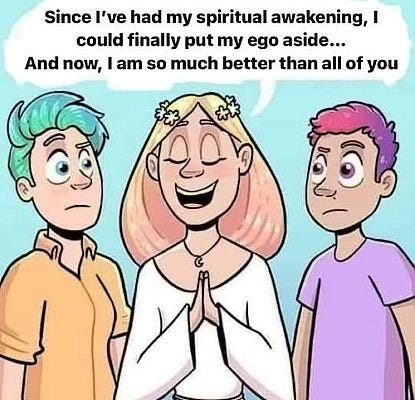
When a spiritual person does this, we sometimes call it the “Spiritual Ego” Kimberly Fosu described that as:
When a person goes around announcing to the world and boasting that they are spiritual, enlightened, high vibrational or whatever term they may use, it’s always almost the spiritual ego talking. —(in The Only Thing Worse than Ego is a Spiritual-Ego (a Medium article)
That happens because the ego thinks it is Pure Consciousness (Type V) and that then becomes its Story (Type II). That is especially dangerous when we believe we have reached a level of consciousness with no ego.
Whether we have done that may depend on which type of ego we no longer have. If it is an ego judgment, then it is a Spiritual Ego that is involved. When Paramhansa Yogananda said that “if you think you are enlightened, then you probably are not”, he was referring to the Spiritual Ego.
This situation can also be a form of Spiritual Bypassing, which is using spiritual reasoning to either ignore physical reality (“it’s just an illusion”) or to justify immoral and unethical behavior (“I am God so I can have sex with whoever I want”).
We cannot assume that someone who has reached an expansive and more open state of consciousness will always be in that state and with that level of ego understanding. This is the potential trap that all followers of spiritual teachers and gurus face.
I heard someone once say that to accuse another of spiritual bypassing is itself spiritual bypassing. I understand that to mean it is divisive and comes from a state of moral superiority. It does not recognize the unity of reality and does not reflect the compassion and unconditional love that we associate with higher states of consciousness.
Accusing others of spiritual bypassing reflects and strengthens our 3D experience. That is perfectly OK if 3D is what we want. But nowadays, most spiritual people are seeking more than that.
For more on how this works, see:
[3.2] Confirmation Bias
It is much easier to see the Spiritual Ego and Spiritual Bypassing in others than in ourselves. That is because we are naturally and easily drawn toward things that support how we think. We know this as “Confirmation Bias”, which is the tendency of the ego-mind to…
search for, interpret, favor, and recall information in a way that confirms or supports one’s prior beliefs or values…ignoring contrary information. — Wikipedia
For the spiritual ego, it is seeing and interpreting things in a way that convinces the ego that it is “enlightened”, or whatever other state it has adopted as its story. Confirmation bias blinds us to contrary information.
If we have an ego, we have some Confirmation Bias that blinds, or at least blurs, our vision. We even manipulate the world and others to get them to conform to our beliefs. Every boss and every teacher does this as part of their job.
Confirmation Bias is insidious because it usually happens without us knowing it.
The worst-case scenarios are those in which the ego/person intentionally undermines and destroys the beliefs and values of others to support their own ego beliefs. That is when Confirmation Bias becomes Narcissism.
[3.3] Ego Power: Charisma & ‘Siddhis’
A spiritual teacher is one form of Confirmation Bias.
The more devoted the followers are, the more likely it is they will not see the teacher’s “spiritual ego” when it arises. That is due to “charisma”.
While the teacher’s spiritual ego strengthens through Confirmation Bias, the apparent charisma of the teacher feeds the follower’s spiritual ego.
Charisma has two related definitions. The first is the Christian charismas, which is from the Bible and the Holy Spirit. I think of this as “religious charisma” when associated with Christianity and “spiritual charisma” when associated with spirituality more broadly.
They are like Hindu siddhi powers and one of them is the power to lead or rule over others. Also, like siddhi powers, others use charisma as a measure of a person’s spiritual attainment. Many advanced spiritual teachers warn against that.
The second definition of charisma is psychological and non-religious. It is an innate personality characteristic that attracts others. Psychologists consider it an important leadership skill that we can develop to a degree.
Like charismatic evangelical preachers, popular New Age gurus and teachers have spiritual charisma. It might come from something equivalent to the Holy Spirit and reflect their level of spiritual attainment.
Or it might be an innate ability that they were born with, reflecting their spiritual ego attainment. With charisma, it is hard to tell. In most cases, it is likely both.
Money and fame are two powerful ego-driven motivations to expand our charisma and ego. When we do that in a spiritual context, we are expanding our spiritual charisma and spiritual ego.
[3.4] Egoism, Egotism, Egocentrism, & Narcissism
Ego is a slur that we emphasise in our opponents and overlook in ourselves. — James Cussen in Why the Ego Became a Cultural Piñata (a Medium article)
Although it is not so obvious in the definitions at the top of this article, in popular use, we almost always consider the ego a negative aspect of our human personality. Even in spirituality, there is the concept of “killing the ego”, the “death of the ego”, and “the ego is not your friend”. As mentioned above, this is referring to our attachment to/identification with the ego (making it all consuming of who we are), rather than the ego itself.
These negative perspectives mostly come from the way we define the word ego in Western psychoanalysis (see the James Cussen article linked above).
For example, here are three psychoanalysis concepts related to the ego, all of which are negative character traits. They are closely related to each other, and I am only briefly defining them here (based on Wikipedia):
- Egoism, Egotist — the belief that everyone and everything always and only behaves solely in their own personal self-interest.
- Egotism, Egotistical — the belief in the need to maintain and enhance favorable, inflated, and overestimated/over-confident views of oneself compared to others.
- Egocentrism, Egocentric — the inability to see the perspective of others.
In common usage, when we hear the word ego, these are the first images that come into our mind. We think of someone who is overly prideful, self-centered, greedy, image-obsessed, materialistic, and insensitive to others.
We all have these ego characteristics to a degree. Narcissism is the extreme case of these. It is said that a narcissist is someone who falls deeply in love with their story (or fantasy). They do everything they can do to prove to themselves that their I Am My Story is true.
And of course, this is something that many of us would want to “kill”! It is, by most definitions, the opposite of spirituality. And I agree with that. However, as seen in the definitions that started this article out, this is a limited perspective on the ego.
This perspective sees the ego as an “illness”. It comes from a long history of psychoanalysis in which profited from a focus on illnesses. It also comes from an entertainment-based media industry that plays to the lower, more negative instincts of humankind as their source of income.
Spirituality is changing this by (slowly perhaps) bringing in a larger perspective that is less judgmental and more understanding of the value and purpose of everything in existence. That is what we see in most of the five general definitions of ego described above.
As you create a space-time structure, you create an ego structure in order to experience it. They go hand-in-hand. They’re simultaneously coexistent and co-created. Now, when we say ‘ego structure; again, we don’t necessarily mean it in the negative context because we understand that many people on your planet experience the ego structure in what you call a negative way. The ego’s basic job is not negative in a sense. It’s not even really positive per se. It’s just neutral. It’s just to keep you focused so you can have a physical experience. — Bashar/Darryl Anka, Hall of Mirrors session, June 18, 2011
[3.5] Collective Egos & Racism
Expanding our ego might mean we identify more strongly with a collective ego.
In a Facebook discussion on “racism”, I suggested it is our “I Am My Story” ego that causes us to identify with one socially constructed group and dis-identify with other groups. That separation is racism, though its intensity varies from one situation to another. I concluded that if there were no “I Am My Story” ego, there would be no racism.
During a discussion that followed my comment, I came to realize that a more troublesome source of racism is the “Autopilot” ego. As noted above, the Autopilot ego is more insidious than the “I Am My Story” ego because it is mostly unconscious and we believe its beliefs are universal truths.
The social sciences tell us that there are 3 types of racism:
- Individual Racism — overt/conscious acts by individuals that are racist (I Am My Story Ego)
- Institutional Racism — institutional policies that have racist outcomes (mixed of the other two)
- Systemic Racism — covert/unconscious values and beliefs held by social groups have racist outcomes (Autopilot ego)
As I mentioned above, we are the different versions of our ego all at the same time. So, some of our racist acts are overt (conscious) based on our I Am My Story ego, and some of our racist acts are covert (unconscious) based on our Autopilot ego.
Neither are acceptable from spiritual and humanist perspectives. I still maintain, however, that the only true way to solve these problems is to raise our collective consciousness beyond the limitations of our 3D egos.
Individual ego come together and support one another as Collective Egos.
Institutional and Systemic racisms are clearly social and collective. They also form an “Autopilot Collective Ego”. And being more deeply embedded in our psyche, they have an enormous impact on our individual ego.
There are many more Collective Ego issues that share the same challenges of racism. The way our economy exploits of our environmental resources, for example, is Collective Ego racism toward our natural environment.
Humans often feel powerless in relation to the collective institutions and collective subconscious that we are a part of. We feel so small against those massive structures.
However, those collective structures exist because of us. They exist because of our conscious I Am My Story ego, which then becomes our unconscious Autopilot ego. Like those egos, they are not our true self that is beyond the ego. They are temporary ego illusions and we can change them.
Our Legal System, Political System, Medical Care, Religions, Mass Media, and Educational Institution are other collective entities with Collective Egos. We can change them by consciously changing our individual “I Am My Story” ego, which will directly affect our collective unconscious Autopilot ego.
This is how individual action affects the collective. We are the collective and to change the collective; we need to change ourselves. The big question for us as individuals, and thus for our planet’s future, is:
How can we re-create our collective institutions and collective subconscious culture to reflect a “Beyond the Ego” state of consciousness?
I do not know the answer to this. But I think Ramana Maharshi is right when he said:
“Our own self-realization is the greatest service we can render the world.” — Ramana Maharshi
[4] Do We Need an Ego?
Be kind to your ego. Do not treat it like a dumb relative, that you want to thrust aside. Tell it that it will also gain in its manipulation within physical reality and coax it a bit. Do not give it the boot.” — Seth/Jane Roberts, The Early Class Sessions, book 3, ESP Class Session, on May 18, 1971
From a New Age spiritualist perspective, a major reason we have an ego is so we can function in the 3rd Dimension, physical reality that we are currently present in. As noted above, some say that we leave our ego behind when we end this incarnation.
Others, myself included, believe that the ego is not just a characteristic of the 3rd Dimension. Rather, we need an ego to be an individual or separate being or form through all the dimensions of manifest reality.
Everything in existence on our side of Source/God/The Void has an ego expression. This included plants and rocks, besides humans and animals. We all need an ego to exist. So, we should learn to enjoy it as much as we can.
When the ego disappears entirely, then we no longer exist. Then we absorb back into Source/The Absolute, which is formless and cannot be described or known from the universe of form — despite our many efforts to do so.
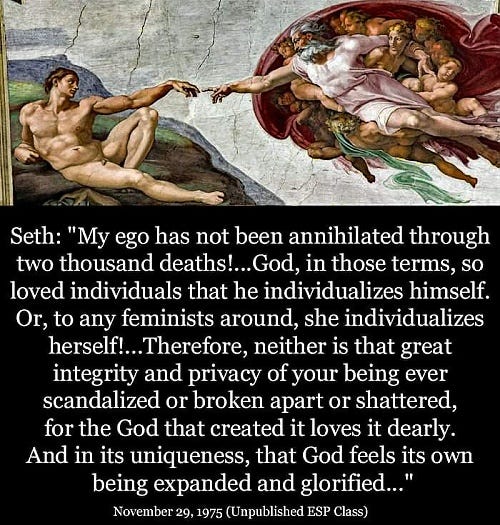
Neo-Advaita (nonduality) speakers may come closest to a non-ego experience while in our human form. Their seemingly nihilistic and negative theology message, however, is challenging for many because of our ego’s resistance. But I also sense a deep melancholy in at least some of them, as if they missed their “ego”. I also feel they like to talk about nonduality so much because they fear they will lose that awareness if they do not.
Ramesh Balsekar was a more traditional Advaita Vedanta nonduality teacher (a student of Nisargadatta Maharaj). He stated in a video recorded in 1999:
The ego has tremendous value because without the ego, life as we know it cannot happen. The ego is the very essence of the happening of life. — Ramesh Balsekar
At the start of that same video, he says: “You cannot escape from life into enlightenment”. Life continues, but there is an “absence of personal doership”. So, the ego continues, because that is life, be we no longer see the essential self as the ego.
Roger Castillo described the absence of a “doer” this way:
Life happens…Thinking happens…Experience happens. But we do not create these, they all happen completely outside of our ego’s control. We [the ego] are simply the witness to these happenings. — paraphrased from Roger Castillo
(See also Ramana Maharshi’s comments on the ego in section [1.2].)
I heard elsewhere that if we did not have an ego, we could not experience loving another person, or anything else. This differs from the unconditional love of oneness, where one loves everything because we know everything to be us in an ocean of pure love.
The love of another requires a sense of separation, which only the ego can provide. This is also true of feelings of gratitude, service, cooperation, co-creation, connection, and appreciation. It also includes negative emotions felt toward others. They all require a sense of “other” — whether the other is an illusion.
And another related concept, mentioned above, is the idea that our subconscious mind (our soul-self, or consciousness) does not know good from bad, nor right from wrong. At that level of consciousness, everything is energy and experience, and there is no judgment.
But in our 3D level of experience, good/bad and right/wrong are very real experiences. The problem is that our soul-self delivers to us what our ego-self tells it we need. So, yes, we need an ego to communicate with our subconscious soul-self. But we need an ego that has a clear vision of what is in our best interest.
For more on the importance of both the ego-self and soul-self perspectives, see:
To have a sense of awe and wonder about the world is another experience that can only happen if we have and are our ego.
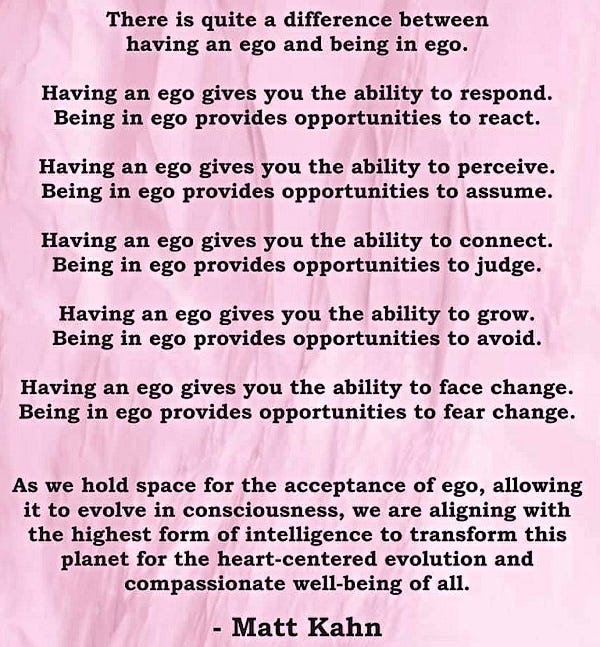
This may be what Matt Kahn describes as the difference between “having an ego” and “being an ego”:
[4.1] What is Your Definition of “Ego”?
LIKE MANY other topics of the mind, especially spiritual ones, the ego is not nearly as well defined as people who use the word make it out to be. We each have our own personal definition, and we then assume that everyone else has the same definition.
Because these different definitions are layered, building on and incorporating aspects of each other, it is easy for us to hold one view at one moment, and switch to another view in the next moment without ever realizing we did this.
I have been wanting to write about the ego for several months now, starting and stopping several times as I encountered different and confusing definitions of it. The poem below came to me about a week ago, which inspired me to produce a way to approach this article.
Please consider the diverse definitions described here and be clearer the next time you try to discuss or debate someone on a topic related to the ego.
For more on the many spiritual personalities (consciousnesses) we have, see:
I use the word “you” a lot in this article, without ever defining what I mean by “you”. Understanding the different versions of you is another way to fine out who you are:
[5] Related Resources
[5.1] Awakening from the Story
(The article above started as this poem, which came to me one night.)
Your story is your ego.
Whenever you say ‘I’, that is your story. As long as you have a story, you have an ego.
When you stop your story, you stop your ego. You become your innermost self. You become your personal soul.
But your personal soul also has a story. Your personal soul’s story is your inner ego.
When you stop your personal soul’s story, you become every story. You become the story of the universe. You become the Universal Soul.
But the Universal Soul also has a story. The Universal Soul’s story is God’s story.
When you stop the Universal Soul’s story, you transcend the phenomenal world. You return to God / Source / The Absolute. This is where you came from.
This is what was always here, behind the veils, hidden by the layers of stories.
[5.2] Other Articles
- For a good overview of Freudian Ego, Id, and Superego, see: What Freud Meant by the Ego, the Id and the Superego by James Cussen on Medium.com
- For more on The Many “Yous”, see this collection of articles:
- For more Spiritual Explainer Articles, see this collection:
- Note that the articles in the 2 collections above are behind the Medium paywall. For paywall-free access to my articles go to www.AlanLew.com, linked below.
Contact
- I am not financially affiliated with any of the people or products discussed in this article.
- I appreciate comments, questions, and typo corrections. - See the About link in my Medium profile for contact information and related articles.
- Written in collaboration with my Energy Group/Higher Self. This is our perspective of the truth and not the whole truth of reality.
My Medium writings are available “paywall free” at www.AlanLew.com:
- follow my Facebook page linked to my Medium writings
- subscribe to My Medium Writings
- become a Medium member to support my writings
Visit and Follow New Earth Consciousness (NEC) for More Articles like this.
- subscribe New Earth Consciousness NEWS, the occasional newsletter for NEC
- …and join our New Earth Consciousness Group on Facebook


