
A Spiritual Explainer — Part 1 of a 4-part series
Meditation Explainer — The What, Why, & How of Meditating
[Updated June 22, 2022] Meditation is central to contemporary spirituality, but just what is it?
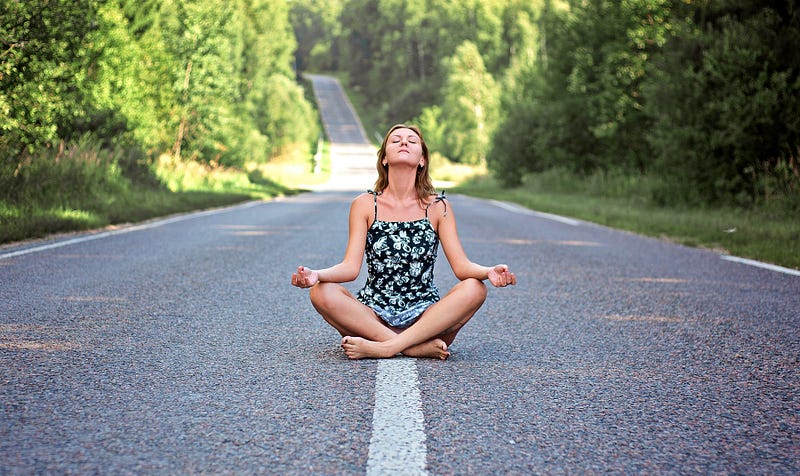
“I have tried meditating, but I couldn’t really get into it.”
I heard the quote above, or something like it, from relatives at 2 recent family get-togethers. I have also seen similar comments on Facebook spiritual groups, along with a lot of suggestions on how to meditate.
Part 1 (this article) is an Introduction & Overview
- What is Meditation? — [1.1] The Goals of Meditation — [1.2] The 3 Forms & 9 Types of Meditation — — [1.2.1] Nuances & Overlaps Among the 3 Forms — [1.3] General Guidelines on How to Meditate
- Examples of Popular Meditation Practices (links to YouTube) — [2.1] Vipassana Buddhist Meditation — [2.2] Nonduality Meditation — [2.3] Transcendental Meditation — — [2.3.1] Christian Centering Prayer
- My Meditation Practices — An Overview & Intro to Part 2
Part 2 (the next set of 3 articles) has detailed examples of each of the ‘3 Forms of Meditation’, based on my personal experience
[1] What is Meditation?
THERE is no clear definition of what meditation is.
That has not stopped people from doing meditation and talking about meditation. But it makes it difficult to discuss clearly and coherently.
The most general definition is that meditation is a way to quiet the mind. This usually refers to quieting the autopilot monkey-mind, which is one definition of our ego.
Meditation sounds good to us because it is natural for our mind to be drawn toward what it finds pleasurable. Meditation techniques attempt to get our thinking ego mind out of the way so that the rest of the mind can experience that pleasure (relaxation, bliss, pure awareness). Some teachings describe that as transcending our “thinking mind”, and even transcending all “experiences” and all manifest reality.
The longer-term goal is to carry the bliss and pure awareness of the transcendent state of consciousness into our non-meditation waking life and activities. And beyond, to hold that consciousness 24/7, including in our dreaming and deep sleep states of consciousness.
All that is easier said than done for most of us.
No single technique will work for everyone all the time. This has given rise to many schools and types of meditation. People resonate with some types and not others. And even that will vary with time and experience.
The problem is that meditation is a subjective experience. Each person experiences it in a different and unique way. How one experiences a meditation technique can vary a lot from one sitting to the next, and within the meditation itself. Meditation teachers sometimes explain the reasons for these variations, but often not.
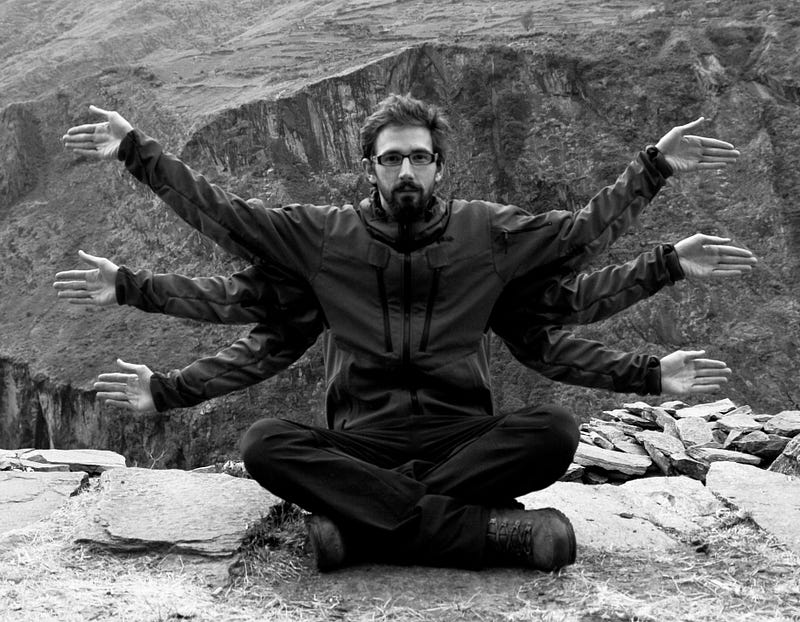
Even within the same meditation tradition, each teacher introduces a personal perspective (like what I am doing in this article). Our subjectivity draws us more to one teacher than another based on the personal twist that each of them offers.
Each school and teacher, of course, is offering the “best” meditation technique available — from their perspective. And “when the student is ready, the teacher will appear” for that student.
As with all life, we learn and advance by trying different meditation practices. This article summarizes the diverse meditations that you may encounter on your spiritual path.
[1.1] The Goals of Meditation
We do not meditate simply to experience meditation. Instead, meditation is a way to reach a goal. Some of the more common reasons for meditating are:
- To Quiet our Ego Mind and Relax our Physical Body into a state of peace and tranquility. It is called “mindful alertness”, making it different from sleep (which also quiets our mind and body). — This includes learning to “Be Here Now”, rather than being overly focused on the past or future. Some see this as an escape from the physical world we are engaged in, which may be good or bad. — At a deeper level, this includes transcending our ego, mind, experiences, and reality, which can be the same as #3 — To Know our True Self.
- To Release Stress and Trauma that has accumulated in our minds and bodies in this life (and maybe prior lives). I like to think of this are releasing our karma. —Including being healthier, both physically (e.g., lower blood pressure) and mentally (e.g., less emotionally volatile).
- To Know our True Self, which differs from what the outside world says we are or should be. — Including awareness that our true self is not our thoughts, emotions, and our autopilot monkey mind ego-self; meditation helps us to dis-identify with those experientially, instead of just intellectually. — That means connecting with our silent, inner, soul-self, which is a state of pure awareness or witnessing.
- To Experience and Attain a Higher State of Consciousness, such as “oneness” (Unity Consciousness) and “bliss”. — Including expanding our subtle senses, perceptions, and awareness to see and communicate with deeper realities; that can include out-of-body experiences (OBEs), lucid mediations (like lucid dreams), and other psychic abilities (like channeling) — To come into greater alignment with our divine self, with nature, and with God/Source; that can be the same as #3 — To Know our True Self.
- To Prepare Ourselves for Our Planet’s Ascension from the 3rd Dimension to the 4th/5th Dimension. — Including aspects of #3 and #4, above, for ourselves and for our entire planet, all its creatures, and all humankind in our shared evolution into the Age of Aquarius. — Meditation connects us with our higher self or higher consciousness/mind, which is less tainted by the ego-self or ego-mind. From that higher state of consciousness, our actions are in efficient alignment with the universe to do what is best for the Earth’s social and environmental challenges. That is because the ego-mind, which causes divisions, fear, and greed, is less present in our problem-solving efforts (#1 above).
To sum up all these goals, we meditate to live a happier life. We all want to be happy. Any of these goals can do that.
Since we were infants, society has taught us that happiness is “out there” in the world. Those without a meditation practice focus their lives on finding the right job, partner, house, and more to become happy. That is the opposite of meditation.
All forms of meditation teach us to turn inward for happiness. All the practices described below point us inward to find and know our happiness. Just as there are many outward paths to happiness, there are also many inward (meditation) paths to happiness.
[1.2] The 3 Forms & 9 Types of Meditation
FROM MY experience, there are 3 major forms of meditation. Each of these has 3 sub-types, for 9 types of meditation. And each of those 9 types includes many creative variations.
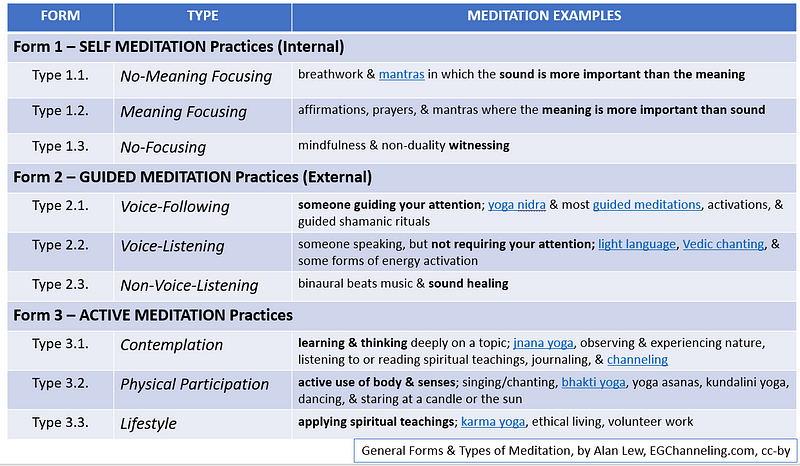
Form 1 — Self Meditation Practices (Internal)
—Type 1.1. No-Meaning Focusing (e.g., breathwork & mantras in which the sound is more important than the meaning) — Type 1.2. Meaning Focusing (e.g., affirmations, prayers, & mantras in which the meaning is more important than the sound) — Type 1.3. No-Focusing (e.g., mindfulness & non-duality witnessing)
Form 2 — Guided Meditation Practices (External)
— Type 2.1. Voice-Following (someone guiding your attention, e.g., yoga nidra & most guided meditations, activations, & guided shamanic rituals) — Type 2.2. Voice-Listening (someone speaking, but not requiring your attention, e.g., light language, Vedic chanting, & some forms of energy activation) — Type 2.3. Non-Voice-Listening (e.g., binaural beats music & sound healing)
Form 3 — Active Meditation Practices
— Type 3.1. Contemplation (learning & thinking deeply on a topic, e.g., jnana yoga, observing & experiencing nature, listening to or reading spiritual teachings, journaling, & listening to or doing channeling) — Type 3.2. Physical Participation (e.g., bhakti yoga, singing/chanting, yoga asanas, kundalini yoga, dancing, & staring at a candle or the sun) — Type 3.3. Lifestyle (e.g., karma yoga, ethical living, & volunteer work)
These cover all the meditation practices that people do nowadays.
Self Meditation Practices (Form 1) are when the meditator is in complete control of the meditation. They learn a technique, but beyond that, there is no active external help in doing the technique.
Guided Meditation Practices (Form 2) are those for which external guidance is required. This is usually as voice instructions or music/sound. Sometimes the voice might be something that the meditator reads. Plants and chemicals taken for spiritual purposes fall under this form of meditation because they typically include special guidance and instructions.
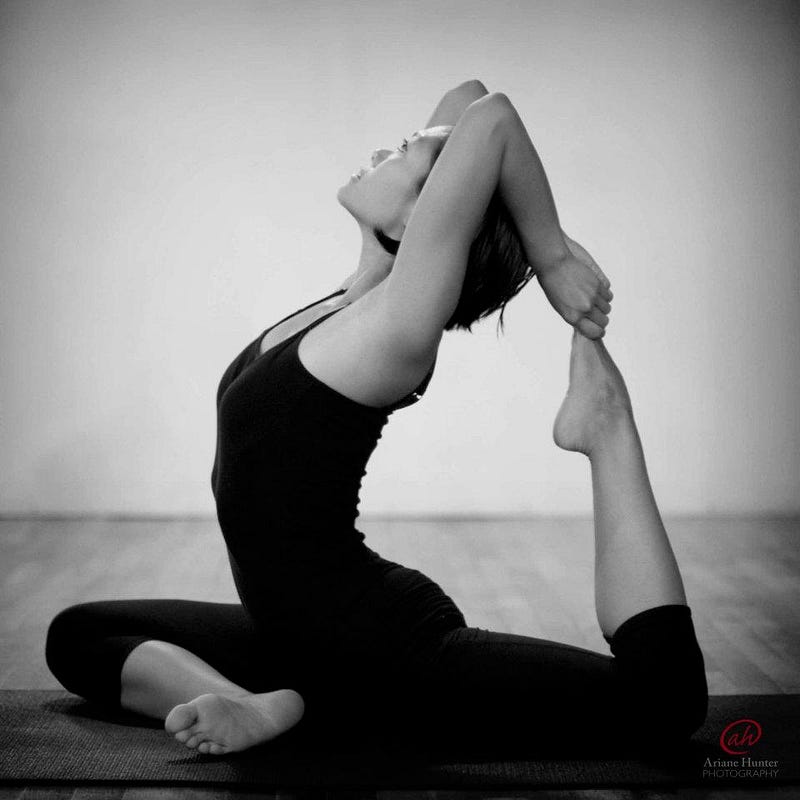
Active Meditation Practices (Form 3) are sometimes not considered “meditation” by contemporary definitions. But anything can be a meditation. For the awakened, their entire life is a meditation.
Contemplation is the original definition of meditation in the West and is still an important meditation practice. That is especially so if we consider that all forms of learning are a spiritual experience.
Physical Participation, such as kirtan chanting and yoga asanas, is an important part of spirituality. This is especially so when your body experiences a flow experience (which can also happen in sport activities). These meditations are different from contemplation because they require intentional physical or sensory effort.
Lifestyle was an important part of Patanjali’s Yoga Sutras (the yamas & niyamas, in particular), and is a core part of the Noble Eightfold Path of Buddhism. Many spiritual people practice this form of meditation without realizing it.
Before you speak, always ask yourself, are your words spoken at the right time?, are they true?, are they kind?, and they are helpful? —”Right Speech”, paraphrased from the Buddha’s Eightfold Noble Path
[1.2.1] Nuances & Overlaps Among the 3 Forms
There are many nuanced variations within the meditation types listed above. The examples that I included above point to that. But we can also teach the same meditation in different ways.
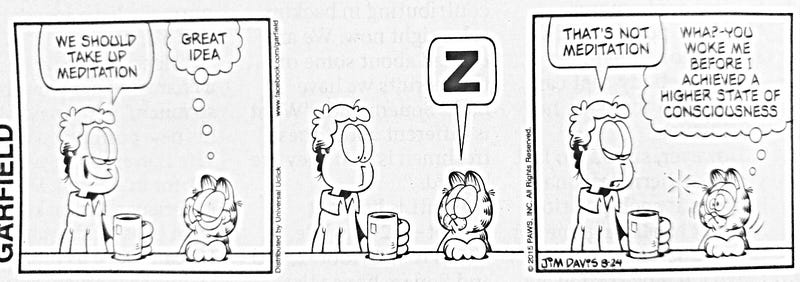
The word “focus” for example, is one of the most challenging aspects of meditation to teach and learn. That is because its meaning ranges from a very intense concentration to a subtle, non-attached awareness. The meditator’s experience varies a lot between those two extremes. Some people like concentration meditation, while others prefer awareness meditations.
Some meditation practices overlap the types above. And many teachings include more than one type. For example, Patanjali’s Yoga Sutras and Buddha’s Eightfold Path include most of the 9 meditation categories.
Other examples of overlaps include:
- For listeners, Kirtan Music is a mix of mantra (Types 1.1 & 1.2 ), prayer (Type 1.2), and participatory singing (Type 3.2).
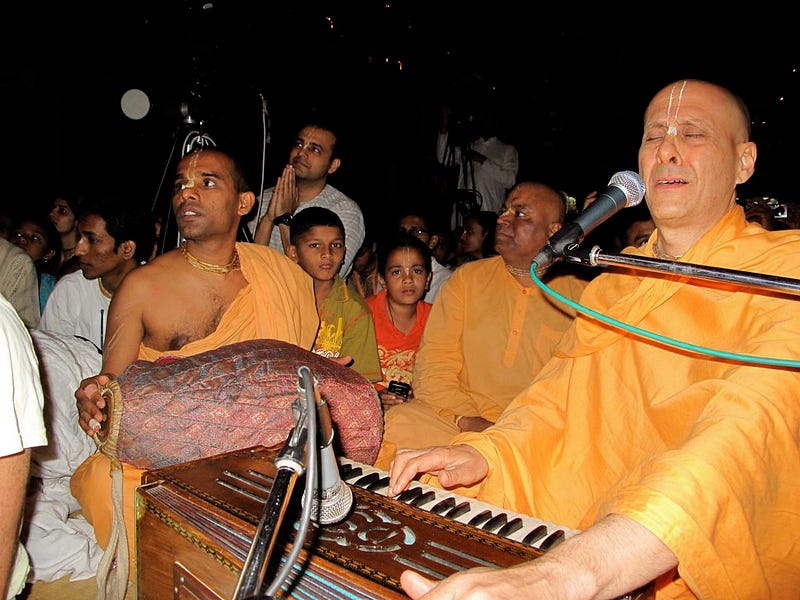
- For most people, listening to Vedic Chanting is a mix of no-meaning mantra (1.1) and voice-listening meditation (2.2). For those trained to do Vedic Chanting, it would be a mix of meaning mantra (1.2) and physical participation (3.2).
- The Voice-Following Meditation (2.1) often includes affirmation statements and chakra focusing that have meaning. This makes them similar to (overlapping with) Meaning Focusing practices (1.2), except that they are not Self Meditations.
- Understanding the conceptual basis (theory or justification) of a meditation practice is often helpful and is a form of Contemplation (3.1). Sometimes the meditator needs this knowledge, especially for Self Meditation practices (Form 1). At other times, that is not so necessary, especially for Guided Meditation practices (Form 2).
[1.3] General Guidelines on How to Meditate
These are my recommendations for anyone interested in getting started or enhancing their meditation practice. These apply to Self Meditations (Form 1), and most Guided Meditation (Form 2). They apply, but less so, to Active Meditations (Form 3).
- The easier the meditation is, the more likely you will stick with it (in my opinion).
- Guided Meditations (Form 2) are easier for most people. — But much depends on how well the guided meditation resonates with the meditator. — Try different guided meditations (on YouTube) until you find a teacher or teachers you resonate with. Do not worry if the ones you follow change. It just shows that you are spiritually evolving.
- Self Meditations can be more flexible in terms of when, where, and how long we do them. Those vary, but we can do many such practices almost anywhere and anytime. — Search on “how to meditate” on YouTube (for video instructions) or online (for text instructions). Much of the material you will find is free. There might also be teachers in your community. — Explore different Self Meditation practices, teachers, and styles. Find those that you resonate with. You might even teach yourself at some point.
- Subtle Awareness is the type of focus that most Self Meditations and Guided Meditations seek to achieve. Subtle means you are barely aware of anything except that you are in meditation (and you are not asleep). In that state, you are less connected to your mind, body, and the world as your awareness is inward. — If you get a headache after meditating, then you either concentrated too hard, or you came out of the meditation too fast.
- Set Up a Routine, such as meditating when you wake up in the morning and after dinner in the evening. The more you can stick to your routine, the better. But also be flexible when needed. — Only meditate for as long as is comfortable in each sitting.
- Falling Asleep in Meditation is controversial. According to some teachings, falling asleep is beneficial. Others say you should avoid it as much as possible (by pinching yourself, for example). — I like meditation-induced naps and my afternoon meditations will often end in a nap. Some recommend meditating a little longer after you wake up from such a nap. (I don’t do that.)
- How to Deal with Thoughts and Restlessness during meditation is another controversial topic. Most meditations seek to silence thoughts and calm the body. Focusing on something other than your thoughts and restlessness is the most common way to do that. — For a Guided Meditation, this would be the words, music, or other sounds that you are following. — For Self Meditations, this is the mantra, your breath, your face, your heart, your aura, or other focus of your attention. — The controversy is in how hard to focus. Some recommend focusing hard (concentration), but that can give you a headache and make you irritable. Others recommend a soft focus (awareness). I prefer a soft focus. I allow the thoughts or emotions to be, while giving a very gentle preference to my mantra. The thoughts will change and (usually) stop at some point. (The examples in Section [2] all tend toward a soft focus.)
- Become a Student of Your Meditation. Whatever type and teaching of meditation attracts you, learn as much as you can about it. That itself is Contemplation Meditation (3.1). It includes learning how and why the meditation works, and how to deal with issues (such as restlessness) that may arise. This will help keep you committed to the practice when your ego-mind might resist it. — Consider attending retreats and meditation-related activities (Active Meditation, 3.2). — With time, you will incorporate the philosophy and teachings associated with your meditation into your life (Lifestyle Meditation, 3.3). Your meditation will be with you in your daily life, and even in your sleep.
- Be Eclectic in Your Practice (or Not). I choose from a wide variety of spiritual teachings. I follow my interests and instincts — what feels good to me at the moment. As you will see below, I currently do a lot of different meditation practices, and I have done many more in the past. I feel more rounded by being eclectic that way. — My wife is not like that at all. She has her practice, and she is happy with that. Only occasionally will she try something new. But my stories of the things I am doing entertain her.
[2] Examples of Popular Meditation Practices
— Introductions & Guided Meditations on YouTube
[2.1] Vipassana Buddhist Meditation
—from the Theravada Buddhism tradition, which is mostly in Southeast Asia
⬇ In this talk, Ajahn Sangharatana covers: (1) A Loving-Kindness (Metta) chant, (2) Different forms of Vipassana meditation, (3) Instructions on breathing meditation, (4) a guided breathing meditation, (5) a Satsang teaching on the importance of meditation, and (6) a Q&A
[2.2] Nonduality Meditation
⬇ “Who Am I?” is the basic question of Nonduality (Advaita Vedanta) meditation. The guided meditation below takes you through a “neti-neti” (not this, not that) meditation to become pure awareness.
[2.3] Transcendental Meditation
— As taught by Maharishi Mahesh Yogi and practiced by the Beatles and many Hollywood celebrities. Transcendental Meditation (TM) is taught one-on-one by trained and certified teachers — you cannot learn it online. I learned TM in 1974 and have practiced it (and attended many TM retreats) since then.
⬇ There are many videos on YouTube that claim to teach TM. I have seen a couple dozen and none of them teaches the TM that I learned. Among those I have seen, this one comes close to giving you an idea of what TM is like. But it still misses some important aspects of the practice.
[2.3.1] Christian Centering Prayer
was developed by Thomas Keating as a Christianized version of TM. If you remove the prayers and references to God and Christ, then it is similar to TM.
⬇ This is a good introduction by Rev. Cynthia Bourgeault, although she associates Centering Prayer with Buddhism, whereas it really comes from the Hindu Advaita Vedanta (nonduality) tradition. The video (on YouTube) includes a 15 minute guided meditation.
[3] My Meditation Practices — an Overview
HERE IS a list of my meditation practices at the time of this writing. It surprised me to find that I do most of the 9 types of meditation regularly. I did not do that on purpose. It just happened by itself, as I followed my interests.
In the list below, if I close my eyes, I use the word “meditation”. If my eyes are mostly open, I use the word “practice”. I have separate articles that go into detail about each of my meditation practices.
[Form 1] Self Meditation Practices (Internal)
Type 1.1. NO-MEANING FOCUSING
<Example 1>—A Self, No-Meaning Mantra Meditation — Transcendental Meditation (TM) — 45 minutes total, twice daily
Type 1.2. MEANING FOCUSING
<Example 2>— None at this time. I have done this type of meditation in the past, such as: A Simple Chakra Meditation to Realize your Higher Self. — The Voice-Following Meditation (#iv below) that I do sometimes includes affirmations and chakra work that have a Meaning Focus, but those are Guided and not Self Meditations.
Type 1.3. NO-FOCUSING
<Example 3>— A No-Focusing Non-Duality Mindfulness Practice — based on Nonduality teachings (like [2.2] above)— off and on throughout the day
See the next article in this series for detailed descriptions of these first 3 types of ‘SELF Meditation’ examples
[Form 2] Guided Meditation Practices (External)
Type 2.1. VOICE-FOLLOWING
<Example 4> — A Guided, Voice-Following Channeled Meditation — Guided meditations by channeled by Lincoln Gergar — 15–30 minutes, twice daily
Type 2.2. VOICE-LISTENING
<Example 5>—A Guided, Non-Voice Breathwork Meditation — “Continuous breathing” with a “cardiac coherence” phone app — 15 to 30 minutes, about once a day <Example 6>—A Guided, Voice-Listening Activation Meditation — a unique style of live (on Zoom) guided meditation by Cornelius Christopher — 30 to 60 minutes, 2 to 4 times a week
Type 2.3. NON-VOICE-LISTENING
<Example 7>—A Non-Voice-Listening Water Sound Meditation — Playing sound frequencies with an underwater speaker — about 30 minutes, about every other week
See part 3 of this series for detailed descriptions of these ‘GUIDED Meditation’ examples
[Form 3] Active Meditation Practices
Type 3.1. CONTEMPLATION
<Example 8>—An Active, Contemplation Learning Practice — Learning and writing (on Medium) about spirituality—most days, but with periodic breaks <Example 9>—An Active, Contemplation Channeling Practice — Channeling my Energy Group / Higher Self — about 15 minutes, once a month

Type 3.2. PHYSICAL PARTICIPATION
<Example 10> — An Active, Physical Participation Yoga Practice — Yoga asanas and some kundalini breathwork through my local yoga studio — 4 to 6+ hours a week <Example 11> — An Active, Physical Participation Vocal Healing Meditation — Chakra humming based on teachings of Jonathan Goldman — 5 minutes, daily <Example 12>—An Active, Physical Participation Sound Healing Practice — My Earth Gongs sound meditations for myself and others — 20 to 50 minutes, one to three times a week
Type 3.3. LIFESTYLE
<Example 13>—A Lifestyle Vegan & Organic Diet Practice — most of my meals at home
See part 4 of this series for detailed descriptions of these ‘ACTIVE Meditation’ examples.
I have a regular, twice-a-day, practice, in the morning and afternoon (as stated above). I do most of these meditations and practices at other times throughout the day and week.
When I travel, I do my basic TM meditation almost every day. I do as much of the others meditations and practices as the trip allows. Sometimes I can barely find time to do the TM meditations.
I believe that meditation is essential for humankind and our planet’s future well-being. Let me know if you have questions or if I can be improved this resource in any way:
Related Resources
Part 2 of this series for detailed descriptions of SELF MEDITATION practices
Part 3 of this series for detailed descriptions of GUIDED MEDITATION practices
Part 4 of this series for detailed descriptions of ACTIVE MEDITATION practices
- For more on Meditations & Meditating, see this collection of articles:
- Note that the articles in that collection are behind the Medium paywall. For paywall-free access to my articles go to www.AlanLew.com, linked below.
Contact
- I am not financially affiliated with any of the people or products discussed in this article.
- I appreciate comments, questions, and typo corrections. - See the About link in my Medium profile for contact information and related articles.
- Written in collaboration with my Energy Group/Higher Self. This is our perspective of the truth and not the whole truth of reality.
My Medium writings are available “paywall free” at www.AlanLew.com:
- follow my Facebook page linked to my Medium writings
- subscribe to My Medium Writings
- become a Medium member to support my writings
Visit and Follow New Earth Consciousness (NEC) for More Articles like this.
- subscribe New Earth Consciousness NEWS, the occasional newsletter for NEC
- …and join our New Earth Consciousness Group on Facebook


