
Nonduality | Ramana Maharshi | Self-realization
What is the Pure Consciousness of “I AM”?
[Updated January 28, 2024] “I Am” is the fundamental teaching of Ramana Maharshi, and it is not who you think you are.
Non-Medium subscribers can access this article paywall free here.
I Am That
Spiritual seekers who have explored Eastern traditions, especially Hinduism, are familiar with the teaching of “I Am”. It is often taught as “Tat Tvam Asi”, which is interpreted as thou art that, or you are that, or I am that. “That” refers to God/Source/the Absolute/the Universe, and in Advaita Vedanta (Hindu nondualism) the “Tat Tvam Asi” means the individual (I/me/you) is not separate from the Absolute (or ultimate reality).
In Advaita Vedanta (as well as the more western Neo-Advaita), self-realization (or enlightenment) is when the separate individual (or ego) drops away and only the Absolute remains. I often refer to this as a state of “Pure Awareness” and sometimes the “True Self”. But many other terms are used, including:
- the Field of Being, Pure Beingness, Oneness, Nonduality
- Emptiness (sunyata), No-self (anatta), the Tao, the Void, Nothingness, No Thing
- Consciousness, Pure Consciousness, I Am-ness, Presence, Radiant Presence
- Awareness, Formless Awareness, Effortless Awareness, Choiceless Awareness
- Witnessing, Silent Witnessing, Witnessing without a Witnesser, Doing without a Doer
- Direct Experience, Raw Experience, Experiential Field, Experiencing without an Experiencer
These terms appear straightforward. But in truth, they are impossible to fully know because they require a kind of comprehension that is beyond the human mind (or ego). It is a no-mind/no-ego/no-self state of being. (In this context, “ego” is the sense of an individual self that is separate from everything else.)
For example, our human ego/mind/self cannot directly know
- witnessing without itself as a witnesser, or
- experiencing without itself as the experiencer, or
- doing anything with itself as the one who is doing it.
That is because the ego/mind/self is itself an object in the Pure Awareness of “I Am”.
At the same time, the Pure Awareness of “I Am” is (almost) always present (some call it the “here and now”). We all know the feeling of being — of existing. That feeling is the “I Am”. It is our deepest sense of knowing, and it is the one and only absolute knowing that we all share.
Beyond humans, it is likely that all sentient beings hold that same sense of “I Am-ness”. And for Panpsychism, even non-sentient objects, like rocks, have a kind of “I Am” consciousness. That is the oneness of all creation.
NOTE: The list of terms above comes from:
The following quote from Michael James further explains the I Am-ness of our True Self. Michael James is a prominent English translator of Ramana Maharshi’s writings. Here he is answering a question from a listener on a YouTube broadcast (linked below).
Pure awareness means awareness that is just aware, without being aware of anything … free of all objects. … That is what we actually are. So long as we are attending to anything other than ourselves, we, who are attending to those other things, are ego.
But if we withdraw our attention from other things by trying to focus it on ourselves, to the extent to which the attention is focused on ourselves, ego subsides. And if we manage to focus our entire attention on our Self alone, ego will cease to exist. And what will remain is just the pure awareness that we actually are.…
For many people, when we talk about pure awareness, it seems to be something very distant. … But there is never a moment when we are not experiencing “I Am”.
So pure awareness is nothing but that “I Am”. It seems to be obscure because of our awareness of other things. So we need to go back to our own being, “I Am”, and try to hold on to that.
The more we turn within and focus our attention on “I Am”, the clearer all this will become because “I Am” is the original light — the light that illumines the mind, allowing it to know all other things. We know objects in the world by physical light. But what is the light that knows that physical light? It is the light of the mind. … It is the light of the fundamental awareness “I Am”.
Without this fundamental awareness, “I Am”, there would be no awareness of anything.
Of course, we cannot say “without the fundamental awareness, “I Am”, because that [“I Am”] is the one reality, the one thing that can never be absent. Awareness of other things comes and goes, along with ego. But the awareness “I Am” shines eternally.
— Michael James, explaining the teachings of Ramana Maharshi (on YouTube)
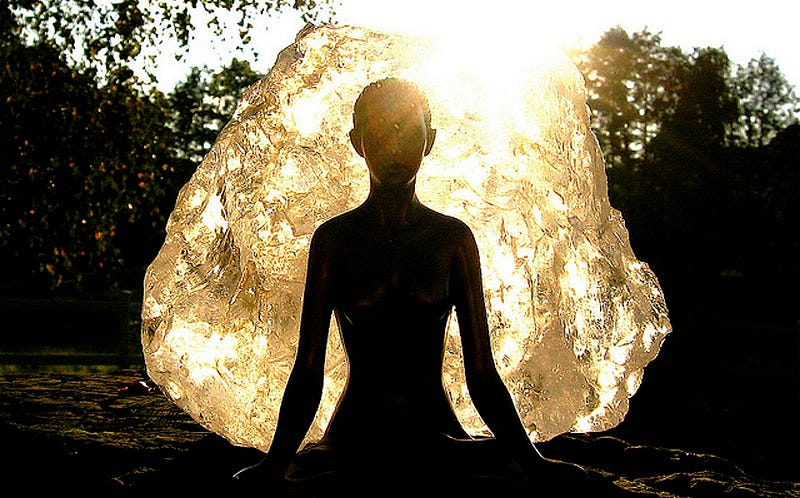
Ramana Maharshi — Meditating on “Who Am I?”
Some consider the Hindu sage, Raman Maharshi (1879–1950), to be the founding father of western Neo-Advaita (or Radical Nondualism).
While much of what Ramana taught aligns with Radical Nondualism, there are exceptions. A major one was his teaching of “Who Am I?” as a meditation that can dissolve the “ego” and reveal the “I Am” (resulting in self-realization/enlightenment).
But Michael James explains that Ramana never told people to ask or think of the question “Who Am I?”. Instead, he said people should investigate “Who Am I?”. By investigate, he meant to observe, seek, or discover without voicing or thinking any words. Words take you outward; self-observation takes you inward.
Ramana suggested that the reason this works is because the “ego” only exists when grasping outward. The ego is fully dependent on outward awareness.
When we turn inward, in the opposite direction as outward, the ego simply ceases to exist. When outward awareness (or grasping) ends, then the ego ends and only pure awareness (“I Am”) remains.
Since we are simply only looking at ourself, and our sense of “I Am” is always with us, this should be the easiest meditation.
But it is also the hardest meditation because our entire life we have been taught to look outward and not inward. As I said in my last writing, it is time to look inward…
RELATED
- Here is the source of the Michael James quote, above…
- For more on Nonduality (Advaita), see this collection of articles:
- Note that the articles in that collection are behind the Medium paywall. For paywall-free access to my articles, go to www.AlanLew.com, linked below.
CONTACT
- I am not financially affiliated with any of the people or products discussed in this article.
- I appreciate comments, questions, and typo corrections. — See the About link in my Medium profile for contact information and related articles.
My Medium writings are available “paywall free” at www.AlanLew.com:
- follow my Facebook page linked to my Medium writings
- subscribe to My Medium Writings
- become a Medium member to support my writings
Visit and Follow New Earth Consciousness (NEC) for More Articles like this.
- subscribe to New Earth Consciousness NEWS, the occasional newsletter for NEC
- …and join our New Earth Consciousness Group on Facebook