
Difference between @SpringBootApplication and @EnableAutoConfiguration in Spring Boot
Understanding the key differences and Usage of @SpringBootApplication and @EnableAutoConfiguration in Spring Boot Applications
Hello folks, If you are doing Java development then you may know that Spring Boot is one of the popular framework for building modern and scalable Java applications. It provides a wide range of features, including auto-configuration, that make Java development faster and more efficient
However, when working with Spring Boot, you may come across different annotations that seem similar in purpose, such as @SpringBootApplication and @EnableAutoConfiguration, while both are used to enable auto-configuration feature of Spring Boot there are some subtle difference between them, knowing which you can make best use of them.
In this article, we will dive into the differences between these two annotations and their usage in Spring Boot applications. Understanding these differences will help you make informed decisions when configuring and bootstrapping their Spring Boot applications for optimal performance.
If you are preparing for Java and Spring Boot Interview then you have come to the right place.
In the past, I have shared a lot of popular questions like difference between RequestParam and PathVariable annotations, difference between @Contorller and @RestController annotation, @Bean vs @Component annotation, and @Controller vs @Service @Repository and in this article, I am going to share another popular Spring Boot question, difference between @EnableAutoConfiguration and @SpringBootApplication.
@EnableAutoConfigurationannotation is used to enable Spring Boot's auto-configuration feature, which automatically configures the application based on the classpath dependencies and other properties.
It scans the classpath for various configurations and automatically configures the beans and other components accordingly. For example, if you have Hibernate JAR file then it can configure Hibernate for you.
On the other hand, @SpringBootApplicationis a combination of several other annotations, including @Configuration, @EnableAutoConfiguration, and @ComponentScan.
It is typically used to mark the main class of a Spring Boot application and is responsible for enabling the auto-configuration features provided by Spring Boot, setting up the application context, and scanning for Spring components.
By the way, if you are new to Spring Framework and want to learn Spring in depth and looking for resources then you can also checkout following online courses:
- Spring Master Class — Beginner to Expert
- Spring & Hibernate for Beginners
- Learn Spring: The Certification Class
- Master Microservices with Spring Boot and Spring Cloud
All of these are top rated courses to learn Spring framework in depth but if you need free resources you can also checkout these free Spring framework courses:
And, if you are preparing for Java and Spring interview then In my earlier articles, I have also shared 21 Software Design Pattern questions, 10 Microservice Scenario based questions, 20 SQL queries from Interviews, 50 Microservices questions, 60 Tree Data Structure Questions, 15 System Design Questions, and 35 Core Java Questions and 21 Lambda and Stream questions which you can use for your Java interview preparation.
In short, @SpringBootApplication is a higher-level annotation that includes @EnableAutoConfiguration along with other annotations, while @EnableAutoConfiguration is used specifically to enable the auto-configuration feature of Spring Boot.
Now that we know the basics, we will deep dive into each of them and understand them in bit more detail with code examples.
What is @EnableAutoConfiguration annotation? How does it work?
As I said, @EnableAutoConfiguration is an annotation in Spring Boot that enables automatic configuration of the application's beans and components based on classpath dependencies and other configuration settings.
When you annotate a class with @EnableAutoConfiguration, Spring Boot automatically performs the following tasks:
- Scans the classpath for relevant Spring Boot starter dependencies and their configuration files.
- Automatically configures beans and components based on the detected dependencies and their configuration.
- Sets up sensible default configurations for various Spring Boot features, such as data sources, caching, logging, security, etc.
In other words, @EnableAutoConfiguration allows Spring Boot to automatically configure the application's beans and components based on the dependencies and their configuration, without having to explicitly define them in the application's code.
This helps in reducing boilerplate configuration code and makes it easier to quickly set up a Spring Boot application with sensible defaults.
Here’s an example of using @EnableAutoConfiguration annotation in a Spring Boot application:
@EnableAutoConfiguration
public class PaymentServiceApplication {

    public static void main(String[] args) {
        SpringApplication.run(PaymentServiceApplication.class, args);
    }
}
In the above example, @EnableAutoConfiguration annotation is used to enable automatic configuration of the Spring Boot application. It scans the classpath dependencies and other settings to configure the application.
The PaymentServiceApplication class is the main entry point of the PaymentService application, where the main method is defined to run the Spring Boot application.
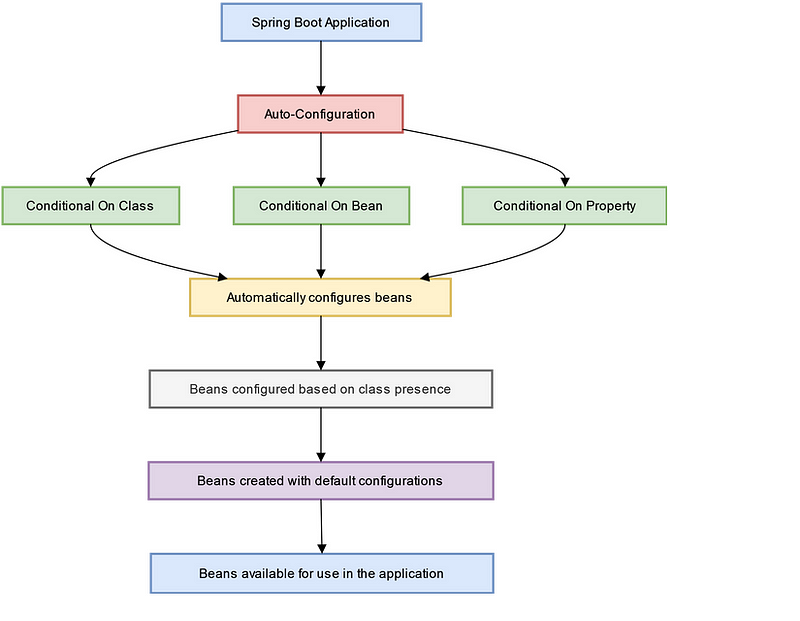
And, if you are not familiar with how auto-configuration works in Spring Boot, here is a nice diagram to understand it, I am going to cover that topic soon, if you want me to cover it next, please leave a comment
What is @SpringBootApplication annotation? How does it work?
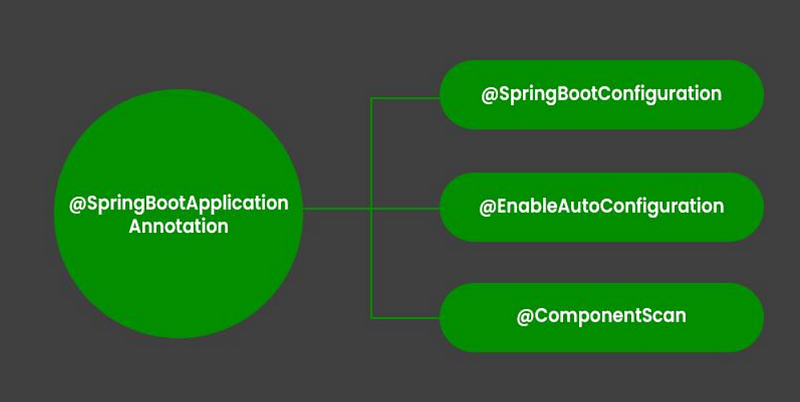
The @SpringBootApplication annotation is a meta-annotation in Spring Boot that combines three commonly used annotations: @Configuration, @EnableAutoConfiguration, and @ComponentScan.
It is typically used to mark the main class of a Spring Boot application and provides a convenient way to configure and bootstrap a Spring Boot application.
Here’s a brief overview of how the @SpringBootApplication annotation works:
@Configuration: This annotation indicates that the class is a configuration class and can contain Spring bean definitions. It is used to define and configure beans that are managed by the Spring framework.@EnableAutoConfiguration: This annotation enables automatic configuration of the Spring Boot application. It scans the classpath dependencies and other settings to configure the application based on the detected technologies and available libraries.@ComponentScan: This annotation scans the package and its sub-packages for Spring components, such as beans, controllers, services, and repositories. It allows Spring to automatically detect and register these components for use in the application.
By combining these three annotations, @SpringBootApplication simplifies the configuration and bootstrapping process of a Spring Boot application.
It provides a convenient way to define beans, enable automatic configuration, and scan for components, making it easier to develop and deploy Spring Boot applications.
Here’s an example of how you can use the @SpringBootApplication annotation with a Service class in a Spring Boot application:
@SpringBootApplication
public class MySpringBootApplication {

    public static void main(String[] args) {
        SpringApplication.run(MySpringBootApplication.class, args);
    }

    // PaymentService class
    @Service
    public class PaymentService {
        // ... implementation of payment service ...
    }

    // ... other application-specific code here ...
}
In this example, PaymentService is a custom service class that can be used to implement payment-related functionality in the Spring Boot application.
The @Service annotation is used to mark the PaymentService class as a Spring bean, which makes it eligible for dependency injection and other Spring-specific features.
The MySpringBootApplication class is the main class of the Spring Boot application, marked with the @SpringBootApplication annotation.
The main method is the entry point of the application, which uses SpringApplication.run() to start the Spring Boot application.
The PaymentService class can be used as a regular Spring bean within the application, and its dependencies will be managed by the Spring framework.
What is difference between @EnableAutoConfigruation and @SpringBootApplication annotations?
As I said in above paragraph, @EnableAutoConfiguration and @SpringBootApplication are both annotations used in Spring Boot applications, but they have different purposes and usage.
@EnableAutoConfiguration:
This annotation is used to enable auto-configuration in a Spring Boot application. It allows Spring Boot to automatically configure the application's beans, based on the classpath and other configurations.
It scans the classpath for available configurations, and automatically configures the application with sensible defaults for various components, such as data sources, web servers, and message brokers, among others.
It is often used in combination with other annotations, such as @Configuration and @ComponentScan, to define additional configuration classes and customize the auto-configuration behavior.
@SpringBootApplication
This is a meta-annotation that combines multiple annotations, including @EnableAutoConfiguration, @ComponentScan, and @Configuration, into a single annotation.
It is typically used as the main annotation for the main class of a Spring Boot application. It enables auto-configuration, component scanning, and marks the class as a configuration class, allowing it to define beans and other application-specific configurations.
It provides a convenient way to bootstrap a Spring Boot application with sensible defaults and enables the application to start as a standalone, executable JAR file.
In summary, while @EnableAutoConfiguration is used to specifically enable auto-configuration in a Spring Boot application, @SpringBootApplication is a meta-annotation that combines multiple annotations, including @EnableAutoConfiguration, to provide a convenient way to bootstrap a Spring Boot application with sensible defaults and configuration capabilities.
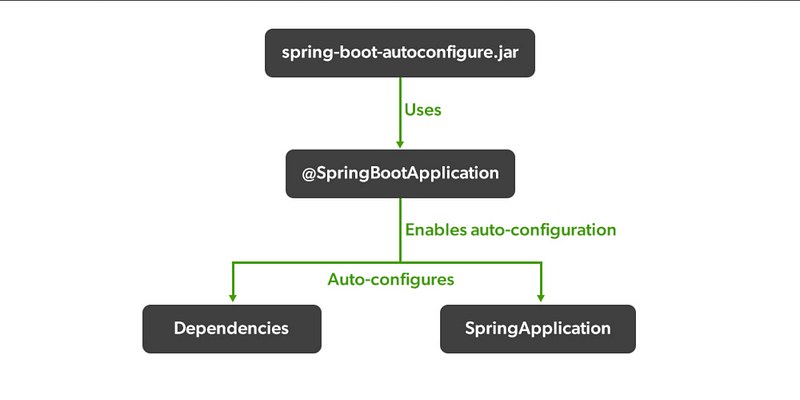
Here is another nice diagram which shows how @SpringBootApplication annotation can enable auto-configuration in Spring boot.
Java and Spring Interview Preparation Material
Before any Java and Spring Developer interview, I always use to read the below resources
Grokking the Java Interview: click here
I have personally bought these books to speed up my preparation.
You can get your sample copy here, check the content of it and go for it
Grokking the Java Interview [Free Sample Copy]: click here

If you want to prepare for the Spring Boot interview you follow this consolidated eBook, it also contains microservice questions from spring boot interviews.
Grokking the Spring Boot Interview
You can get your copy here — Grokking the Spring Boot Interview

Conclusion
That’s all about difference between EnableAutoConfiguration and Spring BootApplication annotation in Spring Boot. Understanding the difference between @EnableAutoConfiguration and @SpringBootApplication is essential for developing Spring Boot applications effectively.
While @EnableAutoConfiguration specifically enables auto-configuration in a Spring Boot application, on the other hand @SpringBootApplication is a meta-annotation that combines multiple annotations, including @EnableAutoConfiguration, to provide a convenient way to bootstrap a Spring Boot application with sensible defaults and configuration capabilities.
This concept is not just important for Spring Framework interview point of view but proper usage of these annotations can help streamline the configuration process and ensure optimal performance of your Spring Boot applications.
Whether you choose to use @EnableAutoConfiguration or @SpringBootApplication, understanding their purposes and usage will enable you to make informed decisions when developing Spring Boot applications.
By the way, if you are new to Spring Framework and want to learn Spring in depth and looking for resources then you can also checkout following online courses:
- Spring Master Class — Beginner to Expert
- Spring & Hibernate for Beginners
- Learn Spring: The Certification Class
- Master Microservices with Spring Boot and Spring Cloud
All of these are top rated courses to learn Spring framework in depth but if you need free resources you can also checkout these free Spring framework courses:
This is one of the important questions for Spring Boot interviews and you should prepare for them. Additionally, you can also prepare Java Microservices Questions like difference between API Gateway and Load Balancer, SAGA Pattern, how to manage transactions in Microservices, and difference between SAGA and CQRS Pattern, they are quite popular on interviews.


