
What is difference between @Component and @Bean annotation in Spring?
Hello folks, if you are preparing for Java Developer and Spring Developer interviews then you must prepare for questions like difference between X and Y like @bean vs @component. In the past, I have shared you about difference between @Contorller and @RestController annotation and @Controller vs @Service @Repository and in this article, we will take a look at another set of popular Spring annotations.
In Spring, both @Component and @Bean annotations are used to register a bean in the Spring container, but they differ in the way they are used which you will find in this article.
By the way, if you are preparing for Java and programming interview then In my earlier articles, I have also shared 25 Advanced Java questions, 21 Software Design Pattern questions, 20 SQL queries from Interviews, 50 Microservices questions, 60 Tree Data Structure Questions, 15 System Design Questions, and 35 Core Java Questions and 21 Lambda and Stream questions which you can use for your Java interview preparation.
Now, coming back to the question, @Component is a class-level annotation that is used to mark a class as a Spring component, indicating that it should be automatically detected and registered as a bean in the Spring application context. The @Component annotation is a generic stereotype annotation that can be used to annotate any class.
On the other hand, @Bean is a method-level annotation that is used to explicitly declare a bean definition in a configuration class. It is typically used when a class does not have the @Component annotation, or when you want more fine-grained control over the configuration of the bean.
While @Component is used for automatic scanning and registering of beans, @Bean is used for explicit manual registration of beans. Another difference is that @Component is used for general classes while @Bean is used for creating a specific instance of a class and providing it to the Spring container.
In short, @Component is used to annotate a class and automatically detect and register it as a bean, whereas @Bean is used to declare a method that provides an instance of a bean to the Spring container.
Now, that you know the basic difference, its time for deep dive.
By the way, if you are new to Spring Framework and want to learn Spring in depth and looking for resources then you can also checkout following online courses:
- Spring Master Class — Beginner to Expert
- Spring & Hibernate for Beginners
- Learn Spring: The Certification Class
- Master Microservices with Spring Boot and Spring Cloud
All of these are top rated courses to learn Spring framework in depth but if you need free resources you can also checkout these free Spring framework courses:
What is @Component in Spring?
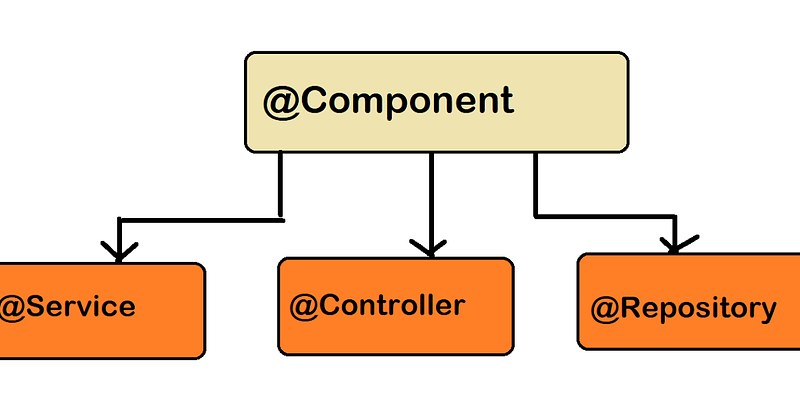
in Spring, @Component is a generic annotation that can be used to indicate any Spring-managed component or bean. It serves as a base annotation for more specific annotations such as @Serv>ice, @Repository, and @Controller.
Here’s an example of how @Component can be used to mark a class as a Spring-managed component:
@Component
public class Order {
  // class implementation
}
By adding the @Component annotation to the Order class, Spring will automatically detect and manage this class as a bean within the application context. This allows it to be easily injected into other Spring-managed components using dependency injection.
Here’s an example of how a @Component can be used in conjunction with dependency injection:
@Component
public class Invoic{
  private final Order order;

  @Autowired
  public Invoice(Order order) {
    this.order = order;
  }

  // class implementation
}
In this example, Invoice is also a Spring-managed component that has a dependency on Order . By using the @Autowired annotation on the constructor, Spring will automatically inject an instance of Order into Invoiceat runtime.
Overall, @Component is a powerful annotation that allows for easy management and dependency injection of Spring components.
What is @Bean in a spring Framework?
In Spring, @Bean is an annotation that is used to declare a single bean. It is generally used to configure third-party beans or beans that are not defined in the application context.
Here’s an example of using @Bean to declare a single bean:
@Configuration
public class AppConfig {

    @Bean
    public MyService myService() {
        return new MyServiceImpl();
    }
}
n this example, @Bean is used to create a bean for the MyService interface. The method myService() returns a new instance of MyServiceImpl, which is then registered as a bean in the application context.
@Bean can also be used to specify bean dependencies. Here's an example:
@Configuration
public class AppConfig {

    @Bean
    public MyService myService() {
        return new MyServiceImpl();
    }

    @Bean
    public MyController myController(MyService myService) {
        return new MyControllerImpl(myService);
    }
}
In this example, @Bean is used to declare a bean for the MyController interface, which has a dependency on MyService. The myController() method takes a parameter of MyService and uses it to create a new instance of MyControllerImpl, which is then registered as a bean in the application context.
The MyService bean is automatically injected into the MyController bean because of its dependency declaration in the method signature.
Difference between @Bean and @Component annotation in Spring Framework?
Here are the key differences between @Bean and @Component annotations in Spring:
- Functionality
@Beanis used to explicitly declare a bean in Spring's application context.@Componentis a general-purpose annotation used to indicate a Spring-managed component.
2. Scope
@Beanis used to define custom bean instantiation logic, and can be used to configure the scope of a bean.@Componentdoesn't define the scope of the bean, it uses the default scope ofSingleton.
3. Usage:
@Beanis typically used in configuration classes that are annotated with@Configurationor@Import.@Componentis typically used to mark classes as Spring-managed components that are picked up automatically by component scanning.
4. Return type
@Beanmethods can return any object, whereas@Componentis typically used to annotate classes that should be instantiated as beans.
5. Configuration
@Beanis used to configure specific instances of a bean or to inject dependencies between beans.@Componentis used to mark a class as a Spring-managed component, and is used to auto-detect and configure beans in the application context.
In summary, @Bean is more flexible and is used to create custom bean instantiation logic and configure specific instances of a bean, whereas @Component is used to mark classes as Spring-managed components and auto-detect and configure beans in the application context.
Java and Spring Interview Preparation Material
Before any Java and Spring Developer interview, I always use to read the below resources
Grokking the Java Interview
Grokking the Java Interview: click here
I have personally bought these books to speed up my preparation.
You can get your sample copy here, check the content of it and go for it
Grokking the Java Interview [Free Sample Copy]: click here

If you want to prepare for the Spring Boot interview you follow this consolidated eBook, it also contains microservice questions from spring boot interviews.
Grokking the Spring Boot Interview
You can get your copy here — Grokking the Spring Boot Interview

That’s all about difference between @Bean and @Component annotation in Spring Framework. Even though, both @Bean and @Component are important annotations in Spring and used to manage beans in a Spring application context.
The key difference between the two is that @Component is used to auto-detect and configure beans while @Bean is used to explicitly declare beans.
If you have a third-party class that you cannot modify and would like to declare it as a bean, you can use the @Bean annotation. On the other hand, if you have control over the class and want to make it a Spring bean, you can use the @Component annotation.
In general, the choice of which annotation to use depends on the situation and the level of control you need over the bean’s creation and management. It is important to understand the difference between @Bean and @Component to make the best use of them in your Spring applications.
By understanding the differences between these annotations, you will be better prepared for your Java and Spring interview and have a deeper understanding of the Spring framework.
Additionally, you can also prepare Microservices Questions like difference between API Gateway and Load Balancer, SAGA Pattern, how to manage transactions in Microservices, and difference between SAGA and CQRS Pattern, they are quite popular on interviews.
By the way, if you are new to Spring Framework and want to learn Spring in depth and looking for resources then you can also checkout following online courses:
- Spring Master Class — Beginner to Expert
- Spring & Hibernate for Beginners
- Learn Spring: The Certification Class
- Master Microservices with Spring Boot and Spring Cloud
All of these are top rated courses to learn Spring framework in depth but if you need free resources you can also checkout these free Spring framework courses:
Other Java and Microservices articles you may like


