
How to manage transactions in Distributed Systems and Microservices?
In this article you will learn about 3 ways to manage transactions in distributed systems and microservices such as two-phase commit, SAGA, and event sourcing.
Hello guys, if you are preparing for Microservices interview question then you may know that how do you manage transactions in a distributed system or Microservices? is one of the popular Microservice interview question and why not, its one of the important concept.
In the past, I have shared essential Microservices design principles and best practices as well popular Microservices design patterns and in this article, I will answer this question and also tell you different ways to handle transactions in distributed system.
If you have worked in Microservices architecture, then you know that a single business transaction often spans to multiple microservices and it that’s why its challenging to ensure data consistency and manage transactions.
A poorly managed transaction can lead to data inconsistencies, lost updates, or duplicate records, which can have serious consequences for the business.
Therefore, it is crucial to have a robust transaction management system in place to ensure the reliability of the system.
In this article, we will explore various strategies and best practices for managing transactions in distributed systems and microservices. We will discuss the challenges associated with distributed transactions and how to overcome them, including two-phase commit and saga patterns.
Additionally, we will cover the different transaction management mechanisms provided by popular microservices frameworks, such as Spring Cloud and Apache Kafka.
By the end of this article, you will have a clear understanding of how to manage transactions in your distributed system and ensure the reliability and consistency of your data.
By the way, if you are new to Microservice architecture or just want to revise key Microservice concepts and looking for resources then here are few online courses you can join:
- Master Microservices with Spring Boot and Spring Cloud [Udemy]
- Building Scalable Java Microservices with Spring Boot [Coursera]
- Developing Microservices with Spring Boot [Educative]
- Master Microservices with Java, Spring, Docker, Kubernetes [Udemy]
This list includes both video and text-based courses as well as project based courses for hands-on learning, you can join one or a couple of them to revise Microservices concepts. If you need more choices, you can see the below articles:
And, if you need more choices, you can also checkout following resources:
3 Ways to Manage Transactions in Distributed Systems and Microservices?
As I said, managing transactions in distributed systems and microservices can be a complex task due to the distributed nature of the system. In real world, Transactions are critical in ensuring data consistency and integrity in distributed systems where multiple services need to collaborate and share data.
One of the most popular approach to managing transactions in distributed systems is to use a two-phase commit protocol (2PC). In this protocol, a transaction coordinator is responsible for ensuring that all participants in the transaction agree to commit the transaction.
The coordinator first sends a “prepare to commit” message to all participants, and if all participants respond positively, it sends a “commit” message to all participants.
If any participant responds negatively, the coordinator sends an “abort” message to all participants, and the transaction is rolled back.

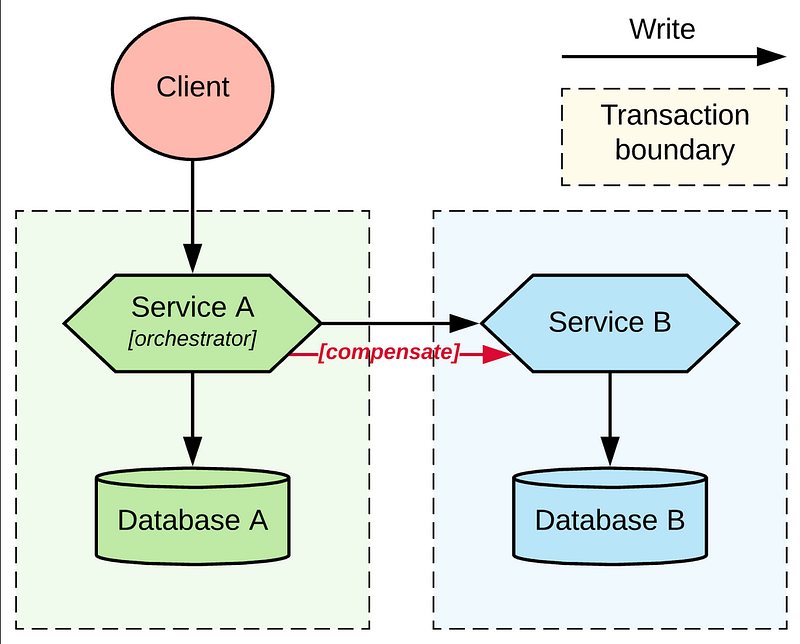
However, 2 Phase Commit can be a performance bottleneck and can lead to reduced availability in the system. An alternative approach is to use a compensation-based transaction protocol. In this protocol, each participant in the transaction is responsible for compensating for any effects of the transaction if it fails.
This approach is more flexible and can be faster and more scalable than 2PC, but it requires careful design of the compensating actions.
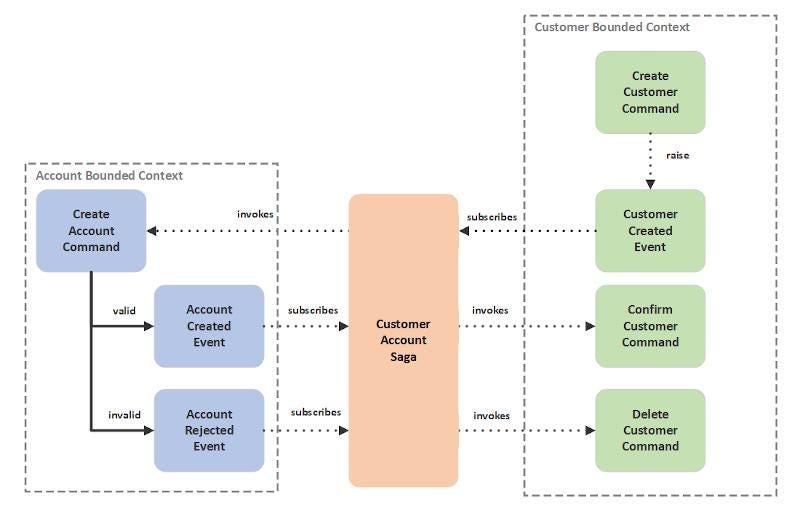
Other techniques for managing transactions in distributed systems include Saga Pattern and Event sourcing. Saga is a transactional pattern that uses a sequence of local transactions to achieve a global transaction.
On the other hand, Event sourcing involves storing all changes to the system’s state as a sequence of events, rather than the current state, which can simplify transaction management.
In Microservices architecture, it is essential to ensure that each Microservice’s transactional boundaries are correctly defined to avoid inconsistent data updates across multiple services.
It is also essential to use a transaction manager that can coordinate distributed transactions across multiple microservices.
In short, managing transactions in distributed systems and microservices can be challenging, but using appropriate transaction management techniques, such as 2PC, compensation-based protocols, Saga, and Event sourcing, can help ensure data consistency and integrity in distributed systems.
Now that you know the basics, let’s look at these techniques in little bit more detail.
What is 2 Phase Commit? How does it help with distributed transaction management?
The Two-Phase Commit (2PC) is a distributed transaction protocol used to manage transactions across multiple distributed systems. It ensures that all the nodes participating in a distributed transaction agree on committing or rolling back the transaction.
In a distributed transaction, a coordinator node is responsible for managing the transaction and coordinating with all the participating nodes.
The coordinator sends a prepare message to all the participants to confirm their readiness to commit the transaction. If all participants are ready, the coordinator sends a commit message, and all the participants commit the transaction.
On the other hand, if any participant is not ready or responds negatively, the coordinator sends a rollback message to all the participants, and they all roll back the transaction.
The Two-Phase Commit protocol ensures that a transaction is either committed or rolled back in a distributed environment, even if there are communication failures or crashes. This protocol is widely used in distributed databases, messaging systems, and other distributed applications.
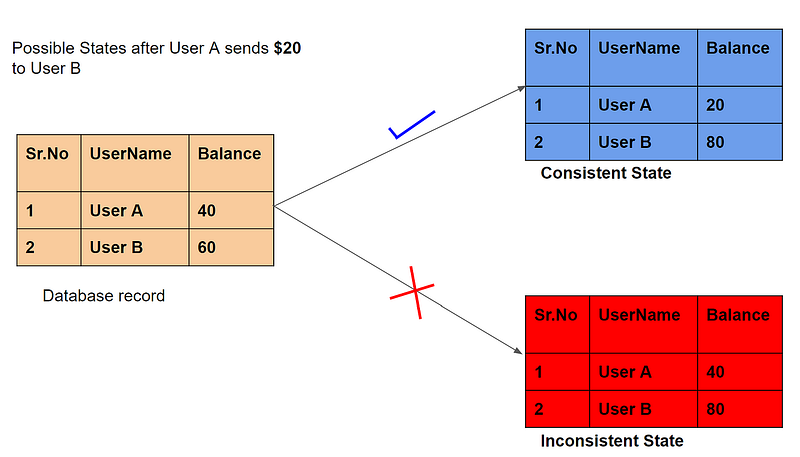
For example, consider a banking system that has multiple branches, and each branch has its own database. When a customer performs a transaction at one branch, it needs to be synchronized with the other branches’ databases to maintain consistency.
In such cases, the Two-Phase Commit protocol can be used to ensure that the transaction is committed or rolled back consistently across all the branches.
What is SAGA Design Pattern in Microservices? How does it help with managing distributed transaction?
SAGA, short for “Saga Pattern,” is a design pattern that helps manage distributed transactions in microservices architecture. In a microservices environment, where different services can have their own databases and transactions, the SAGA pattern provides a way to ensure transactional consistency across services.
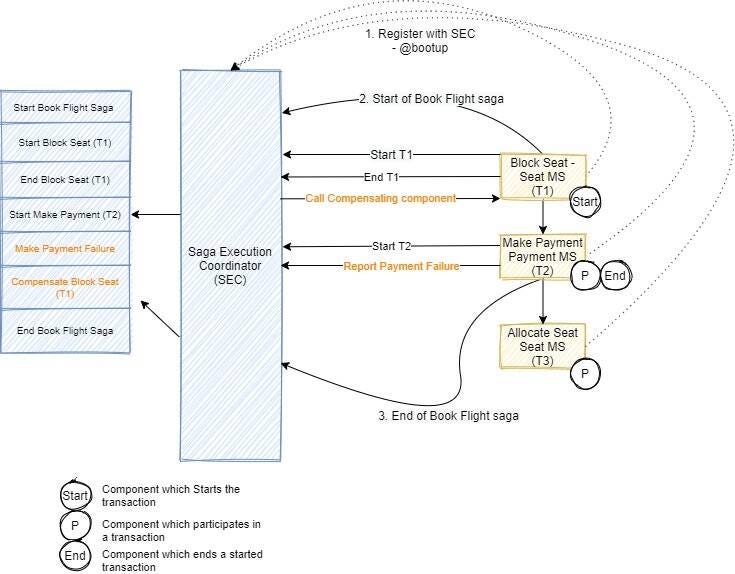
SAGA breaks down a long-running transaction into multiple smaller transactions, each of which can be committed or rolled back independently. These smaller transactions are orchestrated by a saga coordinator, which is responsible for executing the saga in the correct order and managing compensating actions in case of failures.
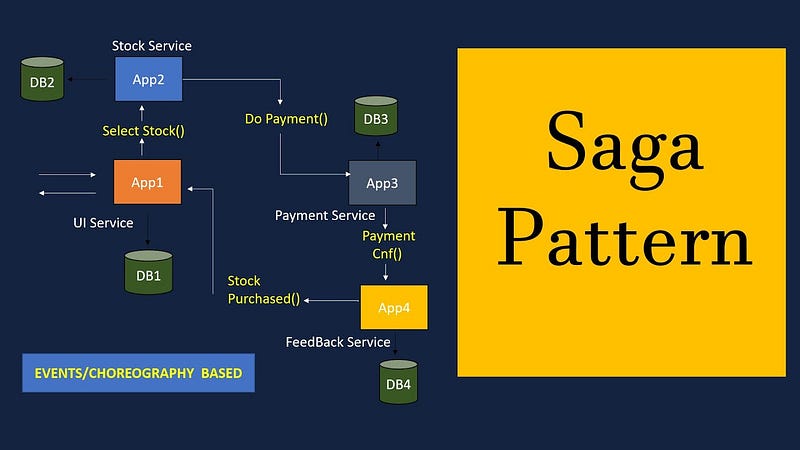
The SAGA pattern can be implemented in two ways: choreography-based and orchestration-based. In choreography-based SAGA, each service is responsible for its own transactions and coordination is done through event-driven communication between services.
While, in orchestration-based SAGA, the saga coordinator is responsible for coordinating the transactions and controlling the flow of the saga.
Here is a nice diagram which explains Saga Pattern in distributed Microservices:
What is Event Sourcing pattern in Microservices? How does it help with managing distributed transaction?
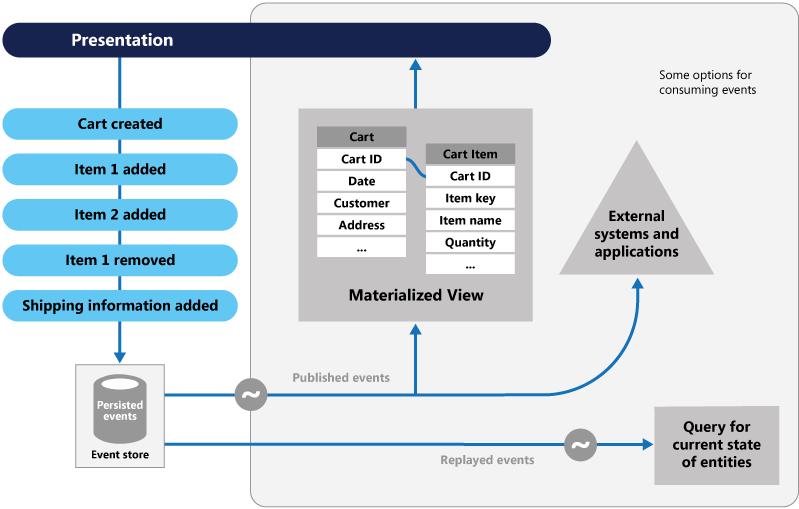
Event Sourcing is a design pattern used in Microservices architecture that involves persisting the state of a system as a sequence of events rather than the current state of the system.
It helps with managing distributed transactions by providing a reliable and scalable way to handle complex business processes.
In Event Sourcing, all changes made to the state of a system are captured as events that are appended to an event log. The event log serves as the source of truth for the state of the system, allowing for easy rollback or replay of events if needed. This approach ensures that all changes to the system are traceable, auditable, and can be easily rolled back if necessary.
One of the key benefits of Event Sourcing is that it enables the creation of loosely coupled services that can operate independently of each other. Each service can consume and generate events as needed, without having to worry about the implementation details of other services.
In terms of managing distributed transactions, Event Sourcing provides a way to ensure that each service involved in a transaction can reliably commit or rollback its changes.
When a transaction involves multiple services, each service can publish an event indicating whether it has successfully completed its part of the transaction or not.
Other services can then consume these events and act accordingly, ensuring that the transaction is either committed or rolled back consistently across all services involved.
Overall, Event Sourcing is a powerful pattern for managing distributed transactions in Microservices architecture, providing a scalable and reliable way to handle complex business processes.
Here is a nice diagram which explains Event Sourcing pattern:
How does Spring Cloud help with distributed transaction management
Spring Cloud provides several features that help with distributed transaction management in microservices architecture:
- Service Registry and Discovery Spring Cloud’s Service Registry and Discovery allow services to discover and communicate with each other easily. This helps with managing distributed transactions by providing a central location for service discovery and registration.
- Circuit Breaker Spring Cloud’s Circuit Breaker pattern helps to prevent cascading failures in distributed systems. By isolating failures in a specific service, the Circuit Breaker pattern prevents the failure from affecting other services in the system and maintains system availability.
- Distributed Tracing Spring Cloud’s Distributed Tracing feature helps to track transactions across multiple microservices. This helps to identify the source of issues in a transaction and debug problems easily.
- Configuration Management Spring Cloud provides a centralized configuration management system that helps to manage configuration across multiple microservices. This allows the system to be updated and scaled easily, which can help with transaction management in distributed systems.
Overall, Spring Cloud provides a range of tools and features that help to manage distributed transactions in microservices architecture, making it easier to maintain the consistency and reliability of the system
Java and Spring Interview Preparation Material
Before any Java and Spring Developer interview, I always use to read the below resources
Grokking the Java Interview
Grokking the Java Interview: click here
I have personally bought these books to speed up my preparation.
You can get your sample copy here, check the content of it and go for it
Grokking the Java Interview [Free Sample Copy]: click here

If you want to prepare for the Spring Boot interview you follow this consolidated ebook, it also contains microservice questions from spring boot interviews.
Grokking the Spring Boot Interview
You can get your copy here — Grokking the Spring Boot Interview

Conclusion
That’s all about how to manage transaction in distributed system. In conclusion, transaction management in microservices and distributed systems can be a challenging task, is not easy but it is crucial for ensuring data integrity and consistency across the system.
It is essential to understand the various transaction management patterns, such as two-phase commit, SAGA, and event sourcing, and select the appropriate approach for your system’s specific requirements. Each pattern has its benefits and drawbacks, and the selection should be based on the system’s requirements and constraints.
While two-phase commit provides consistency, it has a single point of failure, and the performance can be impacted. On the other hand, SAGA and event sourcing provide better scalability and availability but require additional efforts for implementation and maintenance.
Therefore, it is really important for a developer and architect to carefully analyze and design the transaction management system for your microservices and distributed system to ensure that the system performs optimally, and data integrity is maintained.
As microservices and distributed systems continue to gain popularity, the transaction management challenge will continue to evolve, and new patterns and techniques will emerge. Keeping up with the latest developments in this space will be crucial for developing efficient and robust microservices and distributed systems.
By the way, if you are new to Microservice architecture or just want to revise key Microservice concepts and looking for resources then here are few online courses you can join:
- Master Microservices with Spring Boot and Spring Cloud [Udemy]
- Building Scalable Java Microservices with Spring Boot [Coursera]
- Developing Microservices with Spring Boot [Educative]
- Master Microservices with Java, Spring, Docker, Kubernetes [Udemy]
This list includes both video and text-based courses as well as project based courses for hands-on learning, you can join one or a couple of them to revise Microservices concepts. If you need more choices, you can see the below articles:
And, if you need more choices, you can also checkout following resources:
Other Stories you may like


