
Difference between @Controller and @RestController in Spring Boot and Spring MVC?
@Controller is used to declare common web controllers which can return HTTP response but @RestController is used to create controllers for REST APIs which can return JSON.
Hello folks, if you are preparing for Java and Spring Developer interview then you may have come across “difference between @Controller and @RestController annotation” in Spring Boot and Spring Framework in general. It’s one of the popular spring question which I have also mentioned in my list of 25 Spring Framework questions earlier
In Spring MVC, both @Controller and @RestController annotations are used to define web controllers as per MVC Design pattern. A controller is responsible for handling HTTP request and returning HTTP response to client.
The main difference between these two annotation is how they handle client’s request and when they are used
For example @Controller annotation is there from day 1 and it is used to mark a class as a web controller to process HTTP requests and return a view name, which is then resolved by a view resolver to generate the final HTML view.
On the other hand @RestController annotation was added in later Spring version like Spring 3.4 to increase support for REST API development. In case of REST API, instead of returning HTML, you will probably like to return JSON or XML as your client is no more human but machine.
If you want to return a JSON or XML from a Spring MVC controller then you need to add @ReseponseBody annotation to each of Controller method and it seems overkill while implementing REST APIs using Spring and Spring Boot.
Designers and developers of Spring Framework recognized this shortcoming and then added a new annotation called @RestController in Spring 3.4 version.
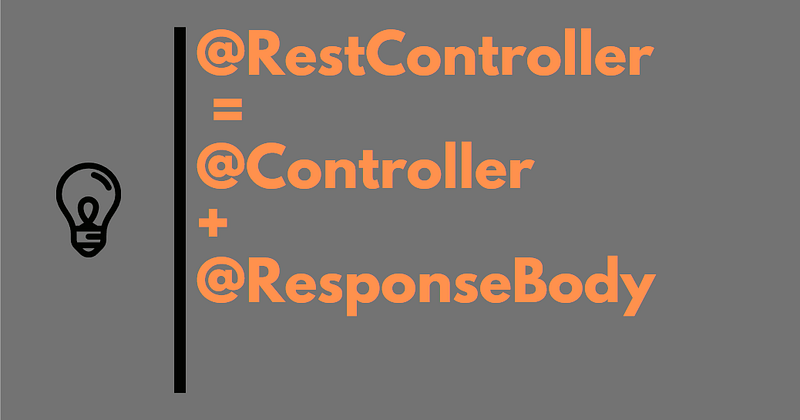
The @RestController annotation is a combination of the @Controller and @ResponseBody annotations and you can use it to implement REST APIs in Java and Spring Boot.
The key difference between
@Controlerand@RestControllerannotation is @ResponseBody annotation,@Controlerdoes not automatically add the@ResponseBodyannotation to all of the controller’s methods, which means that you need to add it to each method individually if you want to return a JSON or XML response.@RestControllerautomatically adds the@ResponseBodyannotation to all of the controller’s methods.
In the past, I have shared many questions for Java developer interviews like these 35 Java Interview Questions, Advanced Java Interview Questions, Spring Framework Interview Questions and System Design Questions and today, I have answered one of the popular spring question, if you are preparing for interviews, you can also check out those articles.
Now let’s see examples of both @Controller and @RestController annotation in Spring framework
By the way, if you are new to Spring Framework and want to learn Spring in depth and looking for resources then you can also checkout following online courses:
- Spring Master Class — Beginner to Expert
- Spring & Hibernate for Beginners
- Learn Spring: The Certification Class
- Master Microservices with Spring Boot and Spring Cloud
All of these are top rated courses to learn Spring framework in depth but if you need free resources you can also checkout these free Spring framework courses:
@Controller and @RestController Example in Spring Boot
Here is a simple example of @Controller annotation which is used to return a response for simple HTTP request on “/hello” path:
@Controller
public class MyController {

    @Autowired
    private MyService myService;

    @RequestMapping("/hello")
    public String sayHello(Model model) {
        model.addAttribute("message", myService.getHelloMessage());
        return "hello";
    }
}
In this example, the MyController class is annotated with @Controller annotation and has a single method, sayHello(), which is mapped to the /hello URL.
The method takes a Model object as a parameter and adds an attribute called "message" to it. The method then returns a string "hello", which is the name of the view to be rendered.
Now, let’s see an example of @RestController annotation from Spring Framework, which i used to respond REST API
@RestController
public class MyRestController {

    @Autowired
    private MyService myService;

    @RequestMapping("/greeting")
    public Greeting getGreeting() {
        return myService.getGreeting();
    }
}
In this example, the MyRestController class is annotated with @RestController and has a single method, getGreeting(), which is mapped to the /greeting URL.
The method returns an object of the Greeting class, which will be automatically converted to a JSON or XML representation and sent as the response to the client.
It is also worth noting that the Greeting class should have getters and setters for the data that you want to be included in the response, otherwise, it will not be serialized properly or converted to JSON.
Things to keep in mind while using @Controller and @RestController annotation in Spring Boot
Here are a few things to keep in mind while using the @Controller and @RestController annotations:
- When using the @Controller annotation, you will need to use the @ResponseBody annotation to return JSON or XML data, otherwise, the response will be treated as a view name and a view resolver will try to resolve it while @ResponseBody annotation is not necessary as it is already included in the annotation.
- When using the @RestController annotation, you can also use the @ResponseStatus annotation to set the HTTP status code of the response and @RequestBody annotation to bind the request body to a method parameter.
- And while using the @RestController annotation, you can use the @RequestMapping annotation to set the URL path to map the methods to.
- Another thing which is worth noting is that, If you are returning a complex object that contains child objects, make sure all the child object classes have getters and setters, otherwise, they will not be serialized properly.
Java and Spring Interview Preparation Material
Before any Java and Spring Developer interview, I always use to read the below resources
Grokking the Java Interview
Grokking the Java Interview: click here
I have personally bought these books to speed up my preparation.
You can get your sample copy here, check the content of it and go for it
Grokking the Java Interview [Free Sample Copy]: click here
If you want to prepare for the Spring Boot interview you follow this consolidated eBook
Grokking the Spring Boot Interview
You can get your copy here — Grokking the Spring Boot Interview
That’s all about the difference between @Controller and @RestController annotation in Spring Boot. Just remember that @Controller is used to create web controllers that return views, which is further resolved by view resolver, while @RestController is used to create web services that return JSON or XML data. It’s also worth noting.
By the way, if you are new to Spring Framework and want to learn Spring in depth and looking for resources then you can also checkout following online courses:
- Spring Master Class — Beginner to Expert
- Spring & Hibernate for Beginners
- Learn Spring: The Certification Class
- Master Microservices with Spring Boot and Spring Cloud
All of these are top rated courses to learn Spring framework in depth but if you need free resources you can also checkout these free Spring framework courses:


