
Difference between @Controller, @Service, and @Repository Annotations in Spring Framework?
While all three are stereotype annotation in Spring and can be use to represent bean where exactly they are used is the key for answering this popular Spring interview question
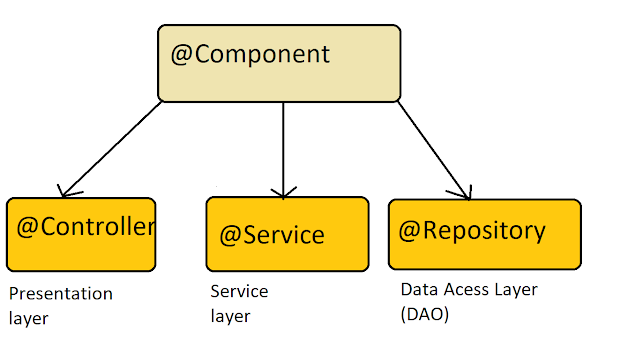
Hello friends, If you are preparing for Java and Spring Developer interview, it is important to understand the different annotations used in the Spring framework like what they do and when to use them. In the past, I have also told you about difference between @Contorller and @RestController annotation and in this article, we will take a look at another set of popular Spring annotations.
Three commonly used annotations are @Service, @Controller, and @Repository. While these annotations may seem similar, they have different purposes and are used in different parts of the Spring application.
By the way, if you are preparing for interview In my earlier articles, I have also shared 25 Advanced Java questions, 21 Software Design Pattern questions, 20 SQL queries from Interviews, 50 Microservices questions, 60 Tree Data Structure Questions, 15 System Design Questions, and 35 Core Java Questions and 21 Lambda and Stream questions which you can use for your Java interview preparation.
In this article, we will explore the differences between @Service, @Controller, and @Repository in Spring from an interview point of view. We will cover the basic definitions of each annotation, where they are typically used, and how they can be implemented in a Spring application.
We will also discuss some common Spring interview questions related to these annotations, such as when to use them and what are the benefits of using them.
So, let’s dive in and explore the differences between @Service, @Controller, and @Repository in Spring.
By the way, if you are new to Spring Framework and want to learn Spring in depth and looking for resources then you can also checkout following online courses:
- Spring Master Class — Beginner to Expert
- Spring & Hibernate for Beginners
- Learn Spring: The Certification Class
- Master Microservices with Spring Boot and Spring Cloud
All of these are top rated courses to learn Spring framework in depth but if you need free resources you can also checkout these free Spring framework courses:
What is @Controller Annotation in Spring Framework?
In Spring Framework, particularly Spring MVC, the Controller annotation is used to mark a class as a controller that handles requests for the web application. When a class is annotated with @Controller, Spring considers it as a web controller that is capable of handling incoming HTTP requests.
It is one of the most commonly used annotations in Spring MVC (Model-View-Controller) architecture, which allows developers to build flexible and loosely coupled web applications.
The @Controller annotation is usually used in combination with other annotations like @RequestMapping, @GetMapping, @PostMapping, etc. to map requests to specific methods within the controller. The methods within the controller handle the requests and return a response to the client.
By using the @Controller annotation, developers can easily build RESTful web services, web applications, and APIs. It provides a clear separation between the presentation layer and the business logic layer of the application, making it easier to maintain and test.
Overall, the @Controller annotation is an essential component of Spring MVC architecture, providing a simple and flexible way to handle incoming HTTP requests and produce appropriate responses.
Here’s an example of a controller class in Spring using the @Controller annotation:
@Controller
public class MyController {

 @RequestMapping("/hello")
 public String sayHello() {
 return "Hello World!";
 }
}
In this example, the @Controller annotation is used to mark the class as a controller. The @RequestMapping annotation is used to map the /hello URL to the sayHello() method, which returns the string "Hello World!".
When a user navigates to the /hello URL, Spring will invoke the sayHello() method in the MyController class and return the string "Hello World!". This string could be rendered in a view and displayed in the user's web browser.
What is @Repository annotation in spring?
In Spring Framework, @Repository is an annotation used to indicate that the annotated class is a repository, which is responsible for data access and manipulation.
It is typically used in combination with other Spring technologies, such as Spring Data, to provide a convenient way to implement the persistence layer of an application.
Here is an example of a class annotated with @Repository:
@Repository
public class CustomerRepositoryImpl implements CustomerRepository {

    private final EntityManager entityManager;

    @Autowired
    public CustomerRepositoryImpl(EntityManager entityManager) {
        this.entityManager = entityManager;
    }

    @Override
    public List<Customer> getAllCustomers() {
        TypedQuery<Customer> query = entityManager.createQuery("SELECT c FROM Customer c", Customer.class);
        return query.getResultList();
    }

    @Override
    public void saveCustomer(Customer customer) {
        entityManager.persist(customer);
    }
}
In this example, @Repository is used to indicate that the CustomerRepositoryImpl class is a repository. The class implements the CustomerRepository interface, which defines the methods for data access and manipulation.
The EntityManager object is injected using the @Autowired annotation, which is a Spring annotation used for dependency injection. The getAllCustomers() method uses the entityManager to create a query and retrieve all customers from the database. The saveCustomer() method uses the entityManager to persist a new customer to the database.
Overall, @Repository is a useful annotation in Spring Framework that helps developers to create and manage repositories for their applications.
What is @Service annotation in spring framework?
The @Service annotation is used in Spring to mark a class as a service provider. It is a specialized version of the @Component annotation and can be used interchangeably with @Component in most scenarios.
The main purpose of @Service is to provide a clear and concise way to indicate that a class is providing some business logic or service functionality. This annotation is particularly useful in larger Spring applications where there are many different components that need to interact with each other.
Here is an example of how to use the @Service annotation in a Spring application:
@Service
public class UserService {
    private final UserRepository userRepository;

    public UserService(UserRepository userRepository) {
        this.userRepository = userRepository;
    }

    public List<User> getAllUsers() {
        return userRepository.findAll();
    }

    public User getUserById(Long id) {
        return userRepository.findById(id).orElse(null);
    }

    // Other business logic methods...
}
In this example, the UserService class is marked with the @Service annotation to indicate that it is providing business logic for the application. The class has a constructor that takes a UserRepository instance as a dependency, which is injected by Spring.
The UserService class provides several methods that perform various business logic operations on user data. These methods make use of the UserRepository instance to interact with the database.
By using the @Service annotation, we can clearly identify the UserService class as a service provider in the application, which can be helpful for developers who are trying to understand the overall architecture of the system.
Difference between Service, Controller, and Repository Annotations in Spring Framework
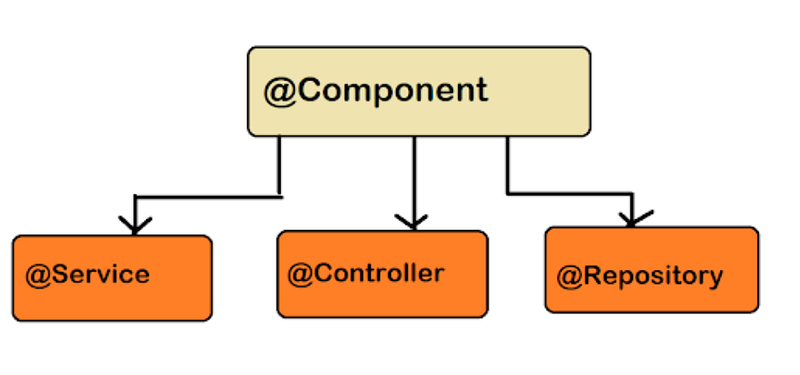
here are the key differences between @Service, @Controller, and @Repository annotations in Spring framework point by point, so that you can understand them better:
1. Purpose
- @
Service: Used to define a service class that contains business logic. - @
Controller: Used to define a controller class that handles user requests and returns responses. - @
Repository: Used to define a repository class that interacts with a database or persistence layer.
2. Layer
- @
Service: Generally used in the service layer of a Spring MVC application. - @
Controller: Generally used in the presentation layer of a Spring MVC application. - @
Repository: Generally used in the persistence layer of a Spring MVC application.
3. Exception handling
- @Service: Typically throws checked exceptions that are handled by the caller.
- @Controller: Uses Spring MVC’s exception handling mechanism to handle exceptions.
- @Repository: Does not handle exceptions, rather, they are propagated to the caller.
4. Dependency injection
- @
Service: Typically, other service or repository objects are injected into a service object. - @
Controller: Typically, a service object is injected into a controller object. - @
Repository: Typically, a database connection or a session factory is injected into a repository object.
5. Transaction management
- @
Service: Typically manages transactions at the service layer. - @
Controller: Does not manage transactions directly. - @
Repository: Typically manages transactions at the persistence layer.
Java and Spring Interview Preparation Material
Before any Java and Spring Developer interview, I always use to read the below resources
Grokking the Java Interview
Grokking the Java Interview: click here
I have personally bought these books to speed up my preparation.
You can get your sample copy here, check the content of it and go for it
Grokking the Java Interview [Free Sample Copy]: click here

If you want to prepare for the Spring Boot interview you follow this consolidated ebook, it also contains microservice questions from spring boot interviews.
Grokking the Spring Boot Interview
You can get your copy here — Grokking the Spring Boot Interview

That’s all about difference between Service, Controller, and Repository annotation in Spring Framework. In summary, @Service, @Controller, and @Repository are all used for different purposes and belong to different layers of a Spring MVC application.
They have different exception handling mechanisms, dependency injection practices, and transaction management styles.
By understanding the differences between these annotations, you will be better prepared for your Spring interview and have a deeper understanding of the Spring framework.
Whether you are new to Spring or have experience with the framework, this blog post will provide valuable insights and practical knowledge that you can apply in your Spring projects.
By the way, if you are new to Spring Framework and want to learn Spring in depth and looking for resources then you can also checkout following online courses:
- Spring Master Class — Beginner to Expert
- Spring & Hibernate for Beginners
- Learn Spring: The Certification Class
- Master Microservices with Spring Boot and Spring Cloud
All of these are top rated courses to learn Spring framework in depth but if you need free resources you can also checkout these free Spring framework courses:


