Difference between @RequestMapping vs @PathVariable in Spring Framework
Hello folks, In Java and Spring Framework, effective handling of HTTP requests is very important for building robust web applications. Two essential annotations, @RequestMapping and @PathVariable, play a crucial role in mapping URLs to controller methods and extracting values from them.
This is also one of the popular Spring MVC interview questions and understanding the nuances of these annotations is fundamental for developers striving to create flexible and dynamic web applications. It will not just help in better using them in your code but also doing better on interviews.
In last couple of articles I have explained difference between @Contorller and @RestController annotation, @Bean vs @Component annotation, and @Controller vs @Service @Repository, as well as RequestParam vs PathVariable annotation.
And in this article, I will explain the difference between @RequestMapping and @PathVariable, providing code examples to illustrate their distinct roles in Spring.
P.S. Keep reading until the end. I have a bonus for you.
@RequestMapping vs @PathVariable in Spring
In Spring Framework, @RequestMapping and @PathVariable are annotations used in the context of web applications to handle HTTP requests. Let's explore the differences between them with code examples.
What is @RequestMapping annotation? How it works?
The @RequestMapping annotation is a versatile annotation in Spring used to map web requests to specific methods. It can be applied at the class level or method level. When applied at the class level, it sets a base URI for all methods in that class.
Here’s an example:
@Controller
@RequestMapping("/example")
public class ExampleController {

    @RequestMapping("/hello")
    public String hello() {
        return "hello";
    }

    @RequestMapping("/greet/{name}")
    public String greet(@PathVariable String name) {
        return "greet";
    }
}
In this example, the @RequestMapping annotation is used at the class level to set a base URI ("/example"). The hello() method maps to the URI "/example/hello," and the greet() method maps to "/example/greet/{name}". The {name} in the URI is a placeholder for a variable that will be extracted using @PathVariable.
What is @PathVariable annotation? How it works?
The @PathVariable annotation is used to extract values from the URI template and bind them to method parameters. In the above example, the greet() method uses @PathVariable to extract the value of the name variable from the URI.
@Controller
@RequestMapping("/example")
public class ExampleController {

    // ... other methods

    @RequestMapping("/greet/{name}")
    public String greet(@PathVariable String name) {
        // The value of 'name' is extracted from the URI
        // and can be used in the method logic
        return "Hello, " + name + "!";
    }
}
In this case, if the URI “/example/greet/John” is requested, the name parameter in the greet() method will be automatically set to "John."
What is difference between @PathVariable and @RequestMapping in Spring MVC?
Now that we know what is @PathVariable annotation and @RequestMapping annotation and how it works, let’s analyze them more and highlight the differences.
1. Purpose
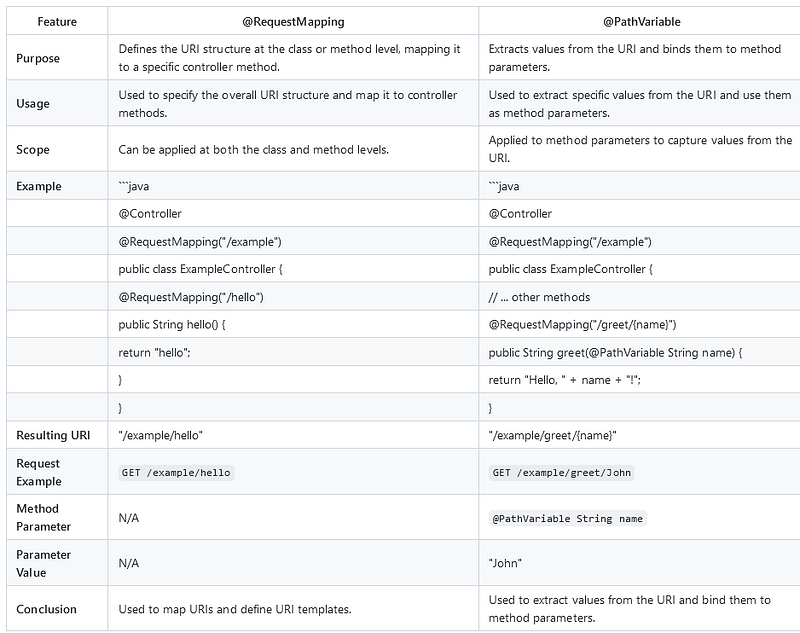
@RequestMapping: Defines the URI at the class or method level, mapping it to a specific controller method.@PathVariable: Extracts values from the URI and binds them to method parameters.
2. Usage
@RequestMapping: Used to define URI templates and HTTP methods.@PathVariable: Used to extract values from the URI template and use them as method parameters.
3. Example:
@RequestMapping: Used to specify the overall URI structure.@PathVariable: Used to extract specific values from the URI.
4. Scope
@RequestMapping: Can be applied at both the class and method levels@PathVariable: Can be applied at both the class and method levels.
In summary, @RequestMapping is used to define URI templates and map them to controller methods, while @PathVariable is used to extract values from the URI and use them as method parameters. Combining them allows for flexible and dynamic handling of different URI patterns in a Spring application.
Conclusion
In conclusion, mastering the usage of @RequestMapping and @PathVariable is essential for developers working on Spring-based web applications. The @RequestMapping annotation serves as a mapping powerhouse, allowing developers to define URI templates at both the class and method levels.
On the other hand, @PathVariable comes into play when values from these URIs need to be extracted dynamically and utilized as method parameters.
By leveraging these annotations harmoniously, developers can create web applications that respond effectively to a variety of URL patterns. The combination of @RequestMapping and @PathVariable empowers developers to build flexible and scalable solutions, making Spring a robust framework for web development.
This one is also an important question for Spring Developer interviews and you must prepare for it. Additionally, you can also prepare Java Microservices questions like difference between API Gateway and Load Balancer, SAGA Pattern, how to manage transactions in Microservices, and difference between SAGA and CQRS Pattern, they are quite popular on interviews.
Other Java and Microservices articles you may like
Bonus
As promised, here is the bonus for you, a free book. I just found a new free book to learn Distributed System Design, you can also read it here on Microsoft — https://info.microsoft.com/rs/157-GQE-382/images/EN-CNTNT-eBook-DesigningDistributedSystems.pdf