
Can These 8 Habits Really Add 20 Years to Your Life?
Lifestyle medicine should be prescribed along with or even in lieu of drugs to promote longer life and better health, researchers and doctors say. But two decades? Seriously?

New research promises eye-popping life extension for people who adopt one or more of eight healthy behaviors collectively called lifestyle medicine. The projections are so astounding — up to 20 years or more of additional life — that one might question their veracity and wonder if it’s just a fresh twist on health hype.
There are caveats, for sure.
You might already be doing some of these things and can therefore wring only so much benefit from the remaining tactics. Or you might find them impractical, onerous or distasteful. Or you might engage in all of them today and then be hit by a bus tomorrow.
But the findings, representing averages across the population, piggyback on mounting evidence revealing the outsized value of lifestyle medicine as a vital complement to drugs and other conventional medical treatments, and in many cases an outright replacement that does a better job preventing illness and also treating symptoms after the onset of disease, sometimes even reversing diagnoses completely.
“This should be the first thing we learn at med school,” Dovile Kalvinskaite, MD, an OBGYN in the United Kingdom and certified lifestyle medicine physician, commented this week on a previous article I wrote about lifestyle medicine. “Most of the conditions we deal [with] as doctors are preventable, and we are only taught about how to deal with the end result at med school. Drugs, surgery, more drugs.”
8 ways to live or die
In the new study, researchers used medical data and surveys of more than 700,000 US veterans gathered between 2011 and 2019 to calculate the approximate reduction of lifespan for each of eight behaviors:
35–40%: Lack of physical activity, smoking, and opioid use. 20%: Stress, binge drinking, poor diet, and poor sleep hygiene 5%: lack of positive social relationships
Conversely, embracing any single one of those factors, even at or after age 40, raises the odds you’ll hang around a few more years, the researchers say. Embrace a second new habit, add some more years to your prospects. And so on, all the way up to two decades or more of additional time on this planet.
Middle-aged women who engage positively with all eight lifestyle factors have, on average, 21 years of additional life expectancy compared to women who do none of them. For middle-aged men, the promise is 24 extra years.
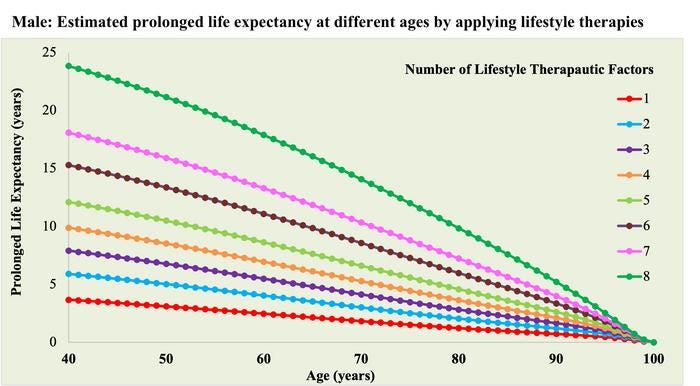
“We were really surprised by just how much could be gained with the adoption of one, two, three, or all eight lifestyle factors,” said study team member Xuan-Mai Nguyen, a health science specialist at the Department of Veterans Affairs and medical student at the University of Illinois Urbana-Champaign. “Our research findings suggest that adopting a healthy lifestyle is important for both public health and personal wellness. The earlier the better, but even if you only make a small change in your 40s, 50s, or 60s, it still is beneficial.”
Is this for real?
C’mon, do we really have this much control over how long we live? Well… yes and no.
Nobody can estimate the years you, as an individual, might gain by adopting any single healthy behavior. Your genetics play a role, as do myriad positive and negative circumstances in life. Like that onrushing bus. Or cancer caused by working in a coal mine or living next to a manufacturing plant that spews deadly smoke. Or lack of access to good healthcare.
But the findings, presented last month at the annual meeting of the American Society for Nutrition and not yet published in a peer-reviewed journal, echo a robust body of research indicating the importance of lifestyle medicine for not just longevity but better health during all those bonus years.
- Women and men can add roughly a dozen years of life expectancy if they begin eating an optimal diet starting at age 20, compared to those who consume a typical Western diet their whole adult lives, according to a 2022 study in the journal PLOS Medicine. Even by starting an optimal diet at age 60, women can add 8 years of life expectancy; 9 for men.
- Brisk walking for 22 minutes a day (2.5 hours per week) can extend lifespan by 14 years in women and 20 years in men. Numerous studies find any sort of physical effort, in any amount, increases odds of a longer and healthier life.
- A study earlier this year suggested that getting sufficient, quality sleep can reduce the odds of dying prematurely for any reason by 30%. And there’s no doubt that better sleep means better moods and thinking skills on a daily basis, a stronger immune system, and more energy to do what you must and what you wish to do.
One recent study suggests a remarkable effect of lifestyle medicine—total recovery from one of the most deadly and growing diseases dogging Western societies:
In a surprising number of cases, people with type 2 diabetes — among the Top 10 leading causes of death in the United States — reversed their diagnoses through significant improvements in diet, a recent study concluded. In 59 patients with the condition, standard medical treatment was augmented by introduction of a low-fat, whole-food, primarily plant-based pattern of eating.
Significant improvements in weight and glucose control resulted, and 37% of the people went into full remission.
Previous research has indicated lifestyle medicine can help reverse the course of heart disease, obesity, high cholesterol and early-stage prostate cancer.
These reversals points to a need for “increased education for both clinicians and patients on the successful application of lifestyle-medicine principles and dietary interventions in everyday medical practice,” said study leader Gunadhar Panigrahi, MD, a cardiologist in Virginia Beach, VA.
If 8 is too many, perhaps 6 is enough
In a comprehensive report last year from the American College of Lifestyle Medicine (ACLM), a group of researchers and health experts argued that lifestyle medicine should get much more attention from patients, physicians, and the entire healthcare system.
“Too many physicians and patients alike may believe they are victims of their genes and they are destined to become chronically ill and dependent on pharmaceuticals,” the experts wrote.
The conclusions, based on a sea of evidence from a wide range of studies, were grouped into six “pillars” similar to the eight factors in the veterans study, each found to heavily influence the avoidance of chronic disease and death:
- Regular physical activity
- Plant-dominant nutrition
- Positive social connections
- Avoidance of risky substances (such as alcohol, tobacco and opioids)
- Stress management
- Restorative sleep
Naturally, one has to figure out how to jumpstart a lifestyle medicine approach. The links above go to Medium articles detailing benefits and strategies for anyone who wants to put a little intention into living longer and living out those years in good health, what the ACLM calls health span.
“Starting preventive and healthy lifestyle strategies early in life is the most effective and efficient way to accomplish the goals of expanding health span, while further expanding lifespan,” Koushik Reddy, MD, a cardiologist and researcher at the University of South Florida, wrote in the report.
Yes, this ain’t easy
Following up on last year’s report, the ACLM recently issued a statement acknowledging how hard it can be to adopt and stick with all these healthy habits, and how complicated it is to integrate lifestyle medicine with conventional medicine to battle soaring obesity rates and related conditions that are behind many of the nation’s health problems and declining life expectancy.
The challenges are many, including the fact that most doctors and other healthcare professionals are not properly trained on how to integrate lifestyle medicine into their practices.
“While adequately dosed lifestyle interventions may unilaterally achieve success, obesity is a complex, multifactorial disease wherein patients may require approaches beyond lifestyle alone,” the statement read. “However, lifestyle interventions are too often not adequately ‘dosed’ for success. Lifestyle medicine clinicians are trained to prescribe a therapeutic dose of all six pillars.”
The idea of prescribing lifestyle medicine isn’t new.
“By ignoring the root causes of disease and neglecting to prioritize lifestyle measures for prevention, the medical community is placing people at harm, a group of 20 medical doctors argued in a 2018 review. “Many deaths and many causes of pain, suffering, and disability could be circumvented if the medical community could effectively implement and share the power of healthy lifestyle choices. We believe that lifestyle medicine should become the primary approach to the management of chronic conditions and, more importantly, their prevention.”
Physicians should be writing prescriptions for diet and exercise on a routine basis, several experts told me back in 2020.
But as any doctor knows, getting patients to “take their medicine” is a lot more complicated when it involves working out and watching everything they eat versus popping a pill.
But when dosed properly and compassionately by clinicians with the right training, ACLM contends, lifestyle medicine can tackle core health problems at the cellular level—such as chronic inflammation or oxidative stress—and thereby help prevent or treat everything from high blood pressure and high cholesterol to chronic pain, arthritis and cancer.
The alternative isn’t working
Conventional medicine has made remarkable advances in saving lives and battling diseases, and many drugs are crucial for treating a range of diseases.
But as I reported recently, America has become grossly overdependent on questionable pharmaceuticals. Some 60% of adults battle at least one chronic disease, and 40% struggle with two or more. More than 80% of Americans age 50 to 80 take at least one prescription medication, and 28% are on five or more.
The entire US healthcare system is geared around waiting for people to get sick, then prescribing drugs — which often don’t work and have serious side effects — then taking little to no initiative to ever get people off those drugs, I wrote.
This burgeoning polypharmacy problem, as it’s called, is its own health crisis. And it’s not solved with so-called “natural” pills or powders on the supplement shelves.
In consultation with a nutritionist or physician, certain vitamins and supplements can fill gaps in dietary nutrition or be important for certain diagnosed medical conditions. But most supplements are not necessary for most people, despite marketers (and individual proponents) making often outsized claims based on incomplete science or anecdotes. And because supplements are not regulated, they frequently contain ingredients not on the label or otherwise fail to provide what the label claims. They can be downright dangerous.
As one Medium reader commented on my story below about the problem with supplements: “You can’t supplement your way out of an unhealthy diet.”
A common-sense approach
Lifestyle medicine proponents aren’t arguing for the elimination of all medications and supplements nor the eradication of conventional therapies or other treatments. They just want natural, age-old good health habits — which are often inexpensive and free of side effects and shown beyond doubt to be effective — to be given greater consideration by doctors and patients.
“That’s why I did my Lifestyle Medicine Physician certification last year,” said Kalvinskaite, the OBGYN. “I use this knowledge every day, and I often hear I was the first person to actually take some time and discuss lifestyle in more detail and create a personalized plan. Patients really appreciate it. I hope this is the future of medicine. Because the old way definitely is not working.”
None of this is to suggest it’d be easy for everyone (or anyone) to fully immerse themselves in several or all of the lifestyle medicine behaviors. Life is hard. Healthy food is not accessible to all. Sleeping well can be an exhausting challenge, especially on hot summer nights. Not everyone has access to a gym or safe outdoor spaces to exercise, nor hours to spend doing yoga or pilates.
But the evidence is clear: Leaning into lifestyle medicine—when, where and how you can—really does add years upon years to how long you might live. And odds are it won’t kill you to give it a shot.


