
We’re Treating Stress, Anxiety and Depression All Wrong
One of the best remedies for mental health conditions is obvious but rarely prescribed

More than half of U.S. doctors receive various forms of payment — ranging from consulting fees to travel and gifts — from pharmaceutical companies, whose industry spends more than $2 billion a year to encourage them to write drug prescriptions. No surprise, doctors who take this money prescribe more of a company’s products. Perhaps this helps explain why the number of people taking prescription antidepressants rose 15% between 2015 and 2019, soaring 38% in teenagers and raising serious concerns among many medical and scientific experts.
Meanwhile, one of the best treatments for stress, anxiety and depression — one that’s inexpensive and whose side effects are almost entirely positive — is well known to scientists but rarely prescribed by doctors.
“Physical activity is highly beneficial for improving symptoms of depression, anxiety and distress across a wide range of adult populations, including the general population, people with diagnosed mental health disorders and people with chronic disease,” according to a comprehensive new review of scientific research. “Physical activity should be a mainstay approach in the management of depression, anxiety and psychological distress.” Distress is defined as “emotional, social, spiritual, or physical pain or suffering that may cause a person to feel sad, afraid, depressed, anxious, or lonely.”
The effect was found in healthy individuals as well as people with diagnosed mental disorders or other chronic diseases that can cause anxiety disorder or lead to clinical depression.
Physical activity is like a wonder drug for human moods, for a host of well-understood reasons, not the least of which is that it releases chemicals like dopamine, noradrenaline and serotonin that make us feel good right away and which build up over time.
“Yet despite the evidence, it has not been widely adopted as a first-choice treatment,” said study leader Ben Singh, PhD, a research fellow at the University of South Australia.
“Physical activity has numerous benefits compared with psychotherapy and medications, in terms of costs and side effects and long-term health,” Singh told me. “Doctors and other medical professionals should consider prescribing exercise for patients experiencing symptoms of depression, anxiety, stress, or other mental health concerns.”
This is not to say medications and other treatments aren’t useful, sometimes in combination with physical activity. But antidepressants don’t work for everyone, and the slew of various drugs prescribed for mental health conditions — often more than one at a time — come with serious side effects.
[Update March 2: Several readers have noted in the comments that for some cases of severe depression or anxiety disorder, medications and/or talk therapy can be vital treatment options. This article is not meant to dismiss either, but rather to stress the underappreciated, tremendous value of physical activity and the importance of healthcare providers (and patients) considering exercise as a front-line treatment, alone or in conjunction with medications and other therapies, on a case-by-case basis.]
Singh and colleagues analyzed 97 existing scientific reviews of more than 1,000 trials involving 128,119 participants altogether. The results, published this month in the British Journal of Sports Medicine, suggest just about any sort of activity, and any duration, can be helpful. The most effective interventions lasted 12 weeks or less, indicating that benefits come quickly.
“Higher intensity exercise had greater improvements for depression and anxiety, while longer durations had smaller effects when compared to short and mid-duration bursts,” Singh said in a statement. “We also found that all types of physical activity and exercise were beneficial, including aerobic exercise such as walking, resistance training, Pilates, and yoga.”
While the study did not analyze chronic stress, other research has shown it, too, benefits from physical activity; Singh said his team’s findings likely apply to chronic stress, too.
Remedy for a vast and growing need
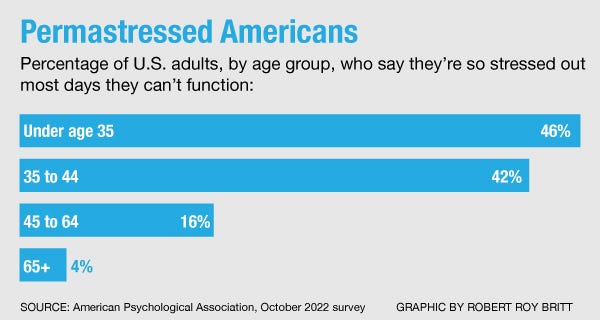
In a survey last fall, 27% of U.S. adults said they’re so stressed most days that they can’t function normally, and three-quarters said stress had caused feelings of nervousness, anxiety, sadness, depression, fatigue or a headache at least once in the past month.
As I wrote recently, neverending crises like the pandemic, inflation, misinformation, mass shootings and war have put many people into a state of permastress, which releases a constant trickle of damaging chemicals into the brain and body, wreaking slow havoc at the cellular level, drip by daily drip.
Compared to the many different drugs prescribed for stress, anxiety or depression — alone or in combinations — exercise combats all of these conditions. So it can help to understand the differences and similarities of all three. Chronic stress and anxiety are similar yet distinct. They don’t happen to us. Rather, they are our reactions to what’s going on — or what we think might be going on.
Stress, for example, is an emotional and physical manifestation of how we perceive, process and react to events, situations and other stimuli. Stress raises blood pressure and breathing rate and can cause sweaty palms, perhaps a lump in the throat, and a muddled mind.
Anxiety, on the other hand, is caused by our worries over things that may or may not happen — those undefined feelings of concern that fester under the surface of consciousness causing symptoms similar to stress, before occasionally busting out in sudden bouts of a racing heart, chest pain or dizziness.
Left untreated, stress and anxiety can become constant — chronic — and lead to depression.
We all experienced depressed moods. That’s normal. Until it’s not, as one expert explained to me:
A little gloom can help us appreciate good times, explains Deanna Barch, PhD, a professor of psychological and brain sciences at Washington University in St. Louis. But severe depression, which can come and go in phases or settle in for the long haul, is an entirely different beast. “When people are chronically depressed, they have low motivation, don’t enjoy things, have disrupted sleep, can’t function, can’t concentrate, can’t engage with people,” Barch said in a phone interview.
‘The body learns how to feel better’
Search the internet, and you’ll be hard-pressed to find a major medical organization promoting exercise as the front-line treatment for mental health conditions, let alone suggesting it be prescribed.
Yet exercise is so good for the body and mind that the University of Vermont Medical Center went so far as to build a gym on-site and do a study of people diagnosed with clinical depression. The participants were put on a structured exercise program three times a week for two weeks. The results:
- 95% of the people reported improved moods
- 91% said they were pleased with how their bodies felt
- 63% said they were happy or very happy
When I wrote about this back in 2020, I asked the study’s leader, David Tomasi, PhD, a licensed psychologist-psychotherapist and inpatient psychiatry group therapist, whether exercise and/or physical activity should be formally prescribed in lieu of or in addition to medication for some conditions.
“Yes, yes, and yes,” Tomasi told me.
Repeated doses of the feel-good chemicals released by physical activity can generate a mental makeover, in which the brain becomes more resilient in dealing with emotions and more conditioned to positive change, Tomasi explained. “The body learns how to feel better, which is also ‘to get better at feeling,’” he said.
Catalyst for a positive cycle
Physical activity is just one option in the virtual cabinet of natural remedies for stress, anxiety and depression.
In other studies, people have found significant relief through mindfulness meditation, which helps settle thoughts and emotions and get a grip on life. Getting higher-quality sleep is extremely beneficial to mental health, and improving your way of eating can also help. Working on any of these things can positively affect the others, creating a positive cycle of improved physical and mental health and well-being.
“Physical activity constitutes a cornerstone of positive physical and mental health,” scientists concluded in a comprehensive 2022 report on “lifestyle medicine” published in the Journal of Family Practice. They acknowledged, however, that psychological stress can be a barrier to the desire for physical activity. “Notwithstanding the challenge that being stressed presents to being physically active, exercise is of tremendous benefit for stress management,” they wrote.
Think of exercise as the ideal catalyst for this positive cycle, reducing stress and anxiety directly, which helps curb poor diet habits and fosters better sleep, all of which give you more energy and desire to exercise… and perhaps even try a simple 3-minute introduction to mindfulness.
Finding the motivation
To gain the bulk of the benefits to physical and mental health, experts recommend a minimum of 22 minutes of daily activity or the equivalent of 150 minutes during the week. Since the desire to exercise is not a strong evolutionary trait—only 24% of U.S. adults meet the minimum recommended thresholds for good health—here are some science-backed fitness suggestions and motivational tips:
- Choose activities you like, whether hiking or hacky sack, dodgeball or dancing, pickleball or push-ups.
- Set concrete but achievable goals. If you’re totally sedentary, aim for a walk around the block, then go for two, and work your way gradually up to 22 minutes daily.
- If you can’t do a push-up, try a few on your knees, and aim to eventually do one real push-up, then two, and so on. (I never realized I could do more than a few, until I tried.)
- Or hold a plank for 10 seconds — it’s not easy! — then aim to eventually last a minute (I know a guy who started planking at age 81, managing 34 seconds on his first day, then went on to set a world record for planking and became a World Champion weightlifter).
- If you like to jog, aim to run/walk a mile. Then maybe start safely training for a 5k — committing to an event (and a T-shirt!) can be a great motivator.
- Work movement into your day, such as by getting out of your chair every half-hour to stretch and move about (yep, it helps). Or spread things out with exercise snacks, such as climbing stairs instead of using the elevator, or parking on the far side of a lot and enjoying a walk to the store.
All your movement adds up positively, whether it’s an hour at the gym or five minutes doing yoga in front of the TV. And remember the most important thing: Moving some is better than none, and more is better than some. But if you want to lower your stress or anxiety level or otherwise improve your mood, you need to get moving.
“The research shows that it doesn’t take much for exercise to make a positive change to your mental health,” Singh said.
Correction: A statement from researchers of the British Journal of Sports Medicine study claimed: “Physical activity is 1.5 times more effective than leading medications or counseling efforts like psychotherapy for reducing symptoms of anxiety and depression.” That conclusion does not appear to be supported by the study results, and was removed from this article on June 14, 2023, replaced by the study’s conclusion, verbatim, that “Physical activity is highly beneficial for improving symptoms of depression, anxiety and distress across a wide range of adult populations…” As the writer, I regret having included the claim and any confusion it caused.
More resources to help you get moving
- The No-Excuses Guide to Physical Activity
- Weightlifting vs. Aerobic Exercise: Why You Need Both
- Two At-Home Workouts to Stay Fit
More information about common mental health challenges
- Anxiety: Learn how anxiety fuels anxiety.
- Stress: Read how a stress expert deals with her own stress.
- Depression: See my 4-part series on depression prevention, stigma, the problem with meds, and why depression so often is not treated.
National helpline
If you feel overwhelmed by stress, anxiety, depression or any mental health condition, SAMHSA’s National Helpline offers free, confidential referrals to local support services: 1–800–662–4357.
Your support makes my health and wellness writing possible. You can sign up for emails when I publish on Medium, or join Medium to directly support me and gain full access to all Medium stories, get my health news briefs on Mastodon, or check out my book: Make Sleep Your Superpower: A Guide to Greater Health, Happiness & Productivity (paperback or Kindle version). — Rob


