
Frequently Asked Hypothesis Testing Questions for Data Scientist Interviews (part 3)
This is the third part of most frequently asked interview questions and answers, along with explanations on Hypothesis Testing.
You can read the first two parts here:
- Frequently Asked Hypothesis Testing Questions for Data Scientist Interviews (part 1)
- Frequently Asked Hypothesis Testing Interview Questions for Aspiring Data Scientists (Part 2)
We’ve covered a long journey, and it will continue in this guide too, which will cover key interview questions and answers on hypothesis testing, focusing on topics like testing means with two independent samples, one-sample proportion tests, two-proportion tests, and even how to implement these tests in Python.
Ready to boost your hypothesis testing knowledge? Let’s dive in! 🚀
1. What is the Purpose of Hypothesis Testing in Statistics?
Let’s start with the revision!
Question: What is the main purpose of hypothesis testing in statistics?
A) To confirm a theory by providing absolute proof
B) To calculate correlation coefficients.
C) To visualize data distributions
D) To make inferences about population parameters based on sample data
Answer: D) To make inferences about population parameters based on sample data
Explanation: Hypothesis testing allows statisticians to make inferences or decisions about population parameters using sample data. It helps determine whether there is enough evidence to reject a null hypothesis, which is an assumption about a population parameter.
2. When to Use a Two-Sample T-Test with Unknown Population SD for Small Samples?
Know when to apply the right test!
Question: When is it appropriate to use a two-sample T-test with unknown population standard deviations and small sample sizes (n < 30)?
A) When the samples are dependent and the population SD is known
B) When the samples are independent and the population SD is unknown
C) When comparing more than two groups
D) When the data is nominal
Answer: B) When the samples are independent and the population SD is unknown
Explanation: A two-sample T-test with unknown population standard deviations is used when comparing the means of two independent samples with small sample sizes (n < 30). Since the population standard deviations are unknown, the sample standard deviations are used to estimate the variability.
3. What is a One-Sample Proportion Test?
Let’s understand proportions!
Question: What is the purpose of a one-sample proportion test?
A) To compare the means of two independent samples
B) To test for a correlation between two variables
C) To test whether the proportion of a single sample is equal to a known population proportion
D) To test for equality of variances
Answer: C) To test whether the proportion of a single sample is equal to a known population proportion
Explanation: A one-sample proportion test is used to determine whether the proportion of a single sample differs significantly from a known or hypothesized population proportion. It’s like checking if the percentage of people who prefer tea over coffee in a sample matches the national preference.
4. How Do You Calculate the Test Statistic for a One-Sample Proportion Test?
Time to get into the formula!
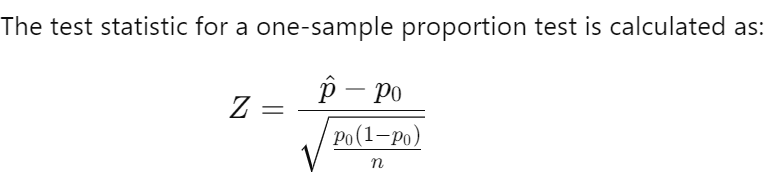
Question: How do you calculate the test statistic for a one-sample proportion test?
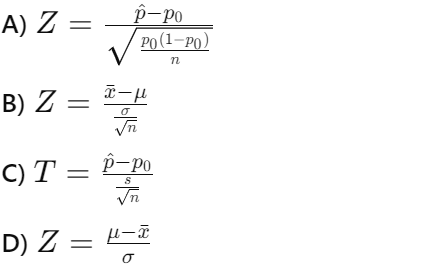
Answer: A)
Explanation:

5. When to Use a Two-Proportion Z-Test?
Let’s compare two proportions!
Question: When is a two-proportion Z-test appropriate?
A) When comparing the proportions of two independent samples with large sample sizes
B) When comparing the means of two independent samples
C) When comparing the variances of two independent samples
D) When dealing with ordinal data
Answer: A) When comparing the proportions of two independent samples with large sample sizes
Explanation: A two-proportion Z-test is used to compare the proportions of two independent samples to determine if they are significantly different from each other. It is appropriate when both sample sizes are large (n ≥ 30).
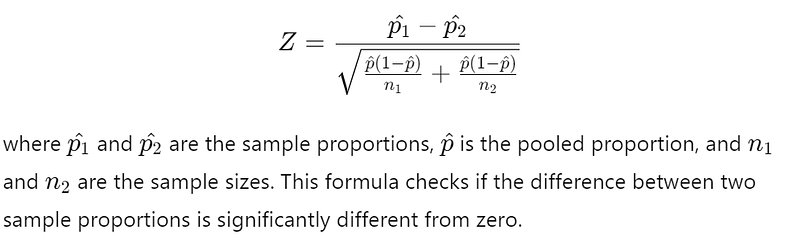
6. How Do You Calculate the Test Statistic for a Two-Proportion Z-Test?
More math on the way!
Question: How do you calculate the test statistic for a two-proportion Z-test?
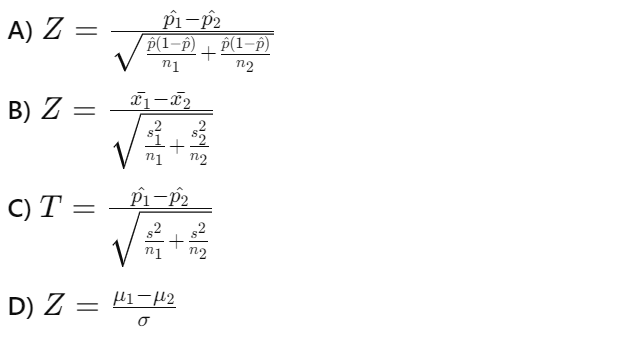
Answer: A)
Explanation: The test statistic for a two-proportion Z-test is calculated as:
7. How to Perform a Hypothesis Test Using Python?
Let’s dive into the practical part!
Question: Which Python library is most commonly used for conducting hypothesis tests, such as T-tests and Z-tests?
A) pandas
B) scikit-learn
C) statsmodels
D) matplotlib
Answer: C) statsmodels
Explanation: The statsmodels library in Python is widely used for conducting hypothesis tests, such as T-tests, Z-tests, and other statistical analyses. It provides a range of functions that make it easy to perform hypothesis testing and interpret the results.
8. How to Perform a One-Sample T-Test in Python Using scipy?
Let’s code it out!
Question: What is the correct way to perform a one-sample T-test using scipy in Python?
- A)
scipy.stats.ztest(sample_data, value=population_mean) - B)
scipy.stats.ttest_1samp(sample_data, popmean=population_mean) - C)
scipy.stats.ttest_ind(sample1, sample2) - D)
scipy.stats.proportion_ztest(count, nobs, value)
Answer: B) scipy.stats.ttest_1samp(sample_data,popmean=population_mean)
Explanation: The function scipy.stats.ttest_1samp() is used to perform a one-sample T-test in Python. You need to provide the sample data and the population mean to test whether the sample mean is significantly different from the population mean.
Here's an example code snippet:
import scipy.stats as stats

# Sample data
sample_data = [12, 15, 14, 10, 13, 17, 15, 12]

# Population mean
population_mean = 14

# Perform one-sample T-test
t_stat, p_value = stats.ttest_1samp(sample_data, popmean=population_mean)
print(f"T-statistic: {t_stat}, P-value: {p_value}")
9. How to Perform a Two-Sample T-Test in Python?
Let’s compare two groups!
Question: Which function from scipy is used to perform a two-sample T-test to compare the means of two independent samples in Python?
A) scipy.stats.ttest_rel()
B) scipy.stats.ttest_1samp()
C) scipy.stats.ttest_ind()
D) scipy.stats.f_oneway()
Answer: C) scipy.stats.ttest_ind()
Explanation: The function scipy.stats.ttest_ind() is used to perform a two-sample T-test for independent samples in Python. This test checks if there is a significant difference between the means of two independent samples.
Here's an example:
import scipy.stats as stats

# Sample data
sample1 = [20, 22, 23, 21, 19, 20]
sample2 = [30, 31, 29, 32, 30, 28]

# Perform two-sample T-test
t_stat, p_value = stats.ttest_ind(sample1, sample2)
print(f"T-statistic: {t_stat}, P-value: {p_value}")
10. How to Perform a Two-Proportion Z-Test in Python?
Handling proportions like a pro!
Question: Which Python function is used to perform a two-proportion Z-test?
A) scipy.stats.ttest_ind()
B) statsmodels.stats.proportion.proportions_ztest()
C) scipy.stats.chisquare()
D) numpy.mean()
Answer: B) statsmodels.stats.proportion.proportions_ztest()
Explanation: The function proportions_ztest() from the statsmodels library is used to perform a two-proportion Z-test in Python. This test checks if there is a significant difference between two sample proportions. Here’s an example:
from statsmodels.stats.proportion import proportions_ztest

# Sample data
count = [30, 50]  # Number of successes in each sample
nobs = [100, 120]  # Number of observations in each sample

# Perform two-proportion Z-test
z_stat, p_value = proportions_ztest(count, nobs)
print(f"Z-statistic: {z_stat}, P-value: {p_value}")
Conclusion
This concludes the third part of the Hypothesis Testing interview preparation series.
Whether you’re comparing means or proportions or implementing these tests in Python, understanding these concepts will give you a strong foundation for your next data science interview.
Keep practicing these questions, stay curious, and good luck with your data science journey! 🎓
Follow me for more such inferential statistics and hypothesis testing guided blog questions and answer series in the future.
Let’s keep learning and growing together! 😊
If you want to practice more interview questions and answers, check out the following blogs:
- Top Interview Questions and Answers on Decision Trees Every Aspiring Data Scientist Should Know
- Top 10 Random Forest Interview Questions and Answers for Data Science Aspirants
- Top 20 FAQs on Descriptive Statistics for Data Science Aspirants
- Top 15 Probability Distribution Questions for Data Science Interviews
- Frequently Asked Hypothesis Testing Questions for Data Scientist Interviews
- Top Interview Questions and Answers on Bagging Algorithms Every Data Scientist Should Know
- Frequently Asked Hypothesis Testing Interview Questions for Aspiring Data Scientists (Part 2)
If you’re also interested in statistics, data science and machine learning, you’ll like these blogs:
- How to Transition into Data Science from a Non-Technical Background
- Credit Risk Modeling in Python
- Exploring Credit Risk and IRFS9 Models
- Analyzing Loan Data with Binomial and Poisson Distributions in Python
- Mastering Credit Risk Analysis: A Step-by-Step Guide to Descriptive Statistics in Python
- Introduction to Hypothesis Testing
- Fraud Analytics — Strategies and Approaches
- Understanding Financial Risk Models: A Guide to Credit Risk, Stress Testing, and More
- The What, Why, and How of Generative AI
- Interview-Ready: Top Generative AI Questions You Need to Know
- 10 Movies to Binge-Watch for Data Science and AI Nerds!
- Sentiment Analysis in Python
You can also connect with me on LinkedIn.
Good luck!


