
Autism “Bewareness” Campaigns
When you want to support a marginalized group, start with listening to them
This April…
Please don’t light it up blue or use puzzle pieces for “awareness”.
I recognize most neurotypical (NT) people who use these symbols have good intentions and are trying to support Autistic people. The best way to be an ally to a marginalized group is to actually listen to them.
We’re already bracing ourselves
Want to know how harmful certain “bewareness” campaigns are?
It’s not even March yet, and many Autistic people and Autistic self-advocates are already anxious about April, emotionally preparing for the onslaught of messages “warning” parents about the perils of having a child with Autism.
Anti-Autism campaigns tell parents to “watch out” for the warning signs their child could be Autistic. They spread hurtful messages about how hard it is to live with an Autistic person.
This is awkward. We’re right here.
How would it feel to know that people wish you didn’t exist? How will their children feel when they grow up and read those kinds of messages one day? (And maybe they already are).
“Be careful how you speak to your children, one day it will become their inner voice.” — Peggy O’Mara
I’m not saying there aren’t challenges that come with being Autistic, with being different from the statistical majority. I’m not saying there aren’t struggles that come with parenting Autistic children. (I’m very aware, I promise).
What I am saying is many of those challenges come from living in a society which is centred around the needs and preferences of the neurotypical majority.
So instead of fighting against a person’s neurotype, we should focus our efforts and energy on improving acceptance and understanding, so we aren’t made to feel like personae non gratae: unwanted and unwelcome.
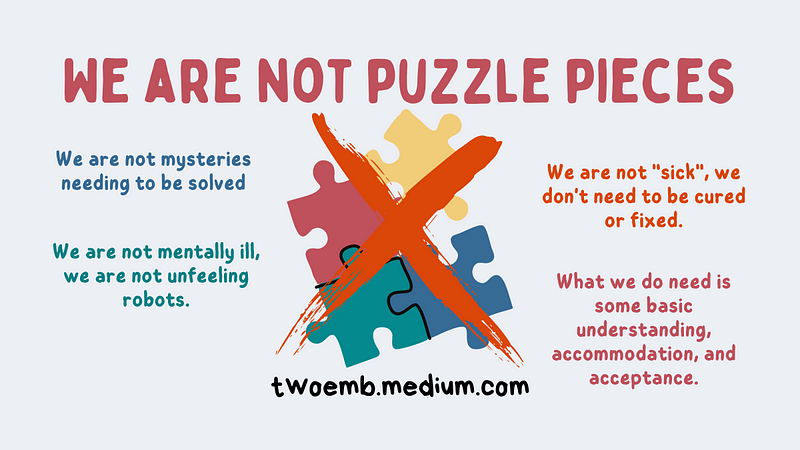
We are not puzzle pieces:
- We are not mysteries needing to be solved.
- We are not “sick”, we don’t need to be cured or fixed.
- We are not mentally ill, we are not unfeeling robots.
- What we do need is some basic understanding, accommodation, and acceptance.
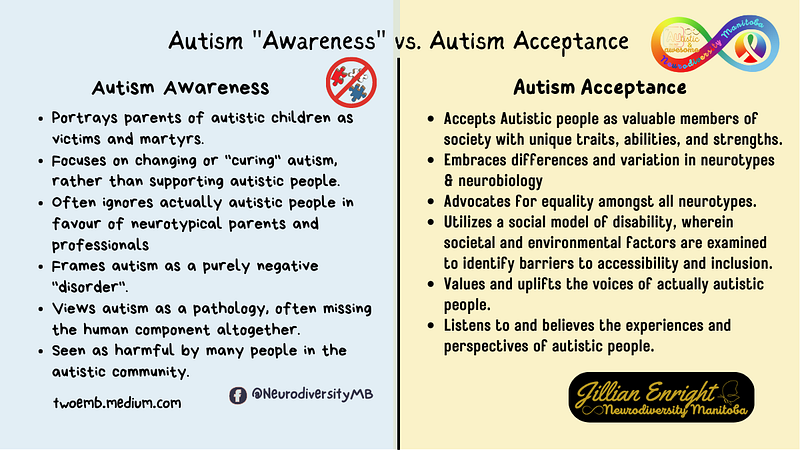
Autism Awareness
- Portrays parents of autistic children as victims and martyrs.
- Focuses on changing or “curing” autism (again: eugenics), rather than supporting autistic people.
- Often ignores actually autistic people in favour of neurotypical (NT) parents and NT professionals.
- Frames autism as a purely negative “disorder”.
- Views autism as a pathology, often missing the human component altogether.
- Seen as harmful by many people in the autistic community.
In contrast…
Autism Acceptance
- Accepts Autistic people as valuable members of society with unique traits, abilities, and strengths.
- Embraces differences and variation in neurotypes and neurobiology.
- Advocates for equality amongst all neurotypes.
- Utilizes a social model of disability, wherein societal and environmental factors are examined to identify barriers to accessibility and inclusion.
- Values and uplifts the voices of actually autistic people.
- Listens to, believes, and respects the experiences and perspectives of autistic people.
Be mindful of who you support
If you want to show your support for the Autistic community, first and foremost, listen to Autistics. Make space for, and lift up, the voices of Autistic self-advocates.
The large “advocacy” organizations out there are being run by allistic (non-Autistic) people who have Autistic children, rather than ensuring they have Autistic leaders guiding their work. This is because they don’t believe in our ability to lead and speak for ourselves.
These large organizations have significant overhead expenses. It’s common for less than 60% of donations, funding, and money raised to go toward the actual cause they claim to support.
Even the better organizations are weighed down by extensive bureaucracy, making change incredibly difficult and slow, and they spend a lot of money on operating costs.
Autism Speaks Canada doesn’t speak for me
For example, Autism Speaks Canada has a five-star rating on Charity Intelligence.
A lot of their spending comes from their financial reserves. They are so well funded, they have $4.5 million in reserve, and could operate for nearly 2 years without a single cent in donations or government funding.
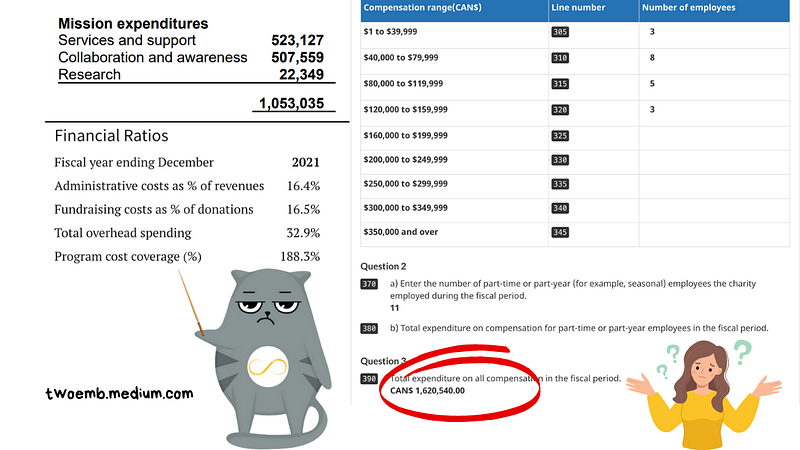
Their administrative costs are listed as only $700K, yet their staff salaries total more than $1.6 million, which would be approximately 40% of their revenue.
Math may not be my strongest subject, so help me out here. If Autism Speaks Canada reported salaries totalling 40% of their revenues, and their other operating costs were 89% of their revenues, how on earth can they direct 67% of their income towards “the cause”?
In fact, their total expenditures, as reported to the Canada Revenue Agency (CRA), were more than $5 million, meaning they spent more than they took in — which is fine, charities do that, that’s why they have reserves.
My issue is with the claim that 67 cents per dollar received goes toward carrying out their mandate. According to their own financial report, only $500K went toward “services and support”. That makes up less than 13% of their reported revenue.
Even if you take all of their reported mission expenditures — which include “collaboration and awareness” and research — those total only one million out of more than $4 million received, comprising 26% of their revenue.
When ‘the cause’ IS the harm
Even when we accept the claim that 67% of their revenue goes toward “the cause” — their cause itself is the harm.
They divert significant amounts of money to autism genetics research, which seeks to find the genes which lead to autism, in order for those genes to be eradicated (that’s eugenics).
Autism Speaks Canada also supports Applied Behaviour Analysis (ABA “therapy”), which so many Autistic adults have clearly indicated they experienced as traumatic and abusive.
Organizations which spread harmful messaging, replete with stereotypes and fear-mongering, hurt the very people they claim to support by perpetuating misinformation.
They rob families of the opportunity to celebrate the amazing Autistic child they have, pressuring them to seek out harmful behavioural “therapies” which aim to change Autistic children, rather than supporting them to become their best authentic selves.
What can you do instead?
Instead of sharing information from these large organizations, which often hurt more than they help, find Autistic self-advocates and learn from us. Share our work instead of posts from groups like Autism Speaks and Autism Ontario (which has only a 2-star rating on Charity Intelligence).
- Listen, learn, and centre the voices of Autistic people.
- Create space for us to be seen and heard, instead of talking over and for us.
- Spread awareness of inclusion, understanding, and acceptance, rather than perpetuating the harmful idea that Autism needs to be eradicated or prevented.
- If an Autistic person says something is harmful to them, listen and believe them, don’t dismiss or invalidate their experience.
- Learn about autism from neurodiversity-affirming advocates so you can understand autism from lived and nuanced perspectives, rather than perpetuating pathologizing and stereotypical information.
- When you understand the lived experiences of actual Autistic people, and what it means to be Autistic from those who know, you will be a more truly supportive and effective ally.
Lastly, if you have any questions about Autism Speaks Canada’s financial data, and how I arrived at those numbers, feel free to ask. I’m Autistic, guys. I made a spreadsheet and everything. Happy to share!
© Jillian Enright, Neurodiversity MB
When you join medium, as a member you’ll have access to unlimited reads for only $5 per month. If you use my referral link, I’ll earn a small commission, and you’ll earn my undying gratitude.
If you’d prefer give a one-time tip, you can support my writing on Ko-Fi — also, it’s free to follow me on Facebook and LinkedIn!


