
Are Curation and Distribution Still the Secret to Success?
A case study review using my April Top and Flop Articles

An important part of growth is to periodically track and reflect on different metrics. While I don’t check stats every day as day-to-day fluctuations often represent more random events than predictable ones (and lead us to overthink small actions), I do reflect monthly on what I’ve learned from each piece.
I’ve struggled to share these lessons on a regular basis, flip-flopping between “posting about success is obnoxious” vs. “transparency helps new writers grow, as others have helped you”, and this month, I’m settling on the latter. I’ve genuinely found posts like these helpful in giving context to how to navigate the world of Medium and freelance writing, and each perspective I’ve read has been valuable. Inspired by Jen’s recent wrap-up reflections, I’m back at this review again.
We are all different human beings, with different experiences, so there is no “gold standard” single piece that will tell you exactly how you, as a writer, will perform. But in gathering different stories from writers who write from different angles and genres, you get to form an idea of where you might place in the pattern of these data.
[1] The distribution gives longevity to an article but engagement comes from within communities that you foster
Yes, this post was curated/ chosen for distribution. But, if you examine the graph, distribution isn’t what promoted most of the views on this article.
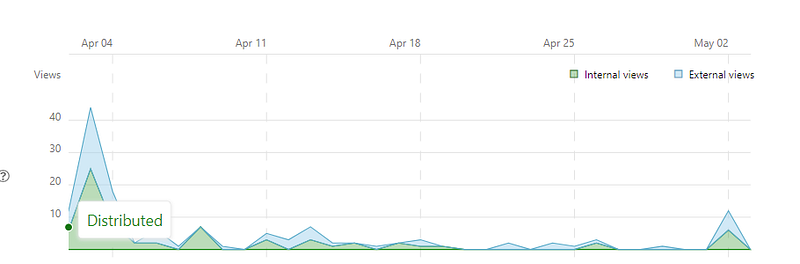
There are two peak points of this graph. The first corresponds with me sharing this article with Writers and Editors of Color, a brilliant community of … writers and editors of colour.
Rather than a community of people who just drop their links and leave, which is, unfortunately, the way many writers groups go, Tee, WEOC - Writer & Editor of Color, and Allison Gaines have set up space where people genuinely engage, learn and grow together.
Not only were people reading my piece and commenting about their own experiences, but they also shared the piece to social media with key snippets that they thought might be relevant to people who follow them. That alone drove views up to 40 in one day — truly phenomenal to me at this stage of writing.
The second peak corresponds with my interview with WEOC on Twitter Spaces for their Writers for Change series. This is a space where we “leave some gems, take some gems” as Allison puts it, helping each other learn about writing processes that help us grow as writers. Attendees from this segment heard about my work and actively found this piece to read it.
In short, the distribution helped get this to more eyes over a longer period, so that the views are sometimes close to 0 but never truly 0. But what got the active engagement is finding a writing community that truly supports their writers.
(PS, check out WEOC if you haven’t yet?)
[2] Distribution/ Curation feeds you for a long, long time
This piece is half a year old! Six months ago, I got hungry and inspired by Aimée Gramblin who fueled my fire to share this framework for fried rice. Since then, it’s made the top of my read list multiple times.
In fact, to illustrate how old this piece is, Age of Empathy has since shifted away from listicle/article type pieces towards creative non-fiction. That means, dear readers, this piece is not only old and curated, but limited edition AoE material (I’m only partially joking).
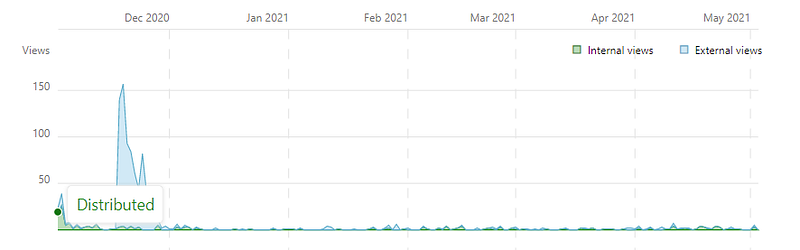
It might not have been a lot of bites (or bytes?) in terms of views but these consistent views that come from distribution have ensured the longevity of this article to ensure that I can have real bites of delicious slightly charred fried rice.
[3] Getting distributed for poetry is its own unhackable beast; it may be more helpful to focus on self-promotion
If you’ve written poetry, you’ll know it’s really hard to get curated under poetry. Or maybe all of your poetry gets curated and you hold all the keys to success, in which case, please do share!
What I realized is that getting curated under poetry doesn’t have the same kind of impact as other ways that I’ve self-promoted poetry. Sure, it’s still nice to get curated because it generates more views on a piece, but it’s not the same impact because poems are typically shorter and you don’t get the same amount of additional time spent on a piece.
Part of the reason that I may not be curated under poetry is that I don’t have any “formal training” in poetry. But keep in mind, I don’t have any formal training in any other writing format, and have a higher curation rate.
I also find that longer articles that can be tagged under more than one “interest” are often more likely to be distributed. For example, if you have a piece that intersects race and gender equality, this is more likely to be distributed than if you wrote a piece under one interest. Perhaps it’s related to higher chances with double the tags, or perhaps the algorithm is picking up that intersectionality is important.
This is not true for poetry though. As an eggspert food poet, tagging poetry and food do not double the rate of curation. At most, it may be curated under poetry, but interests intersecting with poetry have not, in my experience, been wanted under the listed topics.
So that’s a piece of food for thought.
[4] Get relational, but be deliberate in offering value
For the month of May, I wanted to get to know writers in The Brain is a Noodle better so I launched the interview project with 5-short answers, 5 binary choices, and 5 articles to promote.
It was something simple, but also something to get relational to know writers better. Writing can be such a solitary activity.
This interview was particularly successful because the questions themselves gave writers permission to share a part of themselves that perhaps they didn’t have enough material for a whole article. It gave permission for writers to share as if they are human (shocker???) rather than information pumping machines looking for the right string of words and letters that would capture your attention. Or am I being too cynical about the writing process?
Either way, the relational aspect of this allowed writers to genuinely connect, providing value for everyone who hopped in, either to share pieces about themselves or to read about others.
Notice that this doesn’t mean solely tagging people. While sometimes I do tag other writers, particularly in newsletters where I promote a writer’s own work, or in poetry prompts to inspire new pieces, I don’t tag people solely to get them to read my pieces.
The first step to being relational is ensuring that you’re giving first (i.e., genuinely sharing someone else’s work or providing something of value to them), with the acknowledgment that this may not be returned. Relational does not mean tagging everyone in your follow list so that they can read your piece as this provides small value to readers and centers your needs first.
[5] The single thing I’ve earned from my “flop” articles
Curation isn’t the only way to promote your articles — in fact, while curation works for some bigger articles, you’ll have to learn how to market and promote your own articles.
While Medium is the source of 90%+ views on my articles in the first month, older articles have a ratio closer to this:
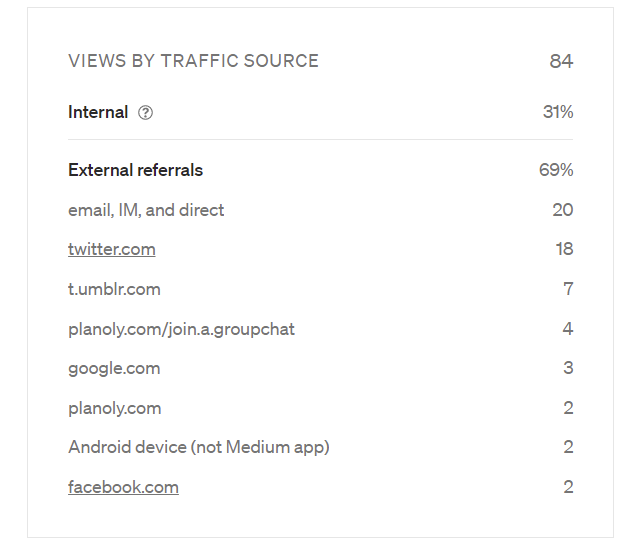
Though not a surprisingly extra # of views, I’m still generating them by just having posted them on social media rather than having to “churn out” more writing in order to get views on past articles.
While some writers really promote this idea of keeping regularly, to the effect of writing almost daily, I’ve just seen too many daily writers (and on Youtube, daily vloggers) burn out to know that while it makes money and generates views, it’s not a human way to live for most.
Although it’s only netting me a few extra views, this is only the beginning. These results refer to the first few months of trying different tactics, and the fact that there are results that outweigh what Medium itself is providing me for some articles is important.
It means there’s hope beyond curation.
For information on how to self-promote…
On Instagram
On Twitter
How to Create Threads Seamlessly on Twitter
A (non-sponsored) review of the Typefully App
medium.com
Supporting your fellow writers in general because community support is the way to grow too
Overall takeaway
Overall, I recommend checking your stats from time to time to observe for general patterns or lessons that you might be able to draw from a period of time of at least one week. Obsessing over daily or even hourly fluctuations is stressful at best and usually captures more random events than predictable patterns.
From this type of stats-checking, I’ve learned this month that in general, while distribution has longevity, numerous other factors are just as important.
- Community matters — if you haven’t yet found a writer’s group where you feel like you belong, keep searching! I used to believe that writer’s groups could only be self-serving and be promotional tools, but in WEOC I’ve really gotten far beyond that.
- Distribution is about longevity — While distribution may not get you to the top right away, it’s been most helpful in keeping some old pieces alive.
- If you’re finding it hard to get curated under poetry, you’re not alone! — a piece of validation that the same formulas and tips that many touts to get curated or distributed, do not apply to poetry. Thus, I look to other ways to get my poetry out there.
- Getting relational help but be sure to provide value — getting relational is sometimes interpreted as “tagging people” or mass default comments, but the truth is closer to making sure you provide space for people to connect on a genuine level.
- Self-promotion works! — Don’t solely rely on the algorithm to promote you because algorithms change and you can suddenly plummet in views. Instead, use a multi-pronged strategy so if one promotional tactic falters, you have another stream still thriving.
Do you agree or disagree with these lessons? Anything else you learned from this month’s writing experiences?
Hi, I’m Lucy Dan 蛋小姐 (she/her/她) and I write whatever swims around in my brain noodle.
Hop down the rabbit hole? 🐰🕳
^ by Vishnu*s Virtues!


