avatarJillian Enright

Free AI web copilot to create summaries, insights and extended knowledge, download it at here

5698

Abstract

his includes, but is certainly not limited to, <a href="https://readmedium.com/adhd-medication-trials-cfe97bf0ad6b">medication</a>. Meds aren’t the right fit for everyone, but right now they are helping us a great deal.</p><p id="3bbd">Self-knowledge and self-understanding have really helped improve my self-concept, as well as find strategies and tools that work better for my <a href="#0890"><i>neurotype</i></a>.</p><p id="1465"><a href="https://readmedium.com/the-power-of-validation-483bb53f9b93">Validation</a> can be incredibly freeing as well. If you’ve struggled a lot in your life, and always felt different, but didn’t know why, this can put a name to some of those difficulties.</p><h2 id="057b">A new lens</h2><p id="3729">Without the understanding that we are <a href="#0890"><i>neurodivergent</i></a>, we are much more likely to blame ourselves (and for others to blame us as well), using hurtful, inaccurate labels such as “<i>lazy</i>” or “<i>stupid</i>”.</p><figure id="2ccf"><img src="https://cdn-images-1.readmedium.com/v2/resize:fit:800/1*P6WwXDuxgGsAP2xOcHw0gQ.png"><figcaption>Created by author</figcaption></figure><p id="8e46">Understanding the reasons underlying some of those difficulties can help us view ourselves through a different lens, hopefully allowing for some self-compassion in the process.</p><h2 id="6480">Most importantly</h2><p id="1b24">In my experience, it can also make us more understanding and open toward other people who are different. Rather than going with our initial judgements, which are often based in ignorance, we become more willing to challenge our preconceived notions (about ourselves and others).</p><p id="6024">Once we have a better handle on what it means to have ADHD, we can then <a href="https://readmedium.com/the-five-stages-of-diagnosis-3e904e2151b5">embrace</a> (or at least accept) our divergent neurotype, even recognizing some of the <a href="https://readmedium.com/the-five-stages-of-diagnosis-3e904e2151b5">strengths and assets</a> that come along with having a differently wired brain.</p><p id="e7de">Most profoundly for me, and many other late-diagnosed ADHDers I’ve met, <a href="https://readmedium.com/when-a-diagnosis-is-more-than-just-a-label-f6e5208d1b60">finding community</a> has been the most previous gift to come with being diagnosed.</p><p id="271c">So go ahead and let your awesome, unique qualities shine. When you’re ready, <a href="https://readmedium.com/professionalism-is-performative-889951b3c4da">put yourself out there</a>. You never know who you’ll find once you fully embrace your neurodivergent self.</p><p id="8257">© Jillian Enright, Neurodiversity MB</p><h1 id="4151">Learn More</h1><div id="936f" class="link-block"> <a href="https://readmedium.com/dsm-5-criteria-for-adhd-ca07985d18fc"> <div> <div> <h2>Actual ADHD symptoms the DSM-5 misses</h2> <div><h3>Help understanding the real-life symptoms of ADHD</h3></div> <div><p>medium.com</p></div> </div> <div> <div style="background-image: url(https://miro.readmedium.com/v2/resize:fit:320/1*nAk39srVYrU-sadfnpoijQ.png)"></div> </div> </div> </a> </div><div id="587c" class="link-block"> <a href="https://readmedium.com/when-youve-realize-you-re-neurodivergent-5d0adfb1b168"> <div> <div> <h2>When You Realize You’re Neurodivergent</h2> <div><h3>Advice for navigating the journey if you’re newly identified Autistic or ADHD</h3></div> <div><p>medium.com</p></div> </div> <div> <div style="background-image: url(https://miro.readmedium.com/v2/resize:fit:320/1*mmuUqYwwakZ4-mwjYs5ITw.png)"></div> </div> </div> </a> </div><div id="0067" class="link-block"> <a href="https://readmedium.com/books-about-adhd-eca20db9e8e"> <div> <div> <h2>Books About ADHD</h2> <div><h3>My reading recommendations for learning about ADHD</h3></div> <div><p>medium.com</p></div> </div> <div> <div style="background-image: url(https://miro.readmedium.com/v2/resize:fit:320/1*hcJMk84JrDaejVc82WKLng.png)"></div> </div> </div> </a> </div><h2 id="22ba">Small self-promotion</h2><p id="5464">If you’re here because you’re newly diagnosed or identified (whether self-identified or formally diagnosed) and want to learn more about Autism and ADHD, I hosted a <a href="https://neurodiversitymb.ca/shop/ols/products/autism-and-adhd-the-essentials-webinar-recording">webinar</a> covering <a href="https://neurodiversitymb.ca/shop/ols/products/autism-and-adhd-the-essentials-webinar-recording">ADHD and Autism Essentials</a>, which is now available for <a href="https://neurodiversitymb.ca/shop/ols/products/autism-and-adhd-the-essentials-webinar-recording">purchase and download</a> on my website.</p><figure id="86e4"><img src="https://cdn-images-1.readmedium.com/v2/resize:fit:800/1*go6de2QOZRdZbT4YzWjf6Q.png"><figcaption></figcaption></figure><p id="4d22">My website also has resources for those who are <a href="https://neurodiversitymb.ca/seeking-assessment">seeking assessments</a>, <a href="https://neurodiversitymb.ca/newly-diagnosed">newly diagnosed</a>, or trying to navigate <a href="https://neurodiversitymb.ca/seeking-assessment">the assessment process</a>.</p><p id="7efa"><i>When you join medium, as a member you’ll have access to unlimited

Options

reads for only $5 per month. If you use <a href="https://twoemb.medium.com/membership">my referral link</a>, I’ll earn a small commission, and you’ll earn my undying gratitude.</i></p><p id="6fc1"><i>If you’d prefer give a one-time tip, you can <a href="https://ko-fi.com/neurodiversitymb">support my writing on Ko-Fi</a> — also, it’s free to <a href="https://facebook.com/NeurodiversityMB">follow me on Facebook</a>!</i></p><p id="a38d">© Jillian Enright, Neurodiversity MB</p><h1 id="0890">Adult ADHD Terms</h1><figure id="0431"><img src="https://cdn-images-1.readmedium.com/v2/resize:fit:800/1*-MxMoGNZmneHehHxxnvhzQ.png"><figcaption>Created by author</figcaption></figure><h1 id="8e31">Related Articles</h1><div id="ef3d" class="link-block"> <a href="https://readmedium.com/october-is-adhd-awareness-month-45e158dd825f"> <div> <div> <h2>My ADHD Diagnosis Took More Than Three Decades</h2> <div><h3>Why it’s more difficult for women with ADHD to be diagnosed</h3></div> <div><p>medium.com</p></div> </div> <div> <div style="background-image: url(https://miro.readmedium.com/v2/resize:fit:320/1*GzFpntY0-IhfCdNBdXQndw.png)"></div> </div> </div> </a> </div><div id="70d5" class="link-block"> <a href="https://readmedium.com/adhd-in-adult-women-6ef386d40647"> <div> <div> <h2>ADHD in Women and Girls</h2> <div><h3>But really, externalizing versus internalizing symptoms of ADHD</h3></div> <div><p>medium.com</p></div> </div> <div> <div style="background-image: url(https://miro.readmedium.com/v2/resize:fit:320/1*VCOdX4-USri0EnqOFII2mA.png)"></div> </div> </div> </a> </div><div id="0a6a" class="link-block"> <a href="https://readmedium.com/yes-adhd-is-genetic-a1867ec0ebf4"> <div> <div> <h2>Yes, ADHD is Genetic</h2> <div><h3>And no, ADHD is not caused by trauma</h3></div> <div><p>medium.com</p></div> </div> <div> <div style="background-image: url(https://miro.readmedium.com/v2/resize:fit:320/1*R2_I9F6GLffObyX3ONyePw.png)"></div> </div> </div> </a> </div><div id="0324" class="link-block"> <a href="https://readmedium.com/can-a-person-develop-adhd-feaef29e4772"> <div> <div> <h2>ADHD Is Not A Disease</h2> <div><h3>You can’t ‘develop’ ADHD, you get the brain you’re born with… (sort of)</h3></div> <div><p>medium.com</p></div> </div> <div> <div style="background-image: url(https://miro.readmedium.com/v2/resize:fit:320/1*d3DM0c5ZWJj7o8euUycbgA.png)"></div> </div> </div> </a> </div><div id="4e4f" class="link-block"> <a href="https://readmedium.com/adhd-and-autistic-assets-8774fa631500"> <div> <div> <h2>ADHD And Autistic Assets</h2> <div><h3>The strengths and gifts of divergent minds</h3></div> <div><p>medium.com</p></div> </div> <div> <div style="background-image: url(https://miro.readmedium.com/v2/resize:fit:320/1*9GPKcCAkzDFp64GL_VhZPA.jpeg)"></div> </div> </div> </a> </div><div id="7fb1" class="link-block"> <a href="https://readmedium.com/the-five-stages-of-diagnosis-3e904e2151b5"> <div> <div> <h2>The Sixth Stage of Diagnosis</h2> <div><h3>Embracing your own or a loved one’s neurodivergence</h3></div> <div><p>medium.com</p></div> </div> <div> <div style="background-image: url(https://miro.readmedium.com/v2/resize:fit:320/1*ba6rR7ozvUZUFUEWrTMfAA.png)"></div> </div> </div> </a> </div><div id="e4b2" class="link-block"> <a href="https://twoemb.medium.com/when-a-diagnosis-is-more-than-just-a-label-f6e5208d1b60"> <div> <div> <h2>A Diagnosis is More Than Just a Label</h2> <div><h3>An accurate diagnosis can open the door to treatment, resources, and support.</h3></div> <div><p>twoemb.medium.com</p></div> </div> <div> <div style="background-image: url(https://miro.readmedium.com/v2/resize:fit:320/1*fQwjC5i_FBXj8t7HIkt5wg.jpeg)"></div> </div> </div> </a> </div><h2 id="e08d">References</h2><p id="a2cf">Faraone, S.V., & Larsson, H. (2019). Genetics of attention deficit hyperactivity disorder. <i>Molecular Psychiatry</i> <i>24</i><b>, </b>562–575. <a href="https://doi.org/10.1038/s41380-018-0070-0">https://doi.org/10.1038/s41380-018-0070-0</a></p><p id="596f">Vasiliadis, H. M., Diallo, F. B., Rochette, L., Smith, M., Langille, D., Lin, E., Kisely, S., Fombonne, E… Lesage, A., <i>et al</i>. (2017). Temporal Trends in the Prevalence and Incidence of Diagnosed ADHD in Children and Young Adults between 1999 and 2012 in Canada: A Data Linkage Study. <i>Canadian journal of psychiatry. Revue canadienne de psychiatrie</i>, <i>62</i>(12), 818–826. <a href="https://doi.org/10.1177/0706743717714468">https://doi.org/10.1177/0706743717714468</a></p></article></body>

Adult ADHD: The Essentials

An explanation of what ADHD is for Adults
Created by author on Canva

What is Adult ADHD?

ADHD is a complex neurological difference, sometimes called a neurodevelopmental disorder, because an ADHD brain develops differently from typical brains.

Every person with ADHD is different.

Although we share similar traits and symptoms, we all experience them differently. No two people will have the exact same definition of what having ADHD means to them.

What Adult and adolescent ADHD can look like

Disorganization

  • I have trouble keeping my things neat and organized.
  • I’ll often forget where I put things and have trouble finding them later.

Planning

  • I struggle with motivation, especially involving repetitive or tasks I do not find interesting.
  • Sometimes I rush through my work when it feels boring, then I make mistakes on things I know how to do.

Distractibility

  • I get distracted easily, especially when there are a lot of steps to remember, or when I’m in a busy environment.
  • It looks like I’m not listening, but in reality, I’m having trouble listening an paying attention to too many things at once.

Impulsivity & emotional intensity

  • When I get excited, my voice gets loud, but I don’t even notice.
  • Sometimes I interrupt people when they’re talking. I am not trying to be rude, I’m afraid if I wait, I’ll forget what I wanted to say.
  • Sometimes my emotions feel so intense, I can hardly stand it.
  • When I get really angry, sometimes I act impulsively and do things I later regret.

External hyperactivity

  • My body doesn’t like to be still.
  • I need to fidget and move.
  • It might look like I’m not paying attention, but it really does help me focus.
  • I have a really hard time waiting for things, especially if they’re very exciting, or if I’m feeling under-stimulated.
  • My brain is always needing something interesting to do.

Internal hyperactivity

  • Racing, disorganized thoughts
  • Distractibility
  • Anxiety and depression
  • Sensory sensitivities

ADHD is complex

It is not just trouble focusing or sitting still.

ADHD involves executive functioning (EF) difficulties which impact our ability to plan, stay organized, and regulate our attention and emotions. EFs also impact working memory (a type of short-term memory), impulse control, and mental flexibility.

Adult ADHD is real

At least 3% of adults in Canada are formally diagnosed with ADHD. This is likely a significant under-estimate of how many adults actually have ADHD, because many go undiagnosed.

The older a person gets, the more difficult it is to receive a formal diagnosis, especially for women and other marginalized genders. I was not diagnosed until age 36, and that was only because my son was diagnosed (at age 6), which led me my exploration of our many similar traits.

We cannot “outgrow” ADHD

Many symptoms can reduce in their severity as our brains mature and we develop strategies for managing those symptoms.

Often due to repeated correction, criticism, and rejection, we learn to internalize and hide our symptoms, but they are still there.

We also may find the environments which better suit our strengths, and mitigate our struggles, so that we find our ADHD symptoms less troublesome as we age.

To diagnose, or not to diagnose?

That is (often) the question

Many parents see ADHD traits in themselves after their child is diagnosed, which makes perfect sense because ADHD is highly genetic and has an estimated heritability rate of 75–80%.

Others find themselves searching for information on their struggles online and end up relating to a lot of Adult ADHD traits, or have a friend with ADHD, and begin to recognize extensive similarities in themselves.

A lot of adults ask, is it worth getting a diagnosis at this point? I’m already x years old, and have muddled through okay for this long, would a formal diagnosis really help anything?

The answer is, as usual: that depends.

Personally, the diagnoses and treatment of our ADHD has significantly improved the quality of life for both my son and myself. This includes, but is certainly not limited to, medication. Meds aren’t the right fit for everyone, but right now they are helping us a great deal.

Self-knowledge and self-understanding have really helped improve my self-concept, as well as find strategies and tools that work better for my neurotype*.

Validation can be incredibly freeing as well. If you’ve struggled a lot in your life, and always felt different, but didn’t know why, this can put a name to some of those difficulties.

A new lens

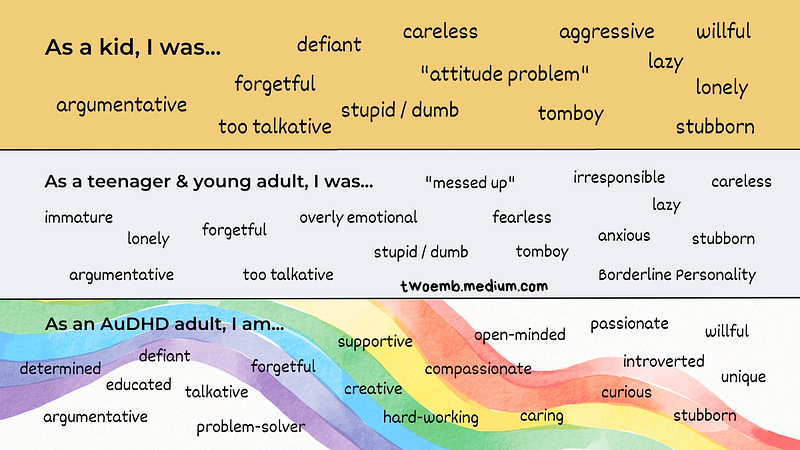
Without the understanding that we are neurodivergent*, we are much more likely to blame ourselves (and for others to blame us as well), using hurtful, inaccurate labels such as “lazy” or “stupid”.
Created by author

Understanding the reasons underlying some of those difficulties can help us view ourselves through a different lens, hopefully allowing for some self-compassion in the process.

Most importantly

In my experience, it can also make us more understanding and open toward other people who are different. Rather than going with our initial judgements, which are often based in ignorance, we become more willing to challenge our preconceived notions (about ourselves and others).

Once we have a better handle on what it means to have ADHD, we can then embrace (or at least accept) our divergent neurotype, even recognizing some of the strengths and assets that come along with having a differently wired brain.

Most profoundly for me, and many other late-diagnosed ADHDers I’ve met, finding community has been the most previous gift to come with being diagnosed.

So go ahead and let your awesome, unique qualities shine. When you’re ready, put yourself out there. You never know who you’ll find once you fully embrace your neurodivergent self.

© Jillian Enright, Neurodiversity MB

Learn More

Small self-promotion

If you’re here because you’re newly diagnosed or identified (whether self-identified or formally diagnosed) and want to learn more about Autism and ADHD, I hosted a webinar covering ADHD and Autism Essentials, which is now available for purchase and download on my website.

My website also has resources for those who are seeking assessments, newly diagnosed, or trying to navigate the assessment process.

When you join medium, as a member you’ll have access to unlimited reads for only $5 per month. If you use my referral link, I’ll earn a small commission, and you’ll earn my undying gratitude.

If you’d prefer give a one-time tip, you can support my writing on Ko-Fi — also, it’s free to follow me on Facebook!

© Jillian Enright, Neurodiversity MB

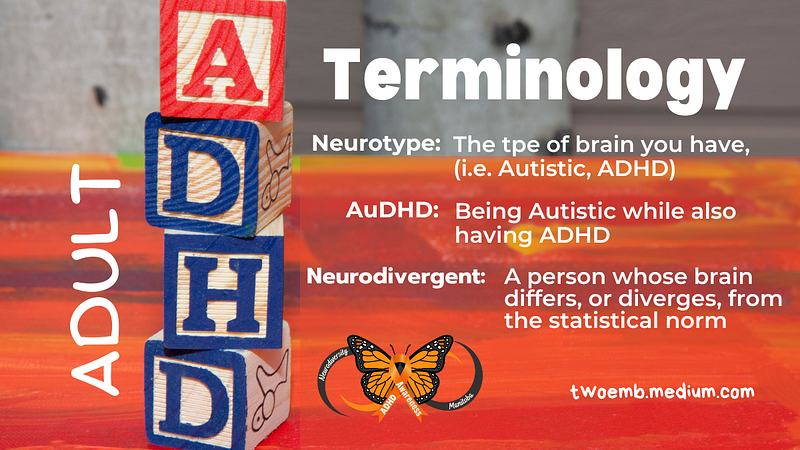
Adult ADHD Terms
Created by author

Related Articles

References

Faraone, S.V., & Larsson, H. (2019). Genetics of attention deficit hyperactivity disorder. Molecular Psychiatry 24, 562–575. https://doi.org/10.1038/s41380-018-0070-0

Vasiliadis, H. M., Diallo, F. B., Rochette, L., Smith, M., Langille, D., Lin, E., Kisely, S., Fombonne, E… Lesage, A., et al. (2017). Temporal Trends in the Prevalence and Incidence of Diagnosed ADHD in Children and Young Adults between 1999 and 2012 in Canada: A Data Linkage Study. Canadian journal of psychiatry. Revue canadienne de psychiatrie, 62(12), 818–826. https://doi.org/10.1177/0706743717714468

Adhd
Psychology
Adult Adhd
Mental Health
Neurodiversity
Recommended from ReadMedium