
ADHD | Mental Health
ADHD Medication Trials
What to expect when a doctor prescribes ADHD medication

Obligatory Disclaimer
This is not an article about different medications and their pros and cons, nor is it a debate about whether or not to use medications to treat ADHD.
As with any medical advice, those are conversations to be had with a medical professional.
What this article is about is what you might expect if you or your child are prescribed and start taking a medication to treat ADHD. This is not predicting what will happen, this is outlining some of the possibilities of what might happen.
These possibilities are based on research, personal experience, as well as my professional experience supporting families who — in consultation with their doctors — have chosen to try ADHD medications.
There are two different types of medications that can be used to treat ADHD symptoms: stimulant and non-stimulant. Stimulants are the most commonly prescribed as they tend to help with focus, hyperactivity, impulsivity, and emotional regulation.
Non-stimulant medications tend to be the back-up plan for people who don’t tolerate the stimulants or their side-effects well, but this is not always the case. Some people simply find their symptoms are better managed with non-stimulant medications.
Once you and your doctor have determined which medication will be best for you, I describe what you might expect. Again, this is general information only, based on research, personal experience, and my professional experience. This does not replace medical advice from an expert.
A Honeymoon Period
For many people, the first two weeks to two months after starting the right medication for their ADHD are a dream. Their child has suddenly been replaced with some kind of angel, or they find they have the energy of an entire army, and their house has never looked better.
Whatever the case may be, be prepared that this may happen. If it does happen, also be prepared for the possibility that it might not last. (Sorry).
It’s not all bad news, however. While it is not entirely understood why this occurs, there are a few theories, as outlined by Dr. Jason Yanofski (2011):
- Bodies Change. As our weight or metabolism change, the medication effects may also change.
- Worsening symptoms. It may be a coincidence. Perhaps the symptoms worsened, but with the medication being new, the timing made it seem as though the medication first improved symptoms and then that improvement regressed.
- Environmental changes. It’s possible things were going along nicely, then something unpleasant happened, or life circumstances changed. Maybe your child is having a disagreement with a friend, or his teacher is away and he has a substitute. Maybe your ADHD meds were working great, but then your workload increased, or your employer is restructuring and everyone is extremely stressed out.
- Paradoxical decompensation. This is similar to the second point, wherein it’s possible that beneath the effective treatment, symptoms were actually worsening. If the person chooses or needs to stop taking the medication, or reduces their dose, their symptoms seem to rebound and return much worse than before.

It Takes Time
Although it can be disheartening to see improvement followed by regression, that too may be temporary. It usually takes time to find the right type and dosage for each individual.
Often doctors will start with a very low dose, then gradually increase it until their patient finds the right balance between positive treatment effects and tolerable side effects. Side effects usually improve over time, as your body adapts to the medication — something to discuss regularly with your prescribing physician.
A common misconception people have about stimulant medications is that dosage is weight-dependent. This is understandable, since a lot of medications are, especially in paediatrics. Your doctor will likely want to monitor for weight loss as stimulants can suppress appetite, and may adjust accordingly, but the actual dose is not directly correlated with weight.
Although stimulants are fast-acting — meaning we usually feel the effects fairly quickly, and they move through our bodies quickly — it still takes time to truly reap the benefits of proper treatment for a few reasons.
While stimulant medications start working quickly, we’ve still developed years of certain ways of thinking and behaving. It takes time to change habits, and even longer to create new neural connections, especially as we get older and our patterns become more ingrained.
Most Common Side Effects
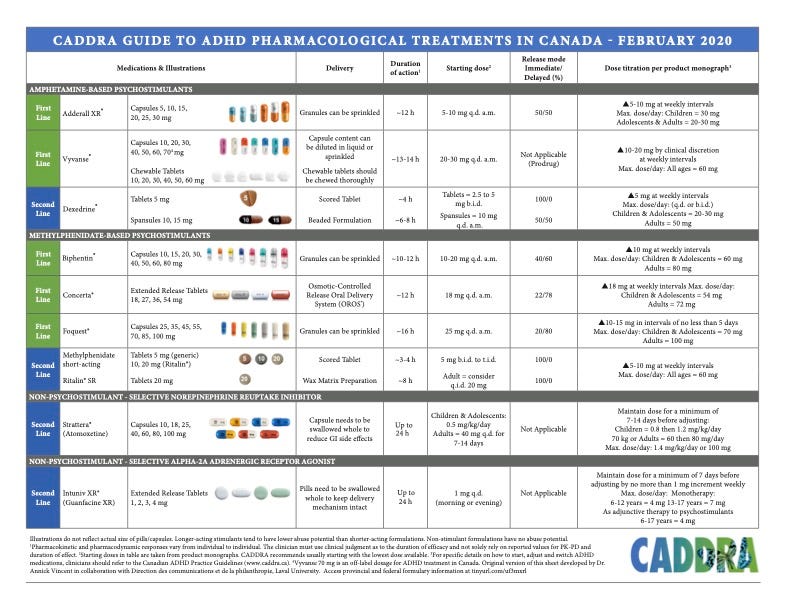
The most common side effects of psychostimulants are appetite suppression and difficulty falling asleep. For more information about medications, please speak to your primary care physician. (CADDRA also has an excellent medication chart available on their website for reference).
Stimulants are considered first-line treatments for ADHD, supported by decades of research and a history of robust response, tolerable side-effects, and safety across the lifespan.
Unexpected Treatments and Side Effects
Treatment does not have to include medication, nor does medication have to be a stand-alone method of treatment. While it is generally the most effective treatment option, it doesn’t work for everyone, and not everyone is ready to go that route. Treatment can also include counselling, occupational therapy, ADHD coaching, and support with executive functioning skills.
Another effective treatment for me has been information. The more I arm myself with knowledge and understanding about neurodivergence, the better prepared I feel to effectively manage my symptoms and to support my son with his.
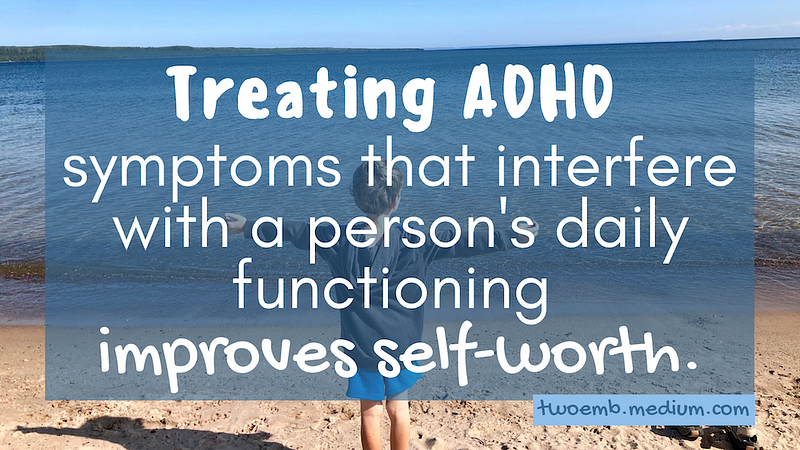
Additional unexpected benefits of treating one’s ADHD are improved social functioning and improved self-worth. Many of us with ADHD already struggle with low self-esteem. Being frequently criticized for behaviours or mistakes we make due to our neurological differences can really chip away at our self-confidence.
Being self-aware, knowledgeable, and having effective treatments and strategies to manage our ADHD symptoms will allow us to function better in our daily lives. Untreated ADHD is associated with poorer long-term self-esteem and social functioning, whereas treatment results in improvement of both self-esteem and social function outcomes.
Knowledge is Power
In addition to information being an excellent treatment strategy, educating ourselves also helps alleviate anxiety. If you’re unsure about starting medication for yourself or your child, or you’re concerned about side effects, look for reputable sources and start reading, then take your questions to a medical professional.
Remember that medication isn’t the only option for treating ADHD symptoms, although it is the most effective. The risks of leaving ADHD undiagnosed and untreated are significant:
- Increased risk of car crashes
- Increased risk of addictions and substance abuse
- Increased impulsive and risky behaviours
- Increased risk of anxiety and depression
- Poor self-concept and low self-esteem
- Underperformance both in school and at work
The good news is that treatment of ADHD improves symptoms, emotional lability, and daily functioning, often leading to favourable outcomes.
We all deserve the best possible treatment, and we all deserve the opportunity to manage our troublesome symptoms so that we can embrace our neurodivergence and discover the gifts that come with our divergent brains.
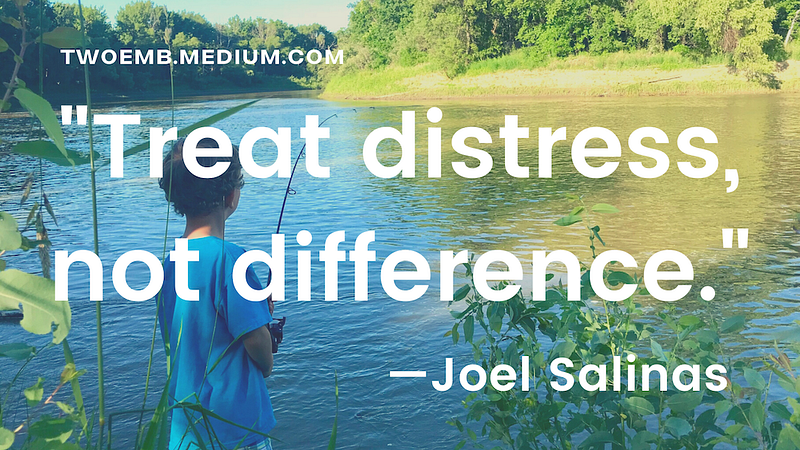
Treat Distress, Not Difference
(Joel Salinas, quoted in Divergent Mind, Nerenberg, 2021)
Whichever route you choose to manage symptoms of your own or your child’s neurodivergence, this is the most important message, especially for your children: choose treatment that helps you or your child feel better, not that which helps others feel better.
The goal of treatment should be to improve daily functioning, improve one’s self-concept, and reduce any distressing symptoms. The goal should never be to force someone to “fit in” with neurotypical norms, nor to suppress or mask aspects of a person’s neurodiversity, simply to make others feel more comfortable.
Let’s work together toward long-term goals such as self-discovery, self-acceptance, and celebration of our unique gifts and strengths.
© Jillian Enright, Neurodiversity MB
ADHD Meds Aren’t Magic
While ADHD medications can be positively life-changing, they are not a panacea. I wrote a follow-up piece explaining what I mean by that:
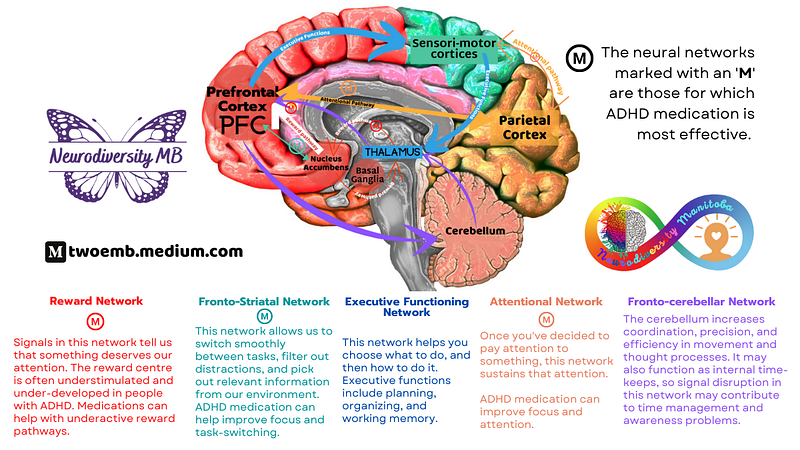
Neural networks for which ADHD medication is most effective
Medication does not help with all ADHD symptoms, and it certainly is not a “cure” (there is no such thing). If you’re wondering which symptoms of ADHD for which medication might be most effective, the infographic below might help.
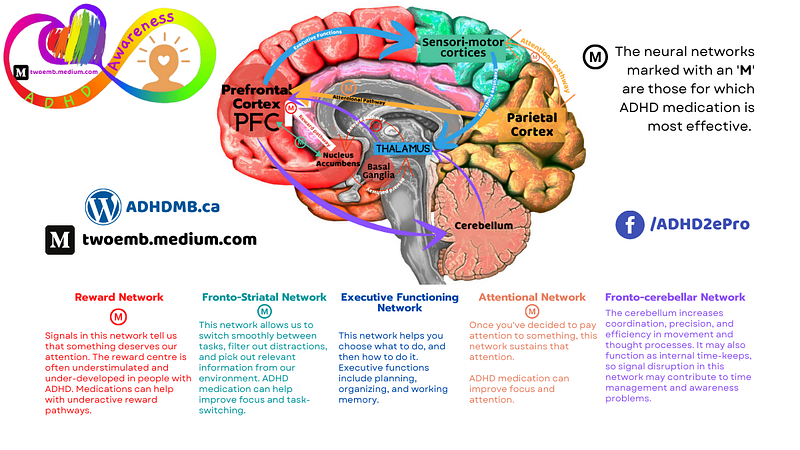
For specific information about medications, please speak to a medical professional. For general information about ADHD medications, CADDRA has a very helpful chart on their website.
Related Stories
My Child was Just Diagnosed, Now What?
A Diagnosis is More Than Just a Label
Treating ADHD has Nothing to do with School
ADHD Puts us at Greater Risk for Addictions
References
Barkley, Russell A. (2015). Attention-Deficit Hyperactivity Disorder: A Handbook for Diagnosis & Treatment. The Guilford Press.
Canadian ADHD Resource Alliance (2022, Nov.). CADDRA Medication Chart. https://www.caddra.ca/resources/medication-chart
Carucci, S., Balia, C., Gagliano, A., Lampis, A., Buitelaar, J.K., Danckaerts, M., Dittmann, R. W., Garas, P…Zuddas, A., et al. (2021). Long term methylphenidate exposure and growth in children and adolescents with ADHD. A systematic review and meta-analysis. Neuroscience & Biobehavioral Reviews, 120, 509–525. https://doi.org/10.1016/j.neubiorev.2020.09.031.
Frankel, F., Cantwell, P. D., Myatt, R., Feinberg, D. T. (1999). Do Stimulants Improve Self-Esteem in Children with ADHD and Peer Problems? Journal of Child and Adolescent Psychopharmacology 9:3, 185–194. https://doi.org/10.1089/cap.1999.9.185.
Ginsberg, Y., Quintero, J., Anand, E., Casillas, M., & Upadhyaya, H. P. (2014). Underdiagnosis of attention-deficit/hyperactivity disorder in adult patients: a review of the literature. The primary care companion for CNS disorders, 16(3), PCC.13r01600. https://doi.org/10.4088/PCC.13r01600.
Harpin, V., Mazzone, L., Raynaud, J. P., Kahle, J., & Hodgkins, P. (2016). Long-Term Outcomes of ADHD: A Systematic Review of Self-Esteem and Social Function. Journal of Attention Disorders, 20(4), 295–305. https://doi.org/10.1177/1087054713486516.
Huss, M., Duhan, P., Gandhi, P., Chen, C. W., Spannhuth, C., & Kumar, V. (2017). Methylphenidate dose optimization for ADHD treatment: review of safety, efficacy, and clinical necessity. Neuropsychiatric disease and treatment, 13, 1741–1751. https://doi.org/10.2147/NDT.S130444.
Nerenberg, Jenara. (2021). Divergent Mind. Harper Collins.
Stevens, J. R., Wilens, T. E., & Stern, T. A. (2013). Using stimulants for attention-deficit/hyperactivity disorder: clinical approaches and challenges. The primary care companion for CNS disorders, 15(2). https://www.ncbi.nlm.nih.gov/pmc/articles/PMC3733520.
Yanofski, J. (2011). The Dopamine Dilemma-Part II: Could Stimulants Cause Tolerance, Dependence, and Paradoxical Decompensation?. Innovations in clinical neuroscience, 8(1), 47–53. https://ncbi.nlm.nih.gov/pmc/articles/PMC3036556