
ADHD Meds Aren’t Magic
Social media trends have people thinking they are

I’ve seen many TikTok videos where someone describes themselves as being on ADHD medication for the first time in their life. The lights are brighter, their brains are quieter, and angels sing.
Awesome. Good for them. Genuinely, I’m glad they found something that helps them tremendously and improves the quality of their life. I find that my medications have also improved the quality of my own life.
And yet.
It’s not a panacea
Firstly, ADHD medications can only effectively treat certain aspects and symptoms of ADHD, but not all.
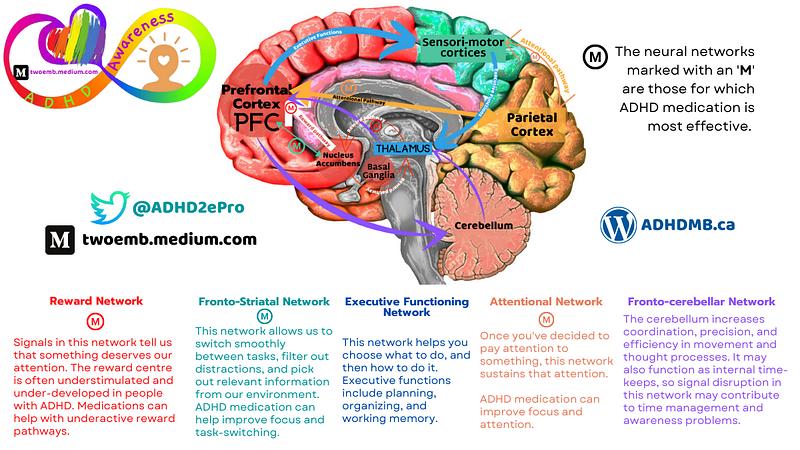
Secondly, especially if you’re late-diagnosed like me, we have a lifetime of ingrained habits, patterns, and ways of behaving, most of which won’t immediately change after swallowing a pill.
Yes, stimulant medications act quickly: they enter the body fairly quickly and leave the body fairly quickly. If you have ADHD and you take a stimulant at the right dose, you likely will see some benefits on the first day.
For some people, finding the right type and dosage takes a while. Some may experience unpleasant side-effects and need to switch, others need to work with their prescriber and play around with the dosing until they find the right balance between benefits and side-effects.
Our bodies can also develop tolerance, so we may occasionally have to adjust our medication doses to compensate.

Underneath it all
Then there’s the double-whammy. A lot of us with ADHD also have other underlying “conditions” — other ways in which our brains are divergent from the typical.
There’s a long list of “comorbidities” (i.e. different neurotypes, as well as mental health issues) with ADHD. In my experience, the two that most commonly show up once ADHD is effectively treated are anxiety and autism.
One reason for this could be that ADHD and anxiety look very similar, with symptoms such as hyperactivity, restlessness, distractibility, and racing thoughts. A significant number of Autistic people have ADHD, and vice-versa: the current comorbidity rate is estimated to be around 40%.
So although your ADHD may be effectively treated with medication, that may serve to uncover additional underlying traits, symptoms, or conditions that were previously masked by the ADHD.
Society hasn’t changed
Although stimulant medications may help us, the world around us is still very neurotypical-centric, or neuronormative. This means our society and culture are built for and by neurotypicals, with their needs and ways of being in mind — and considered the “right” way of being and doing — not ours.
While our ADHD symptoms may be well managed with medications, we’re still neurodivergent. We still think and behave in ways that diverge from the statistical norm— which I think is a good thing, unfortunately, this also makes our lives harder because of the way our world works.
Most people and institutions in our lives expect us to mask or, in the words of Dr. Nick Walker, perform neuronormativity. This means they expect us to act as neurotypical as possible for their benefit, which takes a significant toll on our physical and mental wellbeing.
Do what works for you
If you found your medication instantly made your life better, that is awesome, and I’m truly happy for you. No sarcasm intended here, I mean it.
That said, it’s important we share all types of experiences so that people who are newly diagnosed, or newly trying medication, can have realistic expectations.
Someone seeing those videos may take a stimulant and think they don’t have ADHD because they didn’t immediately clean their entire house while reading a book. They may be led to believe that stimulants don’t work for them if they don’t have some kind of transcendent, life-changing experience.
That’s not how it usually works.
I wasn’t diagnosed with ADHD until I was 36. I started taking medications right away, and they have definitely helped me in my day-to-day life, there’s no denying that. My brain has neural pathways that have done 36 years’ worth of strengthening exercises, so it takes a lot more than a little pill to change a lifetime of habits.
Cure or culture shift?
I have begun to ask myself, do I really want to change the way my brain works?
Certainly, there have been positive changes in my life thanks to medication. I want to treat the symptoms that cause me difficulty, but only because this makes my life easier — helps me to be a better parent, partner, and a better advocate for others.
In other ways, I have truly come to love the fact that my brian diverges from the norm. I don’t want to be neurotypical, and I don’t want to have to pretend I am someone I’m not for the benefit of others.
This world desperately needs more divergent thinkers, people who challenge the status quo, who think critically, and who don’t care about fitting in. I am definitely not 100% there: I frequently do care what others think of me, and camouflage, both for others’ sake and for my own.
It’s a process, one that will probably be life-long, but I hope my fellow neurodivergents will join me on this journey. We’ve spent more than enough time tip-toeing around neurotypicals and bending to their needs, it’s time we focused on our own.
© Jillian Enright, Neurodiversity MB
For more information on what to expect if you do decide to try a stimulant medication for ADHD, check out Medication Trials:
More related stories
When you join medium, as a member you’ll have access to unlimited reads for only $5 per month. If you use my referral link, I’ll earn a small commission, and you’ll earn my undying gratitude.
If you’d prefer give a one-time tip, you can support my writing on Ko-Fi — also, it’s free to follow me on Facebook and LinkedIn!
References
Rong, Y., Yang, C. J., Jin,Y., Wang, Y. (2021). Prevalence of attention-deficit/hyperactivity disorder in individuals with autism spectrum disorder: A meta-analysis. Research in Autism Spectrum Disorders, 83, 101759. https://doi.org/10.1016/j.rasd.2021.101759
Taylor, E. (2019). ADHD Medication in the Longer Term. Zeitschrift für Kinder- und Jugendpsychiatrie und Psychotherapie, 47(6), 542–546. https://doi.org/10.1024/1422-4917/a000664
Walker, N. (2021). Neuroqueer Heresies: Notes on the neurodiversity paradigm, Autistic empowerment, and postnormal possibilities. Autonomous Press.


