
Yes, ADHD is Genetic
And no, ADHD is not caused by trauma

June 2023 update
This article blew up again this month, and I’m receiving some criticism from people who are new to my work. I welcome constructive criticism and respectful debate, which it has been, so I am not complaining in the least.
I do, however, wish to clarify a few important points:
- Saying ADHD is genetic is not the same as saying genetics are not influenced by environment. They are.
- Saying ADHD is genetic is not stating that trauma and other environmental influences don’t have an impact on our genetic expression. They do.
- Saying ADHD is genetic does not dismiss the influence of our life experiences on our neurology.
If you want to learn more about how ADHD and Autism can look like trauma, I have written about that as well.
ADHD is genetic (heritable)
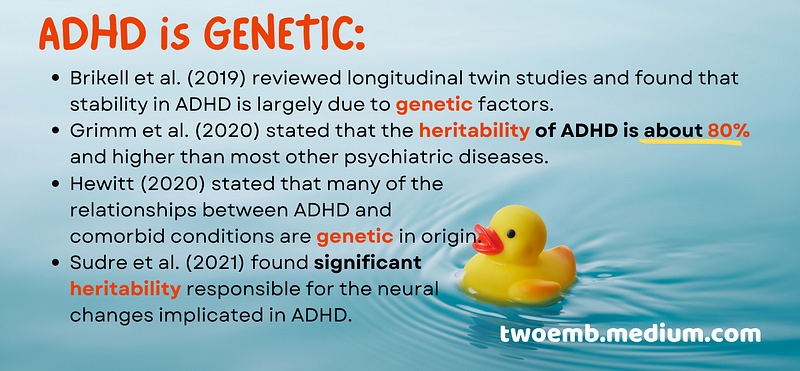
ADHD has an estimated heritability rate of 75–80%. This means that if one of your biological parents have ADHD, you’re highly likely to also have ADHD.
Studies comparing adoptive and biological families of children with ADHD have shown that, even when raised in different environments, biological relatives still have higher rates of ADHD than adoptive family members.
Multiple genetic studies have observed a strong genetic association with various aspects of neuropsychobiological functions, including neural abnormalities and delayed neurodevelopment in ADHD.
ADHD is not caused by trauma
Unfortunately, many people with ADHD have experienced trauma, and certainly trauma will exacerbate and worsen ADHD symptoms. Neither of those are the same thing as actually causing a neurodevelopmental disorder.
I didn’t think I would need to write this article. I thought anybody who has read any rudimentary information about ADHD knows it’s a highly heritable, genetic, neurodevelopmental disorder.
It would appear I thought wrong.
There is more misinformation to be found, this time coming from Dr. Gabor Maté, a doctor who is an expert in trauma, but seems to know little about ADHD. Dr. Maté claims, without a shred of peer-reviewed scientific evidence, that ADHD is not genetic and is “reversible”.
I do not want to link to his website, but this can be verified with a simple online search. Here is a quote from his website:
“Rather than an inherited disease, Attention Deficit Disorder [sic] is a reversible impairment and a developmental delay, with origins in infancy. [ADHD] is rooted in multigenerational family stress and in disturbed social conditions in a stressed society.” — Dr. Gabor Maté
No.
In fact, there is extensive, robust research clearly demonstrating the opposite to be true. Here is a rundown of just a few, with the full citations in the references at the end of the article:
I have argued previously that being neurodivergent increases our risk of experiencing trauma, and later developing PTSD.
Recent research has indicated that delayed identification, diagnosis, and provision of supports may further increase the risk of trauma and childhood adversity. This lends support to the causal relationship being the other way around: having ADHD, in particular if a child has little or no supports for their symptoms, increases their risk of experiencing adversity and trauma.
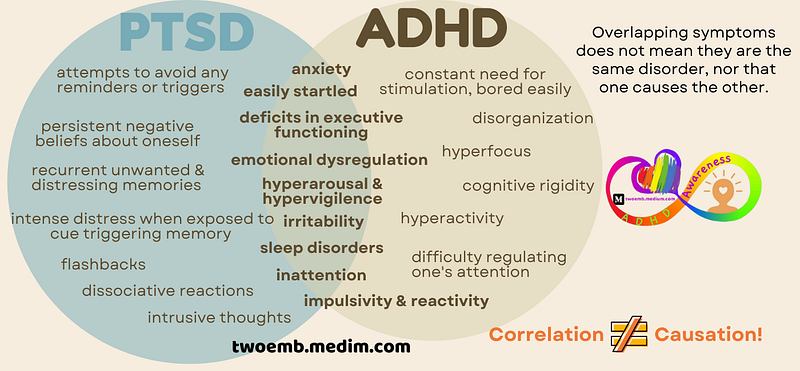
A lot of PTSD symptoms overlap with ADHD, but none of this is even remotely the same thing as demonstrating that one causes the other. Correlation establishes a relationship, a connection, between two variables. In this case, a relationship between ADHD and PTSD. Causation is when it is unequivocally proven that one action or effect actually causes the other.
Associations can be coincidental, which is why researchers attempt to isolate variables and execute controlled studies. Something my university professors repeatedly drilled into us during lectures was the phrase “correlation does not equal causation”.
“Correlation does not equal causation!”
Morally and ethically questionable
Like other doctors who peddle products online, Dr. Maté has to make bold, sweeping statements that give people (false) hope.
Why?
In order to sell, sell, sell!
Dr. Maté’s website contains many links through which people can purchase products, books, tickets to events, as well as register for online courses.
He can’t tell the truth, which is that ADHD is a neurodevelopmental disorder that cannot be cured because that would be bad for business. Instead, he makes false claims ADHD is a “reversible impairment” so that people will buy his merchandise and learn all about his “miracle cure”.
This is so very harmful.
Dr. Maté and other “internet doctors” could be helping people to accept their divergent brains, learn how to work with and adapt to their differences, and develop tools and strategies to manage their struggles.
Instead, these quacks are preying on vulnerable people who mostly just want the best for their children and for themselves. People like Dr. Maté prey on people’s fears and insecurities, rather than helping them build their confidence and embrace who they are.
By the way, Dr. Maté was originally an English teacher who later became a family physician. He’s not a neurologist, or even a psychiatrist. He is certainly not qualified to declare ADHD “reversible” when experts who are much more educated, and have much more experience than him, have said otherwise.
Whew.
Okay, now that I got that out of my system…
A more balanced perspective
Dr. Maté may not be all bad. His work on addictions and trauma is exceptional and ground-breaking, after all, he did win the Order of Canada in 2018 for his work in those areas of research.
And because so many people with ADHD also experience trauma, I’m sure many of his approaches are effective and helpful. There would no doubt be great benefit to acknowledging and supporting people through their trauma.
Unfortunately there are also many people, like myself in fact, who have experienced trauma and are misdiagnosed with Borderline Personality Disorder (BPD) or other related personality and anxiety disorders, rather than ADHD and PTSD.
Some clinicians hear the word “trauma” and immediately jump to anxiety and personality disorders without even considering Autism or ADHD as possibilities, especially when the patient is female-presenting. This can be incredibly invalidating and can lead to ineffective, or less effective, treatment and supports.
If only Dr. Maté had stopped at treating trauma and addictions. If only he had not made those false claims, leading some to believe that ADHD can be “cured”, I might have a modicum of respect for him and his work.
Alas, he did, and so I do not.
© Jillian Enright, Neurodiversity MB
Related Stories
When you join medium, as a member you’ll have access to unlimited reads for only $5 per month. If you use my referral link, I’ll earn a small commission.
If you’d prefer give a one-time tip, you can support my writing on Ko-Fi — also, it’s free to follow me on Facebook and LinkedIn!
Learn more
For more of the good stuff, follow Fourth Wave, where we’re changing the world for the better, one story at a time. Got one of your own? Submit to the Wave!

References
Alberts-Corush, J., Firestone, P., & Goodman, J. T. (1986). Attention and impulsivity characteristics of the biological and adoptive parents of hyperactive and normal control children. American Journal of Orthopsychiatry, 56(3), 413–423. https://doi.org/10.1111/j.1939-0025.1986.tb03473.x
Brikell, I., Kuja-Halkola, R., Larsson, H. (2019). Heritability of Attention-Deficit Hyperactivity Disorder Across The Lifespan. European Neuropsychopharmacology, 29(3), S757-S758. https://doi.org/10.1016/j.euroneuro.2017.06.106
Børglum, A., Neale, B., Franke, B. (2019). Unfolding The Genetic Basis of ADHD. European Neuropsychopharmacology, 29(3), S722. https://doi.org/10.1016/j.euroneuro.2017.06.038
Faraone, S.V., & Larsson, H. (2019). Genetics of attention deficit hyperactivity disorder. Molecular Psychiatry 24, 562–575. https://doi.org/10.1038/s41380-018-0070-0
Grimm, O., Kranz, T.M. & Reif, A. (2020). Genetics of ADHD: What Should the Clinician Know?. Current Psychiatry Reports 22, 18. https://doi.org/10.1007/s11920-020-1141-x
Hewitt J. K. (2020). Twin studies of brain, cognition, and behavior. Neuroscience and biobehavioral reviews, 115, 64–67. https://doi.org/10.1016/j.neubiorev.2020.04.009
Lugo-Candelas, C., Corbeil, T., Wall, M., Posner, J., Bird, H., Canino, G., Fisher, P. W., Suglia, S. F., & Duarte, C. S. (2021). ADHD and risk for subsequent adverse childhood experiences: understanding the cycle of adversity. Journal of child psychology and psychiatry, and allied disciplines, 62(8), 971–978. https://doi.org/10.1111/jcpp.13352
Sprich, S., Biederman, J., Crawford, M. H., Mundy, E., & Faraone, S. V. (2000). Adoptive and biological families of children and adolescents with ADHD. Journal of the American Academy of Child and Adolescent Psychiatry, 39(11), 1432–1437. https://doi.org/10.1097/00004583-200011000-00018
Sudre, G., Bouyssi-Kobar, M., Norman, N., Sharp, W., Choudhury, S., Shaw, P. (2021). Estimating the Heritability of Developmental Change in Neural Connectivity, and Its Association With Changing Symptoms of Attention-Deficit/Hyperactivity Disorder. Biological Psychiatry, 89(5), 443–450. https://doi.org/10.1016/j.biopsych.2020.06.007
Yadav, S.K., Bhat, A.A., Hashem, S. et al. (2021). Genetic variations influence brain changes in patients with attention-deficit hyperactivity disorder. Translational Psychiatry 11, 349. https://doi.org/10.1038/s41398-021-01473-w


