avatarOliver Ding

Free AI web copilot to create summaries, insights and extended knowledge, download it at here

7286

Abstract

e:</p><blockquote id="7cad"><p><i>In order to effectively curate pieces into a meaningful whole, we need Container as part to contain pieces and shape them.</i></p></blockquote><p id="b35e">The theory built a brand new ontology called “Whole, Piece and Part” and adopted James Gibson’s “Affordance”, George Lakoff’s “Container” and Donald Schön’s “Reflection” as epistemological tools. To test the theory, I wrote several case studies, and one of them is titled Knowledge Curation.</p><p id="b589">Later, I worked on the applications of the theory and wrote two books: <i>Knowledge Curation</i> and <i>Creative Life Curation</i>.</p><p id="eee2">These three books form a simple two-level hierarchy: <b>THEORY</b><b>APPLICATION</b>.</p><figure id="cbe4"><img src="https://cdn-images-1.readmedium.com/v2/resize:fit:800/1*l-yGplTMLjYxRnJIcPoo7g.png"><figcaption></figcaption></figure><p id="f85a">After March 2019, I continuously worked on revising Curativity and developing the Ecological Practice Approach as a new project. For the direction of Curativity Theory, I am looking for practical applications, for example:</p><ul><li>Knowledge Curation</li><li>Action Curation</li><li>Life Curation</li><li>Platform Curation</li></ul><p id="5be5">I have written a chapter discussing knowledge curation in the book <i>Curativity</i>. For academic knowledge curation, I mentioned Dean Keith Simonton’s chance-configuration theory, Victor Kaptelinin, and Bonnie A. Nardi’s scientific curation case study “curation at Ajaxe”, and qualitative research. For practical knowledge curation, I focus on <i>Cognitive Container</i> since Container is a core concept of Curativity Theory.</p><p id="0628">Books and courses are typical cognitive containers, however, there are more types of cognitive containers. I highlighted five types of Cognitive Containers:</p><ul><li>Knowledge Card</li><li>Knowledge Framework</li><li>Knowledge Diagram and Chart</li><li>Knowledge Workshop</li><li>Knowledge Sprint</li></ul><p id="49c7">It is not an accurate classification, but a rough recommendation. Also, I suggested that we not only adopt existing types of cognitive containers but also create new types of cognitive containers. Actually, this is the essential point of the Curation Theory. We are shaped by containers and we can make containers too.</p><p id="455a">In 2020, I decided to apply Curativity Theory to Knowledge Building and I started working on the Knowledge Curation project which led to several books later.</p><p id="a9a9" type="7">The mission behind the Knowledge Curation project is Connecting Theory and Practice.</p><p id="37b6"><b>The Theory-Practice Gap</b> is an important issue in a wide range of disciplines including education, organization learning, and development, community building, academic development, enterprise R&D, professional service firms (PSFs), etc.</p><p id="e839">If we can find a good solution to close the Theory-Practice Gap, then we can improve existing social systems of knowledge production, knowledge application, and knowledge management at the individual level and the collective level.</p><p id="c3b1">The Knowledge Curation project started on June 26, 2020, and closed on Oct 18, 2022. You can find more details in <a href="https://readmedium.com/the-knowledge-curation-project-5a100642248"><i>The Knowledge Curation Project (phase 1)</i></a>.</p><p id="ad00">From Oct 2022 to Dec 2022, I worked on the Creative Life Curation project and wrote a possible book (draft). You can find more details in <a href="https://www.activityanalysis.net/creative-life-curation/"><i>Creative Life Curation: Turning Experiences into Meaningful Achievements</i></a>.</p><h1 id="aed2">2. Theme (Concept)</h1><p id="b1ec">I have been working on the theme of “Themes” for many years. On August 27, 2023, I reflected on <a href="https://readmedium.com/themes-6cb1f16ef09c">the journey from 2017 to 2023</a>.</p><ul><li>2017: I used <b>Life Container</b> and <b>Life Themes</b> to discuss the personal journey of knowing.</li><li>2019: I developed the idea of “<b>Themes of Practice”</b> to discuss the “meaning” of the meaningful whole for my book <a href="https://readmedium.com/curativity-theory-2019-5a4932abca42?sk=6dbb259c06ffdf7ff0f71bf74b4c7fd5"><i>Curativity: The Ecological Approach to Curatorial Practice</i></a><i>.</i></li><li>2020: In 2020, I reviewed the hierarchy of Activity and Practice in a previous article <a href="https://readmedium.com/hierarchy-cb1bf97098b0?sk=3b098407e76e33255647c0f2d570478e"><i>Activity U (VI): The Hierarchy of Human Activity and Social Practice</i></a>. The outcome is an eight-level hierarchical model of human social practice. <b>The top level is “Theme”</b>.</li><li>2021: I collected over 440 pages of my writing about the topic and edited a possible book titled <a href="https://readmedium.com/themes-of-practice-2aa5a0a7f111"><b><i>Themes of Practice: The Information Architecture of Social Life</i></b></a>.</li><li>2022: I developed the idea of “Thematic Space” and connected the Themes of Practice approach and the Project Engagement approach to develop the Thematic Engagement toolkit.</li><li>2023: I launched TALE (Thematic Analysis Learning Engagement) as a new knowledge center.</li></ul><p id="ba6a">TALE led to two possible books: <a href="https://readmedium.com/thematic-exploration-f5822dcbf0d8"><i>Thematic Exploration: The Early Discovery of Knowledge Engagement</i></a> and <a href="https://readmedium.com/grasping-the-concept-book-v1-introduction-f8daae90af22"><i>Grasping the Concept: The Territory of Concepts and Concept Dynamics</i></a>.</p><figure id="afe1"><img src="https://cdn-images-1.readmedium.com/v2/resize:fit:800/1*2C1jnDbViZvdqzTh-zJl7g.png"><figcaption></figcaption></figure><p id="289a">For the Strategic Thematic Exploration framework, I made a distinction between “<b>Theme”</b> and “<b>Concept”</b>. While “Theme” emphasizes subjective experience and understanding, “Concept” is more about objective meaning and definition.</p><figure id="6dc3"><img src="https://cdn-images-1.readmedium.com/v2/resize:fit:800/0*glOA7Qi1Cit7XrgF.png"><figcaption></figcaption></figure><p id="3d16">The Thematic Space can be smaller than the Conceptual Space or bigger than the Conceptual Space because it is a dynamic space. You can find more details in <a href="https://readmedium.com/context-mind-3820fe4582dd">A Possible Theme called “Context (Mind)”</a>.</p><h1 id="362b">3. Social (Cognition)</h1><p id="fe97">From August 2023 to Dec 2023, I worked on the Social Moves project. The outcome is a possible book titled <a href="https://readmedium.com/social-moves-38922d0f308d?sk=92f80dd3b84b4a00103b7c6e28428439"><i>Social Moves: The Attachance Approach to Social Cognition</i></a>.</p><figure id="56c2"><img src="https://cdn-images-1.readmedium.com/v2/resize:fit:800/1*orGPt7K6Eod5SXCxhH2uqw.png"><figcaption></figcaption></figure><p id="b72d">The book presents a large framework. See the diagram below.</p><figure id="3907"><img src="https://cdn-images-1.readmedium.com/v2/resize:fit:800/1*rOJEaTm8AGkHP__0hbOH9A.png"><figcaption></figcaption></figure><p id="f06a">It was formed by two sub-frameworks: the <b>Ecological Formism</b> framework and the <b>Ecological Actualism</b> framework.</p><p

Options

id="9634">You can find more details in <a href="https://readmedium.com/social-moves-38922d0f308d?sk=92f80dd3b84b4a00103b7c6e28428439"><i>Social Moves (book, v1, 2023)</i></a><i>.</i></p><h1 id="0085">4. Activity (Knowledge)</h1><p id="54fa">The idea of “<b>Activity (Knowledge)”</b> echoes the idea of “<b>Social (Cognition)”</b>. All details of the <b>Ecological Formism</b> framework and the <b>Ecological Actualism</b> framework can be found in my books about “Activity” and “Knowledge”.</p><figure id="86d9"><img src="https://cdn-images-1.readmedium.com/v2/resize:fit:800/1*78N0GAcT0TlcRAgRtVNxTA.png"><figcaption></figcaption></figure><p id="7c22">The theme of “<b>Activity</b>” refers to <b>the Activity U project</b> and related projects. It led to a series of books. I selected three for this section.</p><ul><li><a href="https://readmedium.com/activity-u-book-d26eb1187e5?sk=81d2fc3021e38dc437497f32060ce31d"><i>Activity U</i></a></li><li><a href="https://readmedium.com/book-a7e4ac1688c?sk=77efc7733b6fcb2bc52210a134c953e8"><i>Project-oriented Activity Theory</i></a></li><li><a href="https://www.activityanalysis.net/aat/"><i>Appropriating Activity Theory</i></a></li></ul><p id="5aa1">The theme of “Knowledge” refers to the <b>Knowledge Engagement</b> project. I selected three books for this section.</p><ul><li><a href="https://readmedium.com/knowledge-engagement-b533b8390c79"><i>Knowledge Engagement: Knowledge Center and Creative Life Theory</i></a></li><li><a href="https://readmedium.com/knowledge-discovery-4092d0695ad4?sk=d3f694ed99c1e454d3a2b62b2b036e23"><i>Knowledge Discovery: Developing Tacit Knowledge with Thematic Space Canvas</i></a></li><li><a href="https://readmedium.com/mental-moves-book-v1-introduction-5fb4470b57d9"><i>Mental Moves: The Attachance Approach to Creative Cognition</i></a></li></ul><h1 id="933a">5. Diagram (Framework)</h1><p id="e8af">The idea of “<b>Diagram (Framework)</b>” is a sub-level of the theme of “<b>Knowledge</b>”.</p><p id="a453">A <b>Diagram</b> is a concrete representation of a <b>Knowledge Framework</b>. In other words, a Diagram is a Container of a Knowledge Framework which is the Containee.</p><figure id="679a"><img src="https://cdn-images-1.readmedium.com/v2/resize:fit:800/1*Yz0pgRM682yWnSZBymYMgQ.png"><figcaption></figcaption></figure><p id="b00b">In 2021, I worked on <a href="https://readmedium.com/60e8c63c6be3">the D as Diagramming project</a> and edited two possible books:</p><ul><li><a href="https://readmedium.com/ca31f8a35bb9">Diagramming as Practice (Book, version 1.0)</a></li><li><a href="https://readmedium.com/c9b90682269">Diagram Blending: Building Diagram Networks</a></li></ul><p id="f084">I also worked on developing a series of knowledge frameworks. Some of my possible books are about particular knowledge frameworks. I selected three books for this section.</p><ul><li><a href="https://readmedium.com/ecological-practice-design-a9b98d113bf9?sk=701075641556af8c0941425368500bf0"><i>Ecological Practice Design: The Lifesystem Approach to Everyday Life Innovation</i></a></li><li><a href="https://readmedium.com/d13c9ad88016"><i>The ECHO Way (v2.0)</i></a></li><li><a href="https://readmedium.com/perspectives-on-product-engagement-492fc91747a2"><i>Perspectives on Product Engagement (v1.0)</i></a></li></ul><h1 id="90c4">6. Life (Self)</h1><p id="6b82">On June 20, 2023, I published a possible theme called <a href="https://readmedium.com/context-mind-3820fe4582dd"><b>Context(Mind)</b></a> which introduces the Ecological Practice approach to <b>Mind</b>. On July 17, 2023, I applied the same approach to <b>Self</b>.</p><p id="495d">Originally, the idea of <a href="https://readmedium.com/life-self-c194533e0597"><b>Life(Self)</b></a> was the outcome of a rough literature review on self theories in the field of psychology. Later, I realized that it is a new unit of analysis to understand <b>Self</b>.</p><blockquote id="8678"><p>We can’t understand the “Self” without understanding the “Life”. This insight returns to the Ecological Practice Approach’s basic model: Container (Containee).</p></blockquote><p id="15c1">We can also apply the idea of “<b>Life(Self)”</b> to the <b>Creative Life Theory</b> project.</p><figure id="a4e5"><img src="https://cdn-images-1.readmedium.com/v2/resize:fit:800/1*dqddXI2ca2JG4dzCJ0Rj8A.png"><figcaption></figcaption></figure><p id="0d6b">The Creative Life Theory project focused on knowledge creators’ life course.</p><p id="90e4">The Creative Life Theory is a large knowledge enterprise that includes multiple units of analysis, a series of frameworks, and a set of tools. I also wrote several books about it.</p><p id="906f">The possible book <a href="https://readmedium.com/creative-life-theory-v2-book-2023-03b569e20910"><i>Creative Life Theory: Building A Knowledge Enterprise</i></a><i> </i>introduces the meta-framework of the <b>Creative Life Theory (v2) </b>and collects ideas about<b> </b>the <b>“Building A Knowledge Enterprise”</b> activity, such as “<i>Knowledge Discovery</i>”, “<i>Knowledge Center</i>”, “<i>Creative Dialogue</i>”, “<i>Value Circle</i>”, etc.</p><h1 id="edca">7. Career (Project)</h1><p id="4bf6">The idea of “<b>Career (Project)”</b> echoes the idea of “<b>Life (Self)”</b>.</p><figure id="4b3b"><img src="https://cdn-images-1.readmedium.com/v2/resize:fit:800/1*95XcsYOHTFhBT1CKiWkDsw.png"><figcaption></figcaption></figure><p id="5899">The theme of “<b>Career</b>” refers to my thoughts on the ecological approach to <b>Adult Development</b>, especially the <b>Social Environments</b>. I selected three books for this section:</p><ul><li><a href="https://readmedium.com/72303d09ca8"><i>Career Curation: Career Curation: Curativity Theory for Personal Innovation</i></a></li><li><a href="https://readmedium.com/p4d2-8392b081f86c?sk=1db0380e1fed80dd1f169596c4682c33"><i>Platform for Development: The Ecology of Adult Development in the 21st Century</i></a></li><li><a href="https://www.activityanalysis.net/advanced-life-strategy-anticipatory-activity-system-and-life-achievements/"><i>Advanced Life Strategy: Anticipatory Activity System and Life Achievements</i></a></li></ul><p id="1395">The theme of “<b>Project</b>” refers to the <b>Project Engagement</b> approach, especially the Developmental Project Model. I selected three books for this section:</p><ul><li><a href="https://readmedium.com/life-discovery-part3-344720343e59?sk=70673287c59588ee1b59180b007759a9"><i>Life Discovery: The Life-as-Project Approach</i></a></li><li><a href="https://www.activityanalysis.net/project-engagement-v2-as-an-innovation-approach/"><i>Project Engagement: Life, History, and Multiverse</i></a></li><li><a href="https://readmedium.com/mapping-developmental-projects-book-v1-2023-d311f6073af7?sk=a2b355234002af4ffdef10130d1f8789"><i>Mapping Developmental Projects (book, v1, 2023)</i></a></li></ul><h1 id="19c8">Updated</h1><p id="c359">I made a new version on Jan 5, 2024.</p><figure id="471b"><img src="https://cdn-images-1.readmedium.com/v2/resize:fit:800/1*nTJ5idNwYkbbPUEh05kbYw.png"><figcaption></figcaption></figure><p id="1bbd">See the “Project” part:</p><figure id="75e9"><img src="https://cdn-images-1.readmedium.com/v2/resize:fit:800/1*6eUAEgNSZsbaDqgM5zMkbw.png"><figcaption></figcaption></figure></article></body>

Situational Note-taking: A Tree of Thoughts (Oliver Ding, 2023)

A short note
This short note is part of my 2023 annual review. You can find other posts below:

From 2019 to Dec 2023, I wrote 26 possible books. The previous posts used different ways to curate these books.

Last night I curated these 26 books again.

I turned them from a network into a tree. This was a challenge for me.

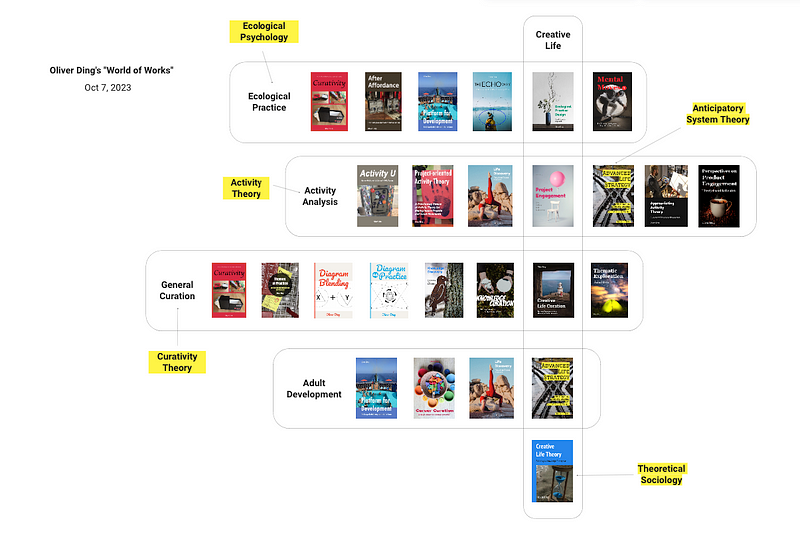
In the past several years, I worked on connecting THEORY with PRACTICE. My major theoretical resources are the following theories:

  • Ecological Psychology
  • Activity Theory
  • Anticipatory System Theory
  • Theoretical Sociology
  • Curativity Theory

Each theory has its unique theoretical structure and conceptual system. To maintain the boundary of these theories, I used the following diagram to curate my books.
Yesterday I gave myself a challenge:

Can I turn it into a hierarchical structure?

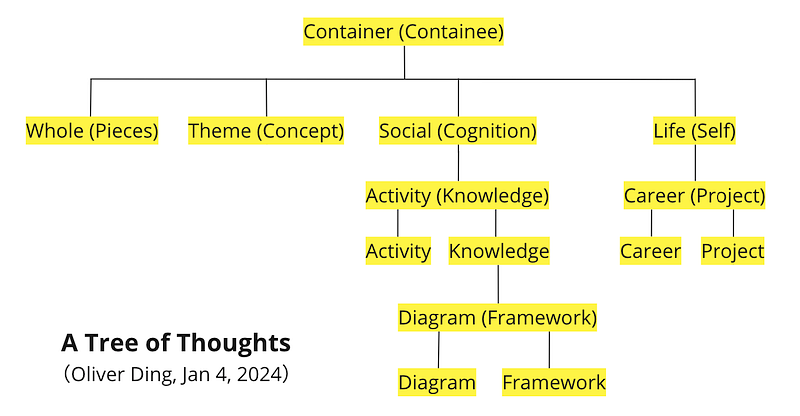
0. Container (Containee)

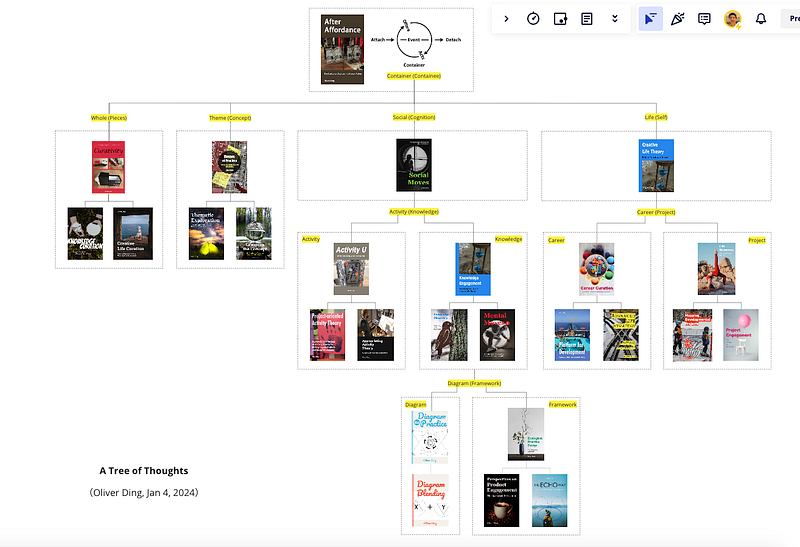
The solution is very simple. See the map below.
The idea of “Container(Containee)” is a primary theoretical concept of the Ecological Practice approach.

In 2020, I wrote After Affordance: The Ecological Approach to Human Actions and developed a new diagram to represent the germ-cell of the Ecological Practice approach. A Germ Cell of a theoretical approach is its smallest entity which can represent the whole of thinking in different levels of analysis. The diagram below shows the germ cell of the Ecological Practice approach.
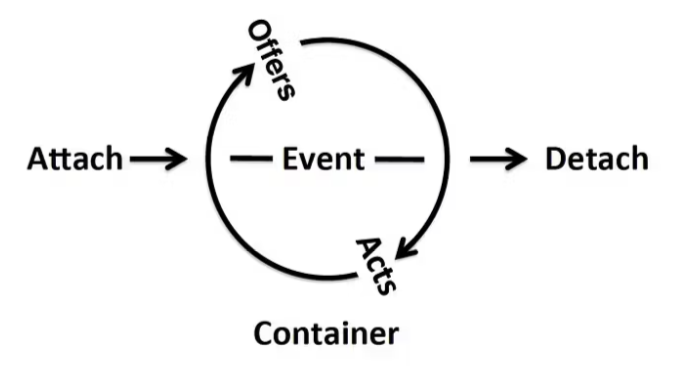
The above diagram combines three core concepts of the Ecological Practice approach: Affordance, Attachance, and Containance. The term “Offers” is an affordance-inspired concept, it refers to opportunities afforded by the Container. The group of “Offer — Act” forms “Event” which changes the status of the Container. The new status of the Container affords new opportunities that guide the new acts and events. In a broad sense, the Ecological Practice approach has its philosophical roots in traditional Pragmatism.

You can find more details in Situational Note-taking: The Ecological Practice Approach (Oliver Ding, 2019–2023) and The Ecological Practice Design Toolkit (V2, 2023).

I used the idea of “Container(Containee)” as the germ cell to build the new tree:

  • Whole (Pieces)
  • Theme (Concept)
  • Social (Cognition)
  • Life (Self)

I also repeat it at each level. For example:

  • Social (Cognition) > Activity (Knowledge) > Diagram (Framework)
  • Life (Self) > Career (Project)

Wow! This echoes Kant’s fractal tree.

In the 2001 book Chaos of Disciplines, the American sociologist Andrew Abbott started an insight that claims many social structures look the same on large scale and on a small scale. He called this insight “Self-similar social structure” and applied it to discuss academic social science in general and sociology in particular. He also found there is a classical example from Kant, “…Kant obviously does not think there is an infinite gradation from absolute pure reason through some proportionately mixed varieties of reason to absolute practice reason. He has done something else. He has created what I shall call a ‘fractal distinction.’ The name captures the fact that such a distinction repeats a pattern within itself, as geometric fractals do…There are, of course, dozens of general sources on fractals…I have tended to focus on fractals that are nested dichotomies. There is no necessary restriction to this case; it is simply the most familiar and hence makes for the easiest exposition.” (2001, p.9)
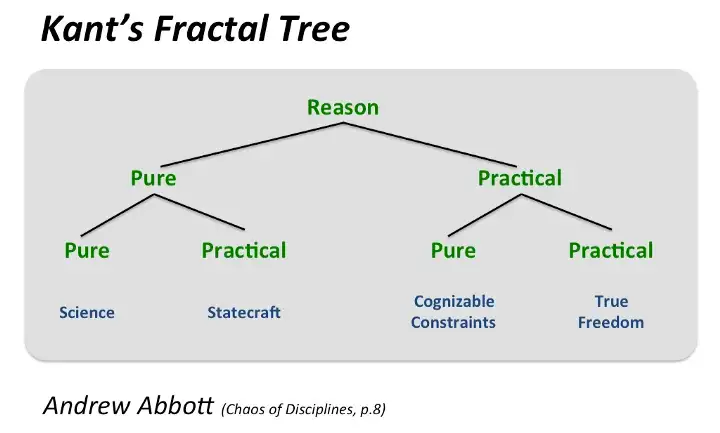
The above diagram is adopted from Andrew Abbott and it represents Kant’s fractal tree. After reviewing Kant’s writing, Abbott summarized that “Kan has first split pure and practical reason and then, under each of those headings, has split pure and practical reason once again.” (2001, p.8)
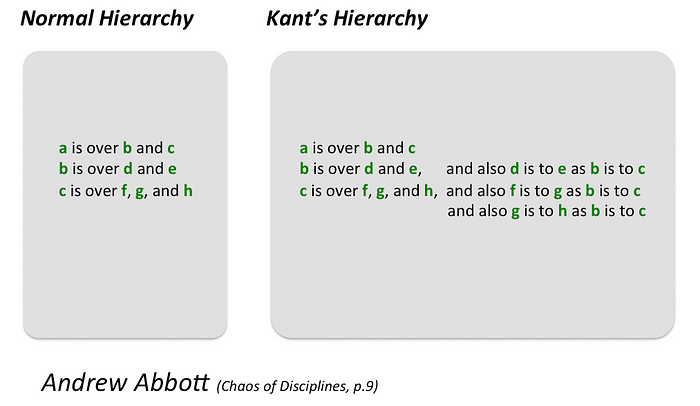
Abbott also pointed out Kant’s approach is not a normal hierarchy,

“…Kant has made a relational judgment at one level and then repeated it at the next…the relation of the general terms is recapitulated in the specific ones…This is not a simple hierarchy.” (p.9)

I repeat the structure of “Container (Containee)” at each level!

Now let’s see the leaves of the tree.

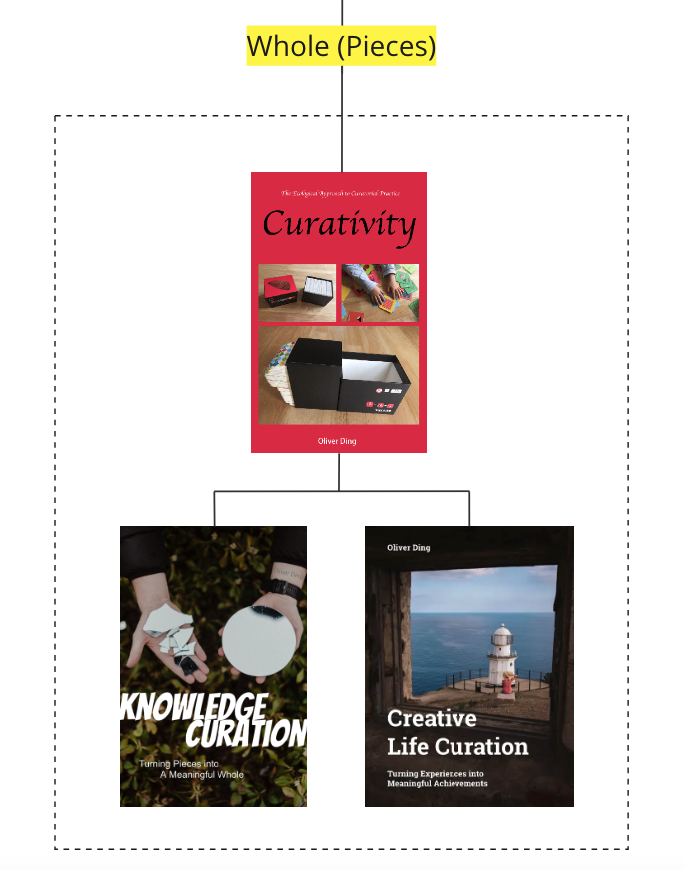
1. Whole (Pieces)

The first book Curativity: The Ecological Approach to General Curation Practice was written from Sept 2018 to March 2019. The book introduces Curativity Theory.

The core idea of Curativity Theory is very simple:

In order to effectively curate pieces into a meaningful whole, we need Container as part to contain pieces and shape them.

The theory built a brand new ontology called “Whole, Piece and Part” and adopted James Gibson’s “Affordance”, George Lakoff’s “Container” and Donald Schön’s “Reflection” as epistemological tools. To test the theory, I wrote several case studies, and one of them is titled Knowledge Curation.

Later, I worked on the applications of the theory and wrote two books: Knowledge Curation and Creative Life Curation.

These three books form a simple two-level hierarchy: THEORYAPPLICATION.

After March 2019, I continuously worked on revising Curativity and developing the Ecological Practice Approach as a new project. For the direction of Curativity Theory, I am looking for practical applications, for example:

  • Knowledge Curation
  • Action Curation
  • Life Curation
  • Platform Curation

I have written a chapter discussing knowledge curation in the book Curativity. For academic knowledge curation, I mentioned Dean Keith Simonton’s chance-configuration theory, Victor Kaptelinin, and Bonnie A. Nardi’s scientific curation case study “curation at Ajaxe”, and qualitative research. For practical knowledge curation, I focus on Cognitive Container since Container is a core concept of Curativity Theory.

Books and courses are typical cognitive containers, however, there are more types of cognitive containers. I highlighted five types of Cognitive Containers:

  • Knowledge Card
  • Knowledge Framework
  • Knowledge Diagram and Chart
  • Knowledge Workshop
  • Knowledge Sprint

It is not an accurate classification, but a rough recommendation. Also, I suggested that we not only adopt existing types of cognitive containers but also create new types of cognitive containers. Actually, this is the essential point of the Curation Theory. We are shaped by containers and we can make containers too.

In 2020, I decided to apply Curativity Theory to Knowledge Building and I started working on the Knowledge Curation project which led to several books later.

The mission behind the Knowledge Curation project is Connecting Theory and Practice.

The Theory-Practice Gap is an important issue in a wide range of disciplines including education, organization learning, and development, community building, academic development, enterprise R&D, professional service firms (PSFs), etc.

If we can find a good solution to close the Theory-Practice Gap, then we can improve existing social systems of knowledge production, knowledge application, and knowledge management at the individual level and the collective level.

The Knowledge Curation project started on June 26, 2020, and closed on Oct 18, 2022. You can find more details in The Knowledge Curation Project (phase 1).

From Oct 2022 to Dec 2022, I worked on the Creative Life Curation project and wrote a possible book (draft). You can find more details in Creative Life Curation: Turning Experiences into Meaningful Achievements.

2. Theme (Concept)

I have been working on the theme of “Themes” for many years. On August 27, 2023, I reflected on the journey from 2017 to 2023.

  • 2017: I used Life Container and Life Themes to discuss the personal journey of knowing.
  • 2019: I developed the idea of “Themes of Practice” to discuss the “meaning” of the meaningful whole for my book Curativity: The Ecological Approach to Curatorial Practice.
  • 2020: In 2020, I reviewed the hierarchy of Activity and Practice in a previous article Activity U (VI): The Hierarchy of Human Activity and Social Practice. The outcome is an eight-level hierarchical model of human social practice. The top level is “Theme”.
  • 2021: I collected over 440 pages of my writing about the topic and edited a possible book titled Themes of Practice: The Information Architecture of Social Life.
  • 2022: I developed the idea of “Thematic Space” and connected the Themes of Practice approach and the Project Engagement approach to develop the Thematic Engagement toolkit.
  • 2023: I launched TALE (Thematic Analysis Learning Engagement) as a new knowledge center.

TALE led to two possible books: Thematic Exploration: The Early Discovery of Knowledge Engagement and Grasping the Concept: The Territory of Concepts and Concept Dynamics.
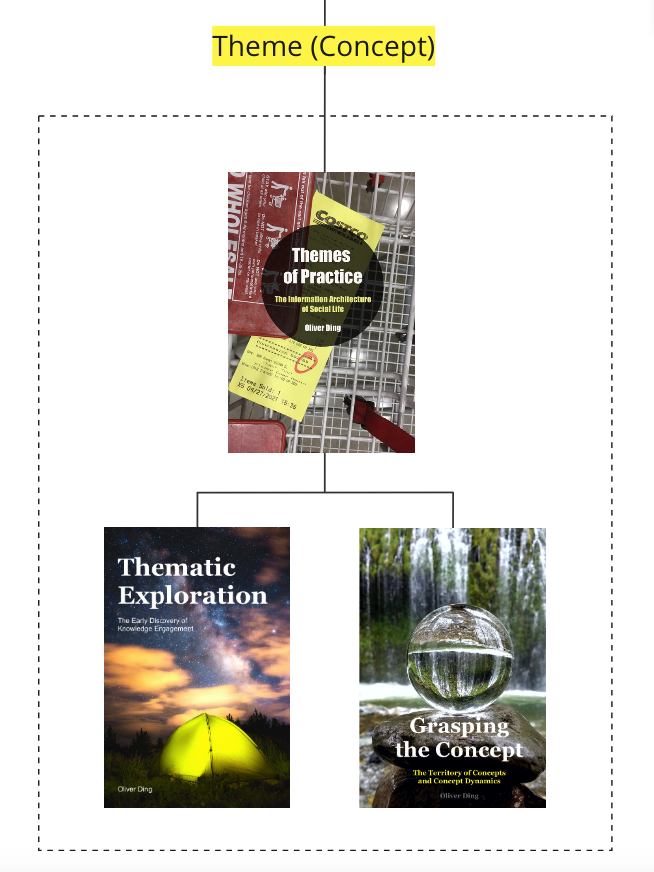
For the Strategic Thematic Exploration framework, I made a distinction between “Theme” and “Concept”. While “Theme” emphasizes subjective experience and understanding, “Concept” is more about objective meaning and definition.
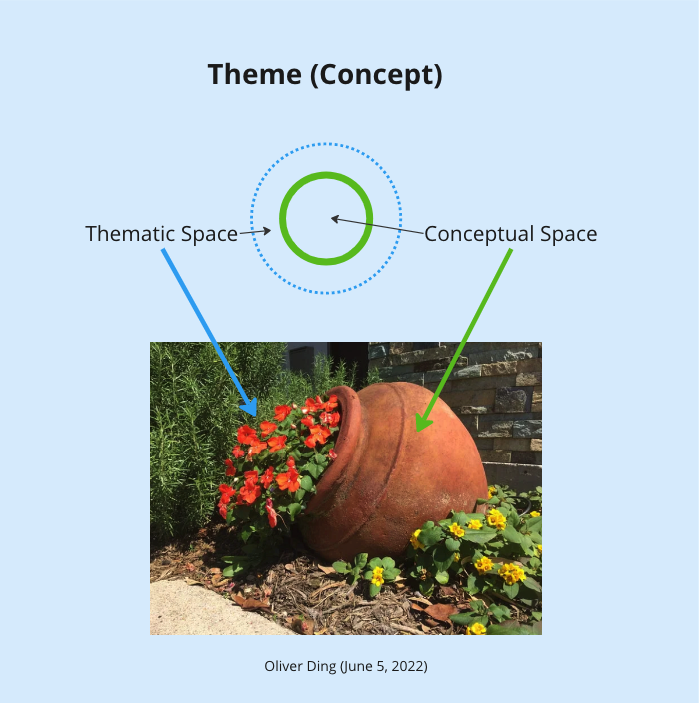
The Thematic Space can be smaller than the Conceptual Space or bigger than the Conceptual Space because it is a dynamic space. You can find more details in A Possible Theme called “Context (Mind)”.

3. Social (Cognition)

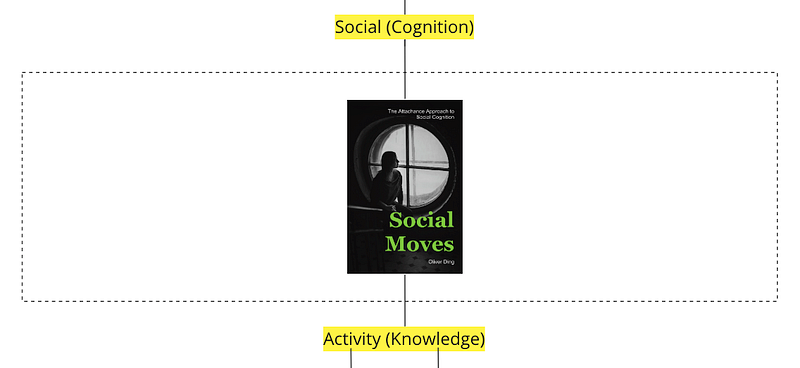
From August 2023 to Dec 2023, I worked on the Social Moves project. The outcome is a possible book titled Social Moves: The Attachance Approach to Social Cognition.
The book presents a large framework. See the diagram below.
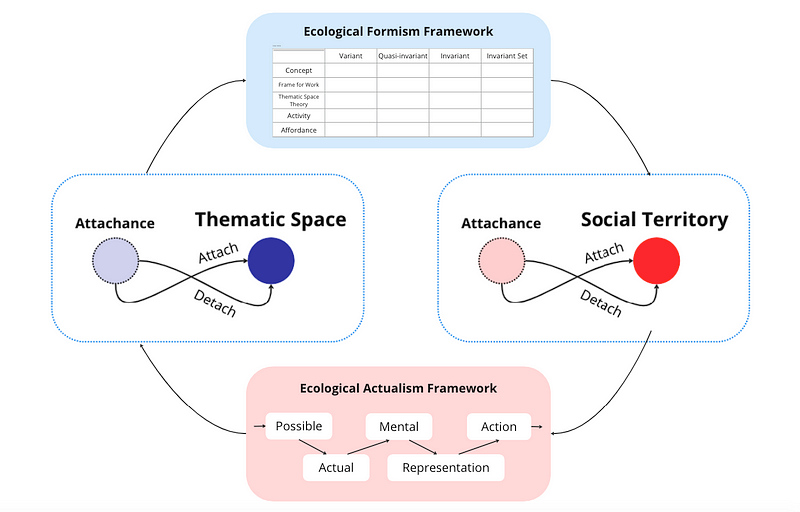
It was formed by two sub-frameworks: the Ecological Formism framework and the Ecological Actualism framework.

You can find more details in Social Moves (book, v1, 2023).

4. Activity (Knowledge)

The idea of “Activity (Knowledge)” echoes the idea of “Social (Cognition)”. All details of the Ecological Formism framework and the Ecological Actualism framework can be found in my books about “Activity” and “Knowledge”.
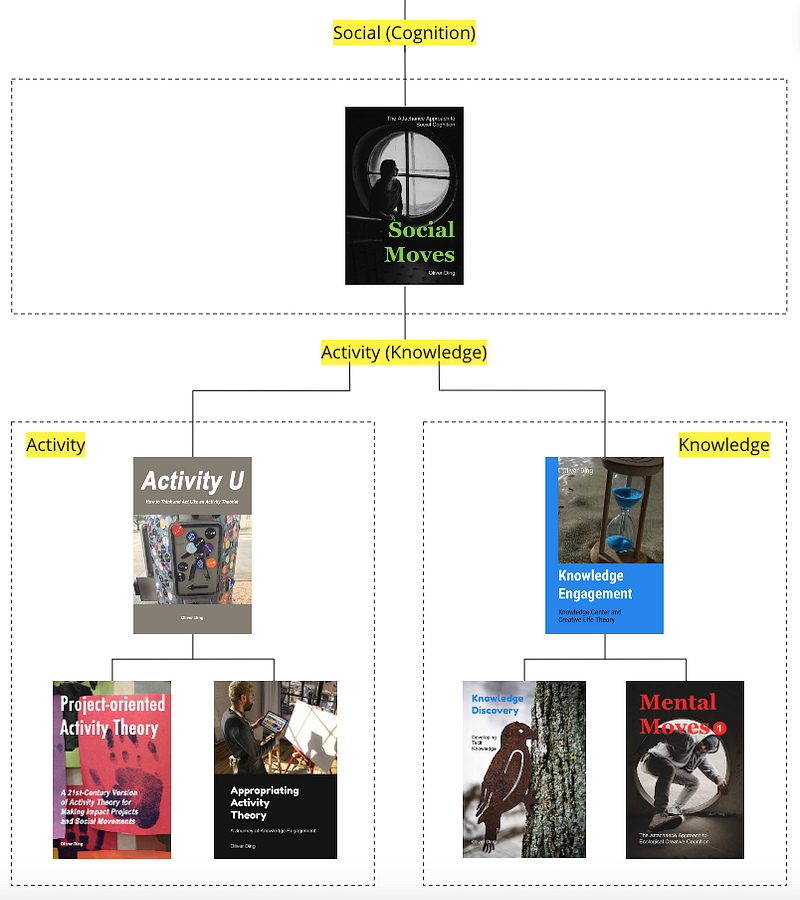
The theme of “Activity” refers to the Activity U project and related projects. It led to a series of books. I selected three for this section.

The theme of “Knowledge” refers to the Knowledge Engagement project. I selected three books for this section.

5. Diagram (Framework)

The idea of “Diagram (Framework)” is a sub-level of the theme of “Knowledge”.

A Diagram is a concrete representation of a Knowledge Framework. In other words, a Diagram is a Container of a Knowledge Framework which is the Containee.
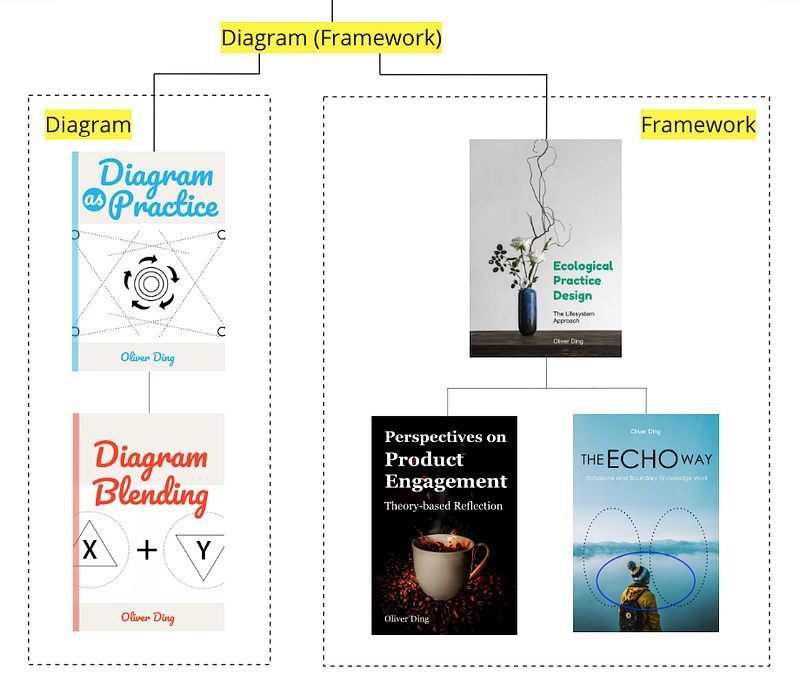
In 2021, I worked on the D as Diagramming project and edited two possible books:

I also worked on developing a series of knowledge frameworks. Some of my possible books are about particular knowledge frameworks. I selected three books for this section.

6. Life (Self)

On June 20, 2023, I published a possible theme called Context(Mind) which introduces the Ecological Practice approach to Mind. On July 17, 2023, I applied the same approach to Self.

Originally, the idea of Life(Self) was the outcome of a rough literature review on self theories in the field of psychology. Later, I realized that it is a new unit of analysis to understand Self.

We can’t understand the “Self” without understanding the “Life”. This insight returns to the Ecological Practice Approach’s basic model: Container (Containee).

We can also apply the idea of “Life(Self)” to the Creative Life Theory project.
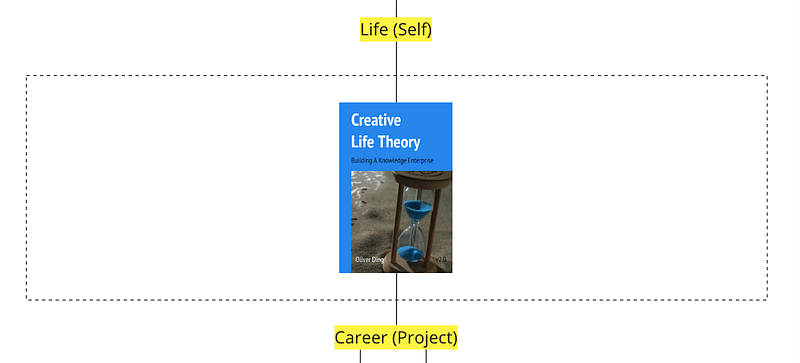
The Creative Life Theory project focused on knowledge creators’ life course.

The Creative Life Theory is a large knowledge enterprise that includes multiple units of analysis, a series of frameworks, and a set of tools. I also wrote several books about it.

The possible book Creative Life Theory: Building A Knowledge Enterprise introduces the meta-framework of the Creative Life Theory (v2) and collects ideas about the “Building A Knowledge Enterprise” activity, such as “Knowledge Discovery”, “Knowledge Center”, “Creative Dialogue”, “Value Circle”, etc.

7. Career (Project)

The idea of “Career (Project)” echoes the idea of “Life (Self)”.
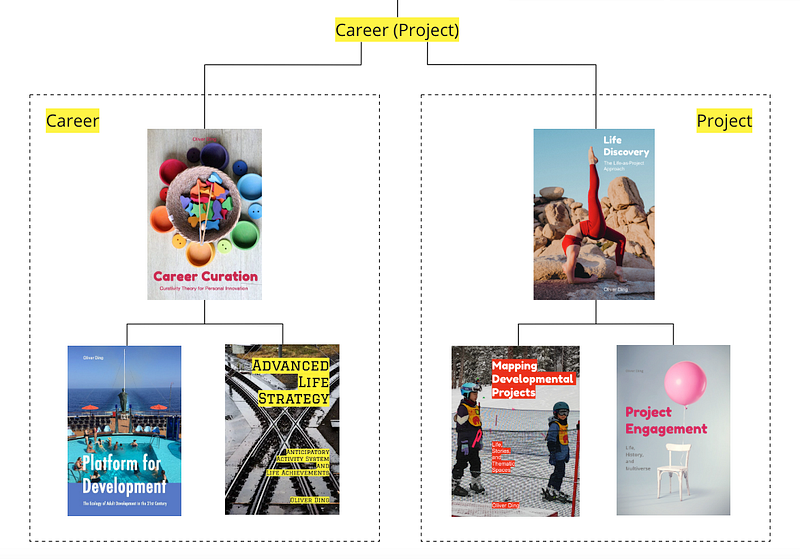
The theme of “Career” refers to my thoughts on the ecological approach to Adult Development, especially the Social Environments. I selected three books for this section:

The theme of “Project” refers to the Project Engagement approach, especially the Developmental Project Model. I selected three books for this section:

Updated

I made a new version on Jan 5, 2024.
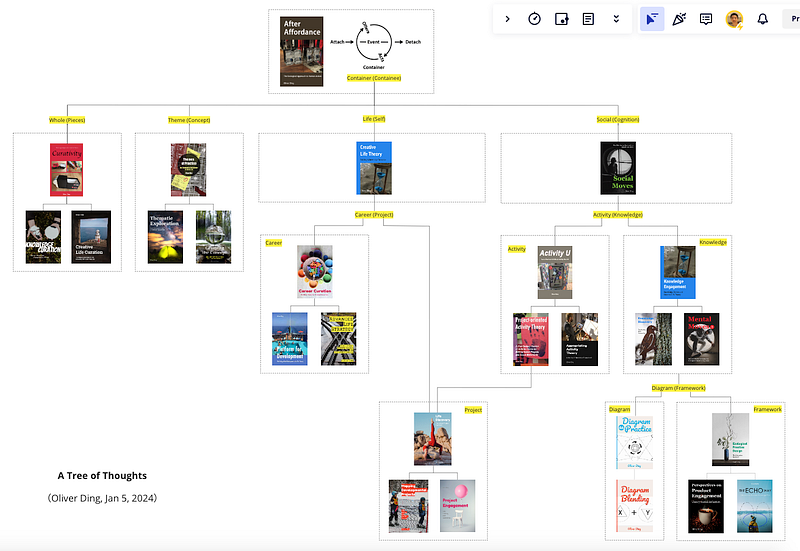
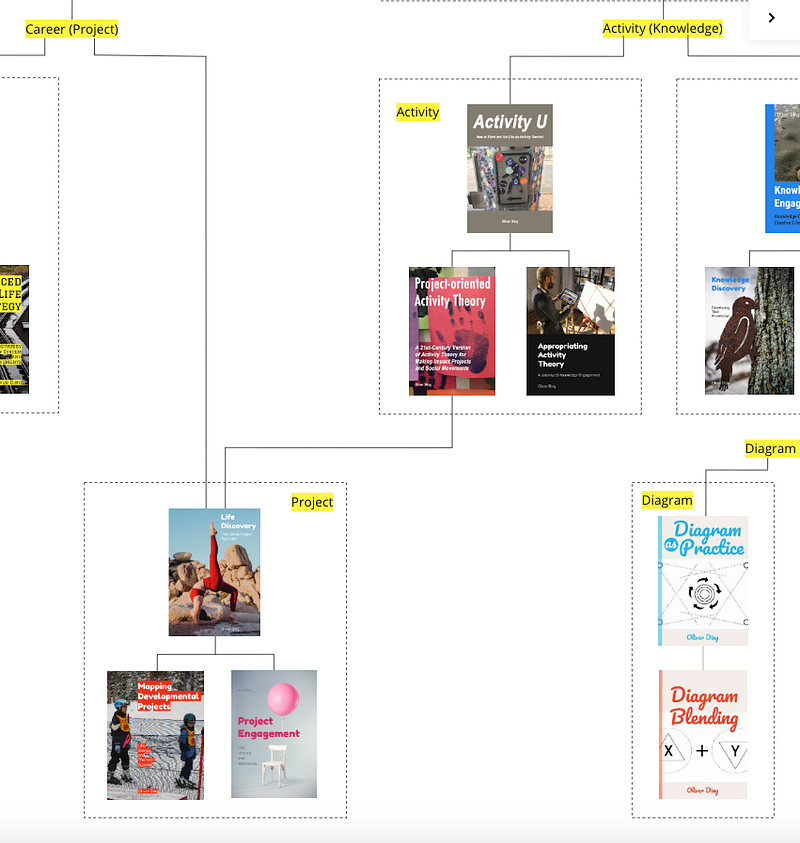
See the “Project” part:
Notes
Notetaking
Life Reflections
Trees
Information Architecture
Recommended from ReadMedium