
Situational Note-taking: The Art of Knowledge Engagement (15 Possible Books)
A short note
The day before yesterday, I wrote a short annual review of my creative work in 2023.
Yesterday I wrote a short note: Situational Note-taking: “Frame for work” and “Framework”.
Today I will write a short note again. This time focuses on a diagram for curating my possible books.
Jan 2023: A Journey of Knowledge Engagement and 18 Possible Books
On Jan 9, 2023, I published a short article with the diagram below on Linkedin.
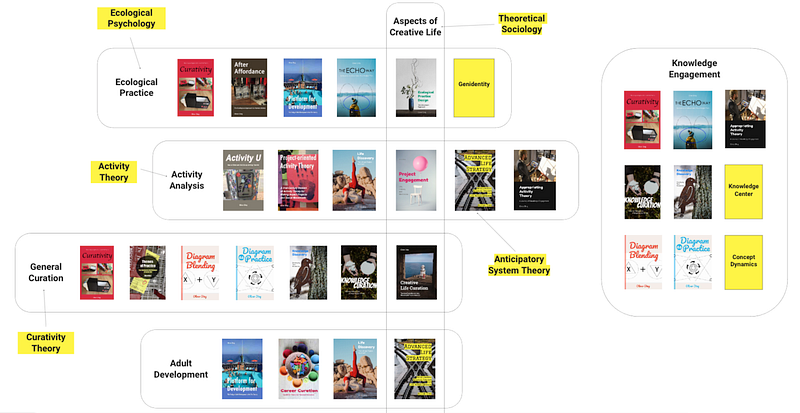
From 2019 to Dec 2022, I wrote 18 possible books which are inspired by five theoretical resources:
- Ecological Psychology
- Activity Theory
- Anticipatory System Theory
- Theoretical Sociology
- Curativity Theory
Initially, I called my journey Knowledge Curation. Later, I realized that I worked as a knowledge creator too. Thus, I used Knowledge Engagement as a new name to cover both curation and creation.
Knowledge Engagement = Knowledge Curation + Knowledge Creation
The primary interest of the journey is Closing the THEORY—PRACTICE gap. During the past three years, I developed a series of tools such as frameworks, diagrams, maps, canvas, typologies, etc. They form a solution for dealing with the THEORY — PRACTICE Gap.
I used two simple steps to connect THEORY and PRACTICE.
Step 1
I curated some theoretical concepts together and turned them into new knowledge frameworks.
Step 2
I applied new knowledge frameworks to some practice domains.
However, there are many various actions under these two steps. I also used and developed many tools.
These 18 possible books are the outcome of the journey. Their primary goals are to represent my knowledge frameworks. Some books also collect articles around some theoretical concepts.
Dec 31, 2023: 26 Possible Books
In 2023, I wrote seven possible books. You can find more details in 2023: Aspects of Early Discovery (Series) and Beyond.
On Dec 31, 2023, I updated the above diagram with new possible books.
From 2019 to Dec 2023, I wrote 26 possible books!
Wow!
This is a fantastic journey!
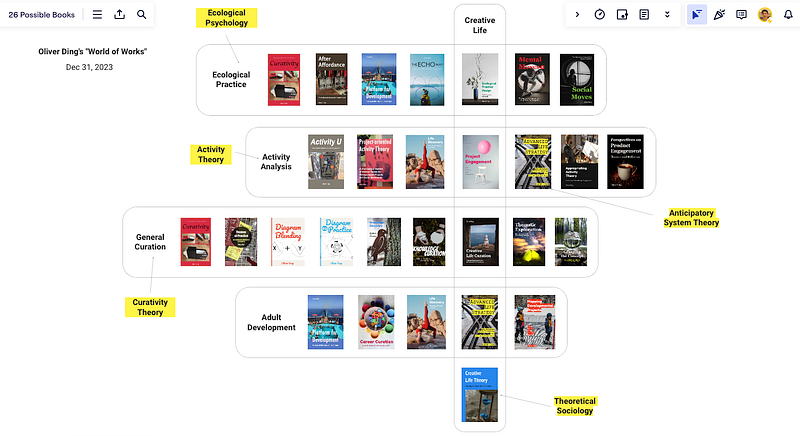
On Jan 1, 2023, I reflected on the above diagram.
I asked myself a question:
Can I use a new diagram to curate these books?
What did this question mean?
I was using the technique of “Continuous Curation” to explore something new.
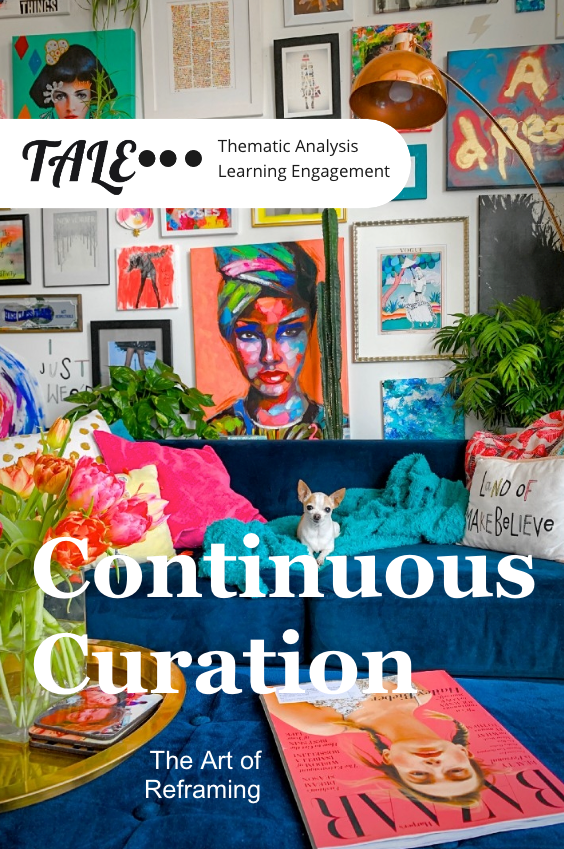
On Feb 15, 2023, I used the above picture to share a simple idea:
Frame > Unframe > Reframe
I discovered the above pattern from my journey of knowledge engagement in the past several years. I realized that I often unframed my knowledge frameworks once I learned something new or discovered some new insights. This pattern echoes scholars’ ideas about theory building.
In 2004, Clayton M. Christensen and Paul R. Carlile wrote a paper about theory building in Management Research: The Cycles of Theory Building in Management Research. They suggested two stages of theory building: the descriptive stage and the normative stage.
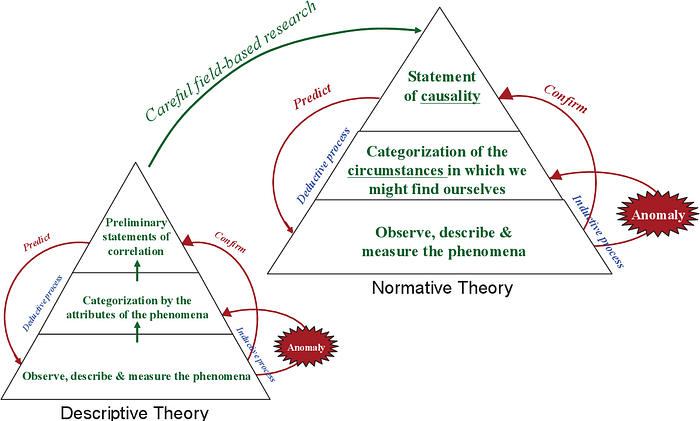
In the first stage, researchers find a conceptual insight from observing phenomena and design a typology by making classifications, finally, they define the relationships between categories and form a model. In the second stage, researchers need to collect more data to test the model and confirm the causality. If they pass the anomaly test, the outcome will be a new version of the theory: the normative theory.
Academic theoretical frameworks are one kind of knowledge framework. In the real-life world, we often use some heuristic tools as the “Frame for Work” for our actions and projects.
The above diagram is a “Frame for Work” for curating my possible books.
How can I re-frame this diagram?
Jan 2, 2024: The Art of Knowledge Engagement
On Jan 2, 2024, I made a new diagram.
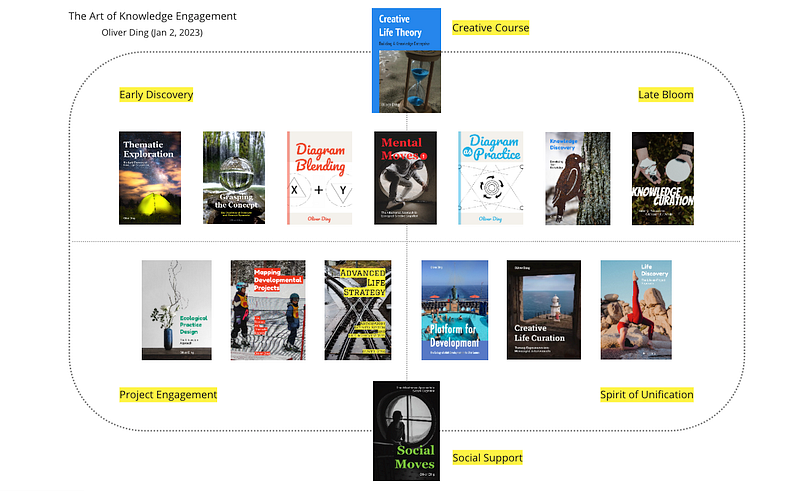
I selected 15 books for the Knowledge Engagement project. See the diagram below.
These 15 books are curated into 6 thematic spaces:
- Creative Course
- Early Discovery
- Late Bloom
- Project Engagement
- Spirit of Unification
- Social Support
These 6 thematic spaces were inspired by a post I wrote on Oct 5, 2023:
In the post, I used the technique of “Thematic Scrapboard” to discover five thematic spaces for the Creative Life Theory (v2).
I use the sign of Creative Life Theory (v2) as the primary mental model to build the thematic scrapboard.
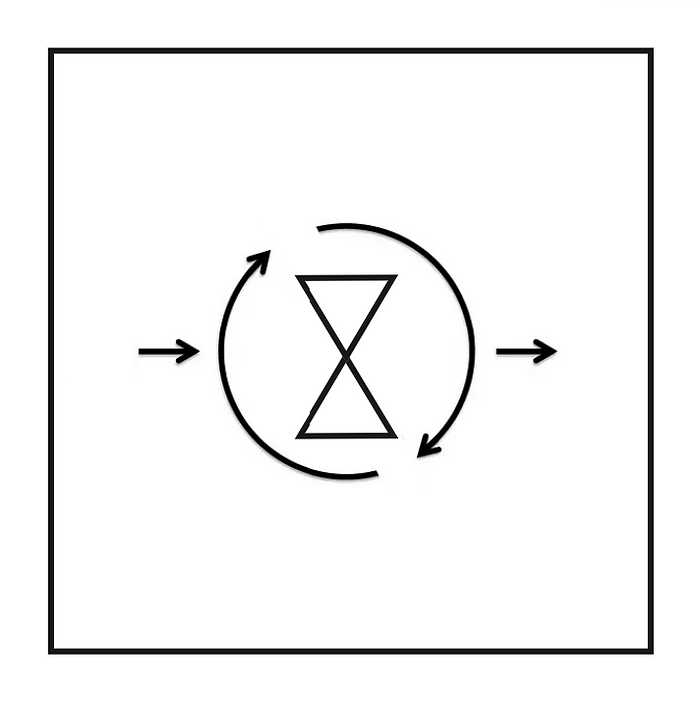
It highlights three major ideas of the Creative Life Theory (V2) with the following three metaphors:
- The Square
- The Circle
- The Sandglass
The Square refers to “Lifescope” which is also called “World of Activity”. The Circle refers to “Knowledge Center” which is the container of Knowledge Engagement. The Sandglass refers to the S-T-O Tendency which is a core idea of the Creative Life Curation framework.
You can find more details in Slow Cognition: The Creative Life Curation Framework.
Inspired by the sign, I discovered five thematic spaces:
- Early Discovery
- Late Bloom
- Project Engagement
- Social Support
- Spirit of Unification
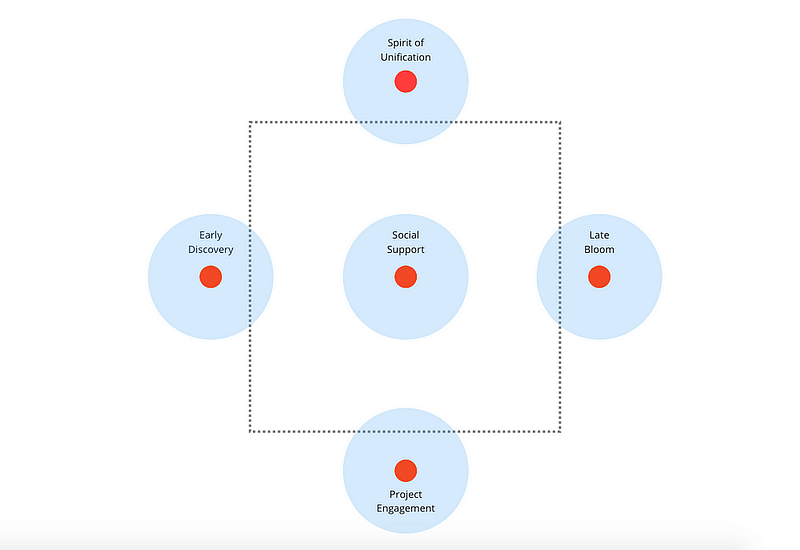
The “Early Discovery” thematic space refers to the early discovery stage of a journey of knowledge engagement. It also can be used to describe the early discovery of a particular knowledge project.
The “Late Bloom” thematic space refers to the late stage of a journey of knowledge engagement. It also can be used to describe the end of a particular knowledge project.
The “Project Engagement” thematic space refers to the chain of projects of a journey of knowledge engagement. It also can be used to describe the activity of a particular knowledge project.
The “Social Support” thematic space refers to the “Self — Other” relevance of a journey of knowledge engagement. It also can be used to describe the social environment of a particular knowledge project.
The “Spirit of Unification” thematic space refers to curating pieces of knowledge into a meaningful whole for a journey of knowledge engagement. It also can be used to describe the theory integration in a discipline.
On Jan 2, 2024, I adopted these five thematic spaces for making the diagram of “The Art of Knowledge Engagement”. In addition, I also added a new thematic space called Creative Course.
The “Creative Course” thematic space refers to the Creative Life Theory (v2) because its meta-framework is called “The Creative Course Framework”. You can find more details in Knowledge Engagement: The Expanded Creative Course Framework.
Also, the top 7 books are about Creating Knowledge (Creative Cognition) while the bottom 6 books are about Running Activity (Social Practice).
This idea was inspired by the Universal Reference for Knowledge Engagement. See the diagram below.
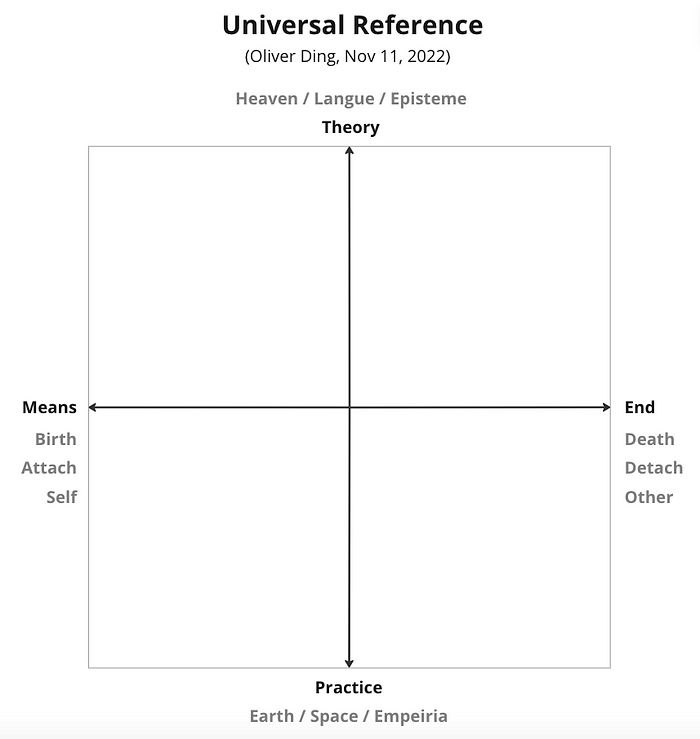
What does the above diagram mean?
It highlights two aspects of “Knowledge Engagement”:
- Knowledge: The Degrees of Abstraction
- Engagement: The Situations of Activity
The Vertical group refers to the Degrees of Abstraction of “Knowledge”.
The “Theory — Practice” dimension is shared with the following pairs of concepts:
- The “Heaven — Earth” dimension
- The “Langue — Space” dimension
- The “Episteme — Empeiria” dimension
The Horizontal group refers to the Situations of Activity of “Engagement”.
The “Means — End” dimension is shared with the following pairs of concepts:
- The “Birth — Death” dimension
- The “Attach — Detach” dimension
- The “Self — Other” dimension
You can find more details in Diagram: A Universal Reference for Knowledge Engagement.
It’s time to close the Knowledge Engagement Project!
I’d like to use this new diagram to close the Knowledge Engagement project.
The journey started with the idea of Curativity in 2019. From 2020 to 2022, I worked on the Knowledge Curation project. From 2022 to 2023, I worked on the Knowledge Engagement project.
The term “Knowledge Engagement” is not a theoretical concept, but a theme. I roughly use “Knowledge Engagement” to refer to “Knowledge Creation + Knowledge Curation”. You can find more details in The Knowledge Engagement Framework (v4).
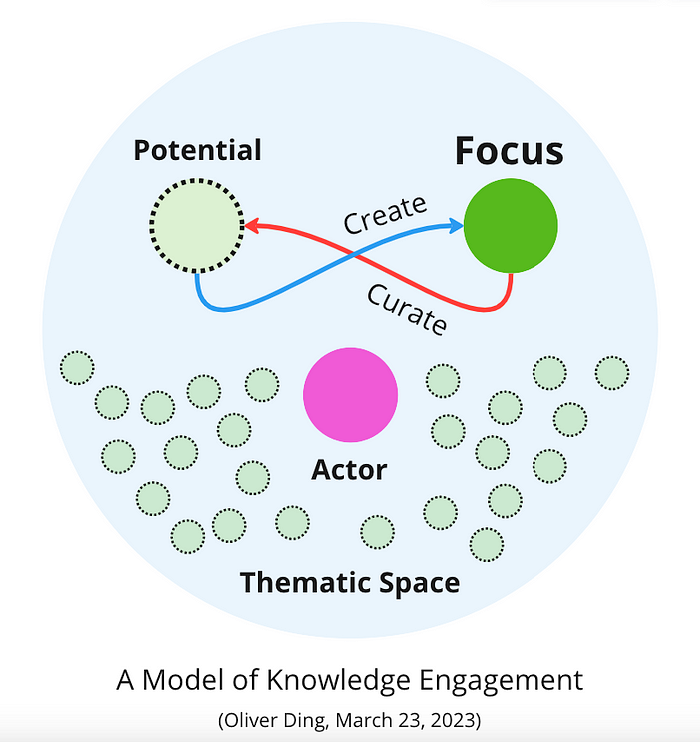
- Potential: Mental Elements
- Focus: Knowledge (such as Concept, Theory, Framework, Center, etc)
- Thematic Space: A creative space that is framed by a theme
- Actor: A person (sociologists tend to call a person an Actor)
- Create: Making concrete things to represent abstract knowledge
- Curate: Organize pieces of knowledge-related experience into a meaningful mental element
The term “Mental Elements” is adopted from Dean Keith Simonton’s Chance-configuration theory (Scientific Genius,1988). I use it to describe ideas, insights, sparks, etc. The above model of Knowledge Engagement considers “Mental Elements” as “Potential” things for developing Knowledge.
The term “Focus” is inspired by Activity Theory’s “Object”. I use it to refer to things we are working on. The above model of Knowledge Engagement considers “Focus” as various types things of Knowledge such as Concepts, Approaches, Frameworks, Papers, Books, Workshops, Knowledge Centers, Knowledge Communities, etc.
The term “Thematic Space” is used to describe a special type of Container: Cognitive Container.
The pair of terms “Create — Curate” is inspired by “Knowledge Creation — Knowledge Curation”. However, I use them to refer to two types of actions:
- Create: Making concrete things to represent abstract knowledge
- Curate: Organize pieces of knowledge-related experience into a meaningful mental element
Moreover, if we connect the Model of Knowledge Engagement with the Creative Life Curation framework, then the “Curate” action echoes “Subjectification / Experience 1” while the “Create” action echoes “Objectification / Experience 2”.
From the perspective of Activity Theory, we can use the Project Engagement approach to understand the theme of “Knowledge Engagement”. You can find more details in Slow Cognition: Mapping Thematic Journey (Engaging with Activity Theory, 2020–2022).
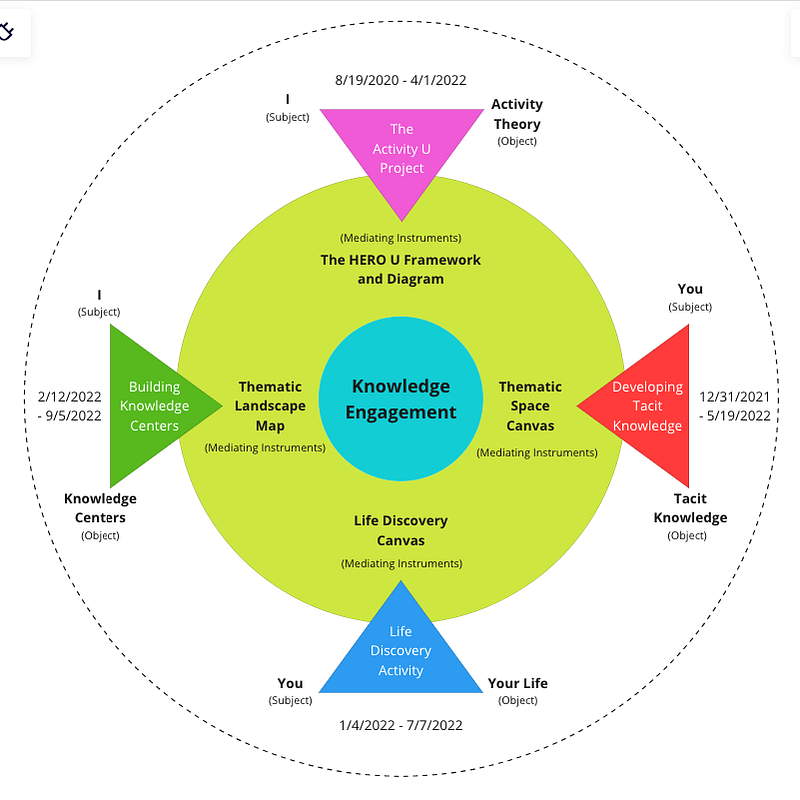
I selected four knowledge projects about Activity Theory and considered them as a Creative Journey.
Finally, I made a large knowledge framework about Social (Cognition) in Dec 2023.
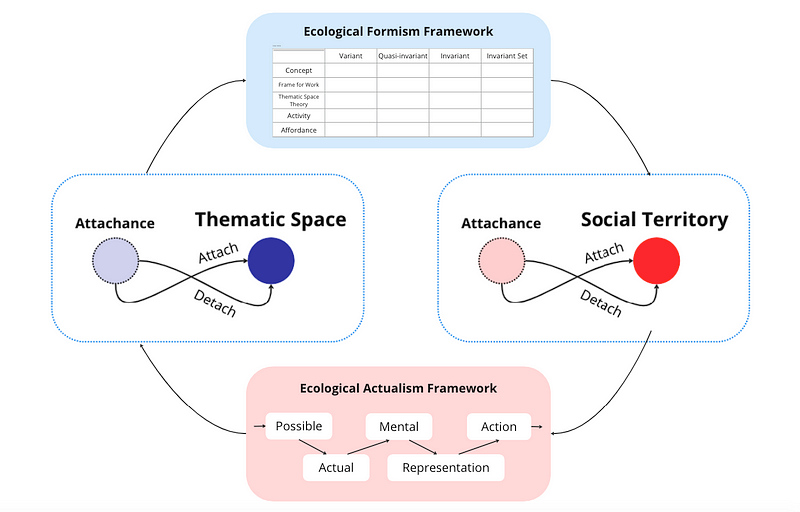
In July 2023, I finished the “Mental Moves” knowledge project and edited a possible book titled Mental Moves: The Attachance Approach to Ecological Creative Cognition. On August 24, 2023, I started the “Social Moves” knowledge project which uses “Social Territory” as the primary concept.
The term “Social Territory” was inspired by Ping-keung Lui’s term “Social Territory” and his Subjectivist Structuralism which is part of his theoretical sociology.
I have claimed that “Knowledge Center” is a type of Social Territory. You can find more details in Knowledge Engagement: The Creative Course Framework.
If we put “Mental Moves” and “Social Moves” together, we see a new unit of analysis of Social Cognition. While “Social Moves” are about Social Actions, “Mental Moves” are about related Mental Activities.
Social Cognition = Social Moves (Mental Moves)
For the Knowledge Engagement project, the “Mental Moves” part is related to Creating Knowledge (Creative Cognition) while the “Social Moves” part is about Running Activity (Social Practice).
It’s time to use these 15 books to close the Knowledge Engagement project.
What a creative journey!
Related books (Drafts)
- Creative Life Theory: Building A Knowledge Enterprise
- Thematic Exploration: The Early Discovery of Knowledge Engagement (book, v1)
- Mental Moves: The Attachance Approach to Ecological Creative Cognition
- Social Moves: The Attachance Approach to Social Cognition
- Knowledge Discovery: Developing Tacit Knowledge with Thematic Space Canvas
- Knowledge Curation: Turning Pieces into A Meaningful Whole
- Life Discovery: Biography, Journey, Program
- Perspectives on Product Engagement
- Diagramming as Practice
- Diagram Blending: Building Diagram Networks
- Creative Life Curation: Turning Experiences into Meaningful Achievements


