
DIGITAL TRANSFORMATION
A strategic framework for successful Digital Transformations
Incumbent businesses can tackle the challenges of digital disruption and extract value through a four-step digital transformation framework
With the advent of digital disruption since the early 2000s, a great number of incumbent companies have undergone radical change or even been fully dissolved. No industry has been more disrupted than journalism, from the way readers are consuming news to the revenue models disrupted by the likes of digital native firms such as Huffington Post and Buzzfeed and non-journalism players such as Facebook or Google. However, few companies such as the New York Times have managed to adapt to the changing conditions and transform their operating models to not only survive but grow and surpass the best of the digital natives. There are plenty of lessons to be learned from these success stories of digital transformation and potentially a playbook or framework to extract for others to benchmark or follow.

Introduction
Three fundamentally exponential trends have driven the evolution of digital technology and radically changed our world. A wave of current, mid-term, and longer-term technologies have, and will be radically changing how we do business. Several underlying economic drivers have also been pushing the adoption of digital transformation. But how can businesses tackle the challenges of a digital transformation and successfully extract value? Today, we can define a framework for businesses to follow to manage their digital transformation efforts.
The framework
For a business to successfully extract value from digital transformation, there are four areas, layers, or components that need to be paid attention to:
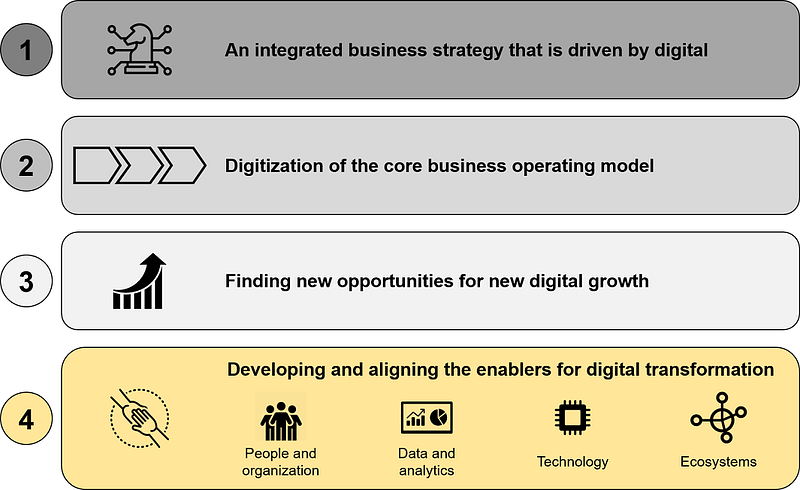
- An integrated business strategy that is driven by digital — the business strategy needs to define a company’s overall approach, not just towards digital, but to where and how it should operate to maximize value creation for the company. Successful business strategies need to be deeply transformed by recent technological evolutions such as digital. The approach to defining this strategy needs to apply a practical approach depending on the business environment the business is operating in.
- Digitization of the core operating model — for a successful digital transformation, businesses need to digitize their core capabilities — i.e. all steps of the value chain, from the customer interface through the supply chain and to the shared functions. When speaking of digitization of the operating model, it does not solely refer to the automation of organizational processes, but rather to the end-to-end customer experience design.
- Finding new opportunities for new digital growth — for growth, we need to think of and find new adjacent opportunities while managing resource allocation to core capabilities, before and after the transformation. In other words, we need to think about where companies have assets that could be taken outside of the current scope of the companies’ activity and commercialized broader, across other industries.
- Developing and aligning the enablers of digital transformation — and there are four of them: 1) People and organization — which is about structure, recruiting, training, scaling operations, culture, governance, adopting new ways of working, etc. — 2) Data and analytics — despite the penetration of big data and advanced analytics jargon into organizations, we need to overcome misconceptions to foster its core value offerings — 3) Technology — utilizing digitally ready functionalities of current technologies while addressing internal tensions within the legacy system — and 4) The business ecosystem — finding the right partnership frameworks to manage the new and complex building blocks of digital transformation, in more open business architecture.

(1) — A digitally driven, integrated business strategy
Digital technology has completely deconstructed the business architecture of many industries and enabled newcomers to disrupt established market leaders with its current, mid-term, and longer-term disruptive trends. Therefore, businesses are finding it harder and harder to build strategies in such new and changing environments with traditional sources of competitive advantage becoming fragile.
For example, positional advantage, the advantage a firm has, by being the volume share leader of a market, is not sustainable anymore. Today, only 7% of companies that are volume share leaders are also profit share leaders, down from 25% in the ’60s, therefore raising a legitimate question about what it means to do strategy in the digital age.
The strategy palette — a strategy for strategy
Today, the one-size-fits-all approach to strategy, if that was ever useful, does not work and firms need to have strategies for setting their strategies. Based on the strategy palette concept, companies can adopt five different approaches when dealing with environmental changes in the digital age.
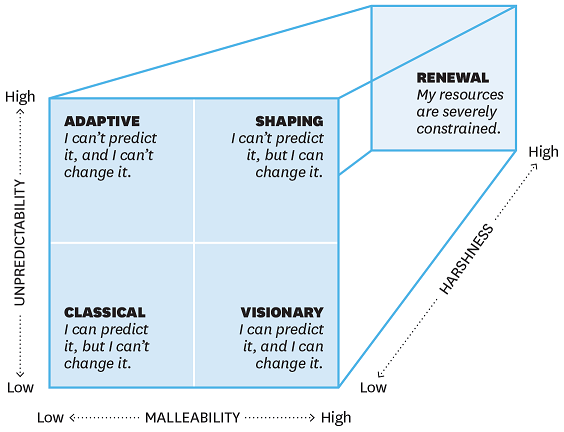
- The classical approach — in the classical approach, strategists start by analyzing the business environment, the starting, and target positions, then plan how to bridge that gap between the two with a sequence of programs, initiatives, and actions, and then go into execution mode, reallocating resources and controlling the outcomes versus competition. The classical approach is appropriate for highly predictable with low malleability markets. If a company falls into this category — for example, in an established market such as the candy industry with big brands such as MARS or Snickers —, it will have to emphasize planning and efficiency in a very stable and predictable market environment. Unfortunately, if business or government leaders keep thinking of their strategy through the classical lens independently from the changing environment — potentially because leaders may fail to fully grasp the level of uncertainty in their industries, especially true when technology-led disruptions are in play — it will generally lead to failure. The reality today is that fewer market environments remain purely classical so new strategy development approaches need to be used.
- The adaptive approach — in a market where unpredictability becomes high but still, with a low level of malleability, long-term planning doesn’t work anymore and strategists need to have a more adaptive approach. An approach with constant goal refinements and much shorter iteration cycles based on experimentation — a trial and error approach. When a new idea, new product, or new business model doesn’t work, stop it quickly and when it does, scale it up, integrate it into the current business, and move to the next idea. For a successful adaptive approach, the company needs to closely manage its experimentation engine with measured metrics such as cost for experimentation, time to market, sales from new products, etc. — just like a startup. This is how firms need to act when technological evolution is not predictable, to experiment with different variations, select the useful one, scale it up, and repeat.
- The visionary approach — environments that are predictable and malleable, are often markets at the early stages of maturity where the existing value propositions are weak, with very little competition and limited regulation. In this malleable environment, a single offer can change the status quo by bringing a bold vision at the right moment and therefore create a future with some degree of predictability. A visionary strategy takes effort, resources, and a lot of persistence. Effort means to see what others have missed, to find an unmet customer need that nobody has addressed, or the opportunity to disrupt an existing process with new technology. Resources will be needed to build products or services and to fund the business for some time before it reaches the economically viable stage as the vision is starting in the early stages of the adoption cycle. Persistence, meaning waiting for the inflection point where the business will penetrate the market and scale, will be needed. For example, UPS, the package delivery company, anticipated 1994 a change in the industry toward e-commerce parcel delivery and spotted the opportunity of becoming the enabler for global e-commerce. UPS persisted for quite some time and invested $1 billion per year in their required IT system until their persistence finally paid off. In 2000, UPS had a 60% market share of the total US e-commerce shipping market.
- The shaping approach — with the evolution of digital technologies, we will potentially witness more unpredictable and malleable market environments. For example, blockchain for money transfer or artificial intelligence for managing customer interactions (i.e. chat-bots), are unpredictable and malleable market environments. In a shaping market environment, a single player will not be able to control and drive the market in a monopolistic manner and will need a whole ecosystem of suppliers, customers, competitors, policymakers, etc. to gradually build the end vision. This is what Apple did with its iPhone ecosystem, or Google did with its Android equivalent. For example, blockchain or AI startups will only be able to tackle their challenges by engaging and educating their ecosystem and developing their competitive advantages depending on how the ecosystem, as a whole, reacts to their value propositions.
- The renewal approach — will be used in ‘harsh’ business environments, for example, when a company suffers from severe underperformance in growth, margins, or free cash flow in a way that even threatens its survival. This is typically what incumbents will go through when a disruption occurs. For example, this is Nokia versus Apple or traditional taxi companies versus Uber. In such cases, a renewal strategy requires the company to proceed in two steps 1) to conserve resources to ensure its survival, and 2) to choose a new approach to rejuvenate growth. This can sometimes mean abandoning the core business and going somewhere less crowded, or niche.
Building strategy by exercising ambidexterity
As mentioned previously, one approach does not fit all business situations anymore in the digital age as it needs to carefully monitor its business environment and choose the right approach to craft its strategy. To be more accurate, it needs to choose the right combination of approaches because any given company is likely to operate in different environments with different business lines, geographies, and products.
For example, a company can run a legacy infrastructure business in a classical environment along with an asset-light platform business in shaping or visionary environments. A legacy infrastructure business can be shaken by a substitutional technology such as what banks are facing with blockchain creating uncertainty on customer response, transaction risk, or regulation. While the asset-light platform business will require an ecosystem approach or the development of a bold vision to grow.
The role of business leaders is to recognize which combination of environments they are operating in and orchestrate different approaches simultaneously. This leadership ability is referred to as strategic ambidexterity. This is not an easy competency to achieve especially in large-scale organizations and will require the recruitment of the best talent in the area of strategic and critical thinking.
In short…
The classical linear approach to devising a business strategy can no longer guarantee a sustainable competitive advantage. Businesses need to adopt new approaches depending on the level of uncertainty, malleability, or harshness of their market environments and leaders need to choose and execute the combination of approaches their businesses need to operate successfully.

(2) — Digitization of the core operating model
The need for efficiencies and better customer experience
Digitization and digitalization are way more than just ‘making all processes paperless’, or having an IT department in charge of making the company ‘paperless’. Digitization needs to fulfill a business purpose not because it is fashionable but because it will bring operational and business efficiencies and help the company become lean.
In addition to operational efficiencies, digitization can enhance the overall customer experience. Imagine a non-ideal experience of yours with purchasing a plane ticket, online. It could look like this:
— it would take you quite a while to enter all the required information including contact details, passport information, or credit card details, with all being re-entered multiple times. Then, you might need to print it out and take the hard copy to the counter at the airport. If there is a flight delay, you might have to stand in a queue to get an answer for quite some time, then you’ll sit around in the around for hours waiting for the plane to take off, and despite reassurance that you won’t miss your connection flight, you eventually miss it and the meetings you have at your destination.
Today, in our digital worlds, we have become accustomed to seamless interaction with digital innovation, to the Amazon-s, Netflix-s, and Uber-s of the world, and expect everything to work smoothly, integrated, and as intuitively as switching to a new iPhone for example. We tend to get unhappy if a product or service isn’t working the way we expect it to work. In other words, our tolerance for bumpy customer experiences has decreased.
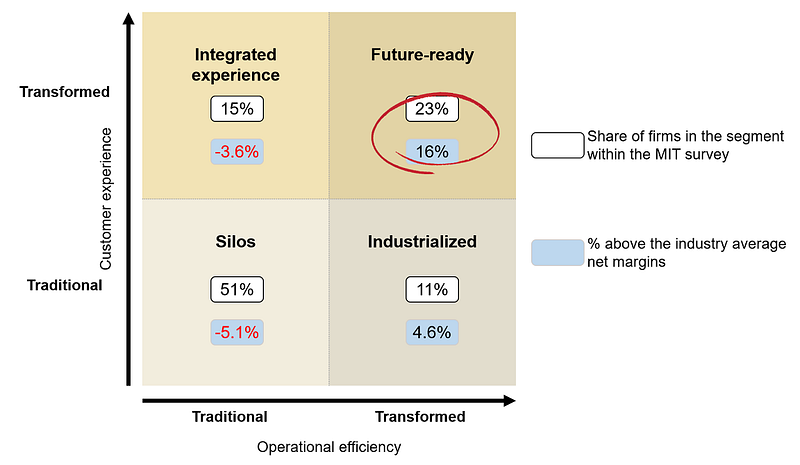
A study conducted by the MIT Sloan School of management in 2018 found that companies that enhance both digital operational excellence and customer experience, outperformed industry average net margins by up to 16% points, helping the company become an industry out-performer. This is not easy, as only 23% of companies managed to excel in both dimensions, but highly rewarding.
Optimizing experience via the customer journey
As discussed, it’s critical to have an end-to-end approach to digitization, one that isn’t limited to only automating existing processes, but completely rethinking how value is delivered to the end-user, rethinking the whole process from the lens of what today’s customers expect. To achieve this, firms need to shift their mindset from thinking about “processes”, to thinking about “the customer journey”.
The customer journey is a step-by-step experience a customer goes through to use a service or product. Businesses typically manage dozens of different customer journeys through different channels for different products and services. For example, for a bank, there’s one customer journey for opening a deposit account, one for applying for a loan, and another for transferring money. There are different journeys for each of these services if we are viewing it from the perspective of the business owner or employee versus an individual consumer. Throughout the journey, the customer is at the center of the universe and whatever change or automation is to happen, we need to make sure the processes are assessed from the lens of the consumer.
Using design thinking to enhance the customer experience
Design thinking provides a compelling framework to reimagine the customer journey, with the customer at the center of attention. The design thinking process is iterative, flexible, and focused on collaboration between designers and customers, consisting of five main steps:
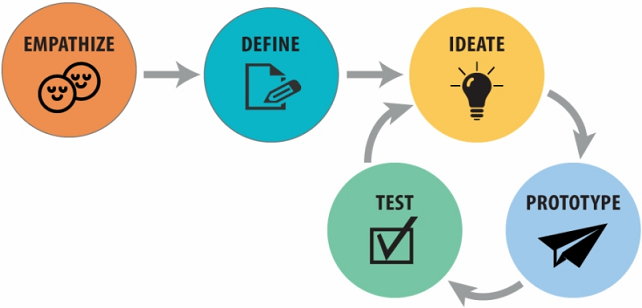
- Empathize — fostering the team with an empathetic understanding of the problem they are trying to solve
- Define — analysis and synthesis of data, re-framing the problem in a human-centric way, or even defining a new unmet need that should be tackled
- Ideate — team members start to identify new possible solutions to the problem
- Prototype — the team produces several inexpensive scaled-down (also termed as MVP) versions of the product or services they want to test, allowing rapid improvement in the initial solution
- Test — the team tests the prototype in real-life conditions, to see how it impacts the customer experience along the whole journey, through a trial-and-error process
The design thinking steps are carried out in a very flexible nonlinear fashion, meaning teams can always jump back to earlier steps or even different groups may work at different stages on varying features of the solution depending on customer findings. For a more comprehensive explanation of design thinking, check the link below:
In short…
Companies need to aim for both higher operational efficiency and better customer experiences in their digitization agendas — this is how value can be maximized. The right lens to rethink value delivery is to shift from focusing on process automation to key moments in the end-to-end customer journey. To re-design a customer journey, digitization teams can utilize design thinking philosophies to develop and deliver offerings.

(3) — Finding new opportunities for growth
Value creation in a firm can come from a range of sources, such as real estate that appreciates over time, the profitability of operations and accumulated savings, or growth and expansion into local and global markets. However, this source of value has an inherent limitation — it will reach a plateau in the adoption curve — as it is quite normal, based on the industry's competitive lifecycle. This means, that once a business has gone from the city to the country, to the globe, where else can it go? This is the point where companies will need to look for new sources of growth, and in action, this has become harder and harder over time.
For example, if you look at the period between 2004 and 2014, growth options’ contribution to market capitalization has dropped from 78% to 68% (-10% change). One reason for this drop is that technology has deconstructed established industries and significantly lowered barriers to entry, especially for new digital attackers and tech startups who have become very good at capturing value from market leaders.
Ambidexterity — exploit and explore your way toward growth
Business leaders, rather than cope with disruption when it happens, need to anticipate change by proactively looking for self-disruption, and by finding new digital growth opportunities, sometimes at the expense of cannibalizing legacy businesses. Incumbent and established players need to be efficient at managing legacy businesses (i.e. exploit) — their predominant source of value — and at the same time building new ventures that might make the legacy business obsolete (i.e. explore). In other words, they need to exploit their core businesses and explore adjacencies at the same time. This ability is an example of organizational ambidexterity. A study shows that in general, only 2% of companies achieve such capabilities.
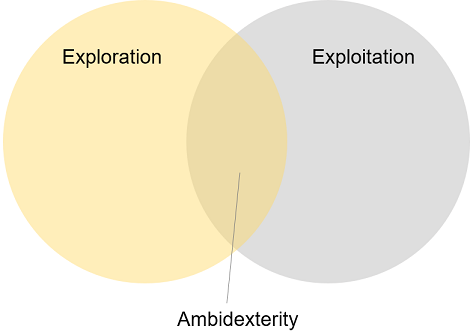
Large organizations are generally not good at organizational ambidexterity. In reality, only 11% of firms manage to achieve ambidexterity and what typically tends to happen is that, once a company pursues innovation, it loses efficiency and once it explores innovation, it neglects exploitation. For example, in the case of 3M, in the early 2000s, they deployed Six Sigma teams throughout the organization to increase operational excellence, and surely enough, operating profits as a percentage of sales increased, but they neglected innovation during that time and the New Product Vitality Index, that is, the percentage of sales from products that are less than five years in the market, declined. Then again, in 2005, they shifted gears towards innovation, and the New Product Vitality Index increased, but operating income dropped.
When organizations find a way of doing something, when they crack or hack a market, they are uncomfortable changing it. They are squeezed by a variety of internal and external pressures such as shareholders, customers, competition, employees, governments, etc. to deliver on operational metrics. Therefore, incumbents tend to fall into one of two common traps: the trapped in the past success or the perpetual search trap.
For example, Nokia was a victim trapped in its past success, and Xerox was the victim of a perpetual search trap.
- Nokia underestimated the migration of users to touch screens and continued too long with the push toward feature phones.
- Xerox invested heavily in innovation and its engineers were the first to create an early prototype of the modern PC, with a graphical user interface and a mouse, — even before Apple’s Macintosh in 1984 — they invented laser printers and the Ethernet but failed to monetize on most of their inventions.
Avoiding growth traps
There are three practical ways for organizations to balance exploration and exploitation and achieve strategic ambidexterity.
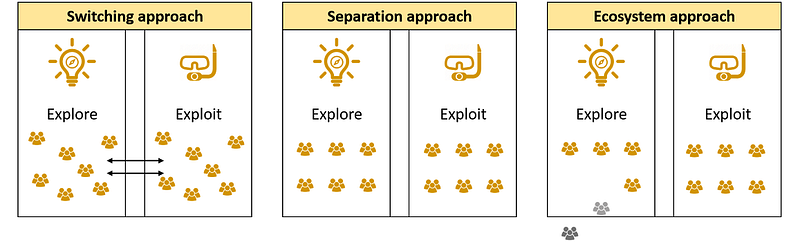
- Switching approach — is the first intuitive answer, by which firms proactively take teams from the exploitation stage to the exploration stage and vice versa, typically occurring at the end of a product adoption cycle, and the early stages of a substitution technology. Firms applying a switching approach manage a common pool of resources that tend to switch roles. Switching is very hard in practice because it relies on getting the timing right in a very narrow window of opportunity.
- Separation approach — the goal here is to create separate units to serve separate objectives of exploitation or exploration. Usually in this approach, firms will form small teams of explorers on the fringes of the organization with atypical profiles — i.e. more digital natives whose background is different from the legacy business — whose mandate is not to deliver immediate revenue targets, but to help think about alternative sources of growth in the long run. These individuals are typically named ‘growth hackers’. In the separation approach, strategic decisions are managed top-down and are run independently from one another in different divisions or geographies.
- Ecosystem approach — whereby ideas are sourced externally. This could be a pragmatic approach for businesses that are unable to manage ambidexterity with internal resources. In practice, this can result in acquisitions, partnerships, incubation, or other more informal exchanges of ideas. For example, today, many banks are running their open innovation Fintech incubators, acquiring, and making large investments into startups to build an exploration ecosystem.
Allocation of resources to exploitation or exploration will depend on the market environment of the company, as segmented in the strategy palette, and requires continuous adjustment to guarantee the exploration-exploitation balance. For example, in a classical and stable environment, firms can allocate a smaller share of resources for medium to longer-term exploration, while in an adaptive and uncertain environment, that requires a lot more iteration, a larger portion of resources will likely be allocated. In practice, business leaders will need to build a feedback loop that constantly monitors the outcomes of resource allocation and calibrates it depending on how the environment evolves and how teams deliver.
‘Innovation’ is key to exploration and digital growth
Real and truly disruptive innovation requires hard work with uncertain outcomes along the way and therefore requires the use of frameworks, guiding principles, and strategies that can help support innovators along this uncertain path. Due to the complexities of innovation:
- We need to structure the innovation process to combine the benefits of creativity, curiosity, ingenuity, science, timing, and chance
- We need to understand the end-user, their challenges, needs and wants
- We need to engage these end-users and other potential stakeholders as directly as possible with some version of the product or service, better to have an MVP, to get tangible feedback and reiterate the offering
- We need milestones, to help innovators convert offering development challenges into a series of doable tasks, deliverables, and measurable outputs and tests
Design thinking is a framework that helps innovators structure innovation efforts. Design thinking is a human-centered approach that connects the complex dynamics of people, technology, and commerce to drive the development of favorable solutions. Its iterative, organic, and user-centered processes, via the use of principles such as personas, jobs to be done, or effectuation, focus on the experiences and underlying motivations of users toward the desired outcome. Moreover, design thinking’s iterative prototyping and testing approach help innovators to develop a range of early guesses of what an ideal solution may look like, providing a convenient methodology for hacking and finding product-market fit.
In short…
Business disruption is a matter of when and not if it will happen, and leading companies should strive to disrupt themselves before others do. The goal should be to achieve ambidexterity, the balance between exploitation and exploration. When a company builds ambidexterity, it needs to continuously adjust allocating resources depending on the business environment and its evolution.

(4) — Developing the enablers of transformation
i — People and organization: agile working at scale
Becoming digitally ready requires a massive change in how an organization thinks and operates, requiring a whole new set of organizational capabilities such as ambidextrous leadership, fast execution, experimental and design thinking mindsets, trial and error approach to prototyping, etc. We can see these qualities in startups with a strong digital entrepreneurial spirit, but established or larger companies lack such qualities.
In the mid to late 2000s, firms that wanted to digitize their operations, depending on priorities and starting points, used a combination of four different structural models to progress:
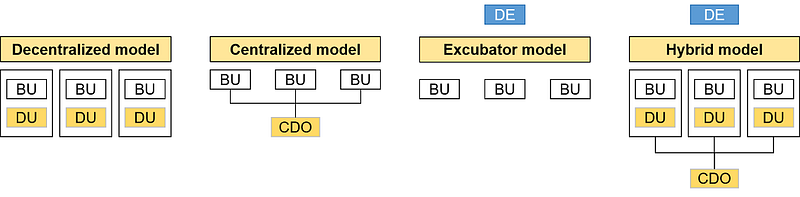
- The decentralized model — digital activities are integrated into each of the existing business units, with independent digital strategies and teams for the units
- The centralized model — such companies create a separate digital entity, headed by a CDO that would lead the transformation, with this center of excellence defining priorities, allocating resources, and executing the digital transformation initiatives in collaboration with the business units
- The external incubator model — here, digital activities run in parallel and sometimes in competition with other business units, with the CEO ensuring the orchestration and allocation of resources needed between the traditional business and the new ventures
- The hybrid model — here, firms choose to have both a central unit as well as a separate incubation lab or business unit team along with a center of excellence for support.
However, in reality, none of the above operational models fully change the legacy processes that could potentially cripple large organizations. Established and incumbent organizations need to adopt new ways of working suited to the needs of the digital age, like what digital startups are using to maintain a competitive edge despite strong headwinds. This mindset is called agile at scale.
— Why is agile so effective?
The reason many startups and digital companies are using agile philosophies is that it allows the organization to scale, ensuring the ability to expand operations from a team or project to a whole organization. Two inherently core concepts within agile allow organizations to scale:
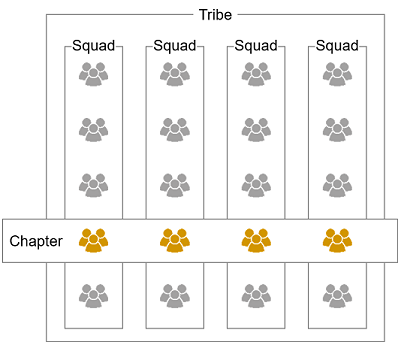
- Alignment and autonomy — incumbent and traditional companies insist on alignment within a hierarchical structure or a surgical line of command that has probably been inherited from military strategy. But this doesn’t allow much autonomy to employees and makes movements slow especially if you want to keep up with exponential growth. However, the agile philosophy relies on small execution units. For example, at Spotify, these teams are called squads. Squads are fully autonomous and multidisciplinary teams with usually 10 to 15 team members. Squads are fully responsible for delivering a certain product or its features. Squads are empowered to make decisions required to ensure that product delivery meets the end objectives assigned such as ‘increasing engagement rates’, ‘ lowering retention rates’, or ‘increasing premium membership purchase’. Additionally, in Spotify, to prevent squads from each running in different directions — therefore destroying alignment and creating havoc —those working on related topics can coordinate as part of the same tribe, and members with the same expertise, such as iOS or Android app developers are aligned on organizational standards through chapters.
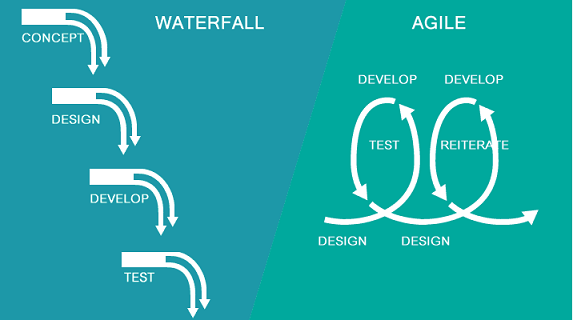
- Iterative delivery of value — to ensure that all teams remain aligned over time. Traditionally, firms used waterfall models to develop offerings, using a linear process of analysis, design, and execution. For example, a painting would be split into milestones from 0% to 100% delivery, in a linear fashion beginning from the bottom to the top. However, in such a model, if you realize that something has gone wrong midway, it’s hard to reverse. In an iterative approach, teams execute repeatedly in short iterations, often referred to as sprints, until they get it right. Sprints enable the team to change direction and respond quickly, as needed. In each of the agile and iterative development steps, the output would be a minimum viable product (MVP), a draft that can be used by customers to collect and incorporate feedback. This allows organizational alignment by iteratively checking the broader environment and adjusting to changes.
— Implementing agile in practice
Depending on the needs of the organization and where the leadership stands on digital transformation, there are two different approaches that companies take to implement agile at scale:
- Transformational approach — fully convinced organization — a top team in the organization along with the CEO, are completely convinced that continuing with the current operating model will not be good enough and the firm needs to change its culture and way of working to survive in the industry. In these instances, it’s top-down-led transformation, that will need full leadership team commitment and their willingness to embrace and drive change as the leaders of the organization.
- Gradual approach — not fully convinced organization — these firms start with pilots and build a few first lighthouse projects using agile and monitor progress, seeing what works well. Then they might scale that up to the level of an agile portfolio of projects. Gradually, at some stage, these firms will come to a tipping point where they will change the organization into an agile one, with more acceleration toward a holistic operating model transformation
— The benefits of agile at scale
There are many benefits to the adoption of agile development in firms. The main impacts of agile at scale for businesses include:
- Decreased levels of risk — due to iterations and constant feedback loops, the risk of taking the business in the wrong direction decreases quickly
- Continuous visibility — the focus on the development of MVPs at every stage, helps the firm keep high visibility on what value every team is creating, allowing near real-time adjustments in product development
- A higher level of adaptability — agile keeps the organization adaptive and flexible, in case an unforeseen disruption or new opportunity arises
- Faster business impact — income can be realized much earlier, with early releases, and faster time to markets
- Operational effectiveness — helps firms become better and faster in responding to changing customer needs, increases effectiveness by breaking down internal silos and taking out bureaucracy, increases employee engagement, and attracts and retains the best talent
— Changing the operating model to scale for agility
The building blocks of agile are the iterative way of working and working in small multi-disciplinary persistent teams otherwise referred to as mini-startups. However, the challenge of implementing agile arises when we want to scale the operating model across hundreds of teams and thousands of people. Implementing and scaling agile philosophies in an established organization can be a huge challenge as it will require changing all the dimensions of a company’s operating model over several years. The key components to building such a transformation include:
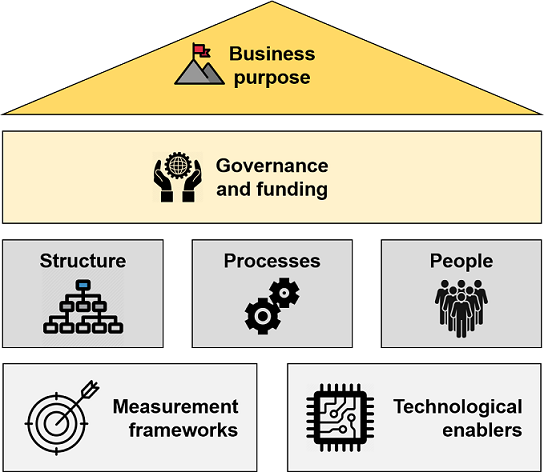
- A business purpose — leaders need to focus on the overall company purpose, strategy, and priorities and lead their teams to figure out how to do things in the new mindset. This starts with leadership, behaving as catalysts of change
- Governance and funding to teams — translating the business purpose into action, by allocating funds to squads rather than to projects
- A new structure — that defines the squads, tribes, chapters, and guilds as the organization wants to move away from functional silos to small multidisciplinary teams. Ideally, teams will be co-located, so that means rethinking location strategies, for example, if the firm has staff that are outsourced, it could think of bringing them in-house
- New processes — less linear and hierarchical — more iterative and empowering. Whenever agile methodologies are executed, we will need to think about the underlying IT enablers such as modular IT architectures using APIs, IT processes automation, continuous testing, etc. All of these would be implemented in parallel to bring agility to the organization
- New behaviors — new employee hiring criteria, reward and promotion mechanisms, development and training schemes, change in the role of managers, etc. In essence, we will need to change almost all of the elements of the HR models, trying to put multidisciplinary teams together
- Measurement frameworks and technologies — that allow and monitor fast iteration, testing, and outcome measurement. Agile organizations are extremely data-driven. So, firms aiming to transform have to make sure that they have the data analytics and tools in place.
— In short…
Scaling agile methodologies is needed to balance alignment and autonomy for digitally-ready organizations. This relies on autonomous multidisciplinary teams that drive the end-to-end delivery of a product or service iteratively. In action, agile will increase time to market, productivity, and employee engagement rates. However, implementing agile operations at scale is a multi-year journey that requires a complete transformation of a company’s operating model.
ii — Data and analytics: gaining value-add beyond myths
“Data is the new oil. It’s valuable, but if unrefined it cannot be used. It has to be changed into gas, plastic, chemicals, etc to create a valuable entity that drives profitable activity; so must data be broken down, analyzed for it to have value.”— Clive Humby
Whatever digital product or service you build today, will ultimately rely on data for competitive advantage. For a company to derive value from data, the key is to start with a clear business objective and a clear vision of what the company wants to achieve. A company needs technology infrastructure and know-how to collect, store, and analyze data, but this can be scaled up gradually or even be outsourced relatively easily. For a company to derive value from data, there are four domains it needs to think about when building data and analytics capabilities:
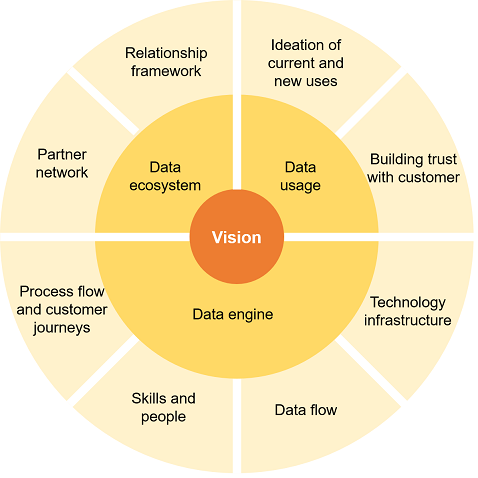
- Defining a clear business objective and vision — big data is not a technology question, it is about how data will resonate with the business objective and help deliver business outcomes. So, if a company’s data and analytics vision are about getting the latest and greatest technology, then they probably stand to waste money.
- Data usage — how will the vision be translated into tangible use cases? To create the right use cases for data usage, it is necessary to promote a data-driven culture in the first place. Firms should not embark on data usage because of intuition or gut feeling but rather ideate carefully on how to utilize their data for improving customer experiences. Moreover, companies who want to collect and use customers’ data, should protect against misuse, regardless of which generation or which group of people they are targeting. Building trust with users in the digital age will be key to long-term business success.
- Data engine — what capabilities does a company need to implement those use cases? This will be about technology solutions, data gathering, skills required, and the link to business processes. When looking for technology solutions, do not get confused with the buzzwords of new offerings in the market. You shouldn’t be looking at technology solutions from the novelty perspective as they will come along with unique risks. What is important is the trade-off between the needed functionalities and the cost you’re willing to pay. Big data analytics has numerous valuable applications in various functional areas such as operation analytics for procurement optimization, predictive maintenance, logistics optimizations, etc. So no matter what business you are running, data can play a crucial role in optimizing your operations. Also, the data engine is not about the people or the ‘data scientists’ who combine deep IT know-how, superior analytics skills with great business expertise, and a strong ability to influence decision-making. Such talent is rarely ever found. However, firms need to set up strong teams that include all the different needed skill sets, especially if close collaboration within the team is ensured through an agile way of working. Data analytics should not live in silos but be embedded in daily business operations.
- Data ecosystem — who beyond the company itself can support the development of data and analytics capabilities? It’s much more efficient to rely on a wider data ecosystem for both data exchanges and analytic support, for example, crowd-sourcing solutions. Understandably, building the right relationship framework that allows seamless sharing of data can be hard, especially if a firm’s data will be key to its competitive advantage, but companies willing to mutually share data, usually get around this hurdle by creating joint ventures.
— Big data transformation: the case of APOC and Eurocontrol
- Eurocontrol — the body in charge of the European airspace
- The challenge — all the different systems in Europe related to the airspace are fragmented with different countries using different airports and airlines that operate in different languages and use different aviation systems
- The business vision — a single European sky for 2025, with improved efficiencies, safety, and flexibility of the system across the entire airspace
- The how — to work with European airports to form central operations centers or APOCs, with the ambition that if airports position all of their different stakeholders in one central location, having all of their data and key decision-makers centrally located, then there could be huge efficiency gains to all the different stakeholders and players in the airspace
- Pilot study — Heathrow Airport, southwest London
- The data and analytics vision — use data that got stored in all the different systems such as security, airlines, baggage control, etc. to be coordinated and looked at in real-time and gain from the efficiencies for stakeholder interactions and how decision-making was made. The ultimate goal, improved customer experiences and happier passengers who find their bags, arrive and depart on time, etc
- Data usage identification and finding what to focus on achieving the vision — data gets used in quite a variety of ways in an airport. For example, for baggage flow, allocating planes to different stands depending on when they arrive, where they’re coming from, and where they’re headed towards, passenger flow across the airport, forecasting connecting journey of transferring passengers, security line queues, and timing
- Data engine component identification — What are the needed technological capabilities? What data need to be fed into these technologies? Who are the people, decision-makers, and organizations involved in the process? For instance, people in charge of the security lines for immigration, and people related to transportation within the airport. What are the processes? Which is identifying all of the passenger journeys from points A to B from when they land, to the next gate as they’re transferring, to the different checkpoints, etc., and identifying opportunities for improvement in passenger flow
- The data ecosystem — needs to investigate different stakeholders from airports to airplane manufacturers, to airline holders, to software developers, etc., and see their information and data exchanges, find opportunities for collaboration, and how to bring all of the various players under one roof to create value for all.
— In short…
Businesses should start data and analytics endeavors with a clear vision closely linked to their business priorities. The vision needs to translate into tangible use cases that serve as compelling proof of value. Big data utilization in the organization does not need magical capabilities by rare talents but rather teams with the right combination of skills. Businesses shouldn’t feel obliged to do everything in-house but rather should partner with their ecosystems to enrich both data sources and analytics capabilities.
iii — Technology: the two-speed IT structure
While once it was argued that as costs for personal computers and the Internet fall, IT technology would become ubiquitous and non-proprietary, and therefore no longer foster a lasting competitive advantage, today, it has become a critical part of many companies' competitive advantage. The success of tech companies such as Airbnb, Amazon, and Alibaba is to a large extent enabled by their technology platforms that:
- Can be quickly scaled up or down
- Is highly cost-efficient
- Can deliver new products or services in very short cycles
To keep up with those digital innovators, incumbent companies such as Walmart, continue to invest in their core technologies. Today, in most industries, the growth of IT investment has surpassed sales growth, and if we put together worldwide corporate IT spending, including hardware, software, data centers, networks, and staff, it is nearly $6 trillion per year.
However, despite these large amounts of spending, companies continue to fail in implementing IT projects due to a variety of reasons such as a mismatch between their visions and the regulatory environment or being too complex to execute projects without disrupting the legacy business continuity. This generally occurs because companies start with technology in mind rather than with a business question or problem in mind. Business leaders fail to ask: ‘What is the business purpose behind the investment?’
— The solution: two-speed IT structure
Today, businesses, ideally require a digital IT department that can partner with business functions to generate larger revenues or increase operational efficiency by delivering offerings at a much higher speed than usual. For incumbents, however, this could be a problem as they are constrained by the existing environment and face legacy challenges that make it hard to adapt to digital speed. Therefore they tend to run two-speed IT teams: the ‘industrial speed’ team and the ‘digital speed’ team. These two IT teams could co-exist within the company but with different focus areas.
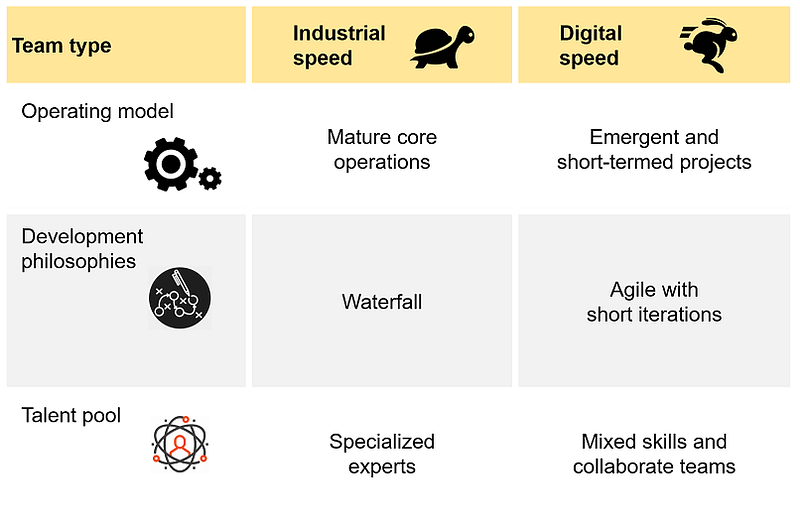
- The industrial speed team focuses on established and core business operations such as the ERP system that manages logistic operations or the core banking system for a financial institution. Industrial speed teams will require specialized experts who have narrow and clear tasks, such as business analysts who define the requirements, or developers for the technical implementation. Within the organization, industrial speed-type work is generally siloed.
- The digital speed team deals with emerging short-lifetime projects that build on fast-changing technologies, enabling and driving a company’s digital agenda, such as building customer-facing apps or experimenting with less mature technologies such as artificial intelligence or blockchain. The digital speed teams work in an agile manner, through short interactions, and require a mixed variety of talent profiles, not only from a technical background but also from business, customer research, and design backgrounds. This cross-collaboration enables a quick response to change, fast integration of customer feedback, and response to competitor’s move, or an evolving regularity system.
The dual team structure helps established incumbents with core legacy operations to gradually adapt to the new working mindset and culture required for tech and digital environments. However, the problem with this structure is that talented individuals are attracted to speed, making it difficult for the industrial team to attract and retain needed talent which further widens the gap between the speeds, slowing the overall organization as the slower team tends to become the common denominator.
— In short…
A digitally ready technology team is required to keep up with new customer expectations and the fast production cycles of digital innovators or disruptors. As incumbents need to manage their legacy operations, a second gear might be required to drive a separate digital speed execution in parallel, but at slower speeds. The ultimate goal is to converge execution speeds in the technology function together with the business side into a single, unified operating model, aiming for agility at scale in the mid to longer time frames.
iv — The ecosystem: leveraging coopetition
While BlackBerry still had a 20% market share until 2010, it eventually failed against iPhone due to several reasons. For example, technologically, BlackBerry didn’t shift fast enough to a touchscreen, and commercially, BlackBerry was too complacent at the start, when Apple was not interested in the professional market and was targeting tech-savvy users. But the main reason was the iPhone’s ecosystem — in 2010, RIM, the manufacturer behind BlackBerry, was manufactured as a single company, while Apple was not coming to battle alone, it had an ecosystem in place to crack the market:
- Telecom operators provided the connectivity and probably subsidized iPhone more than Blackberry due to the large size of the target market
- The device itself was designed by Apple, Gorilla Glass, and Corning, and the assembly was done by different Asian manufacturers
- The apps were built by a variety of developers, ranging from the passionate teenager in his garage to full-fledged companies to the artists on iTunes, banks on Apple Pay, reseller stores, etc.
This was also the same strategy Amazon Kindle used to outperform Sony’s eReader, whereby it leveraged its partners to launch 88,000 e-books ready for download from day one.
Additionally, in today’s digital platform-based businesses, customers are part of the ecosystem as well, building the marketplace for content, products, or services. With Social Network Services such as Instagram, Facebook, or Twitter, billions of users around the world are willing to produce daily content and put it online for free. Uber’s value comes from the ecosystem of users, drivers, and cars. And part of eBay or Alibaba’s value comes from the ecosystem of sellers and buyers willing to trust the service.
— What exactly is a business ecosystem?
An ecosystem is a network of organizations and individuals exchanging information and goods to create joint value. For example, Walmart, and its supplier, Proctor, and Gamble, exchange merchandise, but they also share information about customer demand, to optimize inventory levels. In its simplest form, an ecosystem can be composed of a supplier, manufacturer, and customer just like a value chain.
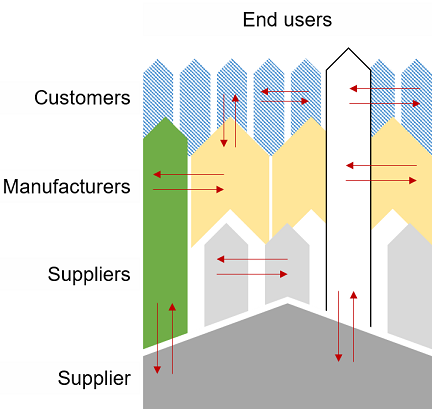
However, in practice, an ecosystem is more complex than a simple linear value chain. Manufacturers could have multiple suppliers who have their suppliers and customers who interface with other retailers before reaching different communities of end-users. Furthermore, digital disruption and the drop in transaction costs have loosened value chain links and the topology of ecosystems has become more complex as players interact more fluidly, leading to the unbundled, layered, or stacked value chain architecture.
— Leveraging the ecosystem to create value
There are two main steps to building a business ecosystem:
- Change in mindset — while traditionally, we would have thought of the players outside the company as forces against the creation of value such as the competitors, substitution agents, or strong suppliers that could take over our business, today, we see more fluid forms of relationships emerging. This form is often referred to as co-opetition or a mix of cooperation and competition, requiring a higher level of openness compared to traditional organizations. Businesses and even cities are opening up their databases and preparing standard development kits for entrepreneurs to create new services.
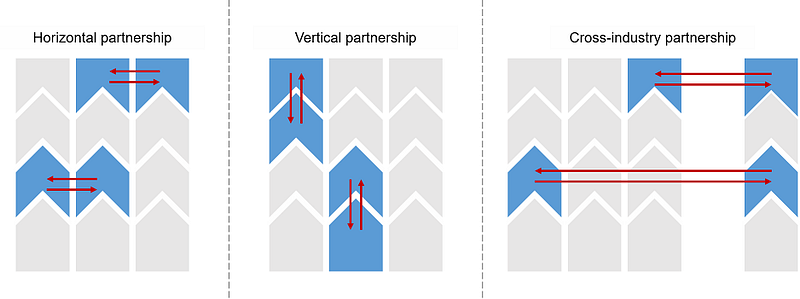
- Finding the right partner — in a stack-based industry, there are three main ways of partnering: 1) horizontally, for example with competitors. Horizontal partnerships are usually used to solve capacity constraints, and scale or neutralize risks. For example, the goal of the joint venture by BMW, Daimler, Ford, and Volkswagen is to build a high-powered charging network for electric vehicles across Europe. These companies are joining forces to create a new enabling layer in their industry stack, but at a scale that none of the individual players would have reached 2) Vertically, it can be up or down the value chain with suppliers and/or customers. Additionally, digital technology has accelerated crowdsourcing efforts, and opened innovation partnerships with the end-users 3) cross-industry, with a company outside of their industry stack. Generally, cross-industry partnerships are less common, but fascinating when they work. For example, recent partnerships between banks and telecoms can unlock a great deal of value with the combination of their capabilities bringing financial inclusions to under-served populations, especially in emerging markets.
In short…
A business ecosystem is an integrated network of organizations and individuals exchanging goods and information to create value and ensure mutual survival. To set up an ecosystem, first, there needs to be a shift in the mindset from an exclusive focus on competition to more cooperation and co-opetition. Then, firms need to connect with the right ecosystem partners, either horizontally, vertically, or with other complementary players from other industries.

Digital disruption has been enabled by three fundamental laws and there are great economic reasons behind its adoption. This disruption has led to a variety of current, mid-term, and futuristic technological trends. Because of these drivers, established firms and incumbents will have to undergo digital transformation one way or the other. There is no one-size-fits-all approach to a digital transformation. However, there are four key ingredients to succeed in a digital transformation:
- In a world of fast technological evolution and unpredictability, the 3–5 years planning cycles approach to strategy is dead and needs to be replaced by a much more adaptive and fluid approach tailored to the changing business environments.
- Companies need to digitize their core operating models. The key is to start from the customer’s point of view, not from the process, providing more enhanced customer experiences and increasing the efficiency of the operations simultaneously.
- Companies need to explore new growth options. The challenge is to find the balance between running the core business and innovating, getting the right level of strategic ambidexterity.
- Organizations need to align four key enablers of digital transformation: agile at scale, data and analytics capabilities, two-speed IT, and the business ecosystem.
Hope you enjoyed reading this article! :)
If so, then:
- Follow me on Medium
- Become a Medium Member
- Subscribe to hear more
- Let’s connect on LinkedIn