
BEYOND THE BUILD
The Complete Growth Marketing Playbook
An essential collection of mindsets, tools, and strategies in nine chapters
Table of Contents
IV. Implement the Marketing Foundations
V. Utilizing Growth Levers and Loops

Welcome!
If you found this article helpful, be sure to follow me on Medium to stay updated on and explore my publications.


I. Defining Growth Marketing
The key defining components of growth marketing or growth hacking are:
- Fast and consistent experimentation across the customer journey to find the best growth options
- Rigorous data analytics around user experiences to understand what’s working and what’s not
- A step-by-step process rather than a one-size-fits-all framework
Since the 2008 experimentation of Dropbox with growth marketing, other startups, and businesses have adopted and innovated similar methodologies to hone in on rapid growth.
Even recently, growth marketers have been coined as the new VPs of marketing, expanding their scope of responsibilities.
Today product marketers and growth managers have fewer resources — and with the proliferation of content development tools and mass digital media — they need to work faster, leaner, and smarter while delivering better results.
Success factors for growth marketing
There are four key success factors for growth marketing:
- “Marketing + Product” not “Marketing vs. Product:” Rather than have marketing and product teams working in silos, in growth marketing, they need to collaborate interdependently as cross-functional teams.
- Rapid testing: Growth Marketers follow a rigid testing process that assesses use behavior across all the touch-points of the customer journey.
- Analytics: Growth Marketers develop, measure, and adhere to metrics. Always aiming for a North Star.
- Grit: Growth Marketers accept that they will fail, but every failure will lead to an eventual success story if they keep pushing forward, as a team.
The Mindset
In essence, growth marketers must love to compete and fail big.
They need to possess the following characteristics, attributes, and approaches:
- Be bold, confident, passionate, and courageous
- Set big goals, be hungry
- Remove complexities and simplify ideas, objectives, and tasks
- Work in small teams
- Use little documentation or make collaboration mainstream and simple
- Hold short and small numbers of meetings
- Centralize communication and ease review processes
- Allow autonomous decision-making to individuals, or hand the final word to at most one person
- Move fast, iterate, and fix things on the go
- Aren’t perfectionists
- Always growing the team’s skills and competencies; they find knowledge gaps and cross-train members internally
- They forget growth myths and shortcuts (e.g. Dropbox, AirBnB, or HotMail). These stories are about the outliers of the world.
- They embrace failures, as they will lead to success
- They are always at the drawing board, sketching, ideating, testing, and contemplating
- They think quantitatively rather than qualitatively, data wins arguments — although qualitative metrics always supplement their quants for well-rounded decision-making
- They inspire team members
- They enjoy their journey, study it, learn from it, and grow with it

II. Elements of Growth
Stick to the iterative idea-testing process
As a team, growth marketers need to discover growth opportunities by:
- Building cross-functional growth teams with members from every domain of the business who can create ideas and execute them
- Identifying North Stars, developing OKRs, and building tracking tools
- Generating bold strategies that could potentially achieve ambitious goals
- Managing projects effectively with Project Management tools
- Acting quickly in testing ideas in action
- Collecting performance data, bench-marking against objectives, and adjusting accordingly
This is the growth marketing cycle that keeps repeating itself and tightening its grip on what is working and what is not.
Tip 1 — Network internally: Make sure to gain internal stakeholder buy-in since your decision could impact all other areas of the business as you experiment across the entire customer journey touchpoints.
Tip 2 — Manage change: Consider your organizational culture if you are building a growth marketing team inside a traditional or established company; not everyone is welcoming to change, especially rapid or major ones. Build rapport gradually and through success stories.
Growth marketing teams
In general, a growth team may include:
- Product managers to manage the roadmap of experiments
- Engineers to implement the idea to be tested
- Marketers who hold expertise in a particular channel or aspect of the marketing funnel
- Analysts to gather all the insights and report on experiment results, and
- Designers to generate any visual items necessary for the experiment
However, not all teams carry all these members; a growth team can be assembled based on the problem that it’s trying to solve.
A growth team can try to change or enhance user experience across the customer journey which might need a full team or only improve conversions of a specific channel such as SEO, requiring a small team of marketers and engineers.
Check this presentation by Andrew Chen on various structures that the growth marketing team could take.
Know and describe your customers
Don’t pursue the wrong audience.
Before starting a growth endeavor, outline the type of customers you’ll be targeting by creating descriptive personas. If you’ve got an existing customer base, conduct surveys and mine your data for patterns, and if you’re just starting as a startup, make educated assumptions.
Consider these steps:
- Picture at least three different types of customers for your product
- Describe each person at a broad level such as age, education, income level, and sex, and gradually become more specific by diving into their careers, professions, lifestyles, degree of tech-savviness, amount of time spent online, level of happiness in life, types of hobbies, etc.
- Build rough descriptive biographies for your personas, this will come in handy when you are pitching to investors. You can tell stories that resonate with them.
- Start imagining their day-to-day life, what motivates them, what would get them to use your offering, and how you’ll need to communicate with them to promote yourself.
As you collect data, fine-tune and align your personas with your findings.
Gradually, as the pieces to your puzzle increase, you can build a better product offering and position your service better in the customer’s mind.
Understand your customers’ needs and wants
Customer development is perhaps the most important and challenging part of growth. All growth efforts will be lost if customers do not want your offering, otherwise known as finding product-market fit.
If you are launching a new product you’ll have to trust your market research data but note that what you hear or see from samples, will not correlate to the market at large and you will need to fine-tune your offering after launching the service.
If you already have a product in the market and are expanding, survey your existing customers and keep track of your NPS across the customer development milestones to make sure you are delivering a desirable offering.

III. Forming a Strategy
Finding and honing in on the North Star metric
Growth is exciting and dynamic, but this excitement could also lead to distracted focus and diminished productivity. Maintain focus by using your North Star metric, a measurable and meaningful metric that all growth efforts revolve around.
The North Star is different for every business and can be hard to pick because it needs to correlate with an immediate and apparent set of actionable steps.
For example, “make more money” is too vague, you can make more money by reducing costs, increasing prices, growing new business lines, etc. If you want to “make more money,” identify your core strengths and guide your North Start towards those strengths. For example, increasing basket size would be the North Star for an e-commerce platform aiming to grow.
Your North Star metric does not have to be connected to revenue. It’s what the growth team needs to accomplish to get to the next step in growth and it can change over time as business dynamics shift or change.
So take time to develop and share your North Star metric. Collect ideas from other individuals at your company, compile ideas, brainstorm collaboratively, and pick the one that resonates with where your business needs.
Harness OKRs (Objectives & Key Results)
When you have your North Star in place, align teams and divisions by monitoring progress by implementing OKRs:
- Set qualitative and quarterly objectives (the Os)
- Develop quantitative key results (the KRs)
- Usually, limit key results to three (the KRs)
Remember to use SMART OKRs to stretch your team’s performance.
Commit to your goals, to your team, and to reviewing them weekly.
Aim to have short weekly meetings at the beginning of the week, review expectations as a team, and send weekly reports of performance and achievements of OKRs at the end of the week, indicating team achievements or shortcomings.
Then, every quarter, hold long team meetings to evaluate performance by using comprehensive business analytics and plan to solve major lags for the next quarter or move to new OKRs.
Developing OKRs
If you are part of a large organization, get stakeholder buy-in for your North Star and OKRs. Follow these steps and suggestions:
- Meet with people, elaborate on your position, and schedule a meeting with the key functional representatives. Include the CEO and members of the executive team.
- Run a company-wide survey with the following question and distill the results down to what you see as the best, most relevant, and most popular ideas: What would you like to see the company set as our objective for next quarter?
- Take these ideas to meetings for further discussion. Develop a strategy to run a successful meeting. Read this article on how to run your meetings by Christina Wodtke
- Assign metrics to objectives as a team, collectively and through voting
- For each objective, your goal is to find three Key Results: 1. an engagement metric, 2. a financial metric, and 3. a satisfaction metric.
- Assign numbers that are stretch goals, a good stretch goal is one that you feel 50% confident that you can achieve. Goals need to be challenging.
- Get everyone’s confirmation on the next quarter’s objectives, metrics, and goals, and then announce them across the organization. Use this worksheet as a guideline.
Take a lean approach toward marketing efforts
Organize all of your relevant marketing information using “The Lean Canvas.”
The Lean Canvas forces you to think about key questions and how to deploy solutions as a growth marketer.
Refresh your understanding of the business as it rapidly evolves on this canvas to stay on top of changes, align with team members, and formulate new ideas and strategies. The Lean Canvas is your up-to-date map of where the business is and where it’s aiming to go. Do not use complex business plans, keep it simple.
I’d love to hear your thoughts!
Share your insights and feedback in the comments below and let’s continue this discussion.

IV. Implement the Marketing Foundations
The digital marketing funnel and the customer journey
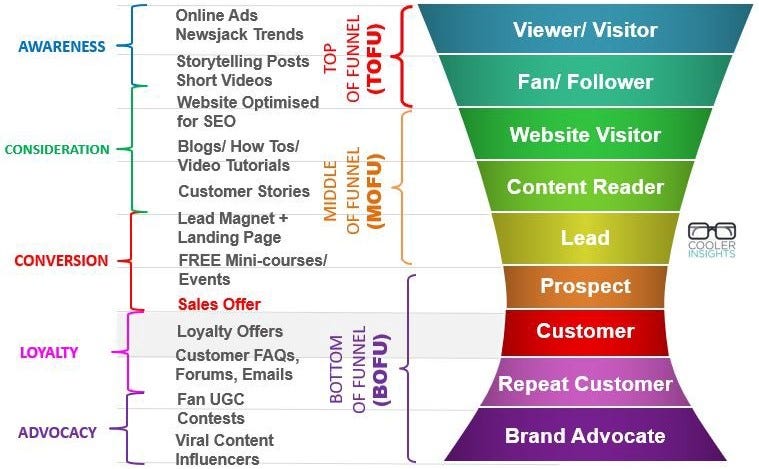
If you search for the “Digital Marketing Funnel” online, you can find that there are plenty of debates on the nomenclature of the stages in a funnel.
Still, below are generally its essential elements:
- Awareness: Of the problem and the solution
- Interest: Customers begin to explore the offerings available to them
- Consideration: The prospect wants to make a purchase but it may or may not be with your brand
- Action: To purchase (or not)
- Loyalty, or advocacy: After sales, repeated purchases, or usage
The marketing funnel represents a customer’s journey as they move towards the purchase of your product or service.
A growth marketer’s goal is to funnel prospects into buyers, moving them from the top to the bottom of the funnel [or vice versa depending on how you are looking at it].
But no customer journey is usually this linear.
Just imagine something you bought recently.
- Each interaction from identifying that you needed to buy something to completing that purchase at the local store had you move through each stage of the funnel, even backward, contemplating and interacting with touch-points on many instances.
Growth marketing aims to identify what touch-points are the most influential in converting customers closer to a purchase and creating loyalty and referrals, in turn pushing more people into the funnel.
The more marketers understand the customer journey and how it connects to pushing a consumer down the path to purchase, the more influence they will have on their decisions and overall product growth.
Mapping the customer decision journey
A successful growth plan needs to identify all opportunities by considering the customer journey inside and outside the product. The growth marketer needs to map the necessary touchpoints to convert a customer.
- Start with the relative path that outlines the most common paths a customer can take through your funnel
- From there, layer in more and more information as you optimize each journey. Develop this into a map as you move along
- The more detailed your map becomes, the easier it will be to pinpoint problems in conversions across your marketing funnel
In other words, this map can help you “hack” your customer growth by identifying bottlenecks and a wider exploration of potential solutions.

V. Utilizing Growth Levers and Loops
One of the biggest desires in growth marketing is to use the smallest resources to generate the biggest results.
That is why growth teams are kept small, filled with the best of talents, given a finite amount of resources, and fueled with the desire to achieve great results.
After the North Star, OKRs, and customer journey are mapped, that is when the team moves into experimenting with ideas, pulling onto a different set of levers that can influence customer decisions.
The Pirate Metrics growth levers
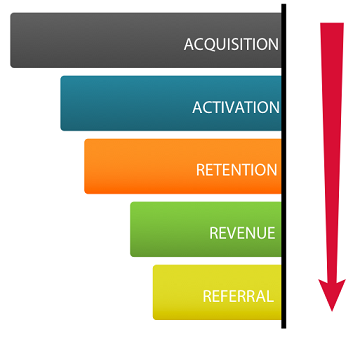
For an effective strategy, use the Pirate or ‘AAARRR’ metrics, breaking your business into individual building blocks, and making it easier to know where you can stimulate the biggest impact. These categories will serve almost any business. When you know what lever you need to use, you can sort out the ideas that will then trigger that growth lever.
Here is how you can think about the growth levers:
- Awareness: This is the first step in driving business growth. This involves making your product visible to your target market through various marketing efforts. Content marketing, paid advertising, partnerships, and events are all effective ways to increase awareness and reach new customers.
- Acquisition: This is where you focus on converting aware customers into paying customers. This can be done through exclusivity, meeting customers at their exact time of need, promotional time boxes, discounts, and free trials. For example, offering limited-time discounts for new customers or providing free trials or demos can help drive acquisition.
- Activation: This involves increasing customer support, improving the user interface, and sending targeted email campaigns. Onboarding emails or tutorials, personalized product recommendations, and regular updates and feature announcements are all effective ways to activate customers.
- Retention: This involves sending alerts as reminders, introducing new features, and implementing loyalty programs. Regular newsletters or updates, loyalty programs with rewards or discounts, and personalized offers and recommendations can help retain customers.
- Revenue: Revenue growth can be driven by adding related products at the checkout page, introducing new product tiers, and reducing overheads and expenses. Upselling or cross-selling related products, offering premium or enterprise versions of your product, and optimizing pricing and packaging can all drive revenue growth.
- Referral: This can help drive growth through word-of-mouth marketing. Offering monetary incentives for referring friends, generating social media buzz or mentions, and showcasing user-generated content and testimonials can all help drive referrals.
Identifying which levers you should pull comes through a deep analysis of your data while considering the lens of that objective that you’re after, developing insights about the growing pains, forming hypotheses about solutions, and experimenting with rigor until the problem is cracked.
Viral Growth Loops
Growth marketers dream of processes that fuel growth through viral loops, self-growing repeatable engines that need little marketing investments.
A loop is the steps a user goes through before inviting new users into the process.
Let’s consider YouTube as an example:
- You watch a piece of content and in the end, you’ll find a prominent button to share it or more content that you can engage with. You may continue down the process of clicking into those recommended videos, consuming more and more content until eventually, you resonate with a piece of content and click share. At that moment, you’ve invited someone else to join this loop. This is called the on-ramp, the opportunity for more people to join this loop creating a viral effect. As more come down the on-ramp, they participate in the loop, continuing to further fuel growth.
To be effective, a growth loop must contain an explicit incentive for a user to pass it on.
- For YouTube, the incentive is likely to evoke entertainment or joy in others.
- Dropbox starts you out with a limited amount of free space, but your storage will increase for each user that you invite.
As you invite more users, they too get on-boarded on the ramp and receive exposure to this growth loop.
Loops can be direct with an immediate effect such as an invite to join or they can be indirect such as when you incentivize users to leave reviews, create content for SEO purposes, or pay them for a referral.

VI. The Product Life Cycle
Always account for your product life cycle
All successful products go through the product life cycle: development, introduction, growth, maturity, and decline.
It’s important to know this life cycle because your role and your goals in growth marketing change depending on which phase your product is in.
Understanding the life cycle you’re in and what’s ahead is important.Having short-term or tunnel vision on a particular phase may lead you to marketing decisions that hurt the next stage of your life cycle.
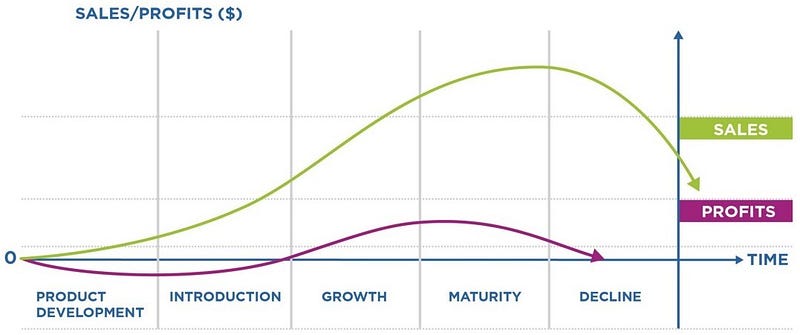
- Development: create the product and prepare to release it into the market
- Introduction: launch, increase awareness, build a brand identity, and penetrate the market
- Growth: if the product receives favorable consumer reactions then it will grow. This is the stage where growth marketing is utilized to the fullest. Here, marketers need to increase consumer adoption and build brand preference and market share.
- Maturity: aggressive growth is no longer possible and marketing is now focused on maintaining market share, creating defensive competitive strategies, building reputation, and finding opportunities to maintain or increase revenue.
- Decline: inevitably, a product loses desirability, and companies make decisions to improve its features, discontinue it, or pivot. A successful move could move the product back to an earlier stage.
Target users with the technology adoption curve
Just as your product goes through a life cycle, so do your customers. The technology adoption life cycle describes the adoption or acceptance of a new product broken down by the demographics and psychological traits of user groups. Essentially, different profiles of people adopt and use your product at each of its various stages. This model shows the types of groups that will use your product over time, in line with that of the product life cycle.
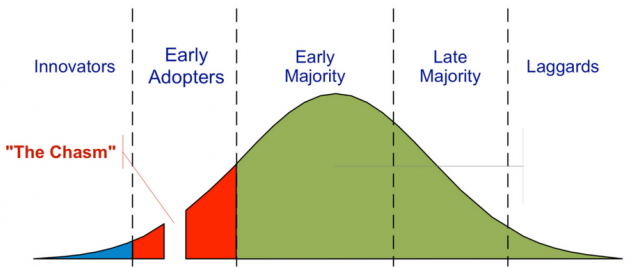
- Innovators: the very first customers to try a product; high willingness to take risks
- Early adopters: tend to be thought leaders who have financial liquidity and higher levels of education
- Early majority: is more risk averse, tends to be conservative with spending, usually follows the opinions of thought leaders or influencers, generally young, and this makes up the largest consumer that can make or break a company and create lasting demand side networks effects
- Late majority: the second largest consumer group, are skeptics and very risk averse. They’ll have limited financial liquidity and be less educated.
- Laggards: the last to adopt an innovation. Laggards don’t like to stray from tradition and are among the older generation
Using the product life cycle
At the core of growth marketing, is maintaining the culture of constant and creative experimentation while accounting for the changes in the business environment.
Let’s look at our motivations for growth in each stage of the product life cycle:
- During the development phase, the focus is to figure out what the market wants. Here, you’re researching the competition, understanding the users, and determining what your product must have to be successful at launch. You want to do everything you can to get the product right. You must have sufficient features to satisfy your innovators and your early adopters. You won’t be able to satisfy the entire, so narrow your focus to resonate with these consumer groups.
- In the introduction phase, demand is not yet proven. You’re working to validate that what you built, resonates with the early adopters in your target market. At this stage, you want to focus on testing around retention and consumer satisfaction. Once you’ve determined that customers are responding favorably, and you’ve deployed growth techniques that keep them engaged, you push forward with your marketing to generate awareness and a foothold in the market.
- When your product has generated awareness and you have an increase in consumer demand, you move into your growth phase. Throughout this phase, you’ll be deploying various marketing strategies to significantly increase your growth curve. And this is traditionally where growth marketing finds its stride.
- As you shift to maturity, your focus is to defend your turf, prolong your product life cycle, and maintain brand preference while at the same time trying to keep your price at a competitive point that maintains profitability. Here, you’ll spend a lot more time looking at new opportunities to revive your core consumer or how to grow or innovate your pricing models.
- Decline, you’re in the end stage and will witness a decline in sales and profits. Consumers get bored, technology evolves, companies make mistakes, and people’s preferences change.
So know where you are in the cycle and invest appropriately in growth.
Evaluating product market fit
Product market fit is when your product satisfies the market.
It’s probably not profitable, but the consumer wants it.
Product market fit is about finding those customers who are desperate for what you have.
If you don’t achieve this fit, you’ll never unlock growth.
It’s okay if you don’t quite have a product market fit yet.
Most products go through many iterations before finding the fit that just clicks. But you must constantly be seeking it.
Until you achieve product-market fit, you’ll remain in the introduction phase of the product life cycle until growth is unlocked.
You’ll see plenty of clues that product market fit isn’t happening:
- Customers won’t quite understand the product or see its full value
- Word of mouth just isn’t spreading
- Reviews might be sparse or mediocre
- You’ll experience a long sales cycle
- Customer acquisition costs that are very high
On the other side, you know when product market fit is happening:
- Your growth curve seems to be taking off
- Money is coming in
- Deals are a breeze to close
- Customers are coming in from outside the campaigns you’re running
- The press is looking to talk to you
Make sure you do not get confused that the problem with the market fit is due to the product offering.
Sometimes it’s your message market fit.
To achieve message market fit, you need to find a way to message your product so that it can punch through the market that strongly favors existing solutions.
Understand how your customers think and how to use words to tell stories that make them feel a need for your offering.
You’re selling a purpose, not a product therefore fully understand your customers’ pains, values, and perceptions.

VII. Initiating Growth
The iterative process in action
Growth is the process of arriving at testable ideas.
You can’t copy other companies’ approaches. Your customers, value offering, and market dynamics will be different and you need to adapt to these variations.
However, the growth process provides you with a scalable and repeatable formula to generate and test ideas that lead to sustainable increases in setting goals.
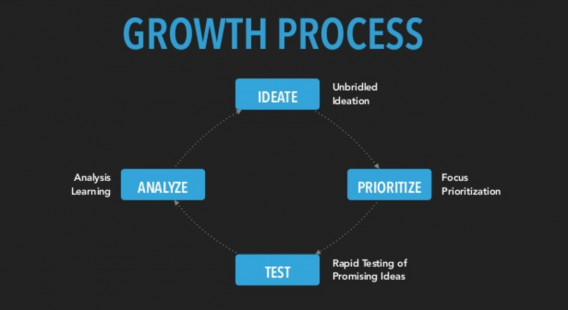
Before you begin your growth endeavors, consider these notes:
By being hyper-focused on one mission with team members all working towards that goal, you create tremendous momentum
Build your dashboards and analytics upfront before testing
Prioritize ideas using a scoring model such as ICE or BullsEye
Continue this process until you’ve met the goal. Then you zoom out, establish new goals, and repeat the process
The more tests you can run, the more you’ll learn, and the more opportunities you’ll discover for growth
You want to run this process as many times as you can in a given period.
Some teams operate on this approach daily and some every week.
This is called the sprint, used in agile processes, especially for a startup that needs speed.
Curve out the appropriate length of time for your endeavor accordingly.
However, every sprint must be time-blocked — you can’t have an open-ended process.
Ideation and communication
To have effective brainstorming sessions, lay down a set of ground rules and leverage methods that better tap into the team’s problem-solving abilities such as:
- Encourages people to break free from routine
- Try to disrupt pre-existing patterns of thoughts and assumptions
- Encourage ideas in a captured room and using a formal session
- Hold regular weekly ideation meetings
- Each person on the team is responsible for having access to the North Star Metric, OKRs, the Lean Canvas and the Growth Levers you’re focusing on
- Encourage self-management, it’s up to each team member to be autonomous and to familiarize themselves with the areas of improvement
- If you find that formal meetings are not bearing solutions, encourage capturing ideas in a shared spreadsheet and then use a formal session for the prioritization
- Respect all ideas equally even if you’re conducting a routine brainstorming session
- Focus on quantity, not quality, don’t withhold anything
- Don’t criticize ideas
- As an individual, don’t let negative self-talk diminish your ideation
- As a team, don’t let others shoot down ideas because it reduces the likelihood that everyone participates
- Keep a neutral tone during the ideation phase, praise can make it seem like other ideas might not be good enough
- Welcome far-fetched ideas, allow “out-of-the-box” thinking
- Build and expand upon ideas that have already been generated
Manage priorities effectively
When deciding on the best ideas from a collection, growth marketers will need to figure out priorities.
- One approach is the ICE (Impact, Confidence, and Ease) scoring system where one estimates the impact, confidence, and ease on a scale of one to ten.
- Alternatively, growth marketers can also use the BullsEye framework and accompany it with the Traction book that allows a deep dive approach towards the traction channel analysis that could help work through the analysis.
Be positive in the face of failures
Let’s be frank, a good number of growth activities will fail and the way failures are dealt with is important, and learning from the failure is a top priority.
The more growth teams assess mistakes, they’ll get better at recognizing warning signs before failure happens.
Some common reasons why growth endeavors fail include:
- Data misinterpretation, causality and correlation errors, and human bias
- Misunderstanding the customer or errors in customer validation
- Execution will always be full of errors in the beginning, but document mistakes and fix them for the future and build upon previous learning
- Patience and contemplation, do not rush into things, contemplate, plan, and strategize before taking action
- The wrong attitude, have positive skepticism rather than pessimism
- Marketing channel fatigue, customers are resilient in paying attention but teams keep insisting on using them, e.g. digital ad displays
Finding this article useful?
For more insights like this, be sure to follow me on Medium and subscribe to get my updates in your email.

VIII. Easier Growth Options
Focus on your current user base
If you already have a customer base or are expanding offers to your current customer bases, leverage them as sample studies for growth by:
- Gather insights via readily available data or run focus groups and surveys
- Convert current customers into your new offering believers, remove their doubt, improve their experience, listen to their needs, and engage with them proactively
- Upgrade your users into advocates by consistently delivering on your promises. Your current base of users will be the most profitable as you expand your services
Lower retention rates
Generating new users is hard, and it’s even more critical that you retain them. Retention is to keep your current customers loyal.
A study conducted by Bain & Company revealed that a 5% increase in customer retention can mean a 95% increase in company profitability and it’s not just about the bottom line, it’s also about “reach”. A loyal customer becomes an inexpensive marketing channel by advocating for your offering to their network.
Do not place too much emphasis on rampant growth while failing to control retention rates.
Although, if you are in the early stages of your product life cycle, retention may take a back seat.
But as you begin to see growth and find product market fit, retention will be key. You need to stop user drainage before investing into growth
If your churn rates are high, dig into why your users are not returning and run tests to determine what improves engagement and stickiness.
Test exclusivity as a sales strategy
Exclusive membership, which signals scarcity, has long been a marketing strategy. Everything from guest lists at a lounge to VIP sections at the airport is exclusivity and people want to be part of something special.
Exclusivity increases the value of your offering and its adoption rates.
In today’s digital marketplace, many online brands artificially create this exclusive perception. For example, Gmail’s launch strategy.
There’s value in artificially building some scarcity, and you can leverage it in many unique ways.
You can also consider incentivizing early adoption by providing a rare, one-time-only discount.
Partnerships through API integrations
An application programming interface, or API, lets others access the information that your platform provides allowing others to leverage your offering.
This will allow you to recruit partners to invest in supporting your product.
If you have a platform that has a unique value, then you can generate awareness through API integration. If you are not a technology company, come up with rare offerings that might add value to your target market and partners.

IX. Utilizing Data
Have a rigorous data-driven backbone
A high-level overview of your data isn’t enough and you need to study the data at each point in the customer’s journey.
It’s a quest to understand why customers are doing what they’re doing.
It’s more than the monthly average users (MAUs) or the time spent on your platform.
A startup needs to monitor several data points to observe and understand its user behaviors.
Each growth team member needs to start their day by:
- Looking over metrics
- Familiarizing themselves with the information
- Exploring ideas that are new and foreign, and
- Trying to correlate things that may be seemingly unrelated
Look at everything from your social media metrics to your customer service emails.
Your data is going to dictate the experiments you try and whether those experiments succeed in growth.
Use third-party tools to help you hone in on insights from your massive data loads.

Read this comprehensive guide to see what you potentially need to monitor at each step of your product’s lifecycle.
Key metrics to track and report
Data is core to growth marketing. We live in a data-driven world and have the tools and resources to measure anything we want. The metrics you measure will depend on your life cycle stage and your goals.
Look at your metrics daily, to monitor the health of your business and growth marketing outputs.
- With a brand new product just entering the market, validate your business via surveys and track NPS
- When you start to gather customers, ask qualitative questions across the six areas of growth including awareness, acquisition, activation, retention, revenue, and referral
- At the end of the introduction life cycle, start quantifying the primary areas of your business with a variety of meaningful KPIs
For example:
- Awareness: impressions, reach, traffic, average session time, bounce rate, social media engagement, paid advertising engagement, brand mentions, sentiments
- Acquisition: number of conversions, conversion rates, CPA, CAC
- Activation: time in product, customer support ticket volume, CLTV, activation rates, feature adoption rates
- Retention: churn rate, recapture rate, recapture rate, ARPU
- Revenue: Monthly recurring revenue or Monthly Revenue, average deal size, sales cycle length, revenue growth rate
- Referral: program growth rates, referral conversion rate, referral revenues, referral rates
Monthly recurring revenue (MRR)
MRR is the measurement of your predictable revenue stream. There are two basic ways to calculate it:
- Add up the value of all of your paid subscriptions
- A better approach is to calculate AMRPU per user. Take the number of customers and multiply that by the average fees
Note that the MRR metric is limited:
- If you have annual plans, divide the annual revenue monthly between each month of the subscription
- It will be challenging to track upgrades and downgrades if customers change plans
- It doesn’t account for churn or lifetime value, therefore, readjust as customers cancel
MRR is limited but provides a great high-level insight into the health and performance of your business.
Churn rates
The churn rate is the percentage of customers who cancel their subscriptions relative to the number of paying or active customers for a selected period.
Churn is a hot topic and an area of argument within the growth marketing community.
On a simpler note:
- Take the number of customers you had at the start of the month
- Subtract the customers that you had at the end of the month, and then
- Divide that by the customers that you had at the beginning of the month
That will give you a good enough churn rate to start with.
By looking at the churn and MRR together, you’ll see the health of your business.
Also note that if you have 100 customers, a 10% churn rate is no big deal. But if you have 10,000 customers, well, that’s a huge problem.
Keep your churn under control. Set a goal to keep it below 2% and experiment until you achieve that goal.
Customer acquisition costs (CAC)
CAC is the total cost to acquire a customer.
It’s all the marketing expenses that you spend to bring a unique customer in.
It’s a key metric that you’ll need to measure and leverage to track your growth progress. You’ll use this metric to understand where you have the most profitable channels, and you’ll generate ideas to work to lower that cost.
A lower CAC leaves more money to allocate toward acquiring more customers. Additionally, when your CAC is low, you’ll spend less time recouping those costs.
We usually evaluate the health of CAC against our CLTV.
A good rule of thumb is to get your CAC to 1/3 of CLTV.
Also, do not mistake CAC for CPA; cost per acquisition (CPA) measures the cost of acquiring something. That could be a registration, an email subscriber, a lead, etc.
As always, there’s debate about the most appropriate ways to calculate CAC.
This is because there are time delays; returning customers that reactivate and if you have free trials, there may be costs associated with servicing that customer.
Over the last decade, marketing has been disrupted and improved by new, lean, super-fast, and agile growth marketing mindsets and methodologies.
All startups and established businesses that desire to keep up with the changing landscape are embracing growth tactics.
Growth marketing goes beyond the traditional marketing team and encapsulates a cross-functional collaboration between business leaders, engineers, designers, product managers, and analysts.
Thanks for reading!
To stay connected and get more insights like this, be sure to follow me on Medium.
As a fellow product enthusiast, be sure to connect with me on LinkedIn to continue this discussion, network, and access my professional network.