
NEW PRODUCT AND STARTUP STRATEGY
Planning for product-market fit before launch
A five-step framework for planning for product-market fit
Product leaders — commonly referred to as Product Managers — have great amounts of responsibilities, and one of the more challenging tasks that they are responsible for is, ‘finding or achieving product-market fit’.
The framework for achieving product-market fit has five steps:
- Identifying the innovators and early adopters
- Uncovering the target customers’ underserved needs
- Building the value proposition strategy
- Building the Minimum Viable Product (MVP)
- Testing, gathering, and incorporating customer feedback
While finding product-market fit is a challenging task that will make or break a product’s success in the market, it isn’t everything to a startup or product’s success or failure. The ability to build a world-class team, find a sustainable monetizable business model, and scale operations for growth will come into play if a startup is to succeed. However, finding product-market fit is the initial, most challenging, and time-consuming hurdle any new offering will experience in the marketplace. This is why it is important to have a framework in place to aim for and test product-market fit.

Unfortunately, product leaders have great amounts of responsibilities, but little power — and one of the more challenging tasks that they are responsible for is ‘finding or achieving product-market fit’. Since 2007 when ‘product-market fit’ was promoted as a term by Marc Andreesen within the venture capital community, people have tended to talk simplistically about product-market fit — such as ‘Facebook succeeded because they had product-market fit and startup-X failed because it did not have product-market fit’ — it is much more complicated than this in reality. The good news is that there are recurring conditions and patterns to product-market fit from which we can extract frameworks and processes to build products or feature subsets.
“The only thing that matters is getting to product-market fit…meaning being in a good market with a product that can satisfy that market.” — MARC ANDREESSEN
The framework
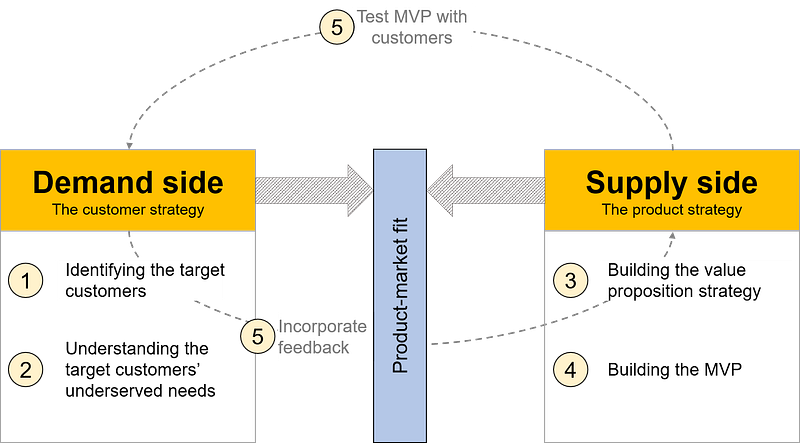
The framework for achieving product-market fit has five steps:
- Identifying the target customers (i.e. innovators and early adopters)
- Uncovering the target customers’ underserved needs
- Building the value proposition strategy
- Building the MVP
- Testing, gathering, and incorporating customer feedback
When and where can it be used?
This framework can be applied to:
- A completely new product
- New features or subsets of an existing product that a team wishes to launch
- Existing products where the intention is to assess current value offerings and improve product-market fit levels
What is ‘product-market fit’ about?
Finding product-market fit has to do with the product leaders’ mindset. It is about solving customer problems and getting hired by customers to perform a task — effectively and economically — on their behalf. Product-market fit is no way or form of building a massive company, with a great culture and making billions in revenue. The latter mindset will almost always end in failure.
Step 1: Identifying the target customers
It needs to be noted that when building a new product (i.e. version 1.0), the product team or startup founders are faced with a blank piece of paper that can carry a great deal of anxiety and uncertainty. In such a situation it is fine to start with some rough tentative hypotheses (i.e. building personas) about who the target customer is and iterate as market research and user interviews progress because as the teams talk to customers they can readily and quickly revise their assumptions.
Additionally, startups need to be looking for hidden or previously overlooked needs— which can be a challenging task. If the need and its solution were obvious, then everyone would have been doing it already. To overcome this challenge it can be helpful to think of a startup as a substitute for a current product or service and as a job-to-be-done effort that people would be hiring for, rather than a company that intends to scale, grow to millions of customers, and make billions in annual revenues.
Segmentation will be a key
When defining target customers, we need to become as specific as possible in defining the various segments in the market as this will guide us in better defining the underserved needs or pains that we will be aiming to solve with the appropriate features and user experience in our product.
Moreover, just as there isn’t a ‘1-size-fits-all’ car out there in the market — a soccer mom’s needs are greatly different from a 25-year-old millionaire’s — we will not be producing a ‘1-size-fits-all’ product either.
Step 2: Uncovering customers’ underserved needs
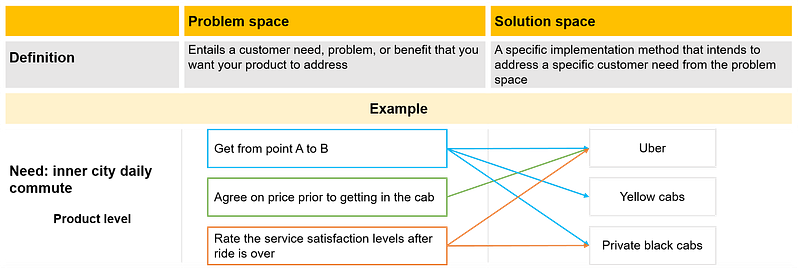
After becoming clear on the target customers, we need to identify their underserved needs. A key concept to help us dig deep into this aspect of the market demand is to understand the ‘problem space’ vs. ‘solution space’.
The problem space entails a customer need, problem, or benefit that you want your product to address. For example, creating a tool whereby people can easily share their CVs with recruiters fits into the problem space. Therefore a well-written product requirement or agile user story would be in the problem space.
The solution space is a specific implementation method, such as a product or a design concept, that intends to address a specific customer need or requirement. For example, LinkedIn, Indeed.com, or Jobseek would fall into the solutions space for the CV problem mentioned earlier.
The major problem with initial product development efforts is that product leaders or teams tend to live and work in the solution space.
This bias tends to push product development into the solution space by sketching solutions and coding products without getting clear on the problems we are trying to solve. Product teams need to make sure they spend enough time in the problem space before proceeding to the solution.
An example here is the wildly used case of the NASA ballpoint pen versus the Russian pencils. This case tries to argue we tend to pollute our focus on the problem with quick and biased ideations from the solution space. One exercise that can help us overcome this bias is the five whys technique. In general, product teams should be able to map the smallest of feature development efforts — from the solution space — to a specific need — in the problem space.
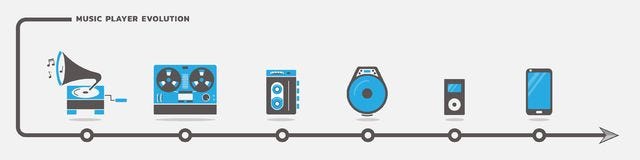
One other reason that we need to focus on the problem space is that customer needs do not change anywhere as near as the speed with which solutions do. For example, people’s fundamental need to listen to music on the go has not changed over the last century, however, solutions have changed from the FM transmitter to the Walkman, to mp3 players, and, currently, to our smartphones.
Product teams should spend a sizable amount of their time brainstorming on the possible pains they are aiming to solve cluster them into major categories and build customer stories and narratives. Teams should come up with as many possible ideas as they can, peeling away into the different layers and aspects of the targeted customer pains.
Prioritizing problems to tackle
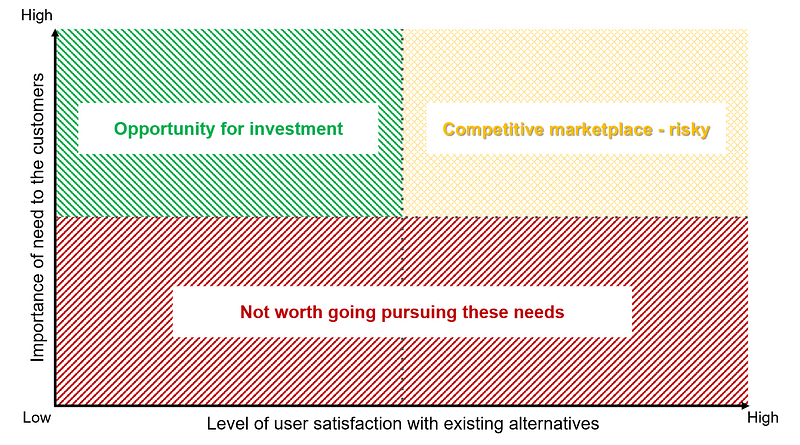
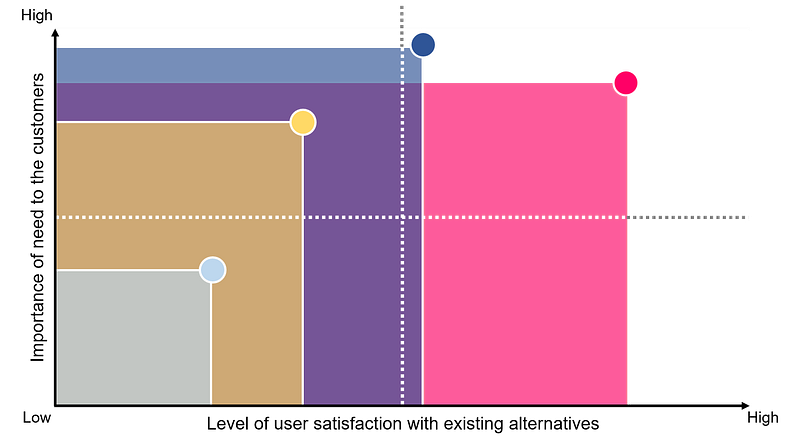
After coming up with the fully expanded problem space, we will need to prioritize and converge on what problems to focus on. To succeed, we need to invest resources into tackling problems of high importance to our target customers and a lack of availability of satisfactory solutions.
The problem with the competitive space is that your solution will need to be 10X better than what is currently offered, which is quite a difficult task to achieve. For example, with the current technological feasibility, it will be difficult to unbundle Facebook’s various features such as building specialized groups (e.g. for families or neighborhoods). A case example of such failure was Google+, which entered a competitive market and did not create enough value to scale.
Uber is an example for the upper left quadrant in the matrix above, where it managed to address an important pain — the frequent need for the inner-city commute — that had no satisfactory solution back in 2009. Uber launched its services at a time when it was difficult to find taxis in San Francisco, they wouldn’t show up on time, there was little pricing transparency, and with no chance to rate the experience to improve the overall ridership journey.
Step 3: Building the value proposition strategy
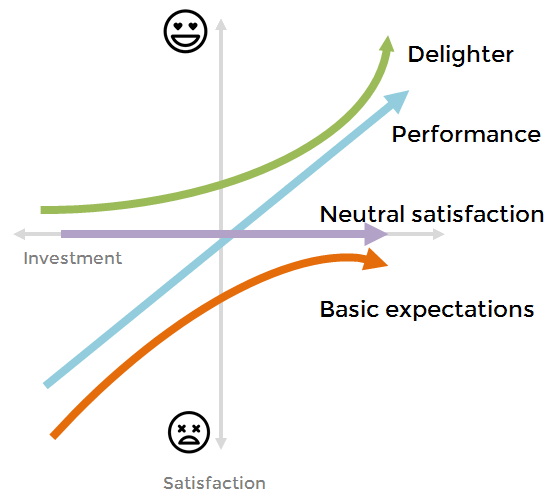
Once we are clear on the prioritized underserved customer needs, we will need to define our value proposition strategy which will focus on what needs our product is going to deliver and how we’re going to be better than and/or different from the competition. To build our value proposition, we need to divide our value offerings or features into the following three categories based on the Kano model to prioritize customer satisfaction and delight:
- Delighter features— or the wow factors. For example, in cars, having autonomous driving features, today, is a delighter. Delighter features will be differentiative in the competitive market as Unique Selling Points.
- Performance features — for example, when comparing two similar cars, the one with the better fuel economies would be a better purchase. The more performance enhancement features that we provide, the more satisfied customers will be, and the better it will be for our product’s positioning in the market.
- Must-have or basic features — for example, in cars, today, seat belts or an electronic entertainment system is a must-have. No manufacturer will provide a car without these features. Basic features are generally non-differentiative — for example, having 100 additional seatbelts won’t make a difference to a car’s value proposition, but not having them will result in no sales.
There is also a fourth category, ‘neutral satisfaction features’ — these are features that don´t add value and may not be worth developing, therefore we will not focus on them.
The overall time trend of the Kano model is that we tend to deliver delighters into the market and as time passes by, those features gradually become performance features, and eventually must-haves. So for example, in the car industry, especially in the developed markets, GPS navigation systems have had such a trajectory over the last 10–15 years. The speed with which this trend happens depends on the profitability levels and competitive dynamics of the target industry.
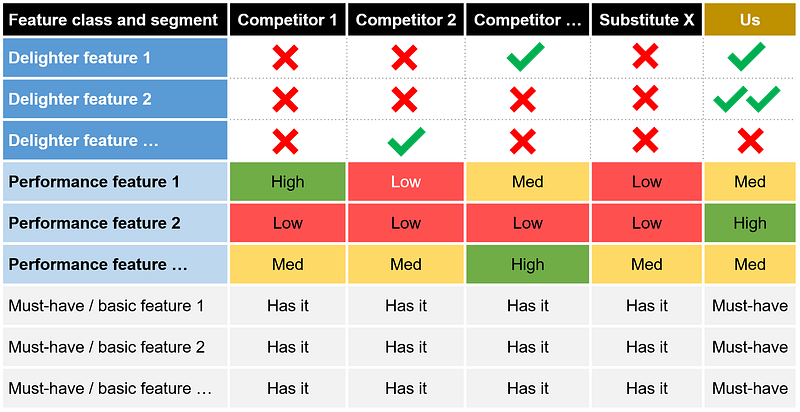
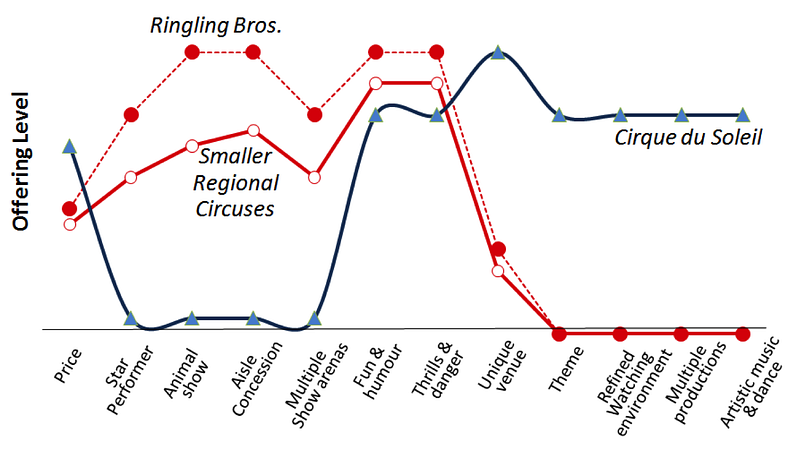
Once we have our value offerings segmented, we need to benchmark them against the competition and find our own positioning. This can be done via table comparisons or value curves. This exercise is a must as we do not have the resources to be a product for everyone and need to deliver a concise and targeted message to the market demand. The important thing here is to find our differentiating features.
Step 4: Building the MVP
With the MVP we will be testing our product packages differentiating features in the marketplace. We will be placing our performance and delighter sets of offerings into tests with users, gathering feedback and analytics on how customers perceive our product. Note that with the MVP we will not be testing the customer pains and problems — these should already have been validated. Rather the MVP will be testing the design, UX, and feature packaging, estimating how the product meets customers’ acceptance.
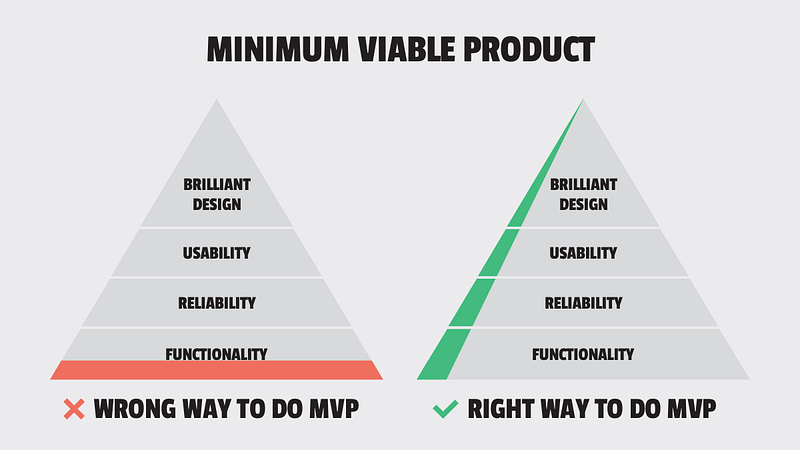
When building an MVP, we need to take care to build a prototype that is just functional, reliable, usable, and delightful enough to the core of the initial target customers we will be pitching it to. An initial prototype that is too focused on functionality is not an MVP that is focused on the early adopters and their pains. For the MVP prototype, a clickable and tappable prototype should be enough — use rapid prototyping methods and expect many iterations on your MVP along the way before seeing stickiness with the users.
In essence, an MVP is about building the most critical value proposition to further prove your product idea's potential and product-market fit, shipping in the best possible quality that will work in the market. An MVP is not about building slimmed-down or extremely compromised versions of all of a final product’s features.
Step 5: Test the MVP and incorporate feedback
With the prototypes or MVP built, it becomes time for us to test the manifestation of all our assumptions and decisions related to the customer needs and priorities. With every user test, we gather feedback, make adjustments, or pivot to the offering design, improving on our ‘product-market fit’.
This iterative process of testing MVPs and gathering market feedback can take quite a large amount of time, especially for a startup company. Startups could perform +20 iterations to their initial MVPs before witnessing sustained customer growth rates and engagement levels — so be patient.
Unbiased customer interviews and UX testing will be major tools during this phase. For every testing phase, you will need 5–10 customers, before incorporating changes and testing with a new batch or sample. Make sure that you have metrics in place to track performance improvement upon the incorporation of customer feedback.
Signs of product-market fit
Product teams should be tracking three key metrics to monitor product-market fit progress:
- Returning usage rate — monitor cohorts in 1, 3, 7, and 30-day return rates. In essence, you should be witnessing growth or at least stability in user return rates
- Net promoter score (NPS) — ideally for product-market fit to be seen, you would expect to see scores above 50%
- Paying customer renewal rates — this is a cohort-based view of paying customers that renew their subscription; if you do not have a freemium business model that needs to scale before monetization.
In action, you’ll see plenty of clues that product-market fit IS NOT happening:
- Customers aren’t quite understanding the product or seeing its full value
- Word of mouth isn’t spreading
- Reviews are sparse or mediocre
- Sales cycles are long, and customer acquisition costs, CACs, are very high
On the other hand, if the product-market fit IS happening:
- The growth curve is impressive
- Money is coming in faster than it is spent
- Deals are easy to close
- Customers are coming in outside of the marketing campaigns
- The press is constantly looking for information
Additionally, do not think that if a product is not growing, it’s because of the product-market fit. Product leaders need to find an effective approach to communicate the product’s value. Product-market fit does not exist without a message-customer fit. To achieve message-customer fit, you need to:
- Find a way to message your product so that it can punch through a market that strongly favors existing solutions
- Master the art of understanding how customers think, and perceive the pain you are trying to solve
- Tell stories that make customers feel positive about your offering
The most critical hurdle to product success
While finding product-market fit is a challenging task that will make or break a product’s success in the market, it isn’t everything to a startup or product’s success or failure. The ability to build a world-class team, find a sustainable monetizable business model, and scale operations for growth will come into play if a startup is to succeed. However, finding product-market fit is the initial, most challenging, and time-consuming hurdle any new offering will experience in the marketplace. This is why it is important to have a framework in place to aim for and test product-market fit.
Hope you enjoyed reading this article! :)
If so, then:
- Follow me on Medium
- Become a Medium Member
- Subscribe to hear more
- Let’s connect on LinkedIn


