
Strategic Communication: How to Develop Strategic Messaging and Positioning
Latest Article:
This article covers the essentials of strategic communication. The goal is to explain why it is critical that companies understand strategic messaging and positioning. In addition, we will discuss some practical and actionable approaches to help you design strategic messaging and product positioning.
Classic marketing concepts and strategies that often get forgotten and seem impractical today are very relevant when it comes to tech companies and software products. It’s a totally different world now, but the basic principles of positioning and marketing apply to software companies today just as much as they did 50 years ago to companies selling things such as bars of soap. As the number of products in every SaaS category continues to grow ever more rapidly, positioning and strategic messaging are becoming more important than ever before.
What exactly are strategic communication, strategic messaging, and positioning? With so many related buzzwords, it’s often not clear how each specific term is used, how it is defined, and what it stands for. The terms “strategic communication” and “strategic messaging” are used interchangeably throughout this article. Feel free to use the term you identify with most.
A few years ago when I started looking into the world of messaging, I was desperate to find a place to start my research journey on this topic. I hope this article acts as a starting point for anyone wanting to learn about strategic communication and positioning.
While my previous two articles on lead scoring and on tracking customer acquisition will probably be outdated in a couple of years, if not as early as next year, I strongly believe that the processes and strategy for messaging and communication will be resistant to the ever-changing landscape.
Please feel free to share your experiences and any helpful resources you have on this topic.
Table of Contents:
PART 1: Why care about strategic messaging and positioning PART 2: Is your messaging effective? PART 3: What is strategic messaging? PART 4: What is positioning? PART 5: How to design strategic messaging PART 6: How to implement new messaging in organizations Summary
PART 1: Why care about strategic messaging and positioning
Strategic messaging and positioning are often overlooked by tech companies. It’s difficult to quantify the impact of bad messaging. And it’s just as difficult to present any accurate ROI for implementing or changing the approach of how we talk about a company or product. Think about Gary Vaynerchuk’s response to a client who wanted to know the ROI of social media. He asked her, “What’s the ROI of your mother?” (check out the video). And in some respects ROI on messaging and positioning is as difficult to quantify.
Messaging is a key part of building any great company. Every business organization has a purpose and vision which leads it to develop products that solve the pain of specific types of customers (or create such customers). As Peter Drucker pointed out — “there is only one valid definition of business purpose: to create a customer”. The process of creating a customer is a process of communicating your vision and values to the right set of customers in the market. Strategic messaging facilitates this communication. Customers never buy just a product, they evaluate its value/utility and buy your vision.
If an organization exists — it communicates. Every company uses messaging and positioning. Whether or not it’s effective is another question. But all organizations communicate their vision and product value in one way or another.
Before we discuss how to define, evaluate and design your strategic messaging, let’s look at specific business areas and see how strategic messaging impacts all internal and external communication in your organization.
Product/market fit also means message/customer fit We all know about product/market fit, which is essentially finding sufficient demand for your product in a big or growing market. What we often forget is getting to product/market fit means getting to message/customer fit as well. Convincing early customers to buy is essentially testing not only how a product solves a customer’s pain, but also how its value is communicated.
Product/market fit = Message/customer fit
In order to find sufficient demand in the market, a company not only needs to solve a real pain for target customers but it also needs to find an effective approach to communicate its product’s value. Product/market fit does not exist without message/customer fit. The right message needs to repeatedly reach the right customer in the right market to validate the startup’s existence.
Company/market fit might be a better framework for us to use. Company/market fit is a combination of product/pain (or problem) fit and message/customer fit. When we only talk about product/market fit, we often overlook an important component in this process — strategic messaging.
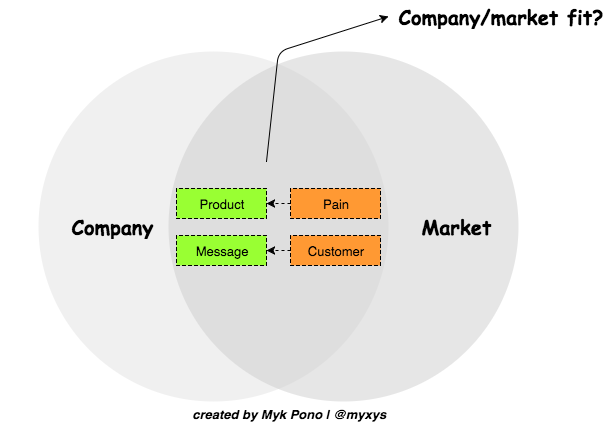
Company/market fit is difficult to achieve without clear strategic messaging. Getting to the right message is as important as getting to the right product. The main reason why it makes more sense to talk about company/market fit rather than product/market fit is that it is not just the product that satisfies market needs and customer pains. The right organizational structure and vision are also needed to fit a particular need in the market.
To paraphrase Peter Drucker, it is not about searching for the right organization, it’s about management needing to learn to look for, develop, and test the organization so that it fits the task. There is no right or wrong way to organize a business. But there is the right organization for specific problems or market needs.
LEARN MORE: Check out this very detailed post by Steven Sinofsky on corporate organizations.
Fundraising and investor decks Strategic messaging is an essential part of your fundraising efforts. Your investor deck can describe a problem, vision, value proposition, positioning, target customer, and market opportunity. And to be successful in planting your message you have to create an interesting and easy-to-follow story. A successful investor deck is a strategic message packaged in an interesting story.
There are already a few great resources on creating a pitch deck, so let’s not spend much time on this topic here.
LEARN MORE: Check out this TechCrunch article, “Lessons From A Study of Perfect Pitch Decks”. If you’re interested in learning more about effective pitches, Andy Raskin has written many interesting articles on this topic — The Greatest Sales Deck I’ve Ever Seen.
Sales My earlier article, How to Design Lead Nurturing, Lead Scoring, and Drip Email Campaigns points out that identifying a prospect’s PAIN and FIT is a critical step in the sales process. FIT corresponds to the target customer profile. And PAIN (or problem) is how prospects perceive product value. Both target customer profiles and values are irreplaceable parts of strategic messaging.
Selling a product to multiple stakeholders involved in the decision-making process complicates and prolongs sales cycles. Each target customer involved has different pains and values they are trying to get from your product. Therefore, where there are multiple stakeholders, strategic messaging is even more critical, since different messages need to address the different personas in the buying process.
Your prospect will already have perceptions about your product and its value even before your qualification call or demo. This judgment will be made based on your website’s content and your communication materials including ads, PR, blog articles, and cold sales emails. If expectations are wrong, or the product value is misinterpreted, it will take your sales team much longer to change this perception.
The further the prospect’s perceived value is from the actual value you want to convey, the more likely the deal is to be lost. It takes effort to form a perception about a product and it takes an even larger mental effort to change perceptions once they’re formed. That’s why it is so difficult to convince people once they have an opinion. Additional facts aren’t very helpful in changing people’s beliefs and perceptions once they’ve been formed.
Looking at this idea from the sales perspective, do you see how difficult the sale can become if a prospect’s perceptions have been formed inaccurately?
Companies with great sales organizations all have clear sales playbooks. Sales playbooks describe in detail such things as sales pitches, competitive landscapes, and how to address differentiation questions, target customer profiles, typical product offerings, and descriptions, and customer success stories. Strategic messaging impacts every single weapon in your sales team’s arsenal.
Coherent and consistent communications in the sales organization depend on the effectiveness of your strategic messaging.
Marketing The goal of marketing is to control perception and to change behavior. This is a simple and accurate definition of marketing. All marketing activities and every aspect of marketing fall under the goals of controlling perception, changing behavior, or both. Try to think of a marketing activity that doesn’t fit this goal. And ask yourself: can you truly change someone’s behavior without changing their perception?
Here are a couple of examples. Awareness content enlightens prospects and customers on industry trends and important issues. The goal is to control the perception of what your target audience should pay attention to. Running paid acquisition campaigns initiate an action by a prospect that leads to conversion — behavioral change. Buying and using a product requires a change in behavior.
Strategic messaging is how companies control perception in the marketplace. It is the responsibility of the marketing team to ensure that the message a company uses is consistent across all marketing channels as well as across all assets and communications.
Recruiting Recruiting is about selling your vision and your values as an organization. The founders and CEO should never stop recruiting and need to dedicate a significant portion of their time to their recruiting efforts. Recruiting is nothing more than selling your company to a prospect. Strategic messaging will help you organize your vision and your values so you have a simple message and story that sparks interest in those who share your values and who are inspired by your vision.
It is hard to imagine anything that has more impact on your organization than messaging, and how you communicate internally with your team, externally with the marketplace and your target audience. We have only discussed a few critical examples, but this list can be expanded. Now, how do we know if our current messaging is effective or needs a revamp?
PART 2: Is your messaging effective?
The symptoms of ineffective messaging aren’t easy to spot. Organizations collect and analyze almost every imaginable metric, but how do you know your messaging is working? It is impossible to say that your sales process is prolonged by X% because prospects are too confused about your offerings. But there is a qualitative way to analyze your current messaging.
One of the main attributes of strategic messaging is consistency. Effective messaging is always simple and consistent. The best way to evaluate your current messaging is to look at how consistently your organization talks about your products and compare that with how your current customers talk about your product.
Effective Messaging = Simple + Consistent
Does everyone in your organization communicate the same product value? Do your customers and prospects understand the value and utility that your product provides?
Here are just a few questions that you can ask your team, and then compare the answers. The simple exercise that we are about to discuss can be done quickly and the insights will help you understand the health of your messaging, so you can spot small issues before they grow into large problems.
Start evaluating your strategic messaging inside your company.
Internal Evaluation This quick, 20-minute exercise will help you understand how your own team talks about your company and product. Get all your sales reps, marketing, and product people (ideally, encourage all of your organization to participate) in one conference room, and ask them to write answers to the following questions:
- 1 sentence company pitch (What we do?)
- 1 sentence problem pitch (What problem are we solving?)
- 1 sentence competitive pitch (How are we different from our competitors?)
- 1–3 bullet points of values we provide for customers (Why should customers buy from us?)
These are very basic questions that everyone in your organization should know the answers to. To make it even more interesting, you can also ask your team about the company vision — Why we do what we do?
This exercise shouldn’t take more than 20 minutes. If the answers you receive from the internal survey are fairly consistent, the next step will be to talk to your customers. The problem is that you might have a very consistent, but still ineffective message. Your message might be consistent and still not resonate with your customers. This is why the next step is to understand the value and utility of your product by interviewing your current customers.
The answers you receive in the internal survey from different teams and even from members of the same team are often so different it will convince your organization to take messaging seriously.
When conducting one-on-one interviews with salespeople at one company, I was shocked at how different the product pitch and company description was from one interview to another. I interviewed one sales rep and then heard a polar opposite pitch from the next sales rep. In this extreme case, almost every sales rep had their own sales decks. I then shadowed their live sales calls with customers to compare what they said during interviews and how they presented to prospects. Some sales pitches were so far apart that if you didn’t know the company name, you would think the pitches were for different products.
But let’s imagine your internal message is reasonably consistent, then the next step in evaluation is to interview a few customers and compare how they perceive your product and your company. Remember, strategic messaging and positioning are all about the perception in your customer’s mind. So your messaging could be simple and consistent but still doesn’t match the perception in the mind of a customer.
External Evaluation External evaluation of your strategic messaging can be done in two ways: 1) customer interviews; 2) with a survey. Surveys are quicker and easier, but interviews are more valuable. If your internal evaluation was enough to convince your team to review your messaging, you probably don’t need to do an external evaluation.
You will talk to your customers and prospects when you start designing your new messaging. It would be very inefficient to interview your customers once for evaluation and again when you are designing the new messaging.
To understand how customers perceive your product, ask questions like these:
- Why did you buy our product?
- What problems were you looking to solve?
- How do you use our product?
- What do you like most about our product? What do you like least?
During interviews, the customer may respond that he/she likes or dislikes the product because of one feature it has. Always follow up with “Why?” questions. It is never about the feature of the product, it is about how this feature impacts their daily work and what value and utility it provides.
Now compare what message your organization communicates and how customers perceive your product. Most companies are very shocked to find out how far apart their internal messaging is from their customer perception.
Even though it’s difficult to calculate the ROI of effective strategic messaging, it’s important to realize that messaging has more of an impact than almost anything else in the business. In the following sections, we’ll learn more about strategic messaging and positioning. We’ll also find out why they are essential to your business and how to design your own strategic messaging.
PART 3: What is strategic messaging?
Strategic messaging is a value-based communication framework that companies employ in all interactions with stakeholders — employees, prospects, customers, partners, and investors. Strategic messaging communicates product value to the customer by describing the solution to a problem.
As discussed earlier, the goal of marketing is all about controlling perception and changing behavior. Strategic messaging is an essential part of this goal.
The Goal of Marketing = Controlling Perception + Changing Behavior
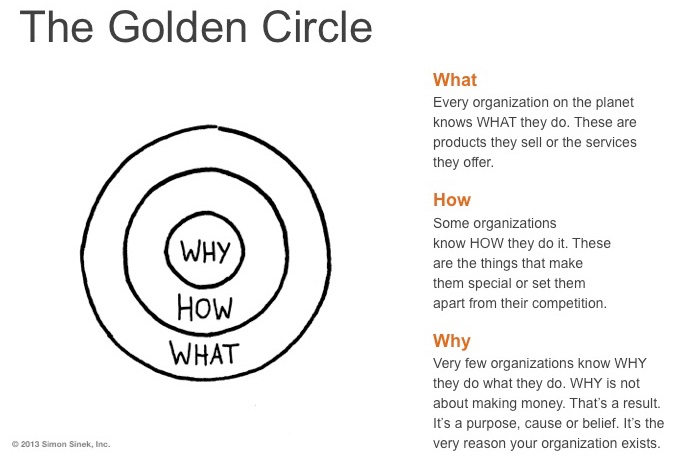
Strategic messaging is an extension of your company’s vision. A vision starts with “why”. Simon Sinek popularized in his book, “Start with Why”, the idea is that to be successful, companies have to start with “why”. Why does the organization exist? Why-driven vision leads to the next question of “how”. How does the organization do what it does? And finally, only after an organization is clear on “why” and “how” does it answer the question of “what”. What exactly does the organization do and what products and services does it provide?
LEARN MORE: To refresh this idea of The Golden Circle watch this TED talk by Simon Sinek.
Now, let’s apply this framework to strategic messaging. “Why” communicates the vision for your organization and manifests itself in taglines, slogan, vision statements, and in short descriptions of a company. “How” is explained through your value proposition, problem description, and positioning through the eyes of your target customers. “What” is described through your product and service descriptions, features, case studies, and other product and marketing-related content.
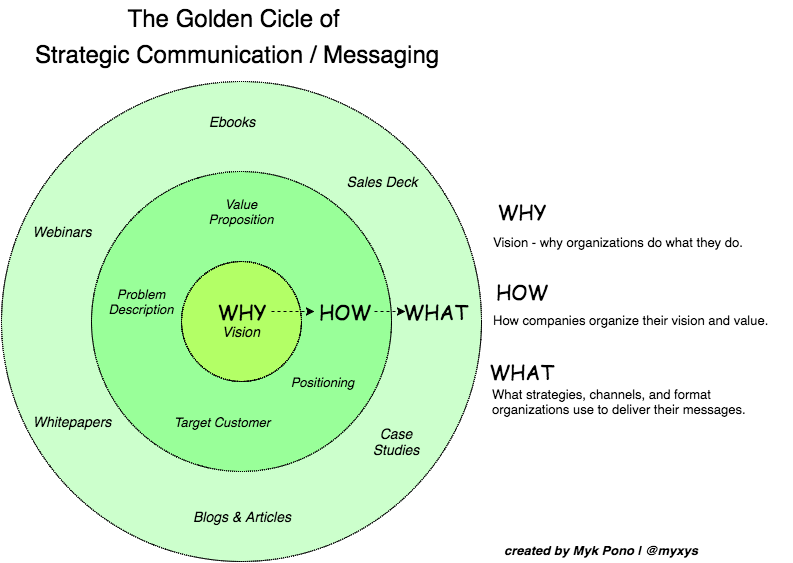
Effective messaging is similar to a fine story, it puts less emphasis on what happens than on to whom it happens and why and how it happens. (8) Strategic communication (or strategic messaging) covers why, how, and what a company does.
Designing strategic messaging starting with why creates a deep emotional connection with your audiences. Our feelings and emotions precede our judgment and reaction.
Every form of communication from the message on your homepage to the “About” section on your press releases, sales decks, paid acquisition campaigns and content strategy should align with your strategic messaging framework.
3.1. The Biggest Strategic Messaging Mistakes or Why Most Companies Are Failing in Designing Strategic Messaging
Before we jump into a specific real-world example of how to create a strategic messaging map, let’s first highlight what makes effective strategic messaging: why certain messages are effective and others aren’t.
Messages should be consistent Consistency reduces opportunities for miscommunication. Consistent messages are more likely to become memorable. Consistency improves message effectiveness, that’s why advertising works — it consistently repeats a simple message over and over again.
Brevity and simplicity leads to clarity Avoid fancy words and use more conventional language. There is a place for longer product copy or longer content, but strategic messaging is not that place.
Our consciousness consists of the thoughts, feelings, and sensations that we are aware of at any given moment, and it represents a very limited view of reality. We can’t consciously pay attention to every detail, so the brain takes all the words and implied meanings and summarizes them into a momentary thought.
When too much information is communicated, our unconscious process arbitrarily chooses which words seem most relevant in the moment. Most of us believe it’s best to give more detailed descriptions, not realizing that the audience can only focus on four tiny chunks of information and for a very brief period of time. Irrelevant speech disrupts patterns and interferes with judgment and learning. (5)
Define, don’t assume Don’t assume that your audience understands the terms that you use in your communication. Companies live in bubbles, employees use the same terms, and very often the meaning changes from one company to another. Define terms that you use internally, and when necessary define them for outbound communication. Even simple terms such as “analytics” can have multiple meanings and interpretations.
Startups often make the mistake of creating positioning and messaging based only on their internal expertise and product features. This approach entices founders to describe their products using industry jargon, complicated technical details, or buzzwords.
Often we don’t know the difference between AI and machine learning, but these words are often used as if everybody understands them. And how about “cloud-based” and “big data”? Do your customers actually know what they mean?
Avoid superlatives and buzzwords You would think that in 2016, companies would realize how big of a turn-off superlative words are — “state of the art”, “best in class”, “world-class”, “leading” — but many don’t.
Don’t change the message too often, preferably never This is related to consistency. You can’t release a new strategic messaging framework every 6 or even 12 months. It’s okay to test new messaging ideas in the field, but anything that impacts the brand as a whole needs to be done incredibly carefully. The perception of your product and company aren’t easy to change. Position your strategic message for the long term.
You know the vision but customers hold the perceptions.
PART 4: What is positioning?
Out of all the pieces that constitute “How” a company explains its vision and value, positioning is often a forgotten strategy in the tech industry.
Al Ries, “the father of brand positioning”, in his book “Positioning: The Battle for Your Mind” describes the basic approach of positioning as not a process of creating something new and different, but a way of manipulating what’s already in the mind, to retie the connection that already exists. “The goal is to position the product in the mind of the prospect.” (1)
This is the main reason why startup founders often present their ventures as “Uber for X” or “Airbnb for Y”. Our attention span is short and investors are no exception to this rule. It is critical for founders to explain their ventures quickly so that investors and prospects understand what the company does and whether they are interested in learning more.
“The best approach in over-communicated society is the oversimplified message.” — Al Ries
Positioning does not explain all the details of what a product does and especially how. In fact, positioning is not even about your product, it is about the perception of the prospect, customer, or investor regarding your product. This is a critical point: the answers to a positioning problem are outside of your product and even your company; they are in your prospect’s mind. In other words, the way you describe and position your product should be dictated by your customers and prospects, and not by product features or internal expertise.
Let’s look back at our example. Investors are very familiar with Uber’s business model, so when a founder describes their venture as “Uber for laundry”, it quickly resonates with investors. They make a clear connection by applying Uber’s business model to the applicable business, in this case, to a laundry business. Uber is already positioned in the mind of investors; therefore, connecting a new idea to an existing perception allows the receiver of the message to understand the new concept with limited use of mental energy.
Positioning is a simplified concept that translates an oversimplified message to penetrate your prospect’s mind and build certain perceptions about your product.
Positioning techniques are widely used in politics. In every race, opponents take positions on the opposite side of the issue or on the opposite side of the solution. Let’s look at the example of “pro-choice” vs. “pro-life” positions. Which position is better framed? Pro-choice implies the opposite position against choice or anti-choice. Pro-life implies the opposite position against life or anti-life. Since our perception views life as more important and more valuable than choice, we subconsciously perceive the pro-life position as a stronger argument.

One of the most successful examples of positioning in tech was accomplished by Salesforce. Salesforce — not software! This absolutely brilliant idea by Marc Benioff led to complete domination in enterprise software marketing for the last 16 years. And the concept is still working well to this day.
Slack is another great example of positioning. Slack positioned itself from the beginning as an anti-email app instead of just another enterprise communications tool. Stewart Butterfield, the founder of Slack, doesn’t actually believe Slack will replace email but his beautiful positioning strategy has forced people in tech to talk about Slack and take sides. You know your positioning works when major publications are writing headlines such as “How E-Mail Killer Slack Will Change the Future of Work”.
There are different techniques for positioning: against a competitor, a market leader, a follower, product attribute/benefits, users, etc. In some cases, you can create a perception of the product by focusing on just one word or phrase. To fully explain positioning, we’d need at least another article and more likely a book. Meanwhile, check the reference section for great books and resources on the topic of positioning.
PART 5: How to design strategic messaging
Let’s assume for the purpose of brevity that you’ve thought about and developed the “why” vision statement for your organization. After that, the design process for strategic messaging can be broken down into a series of discovery-validation feedback loops.
First, you have to pick a set of tools that you will be used consistently throughout this process. You will need to select a target customer profile and a strategic messaging framework. The target customer framework will ensure that you record initial discovery interviews in a consistent and structured way. We’ll discuss this in more detail later.
Based on your initial discovery interviews, you will develop detailed target customer profiles with a set of values that correspond with each target customer profile involved in the buying process. The rest of the process involves careful fine-tuning of your value statements by validating your assumptions with another round of interviews. Only when your value statements are finished can you move on to designing higher-level messaging such as your positioning statement, 25-word description, and tagline.
5.1. Pick Target Customer & Messaging Framework
Before you start with discovery interviews, you need to choose a framework that you will consistently use during the interviews. The framework is just an Excel table or Word doc that you will use to summarize every interview.
In my article on lead scoring and lead nurturing, I described how FIT and PAIN framework applies to the target customer profile. So let’s break down what constitutes FIT/PAIN characteristics of the target customer.
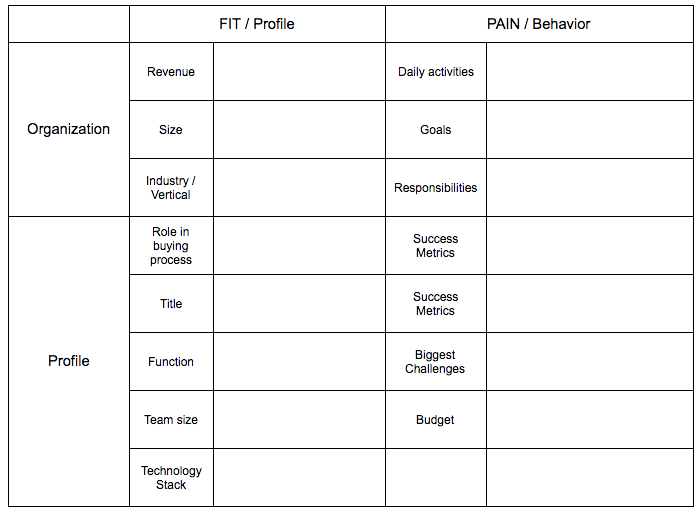
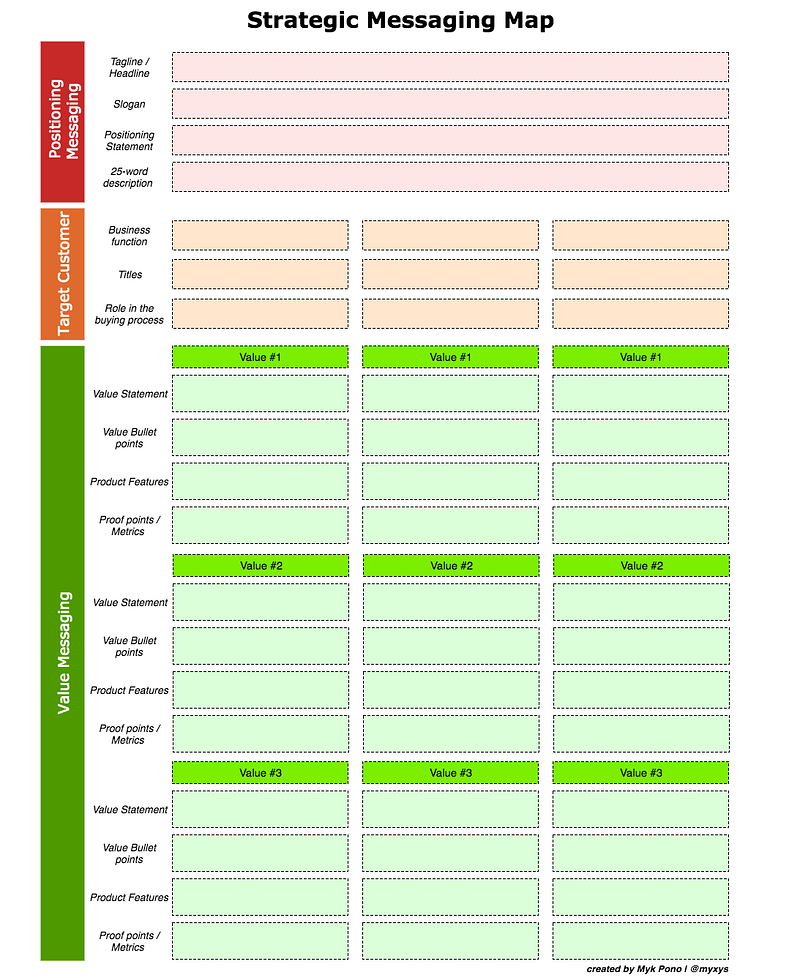
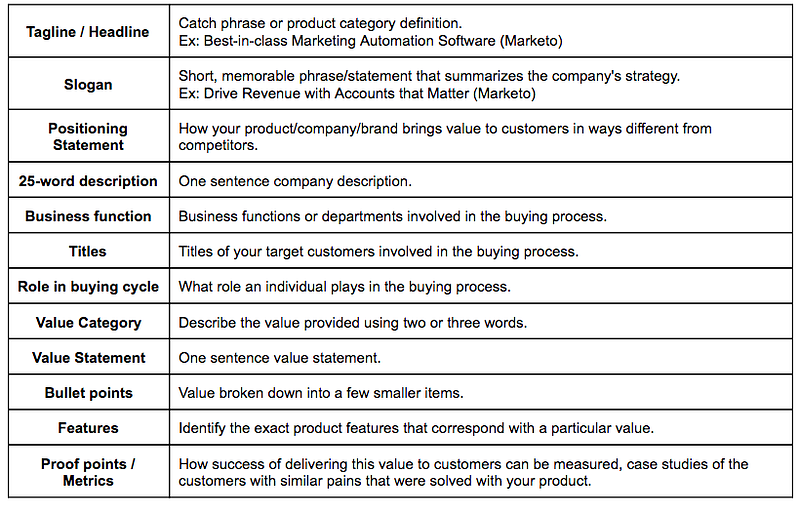
There are a few value messaging maps you can find online. There is no right or wrong framework. You should aim to find the one that fits your company's purpose best or you can modify an existing one. I took a few ideas and created my own version of a value messaging map that fits SaaS companies with multiple target customers in the buying process.
This is what a final strategic messaging map looks like. The order in which you fill it out is important, so we will come back to that later. In the meantime, let’s define each item in the strategic messaging map (see table below) :
5.2. Discovery
The goal of the discovery process is to create a detailed target customer profile by collecting as much information about your current customers and prospects as you can. Create a list of questions for each person you are planning to interview to ensure quality feedback.
Interview sales reps Pick the top 5–10 sales reps to interview. The number will depend on the size of your organization. Sales reps will do almost anything to close deals and great salespeople are very aware of the problems that prospects have.
- Ask them to identify a target customer
- Ask about the easiest deals they’ve closed
- Ask about the biggest deals they’ve closed
- Ask about the toughest deal they’ve closed
- Ask about a recently lost prospect and the reasons
- Ask them to state the pain that most customers have
- Ask what questions they ask prospects to identify their pain
- Ask what customers they have the best relationship with (these are the customers you will be interviewing later)
Tip: make sure that you interview sales reps one-on-one. You want to avoid groupthink and prevent group leaders from influencing the rest of the team.
Interview the product owner and a few customer success managers Interviewing sales reps is a must, but interviewing the product manager and customer success manager can give you a different perspective. Focus on questions that help you understand how customers talk about the product and how your team talks about the product with customers. Keep questions open-ended and record responses.
Listen to the prospect (shadow sales calls) Shadowing a sales call with a prospect is the best way to get close to your target customer. Prospects have had few interactions with your company and product and their original perception about the product isn’t yet changed or influenced. The questions prospects will ask and objections that they will voice are important indicators of how they perceive your company and product. Also, take note of the words they use. One of the easiest ways to improve messaging is to simply use the same words your ideal prospects are using. If you do this, you are sure to focus on the most important points.
The feedback you will receive from shadowing sales calls with prospects will often differ from what sales reps communicated during the one-on-one interviews.
NOTE: I strongly believe that shadowing sales calls with prospects should be a must for every new employee onboarding process, regardless of their title. There is no better way to learn about your product and how customers perceive the product than shadowing a real sales call with prospects.
Interview the last 5–10 lost prospects Ask your sales reps to give you a list of 20 prospects that fit your target customer profile but for some reason, the deal was lost. Send a quick and personal email to the lost customers asking to interview them for 10–15 mins to understand what played a major role in them going the other way. Give them a $20 Amazon or Starbucks gift card for taking the time to talk with you.
The goal of interviewing lost customers is to understand the main reasons why they didn’t buy. Maybe they are not quite the right fit. Maybe the pain that your product solves isn’t big enough for them. Maybe they thought the price was too high. Maybe a competitor product fits their needs better. Ask them about their buying process and who was involved in the decision-making. Ask lost customers to share the one thing that was a deal-breaker.
Interview the newest 5–10 customers Since these companies just became your customers, the interactions that they had with your team and your product during the buying process are still fresh in their memory. Ask recently won customers the same questions you asked your lost prospects:
- What they thought about your product
- What problem did they want to solve?
- What are the biggest challenges they are facing?
NOTE: One of the most important questions to ask is the one about their biggest challenges. During the discovery process, ask this question to your prospects, recent customers, renewed customers (someone who has been a customer for over a year). If your product is not solving one of your target customer’s top 1 to 3 pains, then your product doesn’t provide significant value. It is a nice-to-have rather than a must-have. If there are ever any changes to their budget or the economy, then your product will be on their short-list for cancellation.
Interview customers that have been using your product for more than 1 year If your company is lucky enough to have been in business for at least a year, you should have customers who have renewed and those that have churned. Interview a couple of them with a focus on understanding why they use your product, how often, and what they like most about it.
Interview industry experts/analysts If you are a larger organization and your product fits in a well-established industry you would benefit from reaching out to Forrester and Gartner researchers. Interview researchers and analysts but take their knowledge with a pinch of salt. Most of the large research companies only release one or two reports a year on any particular industry. The market changes faster than that, and by the time a report is released, it is outdated. Also, big research firms mostly concentrate on getting feedback from large organizations, so the findings in the report will be skewed toward large players.
It is important to point out that if you do consult with researchers or analysts that you avoid the temptation to create a message based solely on their findings or knowledge. Many teams fall into the trap of creating analyst-speak messaging as an (apparently) easy solution, but this is a big mistake because such messaging very rarely resonate with buyers.
Another way to conduct a few interviews outside of your organization is to find a company and person that fits your target customer profile but who isn’t a customer but is considered an industry expert. Find a way to have a 10–15 min discussion with at least a few industry experts that have something to do with your company or product.
Review competitive messaging and 3rd party resources You should have a shortlist of competitors against whom you want to position your product. Review their messaging and record in detail how they talk about their product and company. Quora is an incredible and very underrated resource for enterprise companies. If your product is more technical, check out Stackoverflow. Find a place or a community for your target customer and review topics and discussions. Note which questions are most popular in the community.
What if you are an early-stage startup? Reading thus far you might be thinking “wait, but what if I don’t have a sales team yet? What if I don’t have customers that I can interview yet alone customers that have been around for a year?”. What can a small, early-stage startup do to design strategic communication? The answer to this is: focus on interviewing your prospects. Make a list of companies and people who might be interested in your product or idea. Do whatever it takes to interview them. Pay attention not only to the challenges they describe but also the terms they use. Carefully record your conversation. Position your conversations as discovery, where you truly want to know about them and their challenges, and not as sales pitches. Even if you have a product, refrain from sales pitches it can turn off your interviewees. The goal is to learn about your target customers and figure out strategic messaging and not to sell them on your product at this time.
Also, keep your eyes and ears open; you might come across someone in your target audience who can be a great mentor or advisor to your team. You can’t overestimate how helpful an advisor who fits your target customer profile can be early on.
Summary: Carrying out initial discovery interviews is probably the most time-consuming step in creating a strategic messaging map, but it is the most important one. Your strategic message needs to connect with your target audience (prospects and customers) and there is no better way to find out how to do this than to ask them directly. It is critical to keep a detailed record of your interviews so you can identify certain patterns. The next step after your interviews are completed is to start filling out your target customer profile and the values that correspond with each profile.
Let’s connect on Twitter
5.3. Build a Target Customer Profile
You should have plenty of notes from your discovery interview. It is now time to look for common themes. Look into overlapping feedback from your interviews. Always put customer and prospect responses above answers from your team.
How To Create A Comprehensive Customer Profile
I find it very helpful to record interviews right after they occur. Also, I fill out my questionnaire form and then I record any ideas that are unusual or that I think are weird. Sometimes these ideas are just random opinions but some of them might hold great insight. The difficult part is that at the beginning you can’t easily say which is which. So record them and try to validate them in the next interview. During your next interview present an idea and get feedback. To some degree, this is a listening exercise.
Example: during one interview I did with a sales rep, he shared that most customers do not understand “analytics” when it’s used to describe part of our product. This was an interesting insight because analytics was an essential word in communication with customers. The company never asked their prospects if they even understood what “analytics” meant. So during my next interview with another sales rep, I asked whether customers ever proactively asked him to explain the analytics feature or whether the term analytics caused any confusion. As it turns out, this was a critical insight and if we wanted to use “analytics” in the strategic messaging, we had to frame what we meant by it.
When multiple target customer personas are involved in the buying process, you will need to include all of them in your strategic messaging map. Complete your Target Customer Profile for each persona involved in the buying process.
How To Create Effective Ideal Customer Profile (ICP): Goals, Pains, Metrics (6-minute video) …

5.4. Identify Value Categories for Each Target Customer Profile
At this point, your value map should include the business function of your target customers including their titles and role in the buying process. The next step is to summarize your feedback from the discovery interviews and pick the most important value categories. Categorize all the feedback you collected during discovery interviews and identify the main value categories.
- Great quality is not a value.
- Amazing customer service is not a value.
- Cheap price is not a value.
- Easy integration is not a value.
There is no need to describe the value category yet, just identify it. Carefully go over the notes accumulated in the discovery process and prioritize. What does a particular target customer care about? What does he/she want to get out of your solution? What do your customers need?
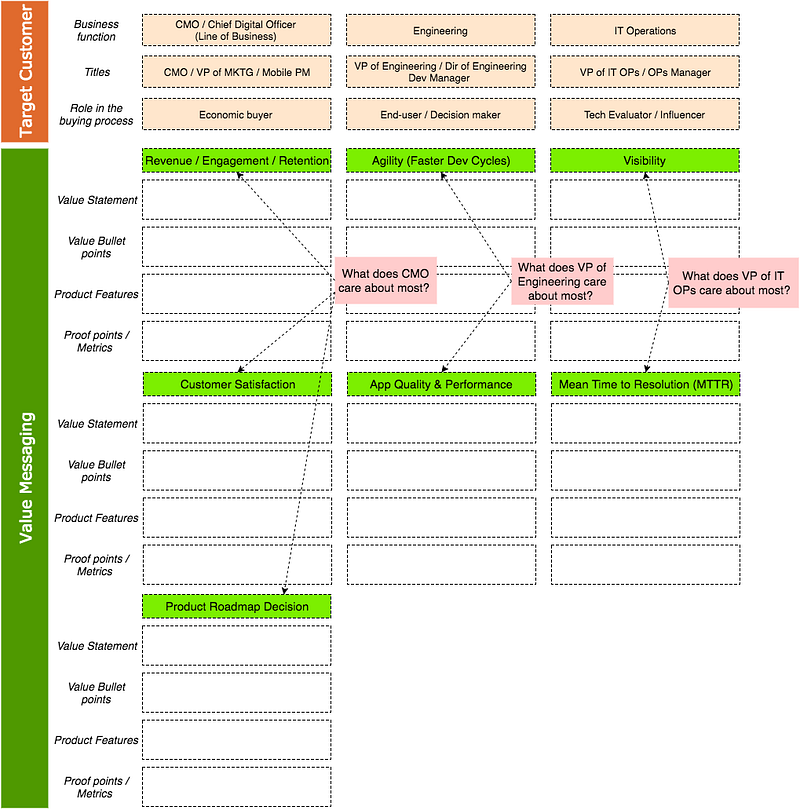
Here is an example of value categories for each target customer:
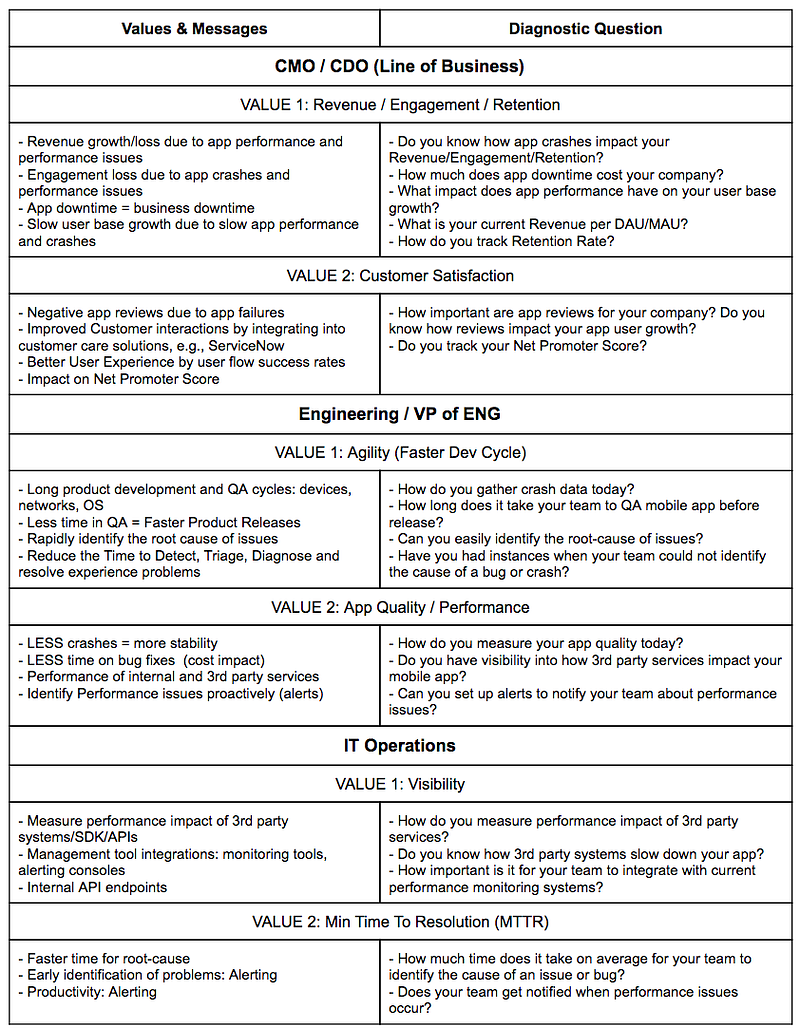
- Economic Buyer: CMO / CDO / Line of Business
Value 1: Revenue / Engagement / Retention Value 2: Customer Satisfaction Value 3: Product Roadmap Decision
2. End-user / Decision Maker: Engineering
Value 1: Faster Development Cycles Value 2: App Quality and Performance
3. Influencer / Tech Evaluator: IT Operations
Value 1: Visibility Value 2: Mean-time-to-resolution
5.5. Summarize Details Under Each Value Category
At this stage, we need to get into the details of each value proposition. Start filling out your strategic value messaging map with value statements. Describe the value of your product from your customer’s standpoint. Your customer doesn’t care about your “state of the art”, “patent pending”, “award-winning”, “best-in-class” technology, or your amazing new feature — explain what will they get out of using your product. What is it in for me?
Keep your tone and style conversational. One helpful technique is having an actual role-playing conversation. Imagine you are sitting at a bar and someone asked you what you do for a living. The conversation will go into more details (let’s assume you started with “why”):
- Why should I buy your product? - Well, you will improve user engagement in your app by correlating behavior and operation metrics. - Cool, but how do you do it? - Most of the engagement loss is due to app crashes and performance issues, including network coverage.
You can actually imagine this conversation happening. It includes short statements and it leads to a clear first impression of what the company does and how.
It usually takes several interactions to write value statements that are brief, simple, and descriptive. You should write 25–40 different variations of the same value statement. Try to use different words and phrases, synonyms, and other techniques to evaluate as many options as possible. Most of the options won’t work and it will be easy to spot them, but this exercise is used to get your creative juices flowing.
Assign every product feature to a value. Assigning every product feature to a particular value is a very insightful exercise. Ideally, you improve your product to bring more value to your customers. It is often forgotten in organizations why this capability is important and who benefits from it the most.
Bullet Points help you deconstruct value statements. Value bullet points help you unpack value statements and show exactly what we mean by each value. While we can only have a very limited number of value categories, we can have many variations of how we describe the value. For example, you can say “minimize revenue at risk by proactively monitoring transaction success” or “increase revenue by proactively monitoring and optimizing transaction success”.
NOTE: While it is difficult to do a valid A/B test to help you develop strategic messaging, there are some instances where A/B testing can be very helpful. For example, testing small words and synonyms. You can run a simple Google AdWords campaign to test which works better in terms of clicks:
- Minimize revenue at risk
- Decrease revenue loss
Proof points and Metrics help customers measure the progress towards perceived value. Proof points help organizations understand how and what customers will be measuring to analyze the benefit of the product. During initial conversations with prospects, sales reps should diagnose the current state of affairs. If you understand how your prospects measure their goals you can be more precise in analyzing and presenting some basic ideas. For example, ask your prospects early on about how much downtime their app currently experiences and then follow up with a question about whether the customer is aware of how much revenue is lost during this time. Then make sure you are armed with metrics you can use to compare this prospect to clients you already have in the same industry or similar size company.
Understanding how customers track success will help you in content marketing because it depends on your target customer profile or industry vertical. You can highlight different metrics in whitepapers, case studies, or paid acquisition campaigns to show how your product delivers value.
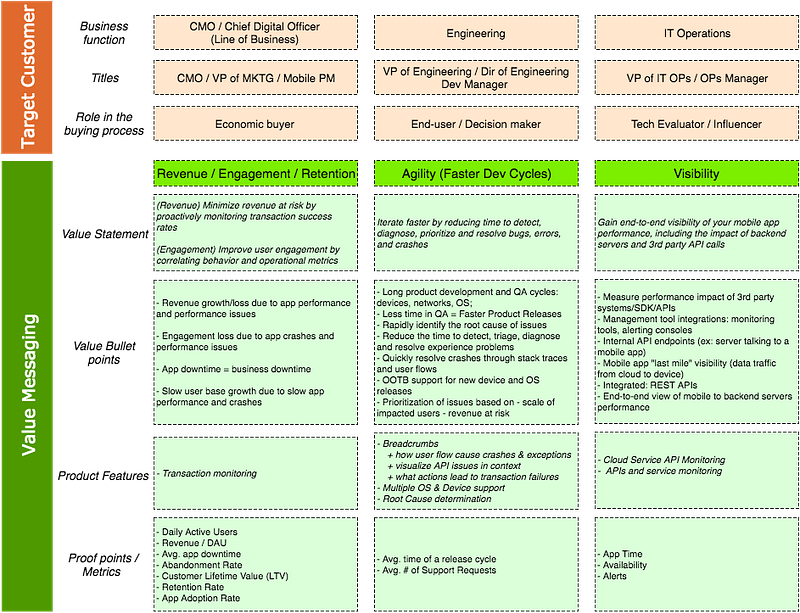
Below is an example of the value messaging map filled out with target customer information and one top value for each group.
5.6. Design Top Tier Messaging
There’s enough information on designing top tier messaging such as product descriptions, slogans, and positioning statements that you could write a whole book about it. I’m not going to cover the whole topic in this article, but let me highlight a few important items.
Tagline/headline is a 5-word description that defines your category or a catchphrase. For example:
Metadata.io — Demand Generation on Autopilot Marketo — Best-in-class Marketing Automation Software Intercom — Customer Messaging Platform
A 25-word description statement is a one-sentence description of your company. This sentence will appear first on the “About Us” section, it can be present in full or partially on your homepage, and it will be a part of your company description across social media profiles and in your PR.
Many companies also have a longer version 50-word description. It usually consists of 1–3 sentences and provides little more information about company values, target customers, and the problem it solves.
Using the same strategy you used when designing your value statements is helpful here. Write at least 25–40 different variations of a one-sentence description. Thinking around the variation of this formula will help you:
Company {does} (value) to {help} (target customers) with (problem).
Examples:
Marketo provides the leading engagement marketing software and solutions designed to help marketers [TARGET CUSTOMER] develop long-term relationships with their customers — from acquisition to advocacy [VALUE].
Zendesk builds software for better customer relationships [PROBLEM]. It empowers organizations to improve customer engagement and better understand their customers [VALUE].
Intercom is the first to bring messaging products for sales, marketing & customer service to one platform [VALUE], helping businesses avoid the stiff, spammy status quo [PROBLEM] and have real conversations that build real connections.
5.7. Review / Get Feedback / Iterate
Your first full strategic messaging map is likely to be far from perfect. It is time to gather sufficient, high-quality feedback from your team and outside stakeholders. While you are likely to encounter people jockeying for their perspective to be included, it is important to have a clear vision and the confidence to defend difficult choices. Again, I would suggest one-on-one conversations instead of group discussions. If you are leading this strategic messaging initiative you have to design a good story and work your new messaging into it.
During your discovery interviews, you should have received many ideas on how to develop your messaging. At the review stage, go back to your customers, prospects, industry experts, advisors, and investors, and present them with your new strategic communication map.
Books have been written, seminars exist, and hours of information can be found on the topic of developing a story that resonates with the audience. It is out of the scope for this article but you can find a few amazing books and resources in the reference section at the end of this article.
NOTE: Outside consultants can be extremely helpful for companies that are going through the process of designing strategic messaging. There are several reasons for this. 1. They can evaluate current messaging with fresh eyes. 2. They aren’t tied to internal politics. 3. They are less affected by any internal product or cultural biases.
Strategic messaging can’t be designed in a couple of days. It takes time to interview internal and external stakeholders, to understand your target audience, its pains, values, and perceptions. I can’t stress enough how crucial this discovery process is in designing your messaging. Every piece of feedback is an opportunity to look at your company and product from a unique perspective. The wider the range of ideas you collect, the better and more thoughtful your strategic messaging will become. Not every idea can be satisfied with your strategic messaging map, but you will certainly benefit from analyzing and evaluating as many different perspectives as possible.
PART 6: How to implement new messaging in organizations
After a couple of rounds of reviews and feedback, your organization should come up with a final strategic messaging map. Every single person in your organization needs to know your core message. From executives and their assistants to junior tech support people. It is a good idea to include messaging as a part of your new hire onboarding process.
The new core message will drive many activities across your organization, most importantly in the sales and marketing departments.
Update your sales playbook, sales scripts, and sales enablement content. Designing Value Diagnostic questions is just one example of how strategic messaging will enable your sales team to ask the right set of questions early on in the sales process. Back to the example, we used previously, since engineering cares about Agility (Faster Development Cycles), what questions can we ask a prospect to understand if this is a pain they can relate to? For example, in the table below each value category corresponds with a specific question that can help your sales team identify what value a prospect cares about most:
Align your content marketing strategy with your new strategic messaging. Strategic messaging speaks in your buyer’s language and provides two key elements that lead to effective content: 1) who is the audience? 2) what do they care about? The notes you have collected during customer interviews should be a great source of content ideas. Some companies are struggling to come up with topics to write about and this almost always signals that the team needs to get closer to their customers and prospects.
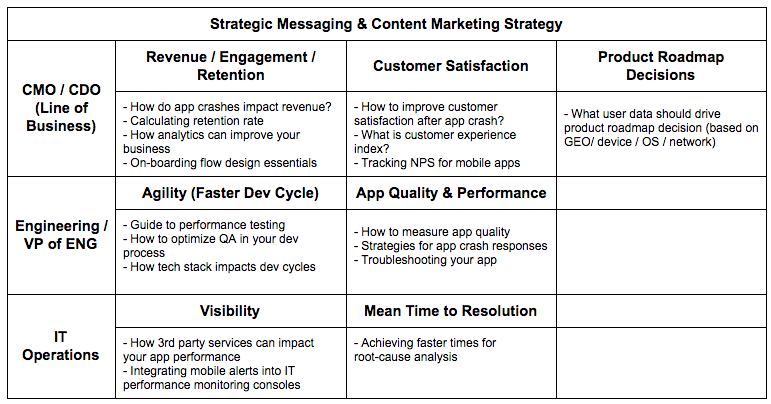
The example of the company that we use in this article has three persona profiles involved in its sales cycle and for each persona, we discovered 2–3 values. When your team brainstorms content topics, ensure that every topic falls under a specific value and specific target customer. It doesn’t have to be perfect, some topics will overlap. But this approach will keep your content strategy organized and your team will be aware of how often each value is covered and what target audience is involved. Before any content is written, look at your table to see who you are writing for (audience) and what theme (value) you are highlighting.
Economic buyers and decision-makers have greater importance in the buying process than influencers. Therefore, estimate the proportion of content created for each persona. In the example in the table below, it would be reasonable to decide that 50% of all content needs to target the CMO/CDO (economic buyer), 30% of the content is related to Engineering, and 20% of the content is created for IT Operations.
As for value categories, keep track of how often you create content for each value. For example, the CMO persona has 3 value categories that the company needs content. Balance it out by using a content breakdown ratio such as 3:2:1; for every 3 stories that are related to revenue value, you should create 2 stories that cover customer satisfaction and one that is related to product roadmap value.
There is no exact science on how to break down your content coverage for each buying persona and for each value category. Just remember that more content should be targeted to the target customer that has a higher influence on the buying decision. And don’t forget that a higher influence on the buying decision doesn’t always mean a higher position in the organization. At the same time, some values are more important, so adjust your content marketing strategy accordingly.
The table below shows how topics can be sorted based on the audience and value category.
TIP: When you track your content performance, put it in the context of target audiences and value categories. Over time, you will see that some values perform better and you can optimize and adjust your content topics and calendar accordingly.
Now that you have your strategic messaging map, you can better adapt your content to match your target personas and their related values. By doing this, your content will be more valuable to them, and the decision-makers will be able to more easily understand your product’s value.
Every aspect of your internal and external communication should change with your new strategic messaging. We’ve only discussed a couple of examples related to marketing and sales in this article, but all communications including marketing campaigns, PR, and webinars should go through the strategic messaging filter.
Summary
Hopefully, this article has helped you realize that strategic messaging/communication has a tremendous impact on the success of your company and product. The easiest way to check the health of your messaging is to compare how different members of your team describe your product and company.
Designing strategic messaging is definitely worth the effort, even though it’s impossible to provide an exact ROI of strategic messaging. Simple and concise messages resonate with your prospects and lead to less friction in the sales process. Strategic messaging drives effective content strategy since it helps your organization focus on target audiences and their values. These are just a couple of examples of how messaging impacts the communication process between a company, its customers, and the marketplace. That’s why many top tech companies dedicate their time to developing the right message.
While your core “why” vision statement starts from the values of your organization, the “how” and “what” is driven by understanding your target customers. Interviews during the discovery process are not only an essential part of the strategic messaging design but also can uncover insights into the daily life of your target customers, industry trends, and product ideas.
This article is not meant to be a comprehensive source on the complicated topic of strategic messaging. Since many aspects of messaging aren’t covered here, please refer to the reference section for books, articles, and people that can help you think about different aspects of strategic messaging in more detail. Please share any additional resources that you find helpful.
Acknowledgments
Gil Allouche, Founder and CEO of Metadata.io, for sharing his ideas on strategic messaging when we first discussed this topic a couple of years ago. Tom Wentworth, CMO at RapidMiner, for mentoring and with whom I’ve had multiple conversations on many aspects of marketing. David Skok, General Partner at Matrix Partners, whose writing on startups and marketing has inspired many entrepreneurs and for providing feedback to this article. Andy Raskin, Strategic Messaging Consultant, for sharing his experiences and pointing out great resources. Greg Spector, PR & Communications Consultant, for discussing with me his approach to PR.
References
Some ideas were taken from this list of resources and some original ideas shared in the article were influenced by it.
Books:
- “Positioning: The Battle for Your Mind” by Al Ries & Jack Trout
- “The Startup Owner’s Manual” by steve blank & Bob Dorf
- “The Essential Drucker” by Peter F. Drucker
- “Start With Why” by Simon Sinek
- “Words Can Change Your Brain” by Andrew Newberg & Mark R. Waldman
- “Cracking the CODE” by Thom Hartmann
- “Made to Stick” by Chip Heath & Dan Heath
- “Story” by Robert McKee
- “Brand Thinking” by Debbie Millman
- “The Challenger Sale” by Matthew Dixon & Brent Adamson
- “Ogilvy On Advertising” by David Ogilvy
- “Subliminal: How Your Unconscious Mind Rules Your Behavior” by Leonard Mlodinow
Articles:
Product positioning in Five Easy Steps Articulate to resonate: crafting and communicating messages that matter Slogans vs. Taglines: What Is Your Brand’s Battlecry? by Laura Ries. Want a Better Pitch? Master the “Move.” by Andy Raskin What I Learned Positioning 40 Companies by Andy Raskin Your Company Messaging Isn’t Working: 5 Guesses Why by Andy Raskin Positioning and Messaging Framework (slide 9) Product positioning Getting to a Messaging Framework and Value Prop by Tiffany Spencer Startup Best Practices 15 — Start With The Why by Tom Tunguz
UPDATE #1 (12/15/16): I just came across the post, Startup Best Practices 15 — Start With The Why, by Tom Tunguz, where he highlights similar ideas about strategic messaging. I found it after this article was written and published, adding a link to the list of references.
UPDATE #2 (3/2/17): To download Strategic Messaging Map template subscribe to my newsletter.
If you like this article please recommend and share.
Follow me on Twitter, Linkedin, Quora, MykPono.com, and Youtube. Subscribe to my newsletter.


