avatarNima Torabi

Free AI web copilot to create summaries, insights and extended knowledge, download it at here

15509

Abstract

ering surgery to reconstruct his face using a series of 3D…</h3></div> <div><p>www.bbc.com</p></div> </div> <div> <div style="background-image: url(https://miro.readmedium.com/v2/resize:fit:320/0*nPZ8SO6UOuZu6iuq)"></div> </div> </div> </a> </div><ul><li>In <b>2015</b>, the FDA approved <b>Spritam </b>as the first 3D printed drug used to <b>reduce seizures</b> for epileptic patients, allowing the pill to disintegrate in the mouth with just a little bit of water, which helps swallow the pill.</li></ul><div id="5236" class="link-block"> <a href="https://www.forbes.com/sites/jenniferhicks/2016/03/22/fda-approved-3d-printed-drug-available-in-the-us/#462cf07d666b"> <div> <div> <h2>FDA Approved 3D Printed Drug Available In The US</h2> <div><h3>A continued step forward in the treatment of epilepsy and the power of 3D printing. According to the Centers for…</h3></div> <div><p>www.forbes.com</p></div> </div> <div> <div style="background-image: url(https://miro.readmedium.com/v2/resize:fit:320/0*-Og9hzcuV04wr73p)"></div> </div> </div> </a> </div> <figure id="eb6f"> <div> <div> <img class="ratio" src="http://placehold.it/16x9"> <iframe class="" src="https://cdn.embedly.com/widgets/media.html?src=https%3A%2F%2Fwww.youtube.com%2Fembed%2FpZqTLGCz09I%3Ffeature%3Doembed&amp;display_name=YouTube&amp;url=https%3A%2F%2Fwww.youtube.com%2Fwatch%3Fv%3DpZqTLGCz09I&amp;image=https%3A%2F%2Fi.ytimg.com%2Fvi%2FpZqTLGCz09I%2Fhqdefault.jpg&amp;key=a19fcc184b9711e1b4764040d3dc5c07&amp;type=text%2Fhtml&amp;schema=youtube" allowfullscreen="" frameborder="0" height="480" width="854"> </div> </div> </figure></iframe></div></div></figure><ul><li>In <b>2017</b>, <b>Reebok</b> 3D printed its next line of shoes by the new liquid factory method, and since then, others, such as Adidas and Nike have followed the path to 3D printing shoes.</li></ul> <figure id="94c4"> <div> <div> <img class="ratio" src="http://placehold.it/16x9"> <iframe class="" src="https://cdn.embedly.com/widgets/media.html?src=https%3A%2F%2Fwww.youtube.com%2Fembed%2F64XESsTfv_4%3Ffeature%3Doembed&amp;display_name=YouTube&amp;url=https%3A%2F%2Fwww.youtube.com%2Fwatch%3Fv%3D64XESsTfv_4&amp;image=https%3A%2F%2Fi.ytimg.com%2Fvi%2F64XESsTfv_4%2Fhqdefault.jpg&amp;key=a19fcc184b9711e1b4764040d3dc5c07&amp;type=text%2Fhtml&amp;schema=youtube" allowfullscreen="" frameborder="0" height="480" width="854"> </div> </div> </figure></iframe></div></div></figure> <figure id="72be"> <div> <div> <img class="ratio" src="http://placehold.it/16x9"> <iframe class="" src="https://cdn.embedly.com/widgets/media.html?src=https%3A%2F%2Fwww.youtube.com%2Fembed%2F2_Mz8saTcRI%3Ffeature%3Doembed&amp;display_name=YouTube&amp;url=https%3A%2F%2Fwww.youtube.com%2Fwatch%3Fv%3D2_Mz8saTcRI&amp;image=https%3A%2F%2Fi.ytimg.com%2Fvi%2F2_Mz8saTcRI%2Fhqdefault.jpg&amp;key=a19fcc184b9711e1b4764040d3dc5c07&amp;type=text%2Fhtml&amp;schema=youtube" allowfullscreen="" frameborder="0" height="480" width="854"> </div> </div> </figure></iframe></div></div></figure> <figure id="d343"> <div> <div> <img class="ratio" src="http://placehold.it/16x9"> <iframe class="" src="https://cdn.embedly.com/widgets/media.html?src=https%3A%2F%2Fwww.youtube.com%2Fembed%2Fufhh6vRfE6Q%3Ffeature%3Doembed&amp;display_name=YouTube&amp;url=https%3A%2F%2Fwww.youtube.com%2Fwatch%3Fv%3Dufhh6vRfE6Q&amp;image=https%3A%2F%2Fi.ytimg.com%2Fvi%2Fufhh6vRfE6Q%2Fhqdefault.jpg&amp;key=a19fcc184b9711e1b4764040d3dc5c07&amp;type=text%2Fhtml&amp;schema=youtube" allowfullscreen="" frameborder="0" height="480" width="854"> </div> </div> </figure></iframe></div></div></figure><h2 id="e542">Defining 3D printing’s key characteristics and types</h2><p id="3ac5">While in traditional manufacturing (i.e. subtractive manufacturing), shapes are cut out of blocks of material, 3D printing is the opposite. The 3D printing process entails three key phases:</p><ul><li>A <b>digital representation </b>of the object is developed, either by building it into design software such as CAD or by scanning a real-life object</li><li>Then, the <b>digital model is sliced</b> into multiple layers of less than 100 micrometers each</li><li>Finally, the sliced model is sent to a 3D printer that creates a 3D object through <b>successive adding of layers </b>of plastics, ceramics or, metals</li></ul><p id="0d0d">3D printing is currently a reality, and in action, there are many variations of 3D printing using different technological solutions. Such as FDM, (i.e. fused deposition modeling), or SLA (i.e. stereolithography, or SLS (i.e. selective laser centering).</p><div id="3da3" class="link-block"> <a href="https://readmedium.com/the-10-types-of-3d-printing-technology-2f07d97882f8"> <div> <div> <h2>The 10 types of 3D Printing Technology</h2> <div><h3>Since I published the article about 3D Food Printing, many of you have asked me about the different types of 3D…</h3></div> <div><p>medium.com</p></div> </div> <div> <div style="background-image: url(https://miro.readmedium.com/v2/resize:fit:320/1*0BFYCIPehPSdhw_tpgmdKg.jpeg)"></div> </div> </div> </a> </div><h2 id="2ab1">The underlying trends: proliferation of Big data and Cloud services</h2><p id="d9e0">Since 2012, the private sector has <a href="https://amfg.ai/2019/04/09/why-is-3d-printing-so-attractive-to-investors-2/">invested</a> more than 1 billion in 3D printing-related R&D facilities, centers of excellence and pilot production plans and in 2020, the overall 3D printing market totaled 16 billion, an increase of more than 10 billion since 2015. The market is projected to reach 350 billion by 2035.</p><p id="e2b9">For industrial firms such as GE, additive manufacturing is a key part of their evolution into a digital company. GE has not only invested heavily in in-house R&D but has also <a href="https://arstechnica.com/information-technology/2016/09/general-electric-doubles-investment-in-3d-printing-with-1-4-billion-purchase/">acquired</a> other companies in the area. With such investments, in 2017, GE succeeded to 3D-print 50% of the parts of a <a href="https://www.additivemanufacturing.media/blog/post/ge-team-secretly-printed-a-helicopter-engine-replacing-900-parts-with-16">helicopter engine</a>, making it 40% lighter and 60% cheaper.</p><p id="83e7">This growth is fueled by three main multi-technological advancements that have made 3D printing more and more mainstream:</p><ul><li><b>More affordable printers — </b>while the entry price a few years ago was 5,000, you can now buy a decent one at 500 and in a couple of years from now, having a 3D printer in your house will not be uncommon</li><li><b>Cheaper materials —</b> the required materials for 3D printing are becoming less and less expensive and more diverse</li><li><b>Faster printers — </b>with recent 3D printers, one can print parts in minutes instead of hours as with the earlier versions</li></ul><div id="0c04" class="link-block"> <a href="https://www.forbes.com/sites/sarahgoehrke/2019/01/25/why-are-investors-pouring-millions-into-3-d-printing/#75d5d90c7f94"> <div> <div> <h2>Why Are Investors Pouring Millions Into 3-D Printing?</h2> <div><h3>3-D printing, once thought to be a consumer-targeted solution, is more often seen today in industrial environments…</h3></div> <div><p>www.forbes.com</p></div> </div> <div> <div style="background-image: url(https://miro.readmedium.com/v2/resize:fit:320/0*MOYvrEseEtVWRVdr)"></div> </div> </div> </a> </div><div id="450c" class="link-block"> <a href="https://amfg.ai/2019/04/09/why-is-3d-printing-so-attractive-to-investors-2/"> <div> <div> <h2>Why is 3D Printing So Attractive to Investors? - AMFG</h2> <div><h3>Investment in industrial 3D printing is booming. Over the past 12 months, hundreds of millions of dollars have been…</h3></div> <div><p>amfg.ai</p></div> </div> <div> <div style="background-image: url(https://miro.readmedium.com/v2/resize:fit:320/0*r16ldHF9CEjZS7YJ)"></div> </div> </div> </a> </div><div id="cdd0" class="link-block"> <a href="https://www.statista.com/statistics/315386/global-market-for-3d-printers/"> <div> <div> <h2>Global 3D printing industry market size | Statista</h2> <div><h3>Learn more about how Statista can support your business. Wohlers Associates. (February 18, 2020). Global 3D printing…</h3></div> <div><p>www.statista.com</p></div> </div> <div> <div style="background-image: url(https://miro.readmedium.com/v2/resize:fit:320/0*bDvL0tA8XtP7tR6f)"></div> </div> </div> </a> </div><div id="551e" class="link-block"> <a href="https://www.mckinsey.com/business-functions/operations/our-insights/are-you-ready-for-3-d-printing"> <div> <div> <h2>Are you ready for 3-D printing?</h2> <div><h3>Systems for additive manufacturing, or 3-D printing as it's better known, represent just a fraction of the $70 billion…</h3></div> <div><p>www.mckinsey.com</p></div> </div> <div> <div style="background-image: url(https://miro.readmedium.com/v2/resize:fit:320/0*rBvxIFkhEweZmseP)"></div> </div> </div> </a> </div><div id="1104" class="link-block"> <a href="https://www.bcg.com/publications/2013/technology-digital-innovation-3d-printing-will-change-game.aspx"> <div> <div> <h2>3D Printing Will Change the Game</h2> <div><h3>3D printing, known more formally as additive manufacturing, is capturing growing interest from both industry and…</h3></div> <div><p>www.bcg.com</p></div> </div> <div> <div style="background-image: url(https://miro.readmedium.com/v2/resize:fit:320/0*gyqIvT9viF_LDqr4)"></div> </div> </div> </a> </div><div id="faa6" class="link-block"> <a href="https://www.bcg.com/publications/2019/surviving-disruption-additive-manufacturing.aspx"> <div> <div> <h2>Surviving Disruption in Additive Manufacturing</h2> <div><h3>Even as additive manufacturing (AM) disrupts traditional manufacturing processes, the AM industry itself is being…</h3></div> <div><p>www.bcg.com</p></div> </div> <div> <div style="background-image: url(https://miro.readmedium.com/v2/resize:fit:320/0*4YN7qelMPs7Kk2-s)"></div> </div> </div> </a> </div><h2 id="f19b">The business advantages of 3D printing</h2><p id="4124">There are multiple benefits in additive manufacturing, including:</p><ul><li><b>Production flexibility</b> — it does not require a lot of set up costs before going into production, giving a company greater flexibility in production volume, timing, and location</li><li><b>Precision </b>— it can be more precise than many traditional methods in building complex objects</li><li><b>Less waste </b>— it generates less waste as the object is not kept out of a block of material, unlike traditional subtractive manufacturing methods</li></ul><p id="1473">With these benefits in mind, many companies are considering different opportunities to evolve their current manufacturing process, such as:</p><ul><li><b>Prototyping </b>— traditionally, prototyping required to either build the prototype manually or to adjust the whole production line, costing a lot of time and money. With 3D printing however, it is possible to develop a prototype without any setup costs or the need to disturb the functioning of the production line</li><li><b>Personalization </b>— during the production phase, for example, creating tailored prosthetics for patients</li><li><b>Innovative products </b>— with 3D printing, we can build innovative products that we were not able to build before such as bionic, lightweight, and hollow structures such as fast-dissolving pills</li></ul><p id="e18c">However, 3D printing is <b>not expected to fully substitute the conventional well-tested processes of subtractive manufacturing</b>, especially for high volume or mass production. This is because when you have a high volume production, setup costs are insignificant in the bigger scheme of things, and when no personalization is required, the scale effect of a mega factory justifies economics of scale.</p><div id="2765" class="link-block"> <a href="https://www.bcg.com/publications/2017/lean-manufacturing-industry-4.0-get-ready-for-industrialized-additive-manufacturing.aspx"> <div> <div> <h2>Get Ready for Industrialized Additive Manufacturing</h2> <div><h3>Additive manufacturing (AM), commonly known as 3D printing, is on the verge of being widely adopted in industrial…</h3></div> <div><p>www.bcg.com</p></div> </div> <div> <div style="background-image: url(https://miro.readmedium.com/v2/resize:fit:320/0*0rycSZ_gQoG3PyaZ)"></div> </div> </div> </a> </div><div id="18e9" class="link-block"> <a href="https://www.mckinsey.com/business-functions/operations/our-insights/additive-manufacturing-a-long-term-game-changer-for-manufacturers"> <div> <div> <h2>Additive manufacturing: A long-term game changer for manufacturers</h2> <div><h3>Additive manufacturing (AM) -the process of making a product layer by layer instead of using traditional molding or…</h3></div> <div><p>www.mckinsey.com</p></div> </div> <div> <div style="background-image: url(https://miro.readmedium.com/v2/resize:fit:320/0*wzIOX6o9rA21Jmg7)"></div> </div> </div> </a> </div><h2 id="9870">The challenges with 3D printing</h2><p id="9c3e">For many industries, additive manufacturing will have profound implications on the whole value chain, for exampling in warehousing of parts and distribution of previously centrally manufactured parts. Some other questions that arise for firms include:</p><ul><li>Does i

Options

t make more sense to store duplicates of each part or just have a universal 3D printer with all the models loaded into it?</li><li>Should firms continue to manufacture and sell parts or close the factory and license the 3D models? Essentially, becoming a design powerhouse.</li><li>How could firms guarantee that designs will not be published, downloadable for anyone? How will regulations need to adapt to the new environment?</li><li>How about if people developed 3D models of dangerous materials such as guns? What if each individual develops their pills and distributes them online — who will attend to the consequences?</li></ul><p id="8d9a">Therefore there are a lot of questions and challenges from <b>regulations</b>, to <b>border control</b>, to <b>intellectual property protection</b>, and even <b>taxation </b>when it comes to the wide adoption of 3D printing.</p><h1 id="ec34">Cyber Security</h1><p id="f6bb">In spring 2017, a ransomeware program called WannaCry infiltrated personal and organizational computers around the world, locking access to files and asking users to pay a fee to get the unlocking keys. Among the victims of the WannaCry was the National Health Service in the UK. On a larger scale, the economic losses from this attack were estimated at around US 4 billion, itsand this is only one example of a variety of cyber security breaches.</p><div id="907a" class="link-block"> <a href="https://en.wikipedia.org/wiki/WannaCry_ransomware_attack"> <div> <div> <h2>WannaCry ransomware attack</h2> <div><h3>Screenshot of the ransom note left on an infected system Date 12 May 2017 - 15 May 2017 (initial outbreak)[1] Duration…</h3></div> <div><p>en.wikipedia.org</p></div> </div> <div> <div style="background-image: url(https://miro.readmedium.com/v2/resize:fit:320/0*o7Fs5Lo9yaTBx65B)"></div> </div> </div> </a> </div><div id="9f35" class="link-block"> <a href="https://techcrunch.com/2019/05/12/wannacry-two-years-on/"> <div> <div> <h2>Two years after WannaCry, a million computers remain at risk</h2> <div><h3>Two years ago today, a powerful ransomware began spreading across the world. WannaCry spread like wildfire, encrypting…</h3></div> <div><p>techcrunch.com</p></div> </div> <div> <div style="background-image: url(https://miro.readmedium.com/v2/resize:fit:320/0*WjBsTd4L-ErFen39)"></div> </div> </div> </a> </div><h2 id="64f7">Various types of cyberattack</h2><p id="ec89">In action, there are a variety of approaches that attackers use to affect computers and servers. The most common methods are <b>Phishing, Malware, DDos, Brutal-Force, and Physical Breach.</b></p><ul><li><a href="https://en.wikipedia.org/wiki/Phishing"><b>Phishing </b></a><b>— </b>this is a relatively low tech attack that entails a fake email, text message, or website created to look like it’s from a legitimate source. Some phishing attacks have the purpose of acquiring information asking users to enter your credit card details or confirm passwords, some will install malware on computers once an attachment is opened, and some pretend to be emails from bosses or friends asking individuals to transfer a certain amount of money.</li><li><a href="https://en.wikipedia.org/wiki/Malware"><b>Malware (short for malicious software)</b></a><b> — </b>is software downloaded from a phishing e-mail, by clicking on an advertisement, or directly from a USB stick, and is designed to get access in an unauthorized way to the system. After access, it can alter, delete or steal information from the device and can potentially spread to other users on the related network. There are multiple subcategories under this wide umbrella of malware including viruses, spyware, trojan horse, or ransomware. Malwares aim to affect and harm companies that have valuable data to protect.</li><li><a href="https://en.wikipedia.org/wiki/Denial-of-service_attack"><b>DDoS (short for distributed denial of service) </b></a><b>— </b>targets a server with an overwhelming amount of requests to ultimately shut it down. This would cause any website hosted on that server or any system relying on it to become non-operational. For this attack, the hacker needs to have access to many infected devices and then direct them to send the request simultaneously to a single targeted server.</li><li><a href="https://en.wikipedia.org/wiki/Brute-force_attack"><b>Brutal-force attack </b></a><b>— </b>is done by a software that tests millions of different combinations of letters and numbers to crack the password and therefore get access to the device, usually aiming to crack encrypted messages or financial data.</li><li><b>Physical breach — </b>is<b> </b>whereby an intruder infiltrates an unlocked computer, installs a malware, steals data or sends an email, then walks away.</li></ul> <figure id="beb6"> <div> <div> <img class="ratio" src="http://placehold.it/16x9"> <iframe class="" src="https://cdn.embedly.com/widgets/media.html?src=https%3A%2F%2Fwww.youtube.com%2Fembed%2FdkAVhg85CjI%3Ffeature%3Doembed&amp;display_name=YouTube&amp;url=https%3A%2F%2Fwww.youtube.com%2Fwatch%3Fv%3DdkAVhg85CjI&amp;image=https%3A%2F%2Fi.ytimg.com%2Fvi%2FdkAVhg85CjI%2Fhqdefault.jpg&amp;key=a19fcc184b9711e1b4764040d3dc5c07&amp;type=text%2Fhtml&amp;schema=youtube" allowfullscreen="" frameborder="0" height="480" width="854"> </div> </div> </figure></iframe></div></div></figure> <figure id="5c37"> <div> <div> <img class="ratio" src="http://placehold.it/16x9"> <iframe class="" src="https://cdn.embedly.com/widgets/media.html?src=https%3A%2F%2Fwww.youtube.com%2Fembed%2F47-Mk4X2Z9U%3Ffeature%3Doembed&amp;display_name=YouTube&amp;url=https%3A%2F%2Fwww.youtube.com%2Fwatch%3Fv%3D47-Mk4X2Z9U&amp;image=https%3A%2F%2Fi.ytimg.com%2Fvi%2F47-Mk4X2Z9U%2Fhqdefault.jpg&amp;key=d04bfffea46d4aeda930ec88cc64b87c&amp;type=text%2Fhtml&amp;schema=youtube" allowfullscreen="" frameborder="0" height="480" width="854"> </div> </div> </figure></iframe></div></div></figure><div id="db16" class="link-block"> <a href="https://en.wikipedia.org/wiki/Cyberattack#Types_of_attack"> <div> <div> <h2>Cyberattack</h2> <div><h3>In computers and computer networks an attack is any attempt to expose, alter, disable, destroy, steal or gain…</h3></div> <div><p>en.wikipedia.org</p></div> </div> <div> <div style="background-image: url(https://miro.readmedium.com/v2/resize:fit:320/0*DZv1-QXfryI-y_hN)"></div> </div> </div> </a> </div><div id="2e9c" class="link-block"> <a href="https://www.businessinsider.com/scams-people-most-likely-fall-for-online-2019-10?r=DE&amp;IR=T#6-fake-debt-collection-scams-3"> <div> <div> <h2>These are the 8 biggest scams people are most likely to fall for online</h2> <div><h3>A new study sheds light on the channels through which scammers are raking in the most money. Fraudulent online…</h3></div> <div><p>www.businessinsider.com</p></div> </div> <div> <div style="background-image: url(https://miro.readmedium.com/v2/resize:fit:320/0*cC4XAroMlRYsCp91)"></div> </div> </div> </a> </div><h2 id="8fa5">The underlying trend: growing numbers of attacks</h2><p id="7df6">The types of attack and the targets are fragmented, change over time, and are usually used in combinations. But overall, we know that the number of attacks is growing. It is estimated that the global number of malware attacks doubled between 2015 and 2016. Attacks are increasingly targeting the end-user devices, such as laptops, mobile phones, fridges, cars, etc. as entry points instead of servers.</p><p id="cec9">Overall all industries are affected by cyberattacks, however, financial services and public sector are usually in the list of the most targeted ones. This is also because 70–80% of attackers are motivated by financial gain, 10 to 20% are acts of espionage, and only a very small fraction is promoting an ideology or just having fun.</p><div id="93e6" class="link-block"> <a href="https://www.bcg.com/capabilities/technology-digital/smarter-way-to-quantify-cybersecurity-risk.aspx"> <div> <div> <h2>Cybersecurity And A New Model for Quantifying Risk | BCG</h2> <div><h3>The last five years have seen a dramatic increase in cyber crime, punctuated by some of the most sensational and costly…</h3></div> <div><p>www.bcg.com</p></div> </div> <div> <div style="background-image: url(https://miro.readmedium.com/v2/resize:fit:320/0*HFvV5IZ79bIY3an5)"></div> </div> </div> </a> </div><div id="ae1a" class="link-block"> <a href="https://www.calyptix.com/top-threats/motivates-hackers-money-secrets-fun/"> <div> <div> <h2>What Motivates Hackers? Money, Secrets, and Fun</h2> <div><h3>Before you can predict how a cyberattack will hit your business, you must first understand why. Discover the top four…</h3></div> <div><p>www.calyptix.com</p></div> </div> <div> <div style="background-image: url(https://miro.readmedium.com/v2/resize:fit:320/0*KFSGWdP6wo55wy_9)"></div> </div> </div> </a> </div> <figure id="2de2"> <div> <div> <img class="ratio" src="http://placehold.it/16x9"> <iframe class="" src="https://cdn.embedly.com/widgets/media.html?src=https%3A%2F%2Fwww.youtube.com%2Fembed%2FBoWouwPGtVY%3Ffeature%3Doembed&amp;display_name=YouTube&amp;url=https%3A%2F%2Fwww.youtube.com%2Fwatch%3Fv%3DBoWouwPGtVY&amp;image=https%3A%2F%2Fi.ytimg.com%2Fvi%2FBoWouwPGtVY%2Fhqdefault.jpg&amp;key=a19fcc184b9711e1b4764040d3dc5c07&amp;type=text%2Fhtml&amp;schema=youtube" allowfullscreen="" frameborder="0" height="480" width="854"> </div> </div> </figure></iframe></div></div></figure><h2 id="997c">The business opportunity of Cyber Security</h2><p id="118a">In the best-case scenario, a cyber attack is annoying and in the worst of cases, it can disrupt the way governments and companies run their day-to-day operations. Such was the case for Stuxnet and the Iranian nuclear plants.</p><p id="0915">Today, the cybersecurity market is estimated at ~180 billion and with recent growth rates of 10% CAGR, it is projected to reach ~$250 billion by 2025. However, considering that the number of attacks per annum is doubling, and with that, so is its sophistication levels, this amount of spending is not on par. In other words, the business world is linearly dealing with an exponentially growing problem.</p> <figure id="f895"> <div> <div> <img class="ratio" src="http://placehold.it/16x9"> <iframe class="" src="https://cdn.embedly.com/widgets/media.html?src=https%3A%2F%2Fwww.youtube.com%2Fembed%2FCS01Hmjv1pQ%3Ffeature%3Doembed&amp;display_name=YouTube&amp;url=https%3A%2F%2Fwww.youtube.com%2Fwatch%3Fv%3DCS01Hmjv1pQ&amp;image=https%3A%2F%2Fi.ytimg.com%2Fvi%2FCS01Hmjv1pQ%2Fhqdefault.jpg&amp;key=a19fcc184b9711e1b4764040d3dc5c07&amp;type=text%2Fhtml&amp;schema=youtube" allowfullscreen="" frameborder="0" height="480" width="854"> </div> </div> </figure></iframe></div></div></figure><div id="358e" class="link-block"> <a href="https://www.statista.com/statistics/595182/worldwide-security-as-a-service-market-size/"> <div> <div> <h2>Global cybersecurity market forecast 2017-2023 | Statista</h2> <div><h3>The global cybersecurity market size is forecasted to grow to 248.26 billion U.S. dollars by 2023. Cybersecurity is the…</h3></div> <div><p>www.statista.com</p></div> </div> <div> <div style="background-image: url(https://miro.readmedium.com/v2/resize:fit:320/0*YAqTRaGWX5GkZHjP)"></div> </div> </div> </a> </div><h2 id="8544">The challenge of Cyber Security</h2><p id="b6fe">The Stuxnet example along with the ‘Ralph Langner: Cracking Stuxnet, a 21st-century cyber weapon’ video above, show how sophisticated cyber attacks can become along with a forgotten side, that this attack was not a pure technology failure but rather a human error. Inadequate technology and systems accounts only for a smaller share of data losses; the people part accounts for most of it. This is why many organizations, top executives and board members still need to take cybersecurity seriously rather than a segment of IT security services. Sustainably addressing cyber risk requires an organization-wide approach, with organization-wide processes and procedures to be in place. Today cyber attacks are not a question of if, but when they will happen.</p><div id="a0de" class="link-block"> <a href="https://venturebeat.com/2014/06/19/95-of-successful-security-attacks-are-the-result-of-human-error/"> <div> <div> <h2>95% of successful security attacks are the result of human error</h2> <div><h3>It's all your fault. At least it is to security researchers at IBM, who just released a rather comprehensive and…</h3></div> <div><p>venturebeat.com</p></div> </div> <div> <div style="background-image: url(https://miro.readmedium.com/v2/resize:fit:320/0*g6jxIxSuQPEYWKDt)"></div> </div> </div> </a> </div><p id="13e3">A complete IoT system will have functions of sensing, processing, and action helping it be aware, autonomous and actionable. Driven by further technological advancement in processing, transmission and storage of data, we will have ~10 connected devices per human being on the plant in 2025 and we need to find new ways such as open-source development to unify IoT platforms.</p><p id="9995">3D printing is widely used today by simple consumers as well as industrial conglomerates. It will not substitute, but complement traditional manufacturing whenever more personalized, complex products at small scales are needed. Increased adoption of additive manufacturing will reshape value distribution among players, dictate new ways of organizing supply chains, and create new regulatory frameworks.</p><p id="21c7">Cyber security breaches are fragmented, changing over time, often used in combination, and growing exponentially, causing both financial and reputation harm to individuals, businesses, and governments. To build cyber resilience, getting the people part is critical.</p></article></body>

Current digital trends — Internet of Things, 3D-printing, and Cyber Security and their business values

A complete IoT system will have functions of sensing, processing, and action helping it be aware, autonomous and actionable. Driven by further technological advancement in processing, transmission and storage of data, we will have ~10 connected devices per human being on the plant in 2025 and we need to find new ways such as open-source development to unify IoT platforms.

A complete IoT system will be aware, autonomous and actionable

3D printing is widely used today by simple consumers as well as industrial conglomerates. It will not substitute, but complement traditional manufacturing whenever more personalized, complex products at small scales are needed. Increased adoption of additive manufacturing will reshape value distribution among players, dictate new ways of organizing supply chains, and create new regulatory frameworks.
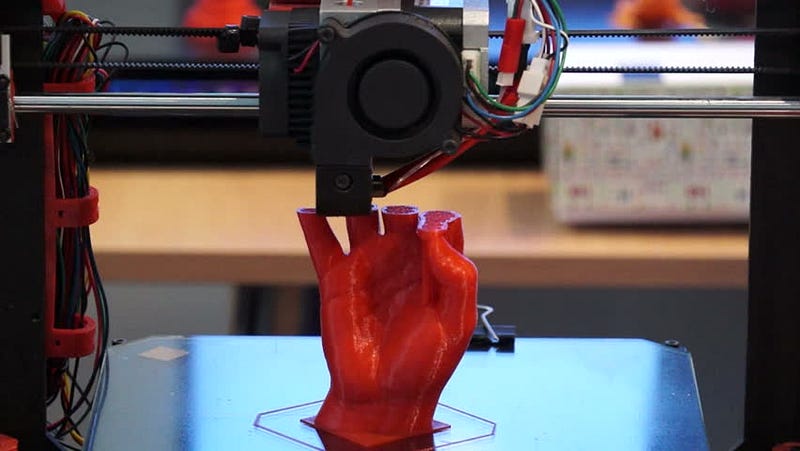
3D printing is widely used today by simple consumers as well as industrial conglomerates

Cyber security breaches are fragmented, changing over time, often used in combination, and growing exponentially, causing both financial and reputation harm to individuals, businesses, and governments. To build cyber resilience, getting the people part is critical.

To build cyber resilience, getting the people part is critical

Internet of things (IoT)

Today, more and more devices are becoming connected to the Internet and each other, allowing us to monitor our home temperature, intrusions, utility usage, etc. in near real-time. These devices can also communicate with each other and adjust to our desired preferences automatically. This hyper-connectivity of machines is becoming ever more relevant for industrial use cases such as transportation, traffic management or production.

Definition and key characteristics

IoT and its hyper-connectivity are networks of complexly connected objects that are aware, autonomous and actionable systems. For example, an autonomous self-driving car:

  • Is aware of its surroundings via a GPS and a couple of smart sensing cameras.
  • Autonomously analyzes its position, draws a map of its surroundings, communicates decisions with other cars, and checks traffic conditions via a centrally located server.
  • Is actionable when it decides from all gathered inputs when and where it to go next and translates its input into commands for the engine, the brakes, and the steering wheel.

For this complexity to work, three data layers continuously interacting and communicating through data with each other via tools such as Wi-Fis to satellites or mobile connections:

  • Connected objects layer — such as the radar, cameras, pedestrian detectors, dashboard meters, etc. generating data from the physical world. Just like the human senses such as our eyes
  • Central platform layers — all the connected devices of the previous layer need to interact with a platform that can consolidate the data and decide what to do with it. Just like our brains
  • Services layers — that can understand the aggregated data and translate it into action, in the physical world. Once again, like our brains

The underlying trends: proliferation of Big data and Cloud services

IoT requires data processing, transmission, and storage — this is the combination of Big Data and Cloud services and as the technology required for each component has become more stable and cheaper to manufacture, IoT has also proliferated, making it economically efficient to embed more of the technology into more and more objects.

Today, in 2020, we have ~20 billion connected devices and these numbers is projected to grow to ~75 billion devices by the year 2025 at ~28% CAGR. This means that today we have ~4–5 and in 2025 will have ~9–10 connected devices per human being on the planet — a doubling in volume over the next five years.

The business opportunity of IoT
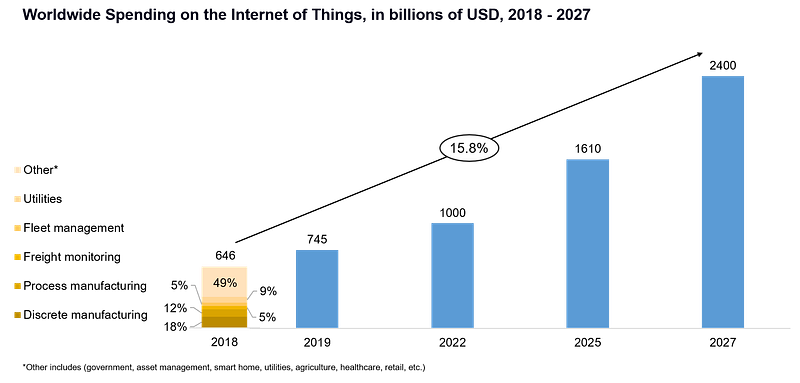
Worldwide segmented spending on the Internet of Things — in billions of USD — 2018–2027

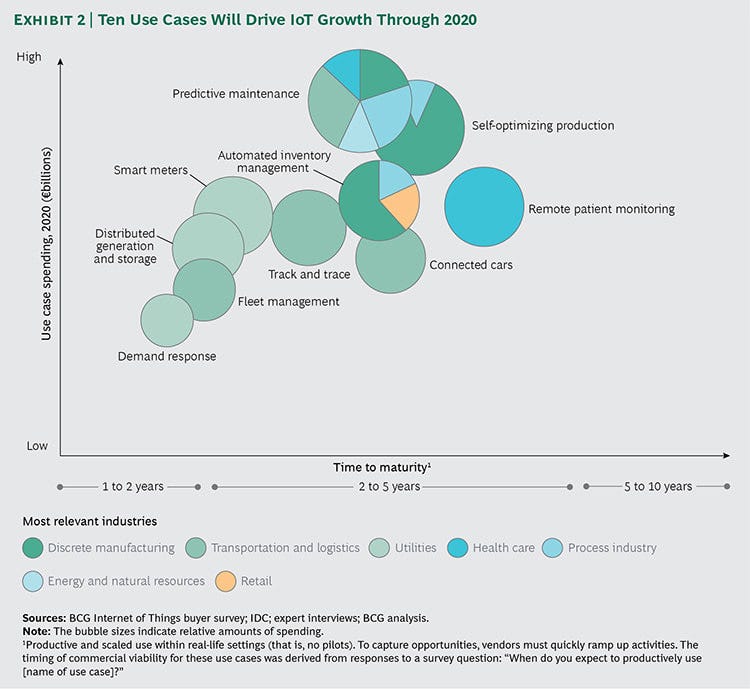
The global IoT market is big and projected to grow at ~16% CAGR to ~2.4 trillion dollars in 2027. This wide adoption is driven by specific use case scenarios rather than by industry-wide adoptions, with some of the use cases not only incrementally improve existing operations but also create new and innovative products or business models that were not possible before. BCG has a report titles Winning in IoT: It’s All About the Business Processes that identifies ten use cases that are poised to mature rapidly and experience widespread adoption (in a B2B context) by 2020, with 50% of the expected IoT spending is generated by discrete manufacturing, transportation and logistics, and utilities. The total of 10 areas as recent drivers include:

  • Utility and energy demand response
  • Energy distributed generation and storage
  • Smart meters
  • Fleet management
  • Track and trace (e.g. in retail)
  • Automated inventory
  • Predictive maintenance
  • Self-optimizing production
  • Connected cars
  • Remote patient monitoring
10 use cases that will drive IoT adoption — by BCG — Winning in IoT: It’s All About the Business Processes

The challenge: interoperability and the IoT ecosystem

Today, IoT is still in its early stages of maturity and there still is no one single platform and many players are trying to consolidate the current cases and win the platform war. The current IoT situation is similar to the situation of the Internet in its early days, before the standardized TCPIP protocol that gave us a single and fully scalable platform. IoT is not there yet and today we have +400 platform service providers — a fragmented marketplace. The reality is that only a few will survive and they will do so if they can federate a large community of application developers around them. Open source and open standards might be one path to full interoperability. The key questions today include: Will the platforms used today be inter-operable with others tomorrow? And will we see the days of full interoperability between devices, services, and platforms? Today, IoT platforms with modular architectures, and easy to use APIs that can integrate with other IoT ecosystems, application, or service providers are desirable.

3D printing — additive manufacturing

While the term ‘additive manufacturing’ is more often used in an industrial context, the general public refers to it as ‘3D printing’. 3D printing is one of the main and current digital trends, but unlike most of the other trends, it has a very tangible effect on our physical world whereby we can create real and tangible physical products. For example:

  • In 2014, surgeons in Wales used 3D printers to reconstruct the facial bones of a man injured in a motorcycle accident, becoming the start of the 3D printing rise in medicine.
  • In 2015, the FDA approved Spritam as the first 3D printed drug used to reduce seizures for epileptic patients, allowing the pill to disintegrate in the mouth with just a little bit of water, which helps swallow the pill.
  • In 2017, Reebok 3D printed its next line of shoes by the new liquid factory method, and since then, others, such as Adidas and Nike have followed the path to 3D printing shoes.

Defining 3D printing’s key characteristics and types

While in traditional manufacturing (i.e. subtractive manufacturing), shapes are cut out of blocks of material, 3D printing is the opposite. The 3D printing process entails three key phases:

  • A digital representation of the object is developed, either by building it into design software such as CAD or by scanning a real-life object
  • Then, the digital model is sliced into multiple layers of less than 100 micrometers each
  • Finally, the sliced model is sent to a 3D printer that creates a 3D object through successive adding of layers of plastics, ceramics or, metals

3D printing is currently a reality, and in action, there are many variations of 3D printing using different technological solutions. Such as FDM, (i.e. fused deposition modeling), or SLA (i.e. stereolithography, or SLS (i.e. selective laser centering).

The underlying trends: proliferation of Big data and Cloud services

Since 2012, the private sector has invested more than 1 billion in 3D printing-related R&D facilities, centers of excellence and pilot production plans and in 2020, the overall 3D printing market totaled $16 billion, an increase of more than $10 billion since 2015. The market is projected to reach 350 billion by 2035.

For industrial firms such as GE, additive manufacturing is a key part of their evolution into a digital company. GE has not only invested heavily in in-house R&D but has also acquired other companies in the area. With such investments, in 2017, GE succeeded to 3D-print 50% of the parts of a helicopter engine, making it 40% lighter and 60% cheaper.

This growth is fueled by three main multi-technological advancements that have made 3D printing more and more mainstream:

  • More affordable printers — while the entry price a few years ago was $5,000, you can now buy a decent one at $500 and in a couple of years from now, having a 3D printer in your house will not be uncommon
  • Cheaper materials — the required materials for 3D printing are becoming less and less expensive and more diverse
  • Faster printers — with recent 3D printers, one can print parts in minutes instead of hours as with the earlier versions

The business advantages of 3D printing

There are multiple benefits in additive manufacturing, including:

  • Production flexibility — it does not require a lot of set up costs before going into production, giving a company greater flexibility in production volume, timing, and location
  • Precision — it can be more precise than many traditional methods in building complex objects
  • Less waste — it generates less waste as the object is not kept out of a block of material, unlike traditional subtractive manufacturing methods

With these benefits in mind, many companies are considering different opportunities to evolve their current manufacturing process, such as:

  • Prototyping — traditionally, prototyping required to either build the prototype manually or to adjust the whole production line, costing a lot of time and money. With 3D printing however, it is possible to develop a prototype without any setup costs or the need to disturb the functioning of the production line
  • Personalization — during the production phase, for example, creating tailored prosthetics for patients
  • Innovative products — with 3D printing, we can build innovative products that we were not able to build before such as bionic, lightweight, and hollow structures such as fast-dissolving pills

However, 3D printing is not expected to fully substitute the conventional well-tested processes of subtractive manufacturing, especially for high volume or mass production. This is because when you have a high volume production, setup costs are insignificant in the bigger scheme of things, and when no personalization is required, the scale effect of a mega factory justifies economics of scale.

The challenges with 3D printing

For many industries, additive manufacturing will have profound implications on the whole value chain, for exampling in warehousing of parts and distribution of previously centrally manufactured parts. Some other questions that arise for firms include:

  • Does it make more sense to store duplicates of each part or just have a universal 3D printer with all the models loaded into it?
  • Should firms continue to manufacture and sell parts or close the factory and license the 3D models? Essentially, becoming a design powerhouse.
  • How could firms guarantee that designs will not be published, downloadable for anyone? How will regulations need to adapt to the new environment?
  • How about if people developed 3D models of dangerous materials such as guns? What if each individual develops their pills and distributes them online — who will attend to the consequences?

Therefore there are a lot of questions and challenges from regulations, to border control, to intellectual property protection, and even taxation when it comes to the wide adoption of 3D printing.

Cyber Security

In spring 2017, a ransomeware program called WannaCry infiltrated personal and organizational computers around the world, locking access to files and asking users to pay a fee to get the unlocking keys. Among the victims of the WannaCry was the National Health Service in the UK. On a larger scale, the economic losses from this attack were estimated at around US $4 billion, itsand this is only one example of a variety of cyber security breaches.

Various types of cyberattack

In action, there are a variety of approaches that attackers use to affect computers and servers. The most common methods are Phishing, Malware, DDos, Brutal-Force, and Physical Breach.

  • Phishing this is a relatively low tech attack that entails a fake email, text message, or website created to look like it’s from a legitimate source. Some phishing attacks have the purpose of acquiring information asking users to enter your credit card details or confirm passwords, some will install malware on computers once an attachment is opened, and some pretend to be emails from bosses or friends asking individuals to transfer a certain amount of money.
  • Malware (short for malicious software)is software downloaded from a phishing e-mail, by clicking on an advertisement, or directly from a USB stick, and is designed to get access in an unauthorized way to the system. After access, it can alter, delete or steal information from the device and can potentially spread to other users on the related network. There are multiple subcategories under this wide umbrella of malware including viruses, spyware, trojan horse, or ransomware. Malwares aim to affect and harm companies that have valuable data to protect.
  • DDoS (short for distributed denial of service) targets a server with an overwhelming amount of requests to ultimately shut it down. This would cause any website hosted on that server or any system relying on it to become non-operational. For this attack, the hacker needs to have access to many infected devices and then direct them to send the request simultaneously to a single targeted server.
  • Brutal-force attack is done by a software that tests millions of different combinations of letters and numbers to crack the password and therefore get access to the device, usually aiming to crack encrypted messages or financial data.
  • Physical breach — is whereby an intruder infiltrates an unlocked computer, installs a malware, steals data or sends an email, then walks away.

The underlying trend: growing numbers of attacks

The types of attack and the targets are fragmented, change over time, and are usually used in combinations. But overall, we know that the number of attacks is growing. It is estimated that the global number of malware attacks doubled between 2015 and 2016. Attacks are increasingly targeting the end-user devices, such as laptops, mobile phones, fridges, cars, etc. as entry points instead of servers.

Overall all industries are affected by cyberattacks, however, financial services and public sector are usually in the list of the most targeted ones. This is also because 70–80% of attackers are motivated by financial gain, 10 to 20% are acts of espionage, and only a very small fraction is promoting an ideology or just having fun.

The business opportunity of Cyber Security

In the best-case scenario, a cyber attack is annoying and in the worst of cases, it can disrupt the way governments and companies run their day-to-day operations. Such was the case for Stuxnet and the Iranian nuclear plants.

Today, the cybersecurity market is estimated at ~$180 billion and with recent growth rates of 10% CAGR, it is projected to reach ~$250 billion by 2025. However, considering that the number of attacks per annum is doubling, and with that, so is its sophistication levels, this amount of spending is not on par. In other words, the business world is linearly dealing with an exponentially growing problem.

The challenge of Cyber Security

The Stuxnet example along with the ‘Ralph Langner: Cracking Stuxnet, a 21st-century cyber weapon’ video above, show how sophisticated cyber attacks can become along with a forgotten side, that this attack was not a pure technology failure but rather a human error. Inadequate technology and systems accounts only for a smaller share of data losses; the people part accounts for most of it. This is why many organizations, top executives and board members still need to take cybersecurity seriously rather than a segment of IT security services. Sustainably addressing cyber risk requires an organization-wide approach, with organization-wide processes and procedures to be in place. Today cyber attacks are not a question of if, but when they will happen.

A complete IoT system will have functions of sensing, processing, and action helping it be aware, autonomous and actionable. Driven by further technological advancement in processing, transmission and storage of data, we will have ~10 connected devices per human being on the plant in 2025 and we need to find new ways such as open-source development to unify IoT platforms.

3D printing is widely used today by simple consumers as well as industrial conglomerates. It will not substitute, but complement traditional manufacturing whenever more personalized, complex products at small scales are needed. Increased adoption of additive manufacturing will reshape value distribution among players, dictate new ways of organizing supply chains, and create new regulatory frameworks.

Cyber security breaches are fragmented, changing over time, often used in combination, and growing exponentially, causing both financial and reputation harm to individuals, businesses, and governments. To build cyber resilience, getting the people part is critical.

Digital Transformation
Innovation
Internet of Things
3D Printing
Cybersecurity
Recommended from ReadMedium