
DIGITAL TRANSFORMATION
The winners and losers of digital disruption
Disruption is a natural product of market economies leading to innovations and new technologies that better the quality of life for humans. It has been around since the beginning of time and will remain constant well into the future. Digital disruption, as a recent global phenomenon, has changed value chains and industries, creating new opportunities, dissolving some incumbents, such as Kodak, and propelling others, such as Apple, to new heights.
For incumbents, it is important to understand their disadvantages, while utilizing their advantages to build barriers to entry and a competitive edge, through a delicate and balanced act of exploration vs. exploitation.

Understanding digital disruption
A brief history of disruption and transformation
Digital transformation is nothing new. Business disruption in one form or another has been around for at +50 years. For example, Swiss watchmakers were one of the leading makers of mechanized watches for centuries, and then along came Japanese digital watches in the late 60s such as Casio, taking over the market. Then in the 1980s, the Swiss watchmakers reemerged with an emphasis on style and design leveraging the new technology.
Another example is Kodak, a market leader in chemical film production, and then along came digital photography and Kodak went bankrupt. Interestingly Kodak had seen the new technological revolution coming and had begun investing in the digital transformation in the 1980s, yet it wasn’t able to make the transition. However, Nikon who also was a leader in cameras on the film side, saw it coming and could make the transition by focusing on its expertise in lens manufacturing.
A similar disruptive pattern was observed in the telco industry, with the rise of cellular technology in the 1990s, companies such as Motorola and Nokia, BlackBerry, and Palm rose to riches, and with the advent of the iPhone in the 2010s, a true game-changer that redefined the dominant design in the industry, they all faded away through an industry shakeout.
Similar disruptive trends were observed in the music industry with the rise of record stores such as Circuit City, their downfall and appearance of various types of digital file-sharing then digital distribution platforms such as Napster or iTunes, and the current success of streaming services such as Pandora and Spotify. The on-demand music streaming market has had an impact not only on record stores and retailers but it has fundamentally changed the business model for musicians, producers, and record labels and impacted how we as consumers consume music.
In the entertainment industry, video-on-demand services disrupted the market, and companies such as Blockbuster disappeared, while Netflix, a DVD-by-mail business model, adapted and made a significant transformation from being a DVD-by-mail business to being one of the leaders in streaming and on-demand content. So some companies can make transitions during a technological revolution.
A similar pattern was observed in the retail space. Sears was the leading retailer for a good part of the 20th century in America, then came Walmart which leveraged information technology to innovate the supply chain, and later, Amazon, which innovated across the whole customer experience around online retail.
The taxi and limo services industry was transformed by the advent of Uber and Lyft, whereby these companies are not leveraging a significant technological change, but changing and redefining the business model user experience, creating new values.
The automobile industry, which had seen a century of stability with the advent of the internal combustion engine, is now being disrupted by electric vehicles and autonomous vehicles, with the entry of companies such as Tesla, Google, and Uber.
Digital transformation has been coined the fourth industrial revolution, and with the rise of new, next-generation digital technologies such as artificial intelligence, machine learning, Big Data, or robotics, digital transformation will be accelerated even more. While any industry transformation tends to be disruptive to existing business models and markets, it also creates new opportunities for new businesses, new markets, innovative opportunities for upstarts/startups, new entrants, and established businesses.
There are varying forms of disruption
Disruption is arguably a natural product of market economies. Disruption leads to innovations and new technologies that better the quality of life for humans, and there are many different types of disruption in the marketplace.
- Technological — for example, digital watches use electronics technology to further enhance the value offering of mechanized wind-up watches. Digital cameras also use electronics to replace chemical film-based cameras. These are both examples of radical changes in the fundamental technology within an industry.
- Architectural — for example, the Sony Walkman came about not with any fundamentally different or new technology, but utilized existing technology that existed in different types of cassette players shrank it, and made it a portable player that consumers could wear on their side while walking around or going for a run. So, while the underlying technology didn’t change, the way they organized and packaged the value proposition had changed, architecturally.
- Business model — for example, Airbnb comes along and leverages communication technology as a way to create market efficiencies in the accommodation industry, redefining the market and value proposition. Here, existing and established technologies are leveraged to change existing business models.
- Consumer side, the high-end — such as the iPhone, which came in with a completely different set of features at the high-end of the market, at three to four times the expense of some of the other phones that were on the market at the time.
- Consumer side, the low-end — for example, Nintendo Wii. With two dominant players, Xbox and PlayStation, Nintendo came in with arguably a much, much technologically simpler machine, one that cost a fraction of the cost of the other players, and had an innovative game control, allowing the development of creative games that resonated with the marketplace, and entered in at the low-end and ended up disrupting the whole market, becoming the winner of its generation. Another example is Wikipedia, which is arguably not of the quality of an Encyclopaedia Britannica, but its new model of using crowd-sourced information allowed it to have a very low-cost entry and free entry for usage by individuals.
- New markets — for example, the Word Processor disrupting the typewriter industry, the automobile redefining transportation and putting the horse-drawn carriage industry to bed, and smartphones redefining several different industries including cameras, mapping, and the like.
- Value chain — for example, Craigslist or other online listing portals. While Craigslist didn’t directly compete with newspapers it disrupted their value chain as it took away their revenues.
Disruptive aspects of the digital revolution
Digital transformation has the potential to be disruptive in many different ways. Here are five main avenues:
- Data — we now have huge amounts of data available to consumers and companies to leverage and advance the products they offer. For example, Waze is an app that leverages people’s cell phone data to determine when there are traffic jams and to crowd-source reports of accidents or road constructions. By leveraging data, Waze can create value.
- Innovation — in the world of a digital economy, we’re able to do quick testing with innovation, speeding the cycle, and allowing companies to run real-time experiments and prototypes in a very inexpensive way. For example, social media networks such as Facebook can offer new features and new offerings on their platform in a way that allows them to experiment and learn in real time before rolling it out to the masses.
- Competition — digital transformation, reduces transactional costs and therefore eases entry by other players within an industry. Therefore we would expect increased competition in any number of domains where digital transformation is having an impact, potentially even blurring defined boundaries between different industries. Companies that were once partners are now increasingly rivals, for example, Google, Apple, and Amazon are increasingly competing in various domains within the larger digital technology space.
- The value created for customers — what we’re seeing is new ways to deliver value in creative ways, leveraging digital technology. Take Uber, for example, leveraging social and communication technologies to offer a new value proposition to customers looking for traditional livery services.
- Customers — themselves, are evolving, becoming highly informed, and potentially being less loyal than they were in the past. For example, Best Buy suffers from the fact that many customers will come to their stores, sample their various products, and then, pull out their cell phones, look on Amazon, and purchase the product then and there. So, customers are becoming more sophisticated, and they’re becoming less loyal to previously established offerings.
Sources of competitive advantage are changing
With the advent of the digital revolution, traditional sources of competitive advantage will largely disappear:
- Natural monopolies formed through resource scarcity — while they’re still important today, many industries, places, and spaces are becoming less important. The obvious example is in the retail sector. As retail goes online, those positional advantages, the geographic or location advantages become less and less important.
- Economies of scale will be under threat — in a digital environment, it can often be quite easy and cost less to scale. For example, Facebook went from two guys in their Harvard dorm room to a billion-dollar business in a matter of a couple of years. The ability to leverage digital platforms to scale a business and its technology is greater than what it had ever been before.
- Learning curves and operational know-how can be acquired easily and cheaply — while clearly, learning curves still do exist, the ubiquity of information provided by the internet and other data sources is making those learning curves less and less pronounced, and allowing others to catch up relatively quickly, by having access to valuable information on how to create and deliver value.
- Vertical integration is becoming irrelevant — while historically, large industrial companies vertically integrated their value chain to create value and serve as a deterrent to others trying to compete with them in their marketplace, digital technology is making it easier and easier for people to disintegrate vertical supply chains and specialize in different components of it. For example, the telco industry has unbundled its vertical integration, allowing innovative and competitive horizontal layers to form.
The drivers of digital economies
So, we want to think about four underlying drivers that try to drive digital economies and have this disruptive potential.
- Network effects and externalities — the idea that a good or service improves in value as others consume that good or service. The classic example is the telephone. Having to be the first person to own a telephone is not very valuable, but as others begin to buy telephones, the value of owning a telephone starts to go up. This is the main driver of value for social networks such as Facebook, Instagram, and Twitter.
- Winner-takes-all markets — the various network effects that are prevalent in digital economies, tend to create winner-take-all all markets, where there might be one dominant player within an industry. Facebook, Google, Amazon, and Apple have all in various ways leveraged network effects to create quasi-monopolies, where they have the advantage of a winner take markets.
- Platform technologies — the internet, mobile, and cloud computing are all examples of platform technologies where an underlying technology that has great value across a wide number of sectors, allows different companies to plug into it in different ways. Traditionally, the advent of the automobile had a similar platform impact in the sense that a whole set of suppliers accumulated around the automobile industry to support it.
- Complementary capabilities — are other ways of delivering value by offering some specific capabilities that allow you to leverage other platforms or established externalities to your advantage. Perhaps it’s manufacturing capability or great customer service that you provide, but no matter, you’re going to need to find that specific way in which you can uniquely deliver value, given the ubiquity of these other different platforms and technologies.
The industry or competitive life cycle
Transformation and disruption follow a common pattern of impact on the industry over time, often referred to as the industry or competitive life cycle. Industry life cycles are similar to the idea of a product life cycle but are viewed at the industry level rather than the individual product level. Some notes on the industry life cycle include:
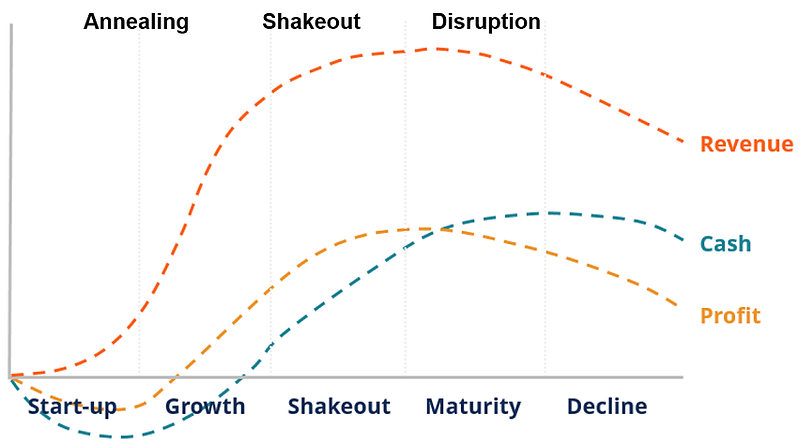
- The S curve — refers to the common pattern in sales or revenues that we see over time.
- There are three revenue phases in an S-curve — emerging or introduction, growth, and maturity. Sometimes, the emerging phase can take decades to occur, for example, in electric vehicles which had existed even back at the early stage of the automobile industry, or it could pass very quickly. The growth phase s is the sweet spot of the S curve where we see a lot of growth in sales. And eventually, there is a mature phase where growth starts to decline and we reach a stable level of sales.
- There are three competitive phases — annealing, shakeout, and disruption. Annealing is this idea that over time, there’ll be a coalescing around the ‘dominant design’ of the technology, showing how the technology looks moving forward. Shakeout refers to what happens to the number of competitors within the industry, generally, early on, a few intrepid entrepreneurs or incumbent firms enter, and as the market starts to take off, others come, and eventually, competition dwindles and we get a shakeout in which firms either go out of business or merge, limiting the number of companies in the market. The general question here is — depending on the industry — what is the competitive outcome during the shakeout phase (prior to maturity with stable dividends)? How severe will the shakeout be? And what will happen to the winner-take-all dynamics?
- Margin dynamics could vary depending on the industry — in many industries early on, margins might be negative, with no profits being made but as the industry starts to grow, they’ll improve. Sometimes, with increasing competition and if winner-take-all dynamics do not exist, then margins might get compressed.
So, the competitive life cycle is a common set of patterns that we see across many different industries. As an example, we could assess and review the patterns seen in the market for digital music players to better understand the competitive life cycle — in the mid-1990s, there was an established industry of portable CD players led by Sony. Rio entered the market as the first provider of digital music players. Then multiple other firms including Microsoft Zune, Dell, HP, and many others entered the market with their unique players. The iPod entered the market as a late entrant, but with its entry, it was able to establish the dominant design, becoming the dominant form function and factor of the industry. Then the iPod was eventually disrupted by the iPhone.

The winners and losers of industry disruptions
If incumbents can hedge their downsides and utilize advantages, get the economics of innovation including timing right, and build barriers to entry by investing in intellectual property, core capabilities, and strategic complementary assets, then they should maintain a winning position in the market, despite disruptive revelations.
The downsides of being an incumbent firm
Incumbents have continuously met their end due to industry disruptions throughout history. The question here is: why do incumbent firms often fail when faced with these disruptions? There are three possible answers:
- There are no better positions when new entrants with an innovation or new technology come along. In essence, the innovation renders existing capabilities valueless, either technologically, organizationally, or market-wise.
- Incumbents could see the entrants coming but have inherent and natural core rigidities. The idea here is that, what made an incumbent successful in the past, what may have been a core capability, becomes a core rigidity as the industry shifts, because they are unwilling to change. Such cases are Borders, the retail bookstore in the US that saw its investment into stores as a sunk cost if it did not recoup profits after the entry of Amazon, or the case of Kodak, whereby its chemical engineering prowess and capabilities were different from digital technologies and hence made change hard for the company.
- Incumbents choose to not change and fail. Maybe there’s a fundamental trade-off between the long-run competencies they need and the short-term advantages that they have or maybe they’re worried about cannibalizing their existing products. For example, Blockbuster believed that it shouldn’t try to transform itself into an online streaming business. They had no inherent capabilities there and needed to milk the cash cow they had, their retail stores until they went out of business — planned obsolescence.
The advantages of an incumbent firm
On the flip side, it becomes a question as to how some incumbents survive disruption and profit immensely from change.
- Innovation might require extensive capital and expertise. Sometimes an innovation will require large amounts of R&D spending and access to expertise that is recruited or protected by large firms.
- Customers’ preferences may aim towards assurance from established firms. Maybe the customers are risk-averse or unwilling to try new brands. It’s going to be interesting to see how BMW and Volvo will perform in the electric vehicle market as two well-established and well-respected brands that are becoming more aggressive with electric vehicles.
- Incumbent firms may leverage some type of complementary resource or capability to their advantage. Think about Nikon and the camera industry, where they were able to make the transition to digital by focusing on their lens technology.
- The incumbent firm has a dynamic capability. This is the ability to adjust to changing business conditions. The prototypical example of this in recent years has been Apple, which they were able to create a dynamic ability to reinvent itself in the face of changing market conditions. And in many ways, this is the golden ideal that many companies are trying to achieve when they think about their innovative capabilities. How do we create a set of capabilities to allow us to be dynamic and responsive to changing marketing conditions as we go through an industry transformation?
The tricky gameplay of the economics of innovation
An observation is that those who invent or those who pioneer a market are not always the ones who win a disruptive transition such as digital. The invention of innovative disruptive technologies is not as important as extracting appropriate value from them.
The total value created by innovation is shared by several different stakeholders including the innovator, customers, suppliers upstream, and other imitators and market entrants. The big question is, how big is the slice of the pie that each of the stakeholders ends up capturing, especially the innovator? The reason this is important is that timing is everything and there are different strategies that different firms might pursue based on their set of capabilities or the nature of the market.
- Sometimes, being first-mover matters — for example, Amazon, the early-mover advantage allowed them to learn immensely about the online retail operations and build up infrastructure associated with that.
- And sometimes, being a later-mover is more advantageous — to let others advance the technology or market and then come in as a quick imitator, with advanced technology, and dominate the marketplace. Microsoft over the years has been very successful with this type of strategy in particular with their Office suite.
Exploitation vs. exploration — a balancing act
Exploitation refers to investing in research and development to incrementally improve existing products and services while exploration refers to investments that aim to advance the technology significantly and bring about incremental disruptions and industry changes. A critical question for a lot of organizations is how much effort to spend on exploitation versus exploration. It’s usually a balancing act for many companies and is involved in part by the nature of the market conditions and the nature of the company. Two factors can shape this balancing act: the strength of intellectual property protection and complementary assets.
When we think about the competing forces and when you time entry into a market, we want to think about these two forces, the strength of intellectual property protection and the role of complementary assets, and reflect where we as a company have those various strengths or weaknesses and that might determine how we might compete in a digital transformation.
Strong intellectual properties as barriers to entry
Intellectual property could be, for example, a patent on technology, or copyright on a written piece, or something about the underlying nature of the technology and the market. Strong intellectual property protection, tends to favor innovators, and weak ones may favor others, the second movers. When is an intellectual property strong?
- When there are legal protections, patents, copyrights, trademarks. It’s important to recognize that simply having a patent or copyright does not necessarily mean you have unassailable rights to it. At the end of the day, you have to be able to fight for it in a court of law
- When there’s some form of first-mover advantage. The first-mover advantage of an innovator needs to translate into some sort of sustainable competitive advantage such as increased know-how, lowered costs, more quality or value, or customer loyalty and branding.
- When it becomes the industry standard. Becoming the dominant design of the industry can lock a firm down as a winner and make it very hard for others to compete with it. This is in essence another form of intellectual property that gives a competitive advantage.
- When it's difficult to imitate. If the imitation of a firm’s technology or operations is slow, then it's another form of tight intellectual property protection. Many companies forgo patents and instead use things like trade secrets that are hard for others to imitate.
- When it diffuses quickly among customers. Examples of this include Facebook as a social network or Pokemon Go game.
Controlling complementary assets as barriers to entry
Complementary assets are the other things necessary to exploit an innovation being marketing or distribution or some other supporting technology such as hardware and software. However, in most cases, these complementary assets are organizational know-how mostly related to insights about the customers.
The question in regards to complementary assets is: how important are these complementary assets? We want to know how tightly held they are. For example, if an innovative product requires a specific manufacturing technology, and that know-how is stored with a specific company, then they would capture a good share of the value of that innovation, even when they are not the innovator. This does not necessarily need to be about manufacturing and could include distribution, marketing, product design, etc.
Some questions to ask to find a position during a disruption
- How long will each phase of the competitive lifecycle take? Do we expect the mature phase to be decades-long or is this just going to be a matter of a few years? How long is that emerging phase?
- Is this a slowly evolving industry, one that might be relatively stable for decades, or is this maybe a hyperdynamic industry?
- How severe will each of these transitions be? Are the disruptions more radical in nature or more incremental in nature? What will the annealing process look like? A single dominant design or will there potentially be multiple competing designs that can coexist?
- Will there be a winner-take-all market during the shakeout? Will, there be one single winner, or will it be a duopoly or an oligopoly?
- Are there first-mover advantages? Does timing matter here? Can we wait and be patient and have a second-mover opportunity?
- What is the role of the complementary assets? Do we need marketing, distribution, etc. as success factors?
Hope you enjoyed reading this article! :)
If so, then:
- Follow me on Medium
- Become a Medium Member
- Subscribe to hear more
- Let’s connect on LinkedIn