
Diffusion of ‘Design Thinking’ mindset into organizations
When thinking of design thinking diffusion, some questions come to mind:
- Why has it gained so much traction and appreciation?
- What is the reason for this interest from innovators in new ventures or established firms?
- How do firms adapt to and execute design thinking?
- Where in the firm is design thinking generally nested?
- What is the organizational design required to make it work?
- What are the performance indicators and key success factors needed to make design thinking work in startups and established firms?
How much has design thinking diffused into firms
According to the publication — ‘Parts Without a Whole’ — the first firms that adopted design thinking and were not specifically design firms were Procter and Gamble in 2004, Kaiser Permanente in 2005, and Intuit in 2007. Over the past 12 years (+)147 other established firms have adopted design thinking methodologies. Here are some facts from the ‘Parts Without a Whole’ publication:
- Size does not matter — design thinking is practiced in firms of all size
- 36% of the 25 top-funded startups, such as Airbnb or Etsy, were co-founded by designers
- Design thinking is adopted in all sectors, with a predominance for firms active in the information and communication sectors
- 70 design agencies were acquired between 2004 and 2017 — consulting firms in management and strategy are developing design thinking capabilities by acquiring design companies; for example, McKinsey acquired Lunar in 2015
- Investment funds have designers on their teams, either at the early stage, such as Andreesen & Horowitz, 500 Startups, or Y-Combinator, or at a later stage such as Google Ventures
Interest in design thinking — individual level
To improve innovation outcomes, design thinking practices such as collecting data, searching for facts, and experimenting and involving teams with diverse perspectives, mitigate individualistic cognitive biases. They prevent the creators from projecting their world views onto others, limiting the options considered, ignoring disconfirming data, and being overconfident and over-optimistic. Some of the biases that design thinking helps overcome include:
- Projection bias — the tendency to overestimate how much our future selves share one’s current preferences, thoughts, and values, thus leading to sub-optimal choices
- Egocentric empathy gap — the tendency to overestimate the similarity between what we value and what others value. We generally project our thoughts, preferences, and behaviors onto other people
- Hot-cold gap — is a cognitive bias in which people underestimate the influences of visceral or instinctive drives on their attitudes, preferences, and behaviors
- Focusing/anchoring illusion — the tendency to place too much importance on one aspect of an event — individuals depend too heavily on an initial piece of information offered (considered to be the “anchor”) when making decisions
- ‘Say/do’ or ‘value/action’ gap — is the space that occurs when the values or attitudes of an individual do not correlate to their actions
- Planning fallacy — the tendency to generally be overly optimistic and overconfident about how our ideas will be received — this is great to keep entrepreneurial behavior, but it is a risk for the project
- Hypothesis confirmation — we generally seek an explanation that coincides with our preferred alternatives
- Endowment effect — the tendency for people to demand much more to give up an object than they would be willing to pay to acquire it
- Availability bias — the tendency to undervalue options that are hard for us to imagine, whereas we value familiar options. This results in a preference for incremental solutions
Interest in design thinking — team level
Design thinking enables the collaboration of interdisciplinary teams, values the differences, and acknowledges the contribution of each discipline while the structured processes, phases, and tools ensure effective collaboration among team members.
Interest in design thinking — the firm-level
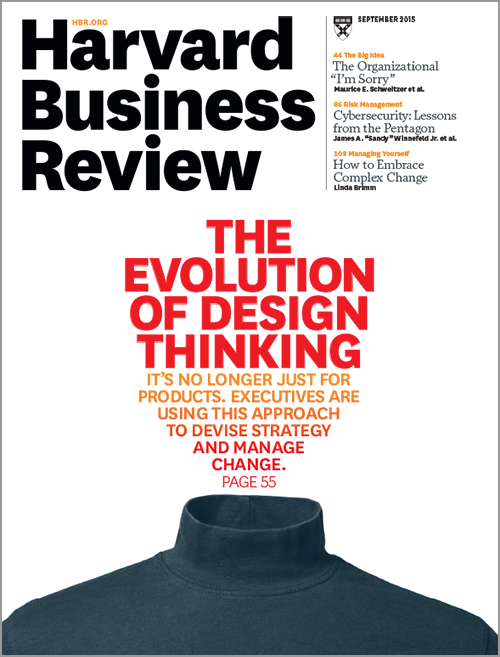
The Harvard Business Review of September 2015 is dedicated to design thinking: ‘The Evolution of Design Thinking’. In this special issue, we learn that firms are increasingly targeting a design-centric culture. The reason is that many products, services, and processes are becoming more and more technologically complex. For example, GE or IBM, for which software is a fundamental part of their businesses, acknowledges the increasing level of difficulties for users when dealing with such high-level complexity products. Therefore, firms want to make interactions with their technologies and complex systems more intuitive and design thinking should help create those kinds of interaction.
Furthermore, this issue of HBR indicates that design thinking qualities tend to spread from the product design function to the whole organization, benefiting other employees and the entire organization as well. There are also many channels through which design thinking enters firms, adapting to the context and specificities of each organization.
Many firms also rebrand design thinking and designate it with different labels to emphasize a certain element that is particularly important to them. For example at GE, it is designated as FastWorks framework, which emphasizes a rapid prototyping dimension, and at IBM, it’s IBM design thinking, which is a framework that emphasizes the focus on user outcomes, the restless innovation by considering everything as prototypes and having diverse, empowered teams. It is also designated sometimes as Service design, Co-creation, Integrated design, etc.
Hosting design thinking in the organization
There are five paths that organizations have taken to structure and utilize design thinking in their processes and operations.
1. Outsourcing
Some firms do not integrate design thinking within their walls and occasionally call external consultants to facilitate design thinking projects.
2. Integrating as an integral practice with functions or departments
In this scenario, design thinking is generally located within departments or support functions, such as marketing, R&D, HR, strategy, etc. In these situations, design thinking is adopted to identify new opportunities, products, or services through alternate methods, besides and simultaneously with the existing innovation capacities of the firm, such as R&D or marketing. When it is hosted in the strategy functions, it is used for strategic decision-making or designing new business models.
3. Creating a separate and dedicated internal unit — Skunkworks
In this scenario, design thinking has a dedicated internal unit, separate from the rest of the firm. The rationale here is that this independence enables the development of specific methods and rules, different from what exists already. This form of organization — called skunkworks — is similar to the one adopted by Lockheed Martin in World War II for advanced development programs that resulted in many famous and successful aircraft.
The risk with having a separate and dedicated design thinking unit is that the rest of the firm may not accept the opportunities identified within these entities, also termed as the ‘not invented here syndrome’. When opportunities are explored in such separate and isolated units, they are somehow thrown over the walls to the rest of the firm, who did not participate and are not even informed about this exploration. This downside needs to be managed as design thinking favors teamwork and interdisciplinary cooperation. Involving and inviting the rest of the firm in the workshops leads to co-creation.
So, if design thinking is hosted in a unit isolated from the rest of the firm if projects do not involve other players from the rest of the firm, and if on top of that, there is no awareness about what design thinking can bring, there will be animosity between units rather than collaboration.
4. Integrating as an internal consulting agency
This agency delivers training in design thinking and consulting by facilitating workshops and exploring opportunities for and with the different internal business units, as well as for HR or strategy projects. In such settings, there could be four main goals that such an agency would aim for:
- To propagate design thinking culture
- To give employees the tools and empower them to be more open-minded
- To provide consulting support and collaboration
- To train employees on new advancements and knowledge
5. Fully integrating design thinking with the firm DNA and culture
It has to do with integrating it into the culture itself. We’re spreading design thinking so that it’s recurring in the company. And no one owns it then. So, there is not an us against them thing — Wendy Castelman, Innovation Catalyst Leader at Intuit
When design thinking is everywhere as an established practice and mindset, it diffuses into the firm’s culture and DNA. In that case, the main principles of design thinking such as user-centricity, experimentation, or interdisciplinary collaboration are shared by everyone within the firm. In such firms, design thinking is adopted everywhere, even in the sales, operations, or finance departments, that are perceived as the antithesis of design thinking.
Usually, creating such a working culture and environment can be difficult as seen in the video below, where Intuit had to go through a comprehensive change management program:
KPIs and Key Success Factors for Design Thinking
Key performance indicators — measure behavior change
Despite the increasing adoption of design thinking by firms, there are no shared and accepted performance measures. There are numerous reports that design thinking improves work culture on an individual and team level, innovation processes are more efficient, it generates a flow of opportunities to develop and feed the firm’s new product development pipeline, but in general, it is hard to find any direct measures of financial benefits of adopting design thinking.
Here are some measures that design thinking promoters highlight when they are asked to show the benefits of design thinking:
- Increased customer feedback and satisfaction
- Increased success stories and case studies
- An increasing number of innovation opportunities explored and validated
- An increasing number of people exposed to design thinking
- An increasing number of training programs or workshops facilitated
One reason that financial metrics linked to design thinking are rare, is that design thinking is a journey that requires time and behavioral change from the employees, whereas focusing on the final innovation outcomes is a short-term view. Hence, it is suggested that firms should not measure profits per se, but the behaviors that lead to profitability.
It is claimed that measuring the innovation outcomes produced by design thinking represents only the tip of the iceberg, and that to be sustainable these outcomes rely on and require a change in perceptions and how people think about the user, about collaborating, experimenting, ambiguity, and divergence in concepts.
Understand your organization
In practice, it is difficult to introduce design thinking into organizations that do not value uncertainty, do not have an “I don’t know, let's experiment” culture and attitude, do not value intuitive thinking, or that favor certainties based on calculation and spreadsheets and thinking tactically.
Key success factors
As the adoption of design thinking requires cultural and potentially structural changes for it to work, there are four determinants of success for design thinking to work in an organization:
- Top management needs to support, ease, and encourage needed changes. Leaders must be trained or at least know about the specificities and the benefits of design thinking.
- Design thinking should not be applied in an isolated manner — also termed organizational embeddedness. Some members of the organization must practice it or are familiar with it. Information about design thinking should be shared within the firm.
- Giving design thinking, time, on the project and the organizational level. Creativity generation requires developing a deep understanding of the users, reframing the problem, and testing and experimenting with concepts that take time — while previously firms used to limit creativity to only ideation and brainstorming.
- The right place. Design thinking depends on its processes, people, and place — a dedicated space that embodies its main principles — a place where things can be messy and flexible, where members feel it is okay to wander and to search, where members can think separately, quietly, and later on work together and discuss loudly, where they can share data, display inspiration boards, and journey maps over a long period, looking for insights and inspiration.
In summary…
When design thinking fails, it is either because of:
- Individual limits such as misunderstandings of the framework, fear of failure, lack of practice, poor team selection, training, etc.
- Organizational limits such as isolation of the practice, social and behavioral barriers, lack of patience, lack of C-level support, etc.
This is part of a 5 series article. You can find all the articles here:
Hope you enjoyed reading this article! :)
If so, then:
- Follow me on Medium
- Become a Medium Member
- Subscribe to hear more
- Let’s connect on LinkedIn