
‘Design Thinking’ — steering the ‘Inspiration phase’
The ‘Inspiration phase’ is potentially the most important part of the design thinking process as it lays the foundation for the next two steps to come. The inspiration phase is about framing the problem and its scope, gathering meaningful data from customers and their pains, and then synthesizing and interpreting the collected data for actionable steps in the ‘Ideation phase’. In other words, the quality of work in the Inspiration phase feeds the raw material to work with, in the Ideation phase — therefore, if, ‘garbage in — garbage out’.
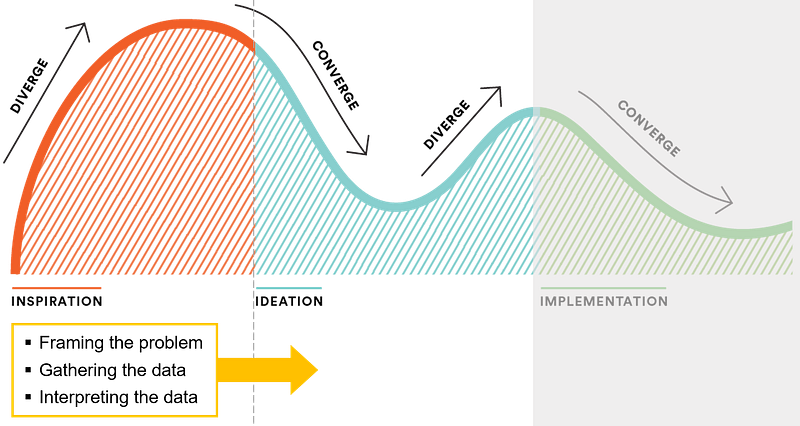
Formulating the problem and its scope
The formulation of a customer problem starts with a ‘How might we…’ question. For example in the case of Uber, ‘How might we improve passengers’ overall commute experience?’, in the case of a high-end hotel chain, ‘How might we enhance the residence experience of guests on business travel or as tourists?’. As design thinking is a human-centered approach, the initial question always starts with the customers and their problems.
Care needs to be taken when articulating the scope of the ‘How might we…?’ question. A scope that is too wide will be non-actionable, lead to a large spectrum of opportunities, be difficult to encompass all stakeholders, and be difficult to assess. On the other hand, a too-narrow scope is too specific and will limit the opportunities to be explored.
Try to start with the first articulation of all the customers and their problems/pains, and then assess the scope by exploring whether the problem is too narrow or too wide. Meaning, choose an articulation that seems actionable with an interesting level of market opportunity.
Collecting customer data — dissect the value chain
Counter-intuitively, even though design thinking is a creativity approach used to identify future-looking opportunities, it starts with ‘the now’, rather than what will be in the future. The first step is therefore to collect data on the customers and the situation at stake (i.e. their problems).
Because design thinking combines intuitive and analytical thinking, it requires qualitative data enabling empathy with the customers and quantitative data on the market, the competition, and the main trends. We can gather this data from primary sources such as interviews or surveys, and secondary sources such as industry reports.
When thinking of the customers involved in collecting data, we need to identify and assess our direct and indirect stakeholders. One way to address the scope of stakeholders is to draw the value chain, mapping all the players involved in the conception, production, marketing, distribution, and support of the offer considered. The objective is to construct an end-to-end value chain to map all the stakeholders and their interactions.
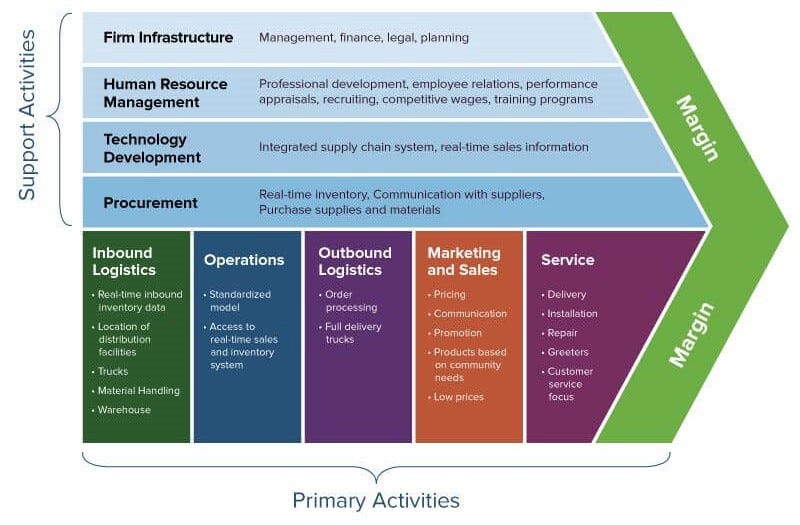
A tip for value chain mapping is to start from the outcomes, the product/service that is supposed to be created for the end customer, and then work backward to identify all the players involved in delivering these outcomes. The players involved are known as the ‘ecosystem’.
A value chain analysis consists of identifying the main steps, the players involved, and their interactions. Once you have identified the main players, you will have to analyze the competitive environment of each player and their main stakes: their strengths, core capabilities, and weaknesses. Without going very deep into this value analysis, the objective for the moment is to have an idea of the main stakeholders that play a crucial role in the situation at stake and on which you have to collect data.
Gathering data — observe your customers
In design thinking, we focus on the customer and the analysis of their problems, from their point of view, to get inspired (i.e. find meaningful insights). The key to getting inspired is building empathy with the customers, meaning putting yourself in their shoes, meaning getting firsthand experience with the customers’ constraints and problems.
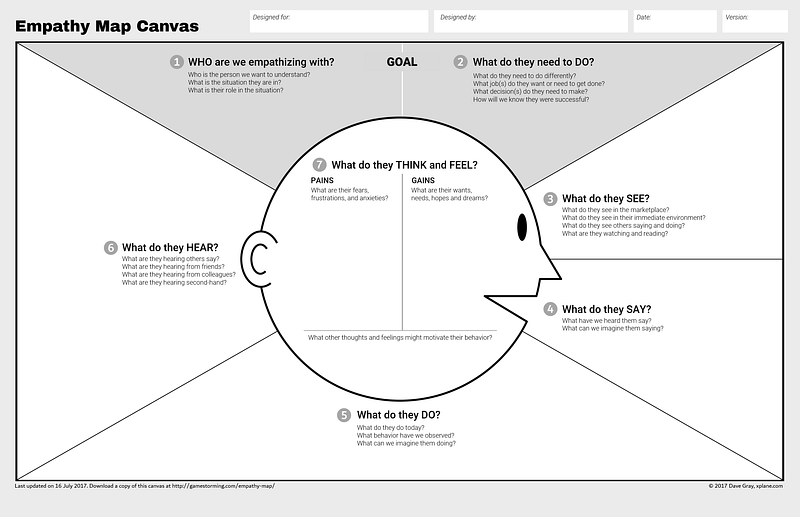
The main way to achieve this sense of empathy is through observation. Observing real people, in action and in real-life situations, to find out what they like, what they hate, what confuses them about current solutions, etc. Observation is key to capturing this empathetic knowledge compared to other methods such as interviews because people do not want to make their desires and behaviors explicit. In reality, people ‘DO’, ‘THINK’, and ‘FEEL’, much different than what they ‘SAY’. And this is mainly for three reasons:
- The usage — when using a product, people go through steps mechanically and unconsciously and do not realize how they perform tasks and therefore can’t explain their actions. Sometimes people adapt to the problems encountered in the usage of a product and find ways to get around the obstacles to the extent that they feel there isn’t a problem anymore. The objective is, therefore, to uncover what comes naturally to people and what they are unable to explicitly articulate.
- Customers’ instinct — people, generally, do not want to provide negative feedback about a product or service or they do not have the right vocabulary to articulate it. For example, you need to be a very good cook or food critic to know what is missing in a dish, and this holds particularly true for new products or services.
- The topic itself — when addressing sensitive issues, people are not keen to make things explicit, noting that sensitive issues change from one culture to another. For example, think of trying to perform customer research on Tinder; dating can be a sensitive topic of discussion for conservative individuals, they can be ashamed and want to hide details or facts. Hence it is better to observe them in action using the product versus trying to dig too deep into their opinions.
One useful tool that helps build empathy with the customer, is the Customer Empathy Map/Canvas. This map tries to deep dive into what people DO, THINK, FEEL, and SAY to build empathy with them while outlining their pains and gains. Below is a sample of the empathy map, its key questions, and a video that explains how to navigate it.
You might have heard that some extremely successful startups were built by founders who wanted to solve a personal problem. For example, the founders of Airbnb, Uber, and Dropbox started with frustration over a specific problem they experienced and developed the right amount of empathy and understanding of their pains and the people close to them to want to solve that specific challenge. In other words, they had personally, and in detail, observed the problem they were setting out to solve.
Observing customers — in action
There are two general types of observations — observing to understand customers, and observing to benchmark for inspiration.
Observing to understand the customers
The objective is to capture what people Do, Think, Feel, and Say in a specific situation. This is filling in the Customer Empathy Map. This is exactly what anthropologists do, studying humans to understand the origins and the evolution of their beliefs and social customs. Great design thinking processes possess similar traits to the ones used by anthropologists:
- They observe with a truly open mind, putting aside prior knowledge or preconceived notions
- They do not judge but empathize
- They look for the emotional underpinnings of the observed behavior
- They focus on what surprises them, especially things that seem broken or out of place
- They look beyond the obvious and seek inspiration in unusual places
Furthermore, to be a successful human behavior observer, one needs to be present in the moment of observation. In other words, one needs to:
- enjoy meeting and talking with people and project an image that says it’s safe to talk
- tap into a childlike curiosity and a sense of open-mindedness, wonder, and discovery
- ask probing questions that encourage people to open up and reveal themselves
- be innovative about where and how data is collected to get under the customer’s skin and develop a sensory immersion to capture emotion and feeling and not just words.
- think about analogies if they can’t observe the specific situation at stake. For example, if you can’t have direct access to an operating room, perhaps it would be easier to have access to an operating room in a veterinary clinic or a pit stop during a Formula 1 race.
- avoid asking people to generalize because, in the process of generalization, people tend to idealize, which defeats the purpose of observation in the first place — never ask about a typical diet or a day commute but rather what people ate that morning or how they got to work — never ask people to tell you how they use a product/service, but rather, ask them to show you how they use it — instead of asking a customer to list what they like or dislike about a service, ask them to tell you a story about a time the service let them down; asking for a story introduces the context, celebrates the experience, and shows that you are ready to listen.
- look for surprises, turnarounds, and intriguing happenings. People tend to be ingenious and flexible when things don’t work as usual, and these can be opportunities for innovative ideas and solutions.
Observing to benchmark for inspiration
The objective here is to explore other industries and cultures to be inspired by them — this is also termed ‘cross-pollination’. There are famous examples of ideas borrowed from one sector to another. For example, laptop keyboards were transplanted from the piano keyboard.
Cross-pollinators can make connections between different things and translate them from one world to another. For example, while a hotel and hospital may seem to serve very different purposes, they both have the commonality of needing to clean the rooms efficiently. Here are some benchmarking tips to get inspired:
- The past, or traditions, and the future, or fictitious circumstances, are great sources of inspiration
- Impoverished or constrained resource environments can bring tremendous insights. Observing how people in such regions have managed to think creatively and solve their problems despite shortcomings, can help them think outside the box
- Nature and how it addresses challenges is also a source of inspiration
But to get inspirational insights from benchmarks, organizations need to plan at the individual and team levels — i.e. getting inspired and creative needs to become systemic within organizations.
- At the individual level — organizations should recruit individuals who enjoy a breadth of knowledge in one field and depth in at least one area of expertise, are open to other disciplines, can make connections, and master lateral thinking — meaning looking at an issue from a completely new perspective.
- At the team level — organizations should develop a culture of sharing fresh insights on new technologies, new business models, etc. They should hire people with diverse backgrounds, cultures, and nationalities, they should organize the workplace in such a way that it encourages mingling and accidental meetings, and they should take on diverse projects, which will enable inter-project learning and capitalization.
Remember that the objective of the inspiration phase is to get insights. These insights can come either from within — by observing and focusing on the customers/stakeholders — or from the outside — by focusing on other sectors, fields, and/or companies.
Synthesizing the data
After we have collected customer data, we need to organize, format, and synthesize the data to draw insights and actionable conclusions. Two main tools can help us in this process:
- Customer journey mapping
- Customer persona building
Journey mapping
Customer journey mapping is a presentation of the customers’ experience with the problem. It describes the actual journey and not what it is supposed to be. Customer journey maps break complex experiences into manageable steps with customer emotions acting as a central focus. Here are some tips to follow to develop the journey map.
- Choose the focal customer, or persona, that you will observe
- Ask the customer to walk you systematically through the journey to be sure that you are capturing all the steps that count. You can either start blank or initially draw a hypothetical journey and identify all the steps from the customer’s point of view, asking them to react to it
- Identify customer emotions associated with each step and focus on the negative experiences. Look for sources of confusion for the customer and their workarounds.
Below is a short video that breaks down customer journey mapping. It is highly recommended that you deep dive into the topic to familiarize how to manage the process in action. You can look up plenty of videos and other materials online to increase your grasp on journey mapping.
Persona building
So — repeating it once more — design thinking is a human-centered approach. The emblematic tool that represents this is the persona, which plays a crucial role in storytelling for design thinking. A persona is a fictional character inspired by a real one whereby we group some of their distinguishing attributes, behaviors, psychographics, and salient dimensions that differentiate them from homogeneous patterns, according to the way the customer base interacts, approaches, and empathizes with the problems they have.
Compared to traditional customer segmentation methods in marketing, personas are not statistically significant but inform us about the variety of experiences customers go through. Moreover, the number of personas is deliberately kept small compared to traditional market segments because the data collected is deep and intense and therefore is extremely cumbersome to go through this degree of data gathering for all the potentially available personas.
A persona is not statistically representative of the larger market because it generally does not represent the average market dimensions. A persona is identified by looking for dimensions that differentiate rather than those that are common. Therefore, personas are generally extreme and inspiring customers who take shortcuts. We tend to learn more from people who break the rules. Here is an example of a service that was designed for extreme customers who did not care much about their change, Bank of America:
And when it comes to recently successful startups, we see the same pattern of targeting extreme customers repeat itself. For example, Uber was designed for extremely high-end customers of luxury cabs in San Francisco; Facebook for college students — extremely active on social media — who needed online social profiles, for socializing and even dating; and Tinder for college students who partied quite often, living the college life.
Identifying extreme customers
First, you need to start considering what aspects of the problem are to be ‘considered as extreme’. List several elements to explore and then think of people who may be extreme regarding these elements. For example, in the case of Uber, the following elements could be considered as important: availability of taxis, 5–10 minutes maximum fulfillment time. With these factors, Uber’s founders could look for highly busy customers who need drivers quite often during the day such as business executives or consultants.
Use the following guidelines to identify extreme individuals to study:
- They are extremely familiar with the elements of the problem or, they are totally unfamiliar with the elements of the problem
- They wouldn’t care about your service at all
- They would intentionally choose not to use this service
- They have highly refined and particular needs
- Or, they demonstrate radical behaviors related to the service, outside the ones mentioned above
Interpreting the data
After the collection of a large amount of data, we need to exploit this information, looking for inspirational insights and meaning related to the customers and their pains. The categories of data we expect to have include:
- Quantitative primary and secondary data such as charts, graphs, etc.
- Qualitative primary and secondary data such as pictures, videos, etc.
- A value chain analysis that highlights key players involved in delivering value to the end customer
- A journey map that summarizes the customers’ experience highlighting emotional levels and pain points
- Personas, with the main characteristics and differentiating themes
- External inspirational data gathered from benchmarking others
Some tips in driving towards meaning from raw data include:
- Lay out the data in a single dedicated space, to have access to all the data in one vision to make connections and find patterns
- Share data with others, engage other team members to align them with the project, and to gather a diverse and fresh range of opinions on the interpretation of your data
In summary
- Spend some time to formulate the problem and its scope
- Collect customer data — dissect the value chain — build the customer empathy map for your customer
- Gather data by observing your customers in action
- Synthesize the data — build the customer journey and customer personas — deeply assess your ‘extreme case’ of customers
- Clear up the garbage, and interpret the data for actionable insights to be used in the ‘Ideation’ phase
This is part of a 5 series article. You can find all the other articles here:
Hope you enjoyed reading this article! :)
If so, then:
- Follow me on Medium
- Become a Medium Member
- Subscribe to hear more
- Let’s connect on LinkedIn