
A FRAMEWORK FOR STARTUP ASSESSMENT
A four-step guide to evaluating startup and new venture ideas
Assessing the problem, solution, underlying business assumptions, and surrounding vibes of startups
There are numerous reasons why we need frameworks to evaluate startups. Wanna-be entrepreneurs may have numerous ideas that they don’t know which to pursue or which to quit their jobs over. Rolled-out new business ventures may need to pivot business models, needing to evaluate moving from one base to another. Business leaders and investors may have questions about why ideas are not growing efficiently or as they would have expected them to. Venture capitalists need to analyze and understand the ultimate potential of a startup idea and build constructive communication mechanisms with entrepreneurs if they are to invest fruitfully.
In summary…
Early-stage investors and venture capitalists — way before they see a working product — need to see solid evidence that the new business idea has the potential to grow quickly. Four factors need to be analyzed when assessing the potential of a startup:
- The demand side — the problem, or initial conditions
- The supply side — the solution and offering
- The connectors — drivers, insights, or reasoning as to why the ‘assumed’ company, will successfully connect the supply and demand sides and create economic value
- The beliefs — the positive emotions, the excitement around the company and its people

What is a startup?
A startup is a hypothetical company that is designed or created to try to grow very quickly. So if a business idea is not aiming to build a company that grows very fast, then it’s just a small business.
A start-up idea is a ‘hypothesis’ about why a business model, could, potentially, grow quickly
Assessing a startup’s attractiveness

Early-stage investors and venture capitalists — way before they see a working product — need to see solid evidence that the new business idea has the potential to grow quickly. Four factors need to be analyzed when assessing the potential of a startup:
- The demand side — the problem, or initial conditions
- The supply side — the solution and offering
- The connectors — drivers, insights, or reasoning as to why the ‘assumed’ company, will successfully connect the supply and demand sides and create economic value
- The beliefs — the positive emotions, the excitement around the company and its people
The demand side: the problem

The problem is the external market setting that will allow the startup idea to grow very quickly. Good problems generally have one or a number of the following characteristics:
- Size — good problems are popular, meaning a lot of people have the problem. You want to avoid problems that only a small number of people experience them
- Growth — good problems need to be growing, at a rate whereby more and more people will be having the problem in the future. The faster the growth rate, compared to the rate of growth of other problems or market drivers, the more interesting the idea will be
- Urgency — good problems need to be fixed ASAP, dire and pressing problems, such as climate change, air pollution, etc. will tend to be more interesting for investors compared to finding a local plumber
- Costly — good problems need capital to be solved, problems that are expensive to be solved will build barriers of entry for other players, building monopolies and opportunities for return on investments
- High willingness to pay — by customers, because investors don’t want to solve costly problems where customers are not willing to pay for them
- Mandatory — good problems are somehow enforced, by regulation, legal contracts, or agreements, for example, healthcare or car insurance
- Frequent — good problems tend to be encountered often, over a specific and measured time interval, such as the need for a daily commute
An interesting problem does not need to have all of the above characteristics, but it needs to have at least one while an ideal problem would tend to have a couple of them.
A note on ‘frequency of usage’
The frequency part of the problem is of high importance. New business ventures rely on the assumption that they will succeed when they have managed to change customers’ habits and behaviors. For example, when Uber was launching its services back in 2009, it assumed that one day, most commuters would prefer to summon a cab via their smartphones. However, changing user behavior is a daunting and expensive task. BJ Fogg, a social science research associate at Stanford and the founder and director of the Stanford Behavior Design Lab, believes that to change customer behavior, you need to have the following three factors in place at the same time:
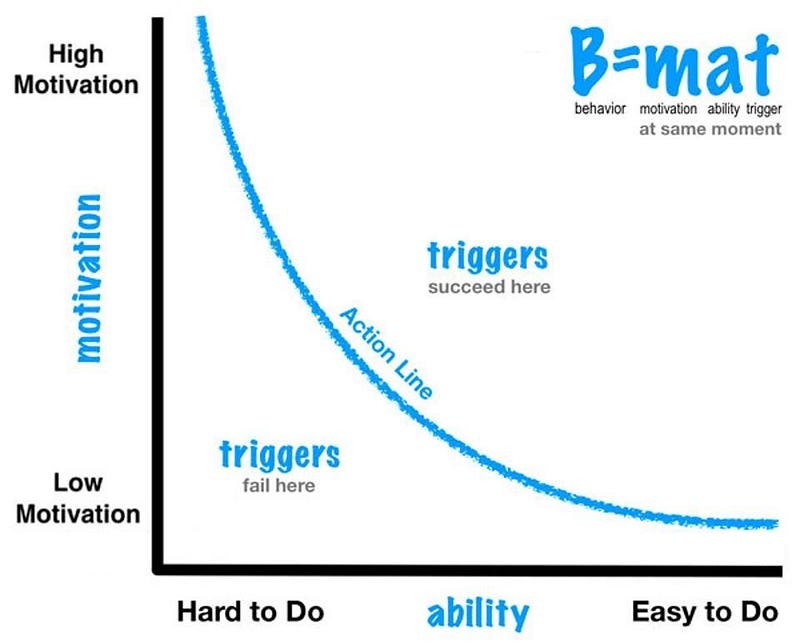
- Motivation — is the customers’ desire to solve a certain problem with whatever solution they can find
- Ability — is your solution or offering to the customers and how it can enable the customers to solve their problem
- Trigger — is the factor that will get users to realize their motivation to solve their needs while presenting the solution
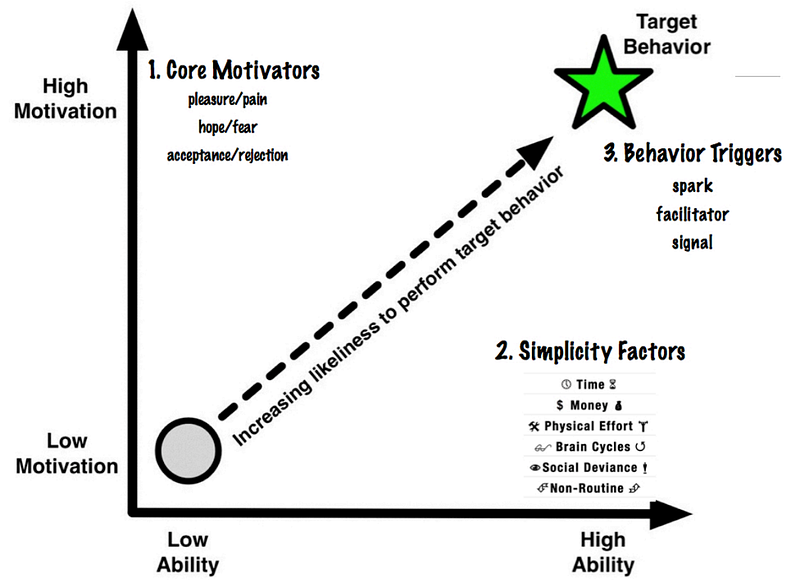
So, when most startups have a low conversion, engagement, or retention rate it generally comes down to the lack of one or many of the above factors that can lead to a change in user behavior. Usually, when the frequency of occurrence of a problem is high, customers are triggered frequently and regularly, therefore raising the level of motivation and desire to solve it.
In summary, an ideal problem will:
- Be large — have millions of users
- Be growing — a market growing at 20% annually is said to be growing fast
- Have urgency — people are trying to solve it right now immediately
- Be costly to be solved
- High willingness to pay — by its customers
- Somehow be mandatory
- Have high frequency — needs to be solved multiple times a day
The supply side: the solution

Never start with the solution
It needs to be noted that a new business always starts with a clear understanding of its demand side — the problem. If for technological reasons, such as the introduction of blockchain, entrepreneurs focus on finding viable commercial business models, the idea will most likely fail when introduced into the market. In these situations, it is said that ‘the idea is a solution in search of a problem’, while it should be the other way around. Even if, out of luck, such a solution attracts demand after introduction, then it will most likely grow very slowly.
Never be a solution in search of a problem — be an ideal problem looking for a solution
The ideal solution
When researching solutions, investors will be looking into factors that will indicate why and how this solution will meet the needs and desires of the demand side (i.e. solve the problem) and trigger rampant growth. Following the importance of the frequency factor of an ideal problem, investors want to find indications of BJ Fogg’s principles of change in customer behavior in the solution — in other words, they will look for habit-forming solutions.
A good solution will need to trigger users’ motivation and enable them with problem solving tools and features
Nir Eyal’s Hooked framework on how to build habit-forming products is based on BJ Fogg’s behavior model and it is advised that entrepreneurs understand and use this framework when developing their solutions.
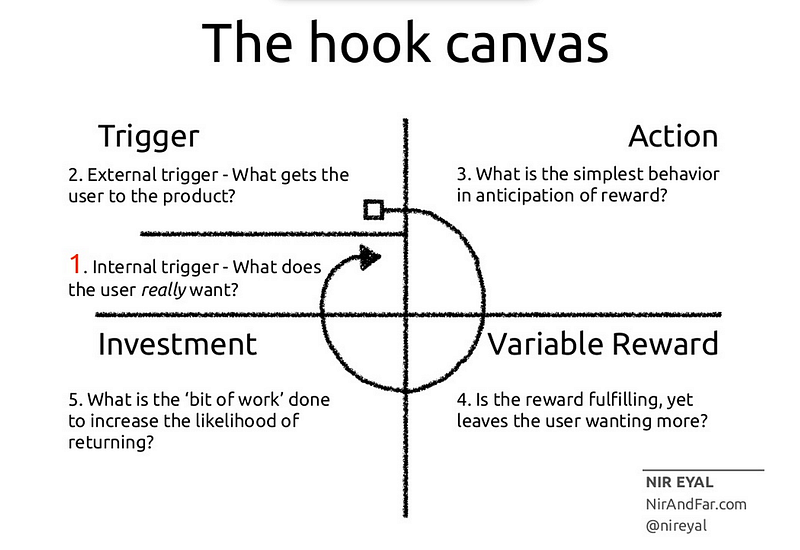
Entrepreneurs can approach early-stage investors and venture capitalists with or without a solution. Some of the key characteristics or signs of a successful solution are summarized below. A deemed to be successful solution may hold one or some of these characteristics.
- The solution can easily communicate the problem it is trying to solve. The problem being solved can be comprehended in a matter of minutes with specificity and simplistic manners. For this to happen, in most cases, the founders have generally experienced the problem themselves. For example, the founders of Uber experienced the difficulty of finding a taxi in San Francisco themselves, and the founders of Airbnb experienced the challenge of making cash as students while their apartments remained underutilized.
- The target customer can be described in detail. The early customers, their needs, personas, how often they interact with the solution, the intensity of their pain, their willingness to pay, and how they can be communicated with are obvious. For example, a car marketplace’s target customer — uncommon to popular belief — is not the person buying a car, but the car dealership that works on the business daily. An individual replaces their car every 5–7 years while a car dealership needs the platform daily. This is also true for a real estate classifieds portal — actual customers of real estate classifieds are the agents, not the people who want to buy a house. Moreover, the importance of intensity of usage is also key to a solution. Consider Uber and the need for the commute — people tend to buy $15–20K cars to help them commute daily, hence, the problem is intense.
- If the product has been launched, then the MVP was a poorly designed version that was quickly launched and met target customers’ needs. The MVP is expected to be a poorly developed version of the solution and despite that, it should have managed to meet customer demand. The general expectation is that an MVP be launched in ~6–8 weeks. Note that even Apple’s initial iPhone was a poorly designed MVP that met its initial customers’ needs, before becoming this fantastic product that we have gotten to know over the past 12 years. Forget the fake Steve Jobs out there who insists on a prophetic and visionary Steve Jobs who launched an amazing product on day 1.
Real-Steve-Jobs iterate their products while fake-Steve-Jobs dreams of making a magical fairy-tale or piece of art
- If the product has been launched, then its set of customers was diverse and outside the founders’ immediate network. Investors will be wary of the communities that the product has scaled upon. For example, users of the investor, friend or family, or tech-enthusiasts community will be discounted when evaluating a startup. The more diverse and non-related the initial users are from the founders’ network, the more credible the traction of the MVP will be considered.
- If the product has been launched, then its initial set of customers has paid high premiums to use it. Well, it's quite obvious — for example, consider Uber or food delivery networks — that initial customers have always been willing to pay for the service from the first ride or order. If the platform makes money from ads, then it needs to show rampant user growth rates.
- If the product has been launched, it is unlikely to have made major pivots. A pivot is a change in the problem or customer segments, mainly resulting in a new business model, while an iteration is a change in the features and aspects of the solution. Building a new product or solution, for a previously unsolved problem, is a difficult task — if it were easy, then someone else would have done it by now. However, a successful solution rarely makes a pivot as it should have deeply understood the problem.
- If the product has been launched, then they have a quick product development cycle in place to test new features. No imaginary and magical service or feature will scale to the mass market in one night — however, teams that have a process to research, ideate, and test new products or features will eventually come on top. There needs to be an agile and quick process to manage this process in place.
- If the product has been launched, then the technical team has developed and considered a dashboard for its metrics. And no, Google Analytics or Firebase is not enough. Investors need to see that the solutions have managed to track events and analyze user behavior. If founders have launched a product with no measurement dashboard, then they probably didn’t know what they were doing and were flying blind.
The connectors: ‘the unfair advantage’

The connectors are the combination of drivers, insights, or reasons as to why the startup’s solution will end up being successful. This is the startup’s unfair or competitive advantage compared to others in the market. This reasoning will indicate why the startup will grow faster than anyone else in the market.
Some of these unfair advantage points include:
- The founders — for example, being a product manager at Google does not foster a founder advantage, however, if the founders are among the top 10 experts in the field of the problem in the world, for example, they have a Ph.D. in molecular bio-science with a patent on cancer prevention drugs, then this becomes a founder advantage.
- The inherent market — when the market is growing at +20% annually and the number of target customers is large, then by default, the solution is expected to grow without much investment. Although this is a weak advantage, as it is driven by market conditions and does not become an internal strength of the startup in the long run, undoubtedly it is better than a stagnating or shrinking market.
- The solution (product) — is the solution 10X better than the current competition, this could mean a 10X better user experience or being 10X cheaper. An order of magnitude of 2–3–4X will most probably not meet the user’s expectations, as it will be unable to break currently established network effects.
- Customer acquisition — generally speaking, running campaigns on social media such as Facebook and showing CAC and LTV to investors as quantitative proof of how the startup is poised to scale, is generally an unsustainable acquisition channel and a weak argument for successful growth. If a startup is to become a viable business a few years down the line with +$100M in revenue, it will certainly attract several competitors and this advantage will dwindle fast, especially if the competition has deep pockets. Investors prefer to look for growth through word-of-mouth, organic, and viral channels of traction.
- Timing — some investors believe that timing counts as everything towards the success or failure of a startup. In general, for the timing to be right, a startup needs to catalyze energy from early customers, early employees, angel, and seed investors, and the media and other analysts that cover these frontier ideas, to gain social momentum for its mission.
- Network effects — refer to the reasons that will make the startup more difficult to be defeated by competitors as it grows and scales. Investors will look for indicators that point to the fact that the startup will become more difficult to fail or be threatened as it scales. For example, Facebook is a company with strong network effects, while Uber — only its ride-sharing services as a standalone business — has weak network effects. NfX ventures have formulated a network effects map that outlines 14 types of network effects and their strengths, and entrepreneurs are advised to fully understand them when working on their ideas.
The beliefs: qualitative indicators

In addition to the previous factors that can be identified as quantitative indicators, investors will also look for qualitative factors to start believing in the idea. Some of these factors are summarized below:
The founding team
Investors need to get the sense that the team has the necessary skill sets to create, develop, and successfully manage the solution and sell it to the market. The most important characteristics investors look for in the founding team are:
- They gain the respect of others by getting things done
- They are great communicators — with users, employees, investors, customers, and the media
- They are self-motivated
- They possess grit
- The founding team members have previously worked together on previous projects at school, work, or other group settings
- They have equally split equity for the long haul
- They are easy to work with and logical in management approaches
- They have the ‘founder-market-fit’
The future vision
Early-stage investors and venture capitalists need to be able to see and become excited about the 5–10-year roadmap of the startup — what it is destined to become and what resources will be needed to help it get there. For example, when Uber first made its pitch in 2008/9, it was obvious to angel investors that if the ride-sharing platform were to scale in the US, then Uber could scale horizontally into other markets and vertically into other logistics-dependent verticals such as food delivery.
Communicating with investors

Before discussing the trivia on how to communicate with investors, it needs to be pointed out that founders should not waste their time with average investors. Average investors will feel like they’re poking holes at the startup. All their questions will be targeted toward the many reasons why the idea could go wrong. Good investors, on the other hand, hear what the startup has to say and try to imagine, with optimism, what needs to be done for the idea to become a billion-dollar company.
Good investors try to imagine what needs to be done for the startup idea to become a $-billion company
- Be clear and brief — a clear and brief idea is the foundation for growth. The most successful startups grow organically by word of mouth. For word-of-mouth to work, it needs willing people who want to talk about the idea, becoming the most interesting person at the dinner table. Consequently, the idea needs to provoke others to want to join the discussion enthusiastically. This will only happen if the startup’s mission and value proposition are clear and easy to communicate. Moreover, clear and brief ideas can be communicated much more easily with other stakeholders such as partners, clients, and customers. Avoid ambiguity, complexity, mystery, and ignorability in content.
- Be reproducible — when investors hear a pitch, they need to be able to think of ways they can help build or even reproduce that company, to be able to pave a path toward helping it grow.
- Lead with the ‘what’ not the ‘how’ or even the ‘why’ — focus on defining the problem and the target customer. Your research on the demand side needs to be extra solid, based on the criteria previously mentioned.
Tips on finding and choosing new ideas

- An idea does not need to be revolutionary to start a startup — not all startups become the Facebook-s or Uber-s of the world.
- Do not start with ideas — start with problems.
- Try to have a personal connection with the problem — is it a problem that you, a friend, a family member, a colleague, or someone inside a community that you know has? The benefit of this connection is that you can tell whether the solution you are building can solve the problem and at times of discouragement, the connections will help you push through.
- Keep a problem journal — note your daily problems in a journal and try to find metrics to rank their priority until you find a problem you deem worthy of being solved. Ask friends and people you may know to keep a journal of their own and look into their problems as well. Every once in a while, when the problems have accumulated, brainstorm with people you trust on which of those problems could be the next venture to dive into. These sessions can also help you find the right co-founder for the startup. Companies such as Uber, Instagram, and Nextdoor were started in the same manner, within only weeks of similar brainstorming efforts.
- Try to choose ideas that you would be positioned uniquely to solve — i.e. the founder's unfair advantage
- Consider the viability of building an easy and scalable MVP for the idea in a short amount of time with maximum cost efficiency. Don’t fall in love with your MVP; it’s only a controlled experiment to test hypotheses.
- Handpick and measure the behavior of your initial set of customers — make sure you have your feedback loops in place.
Hope you enjoyed reading this article! :)
If so, then:
- Follow me on Medium
- Become a Medium Member
- Subscribe to hear more
- Let’s connect on LinkedIn


