
100Hour Challenge — Chess
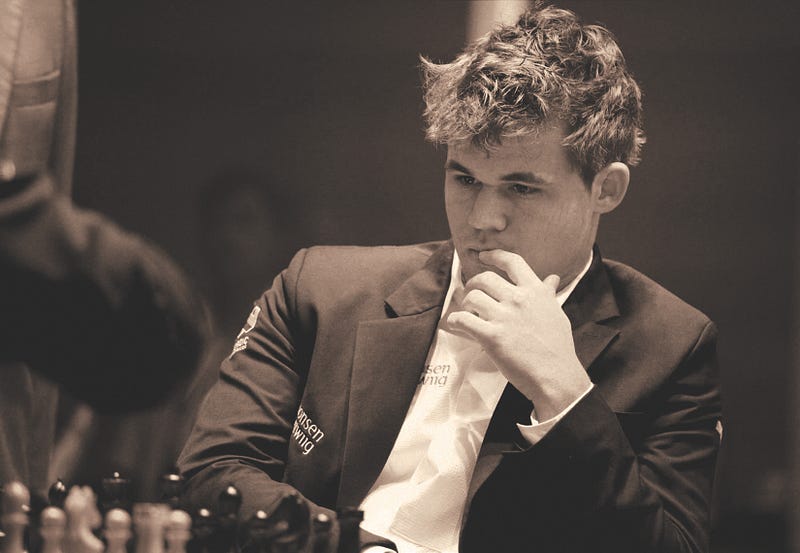
Inspired by fellow Norwegian, Magnus Carlsen, the current world champion and world number one since January 2010, I decided to improve my chess skills.
Background
When I was younger, I played a bit of chess. Not a lot, but enough to know the rules, and how the pieces move. I had no tactical or strategic knowledge and had not done any form of serious study or reading about chess. Playing was quite frustrating, as it would seem like nothing was happening, and then I suddenly ended up losing a piece or getting checkmated. I lost interest pretty quickly.
But five years ago, when I started to get more interested in skill development, I began to study and play chess. In total, I spent about 400 hours on chess. These hours were spread out in time and not as organised as this challenge. And yes, I’ve been counting the hours of all my activities for the last five years :D
When I started the 100hour challenge in chess, I had a rating of 1500+ in daily games (max one day per move) and 1200+ in blitz games (max 3–10 minutes per move) on chess.com. To find my baseline, I played 100 games and had an average rating of 1209 (10-minute games). My goal was to improve play in these 10-minute games.
In comparison, Magnus Carlsen has a rating of about 2800–2900. I thought it would be too ambitious to catch up with him in 100 hours, but I had a goal of improving at least 100 ELO-points. Setting a specific goal is tricky. Instead, I like to focus on having high quality in every practice session and see how much it is possible to improve.
Objective measure
Chess is one of the most used skills in the research of skill development, as it is possible to design controlled experiments, where stronger players consistently make better decisions. There is also an objective measure called an ELO-rating, which estimates how well you play in comparison to other players.
Simply explained the ELO-rating works like this. If you play someone with the same rating, the winner of the game will add about eight additional points to their rating, while eight points will be deducted from the rating of the player that loses.
If you are playing someone who is rated 100 points higher than you, the lower-rated player will get about 10–12 points if they win the game (and the stronger player lose the equivalent). If the higher-rated player wins, then only a few rating points will be taken from the lower-rated player. If the player’s rating is too low, they should do better than predicted, and gain rating points until it reflects their real playing strength.
Luck vs skill
Chess is a skill that has little to do with chance and coincidence. The better player wins most of the time. An objective measure, such as the ELO-rating, is beneficial to keep track of your improvements. In most skills, it is difficult to know precisely how much progress you are making.
The rating system doesn’t tell you which parts of the game you need to work on, however. It doesn’t say if your strengths are in openings and strategy, and that your weaknesses are in tactics and endgames. Your playing strength combines into one number.
Chess can be frustrating in the beginning
You have moved your pieces out on the board, and the game seems to be under control. Then suddenly, your opponent starts to eliminate them one by one, and eventually, you find yourself checkmated. What happened?
You may point to a crucial mistake. But the answer for many new players is that they don’t know what happened (even if they think they do). They still don’t understand the game well enough to realise which moves they were making that shifted the advantage in the game in favour of their opponent. This stage in the skill development process is called the unconscious incompetence stage.
You don’t know what you don’t know.
And you may live blissfully and unaware of your lack of skill. Many people stay at this stage all their lives. When you are playing someone with a lower rating, you can immediately see many of the mistakes they make. But they are probably not aware of them. And similarly, when you play someone rated much higher, you make several mistakes that they will notice, that you don’t even know are errors.
How to improve
There are three main ways to approach your chess game.
The first option is to give up. Blame your losses on bad luck, the wrong genes or not having the required talent.
The second option is just to keep playing and try to figure everything out by yourself by experimenting with different possibilities to see what works and what doesn’t.
The third option is to build on the knowledge of others. Chess has been played for hundreds of years, and players have studied and analysed in depth what types of moves are best in different positions.
While you will probably improve also while following the second option, the third option will lead to much faster improvement.
It is an excellent idea to acquire some of the knowledge that the best players in the world have developed over centuries. Many of these ideas are not obvious, and you most likely would not have figured them out by playing, even if you played every day for the rest of your life.
Where to start
Chess is a complex skill, where performance depends on many sub-skills. To excel, you need to learn openings, strategy, tactics, endgames, and checkmate patterns. Every part is essential, but for beginners, I recommend to start working on tactics.
Tactics are sequences of moves that end up winning material, for example by attacking two pieces at the same time (and only one can be defended), or winning a more valuable piece (e.g., rook vs knight). Roughly speaking pawns are worth 1 point, bishops and knights 3 points, rooks 5 points, and the queen 9 points.
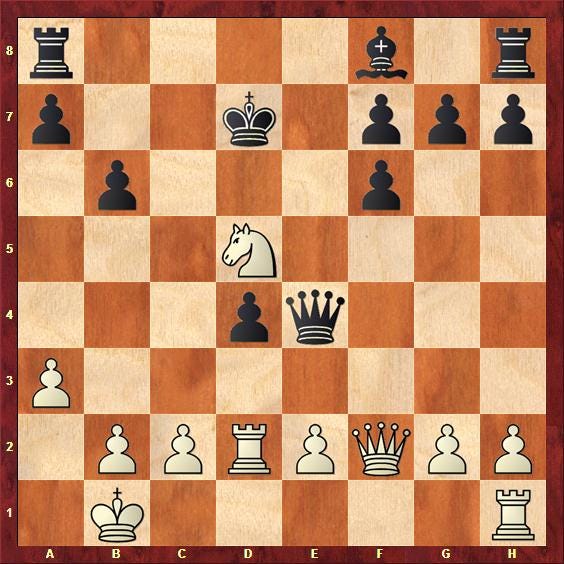
When I started playing, I used the webpage chesstactics.org for this. It is a page that provides extensive examples of many of the tactical situations you meet in a chess game. It also explains the reasoning behind each move and when and how to look for tactical opportunities.
It is essential to understand the thinking behind the moves to be able to apply the knowledge in different situations. Almost every game you play will be unique but will have similarities to problems you have previously worked on.
A great way to improve your play is through tactics puzzles(for example on chess.com). In these, you are given a specific problem and will try to find the solution that wins you some material or gives checkmate to your opponent.
Solving puzzles gives you a lot of repetitions in finding solutions to specific types of problems. This makes it easier to spot when an opportunity arises in a game. If you are only playing games, such opportunities may just come a few times in the whole game, which means you will get much less practice. Also, you may not be aware of them when they present themselves.
When reading, watching videos or solving puzzles, it is crucial to learn actively. It is not a very effective way to learn to immediately look at the solution if you cannot solve the problem. Try to think at least 2–3 minutes about the problem. This forces your brain to understand concepts in a more profound way than you would have by just absorbing the information.
Even if you don’t find the solution after some thinking, this type of training will improve the likelihood that you see it the next time you work on a similar problem. This type of practice improves your ability to see patterns at the chessboard. Fast pattern recognition is even more critical in quick games, as you have less time to react and make your moves.
As you practise, you build up a vocabulary of chess ideas. Each idea is maybe one or two moves long. The player can then put these ideas together, making longer move sequences. But to do this, you need to acquire these ideas and make them part of an active repertoire that you can access while playing.
Asking the right questions
It is essential to ask yourself the right questions if you want to improve.
When your opponent is making a move, think about what they are trying to do. They probably have some plan in mind. Try to figure it out, and see if it is dangerous. Can you prevent it? Can you attack something in another area of the board to ruin their plan?
Examples of questions to ask are:
- What do they threaten?
- What’s their reply if I make this move?
- If I do this, will I leave anything unprotected?
- Do they have any checks that can cause me trouble?
And a bit more advanced:
- Do I have a potential fork? If so,
- Is the square that I need protected? If so,
- Is the protecting piece constrained? Is it pinned, can it be pinned, or would it be pinned after the sequence of moves I am considering?
- Can the protected piece be captured, and then be replaced with a less effective piece?
- Can I capture something that the protecting piece guards, thus luring it away from the forking square?
- If there is no immediate way to do this, are there any sequences of exchanges that would have this effect?
These checklists of questions will train your mind to think in the right way. In the beginning, you may have to check the list to remember the questions. But after you’ve done it many times, this type of thinking will start to become automatic, and your mind will instinctively begin to look for the answers.
How to improve faster
As with every skill, the more time and effort you put into it, the more you will improve. But some ways of learning will lead to faster improvement than others.
Learn actively — Just reading about or watching a video explaining a concept is not enough. You need to practice, think and solve problems actively to understand them.
Be attentive — The more focused you are, the faster you will be able to understand and learn new skills. It is tough to learn something when you are tired, hungry or distracted. If you find yourself in one of these states, try to do something about it and go back to learning when you can focus 100% again.
Many repetitions — Having information presented once is not enough. To solidify the learning, you need to practice it many times in different situations. By repeatedly studying common patterns, you will start to see them faster, and they will sort of pop-out when you are playing a game.
Rest — When your mind gets tired, it is time for a break, as this makes it hard to absorb difficult concepts. I usually practice in 1 or 2-hour sessions (with a break in the middle of the 2-hour sessions).
Be aware of your weaknesses — Analyse your games to see where you most often make mistakes. A good idea is to put all your energy into fixing the most significant flaw, then move on to the next, and then the next.
Be specific — Decide what you want to improve. Then find problems and resources that discuss this topic. Some players will make one particular mistake over and over. This is a good thing, as instead of having to fix a long list of errors, you have a specific problem to focus on. You can target this mistake in all your games, and eventually, the problem will vanish.
Choosing resources
In my study of chess, I mainly solved puzzles and studied lessons from chess.com. I also watched some lessons on youtube.
There is a vast amount of resources (books, apps, puzzles, video lectures, personal coaches). But rather than worrying about finding the ‘best’, try a few and stick with the one you like. Try to understand in depth what that resource is explaining.
Try to find material that is compatible with your current level. Studying advanced concepts before you have mastered basics may be overwhelming.
100 Hour Challenge
People love to hear how you can improve a skill fast with little effort. But I would instead describe improvement as a very gradual process, where the more effort you put in, the more you improve. Here is a graph of how my ELO-rating developed during the challenge. It gives a good picture of how skill development can work.
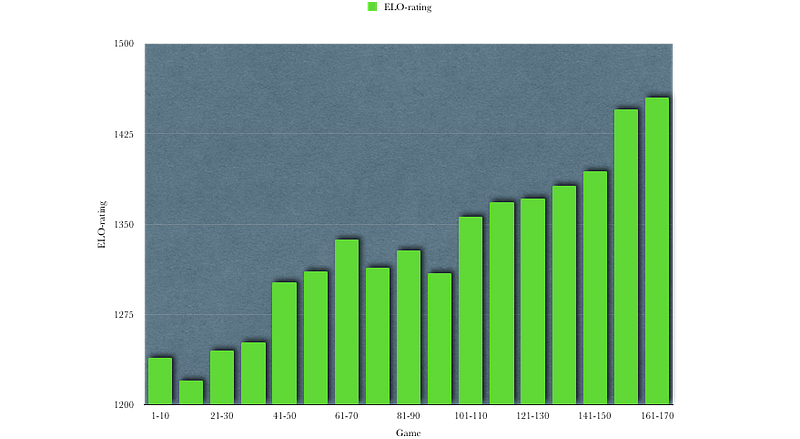
Continuous improvement is about putting in hours of quality practice, and you will eventually (but not overnight) be a lot better than those who spend all their time looking for shortcuts and quick solutions.
I worked on improving these parts of my game:
- Endgame — 30 Hours
- Checkmate patterns — 15 Hours
- Openings — 10 Hours
- Tactics — 25 Hours
- Decision-making — 10 Hours
- Strategy — 10 Hours
I focused a lot on endgames, which used to be my biggest weakness. I often had equal positions in games but ended up making a mistake when there were only a few pieces left, which cost me the game. And I didn’t know what I was doing wrong.
After this challenge, I would now say that endgames are one of my strengths. I’m now relatively better in this part of the game compared to people playing at the same rating level. I now feel much more confident if I come into equal positions towards the end of a game, and this is often where I decide the games.
Another big difference was that I started to notice many mistakes that my regular opponents were doing. They have probably been making the same mistakes all the time, but I hadn’t realised before. Because of the practice, I now started noticing and could look for ways to punish these mistakes.
Another main improvement was in my ability to make good or good enough decisions fast. I have started seeing tactical opportunities quicker and avoid costly mistakes more easily. By playing more quickly, you have more time to think when you come into a difficult situation. When you play faster, it also gives your opponent less time to think, which may lead them to make a mistake or lose on time.
Stats
As I studied, I played a game (10min) after every hour of study to see how my rating changed.
Rating in each game, game 1–100:
1–10 Hours 1241–1251–1261–1252–1244–1235–1242–1234–1223–1214 Avg 1239.7
11–20 Hours 1222–1215–1223–1215–1223–1217–1226–1225–1216–1226 Avg 1220.8
21–30 Hours 1247–1256–1248–1240–1250–1242–1251–1244–1245–1236 Avg 1245.9
31–40 Hours 1226–1234–1242–1251–1258–1267–1275–1266–1259–1252 Avg 1252.9
41–50 Hours 1261–1254–1299–1309–1315–1307–1313–1320–1327–1320 Avg 1302.5
51–60 Hours 1327–1320–1319–1309–1300–1307–1298–1305–1312–1319 Avg 1311.6
61–70 Hours 1325–1325–1336–1345–1351–1343–1350–1343–1333–1324 Avg 1337.5
71–80 Hours 1315–1306–1314–1321–1321–1313–1322–1313–1304–1311 Avg 1314
81–90 Hours 1319–1327–1335–1325–1332–1340–1331–1338–1315–1323 Avg 1328.5
91–100 Hours 1317–1308–1301–1309–1319–1313–1311–1301–1312–1306 Avg 1309.5
My rating is moving up and down quite a bit, but the general trend is rising. As I was often playing right after I had studied for an hour, I was feeling a bit tired, and probably made more mistakes than I should have.
I often knew about the mistake right after making a move. This is an example of almost having learnt something. It is not automated yet, but at least you are aware of it.
In general, I felt my improvement was a bit delayed, and that I had more knowledge than the rating-level I was currently playing against, but I couldn’t yet put it in practice. It often takes some time before new knowledge will become a consistent part of your game.
After I finished the 100hour challenge, I played 50 more games to see my development. And immediately I noticed a significant improvement. I went from an average of 1310/1330 to 1394 in these 50 games. The practice was starting to have its effect.
When you practice a skill, you don’t always get an immediate effect. You need some time to get accustomed to the new level of competition, and it takes a while for your brain to start applying new knowledge in competitive games.
Rating in 50 games played right after the 100hour challenge
Game 1–10 1343–1351–1343–1351–1342–1353–1362–1368–1376–1375 Avg 1356.4
Game 11–20 1367–1373–1381–1374–1366–1358–1366–1358–1368–1375 Avg 1368.6
Game 21–30 1383–1375–1382–1374–1367–1357–1367–1361–1369–1377 Avg 1371.2
Game 31–40 1386–1378–1387–1379–1368–1374–1381–1388–1396–1389 Avg 1382.6
Game 41–50 1380–1390–1397–1406–1399–1408–1401–1394–1387–1380 Avg 1394.2
The average rating illustrates the improvement. The average gives a more accurate picture of your playing strength than your actual rating at any one point. In single games, things such as tiredness, other players playing better or worse against you, and a tiny bit of luck play a role. Luck, you say? Didn’t you say earlier that there was no luck in chess?
In the long run, there is very little luck involved in chess. But in a single game, you can get lucky! Your opponent may miss an opportunity to checkmate or forget to defend a piece. And this could be enough of a difference to beat a better player. But over time, these things will even out, and your average rating will reflect the level you are playing at.
Three months without playing — Latent skill
After I finished my 100-hour challenge, I took an almost complete break for about three months. I was interested in how this would affect my play, so I played 20 games. It was quite enjoyable to see the rating jump more than 50 points, and it now seems to have stabilised around 1450.
20 games after a three-month break:
Game 1–10 1453–1445–1445–1437–1444–1451–1458–1449–1440–1433 Avg 1445.5
Game 11–20 1443–1449–1455–1448–1457–1465–1473–1464–1457–1447 Avg 1455.8
In a month I will play another 20 games, to see whether anything has changed. I’m guessing that my level has stabilised now, but let’s see.
But it is quite interesting to see that the rating did its most significant jump three months after I finished the learning.
This shows that when you practice, the effect may not be immediate. When you learn a lot of new information in a short timespan, the brain needs some time to absorb and process it. And over time you will be able to use this knowledge in the performance of the complex skill.
Keep this in mind when you’re practising a skill. The results may come tomorrow or in three months.
Take home message
Chess is a rewarding skill to learn and the more effort you put into it, the more interesting it gets. And if chess isn’t your thing, the same applies to any skill you are learning. Also, most of the ideas of how to improve at chess apply to any other skill.
This challenge exemplified that learning is gradual and that the effect of learning may only fully come into effect several months later.
Overall my ELO-rating improved from 1220 when I started to 1450. Right after I had finished the challenge, it was around 1390.
The take-home message from this challenge is that you should practice with quality every session, but be aware that your brain and body need some time to adapt. But eventually, the improvement will come, and you can then keep working to advance to the next level.
Thanks for reading, following and sharing ! :)
My other 100hour challenges:
Portuguese (coming soon)
Piano (coming soon)
Drawing (coming soon)
Spanish (coming soon)
Resources


