
100Hour Challenge — Thai Massage
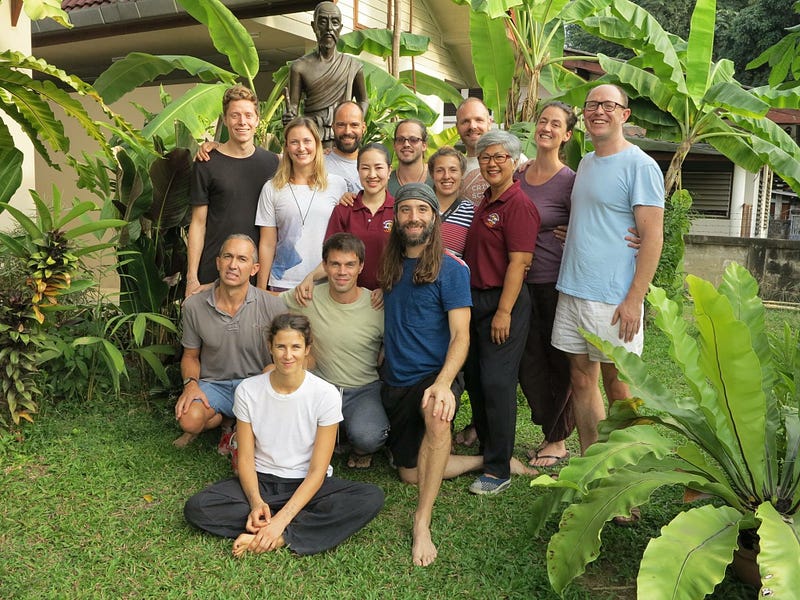
Chiang Mai, in Northern Thailand, is the perfect place to learn Thai Massage (also called Thai Yoga Massage). They have many excellent schools and teachers, and it’s an integral part of the local culture.
What is Thai Yoga Massage?
Traditional Thai massage is an ancient healing system that combines acupressure, stimulation of energy lines, and assisted yoga postures.
In Thai massage, there are ten main energy lines, which hold some especially important acupressure points. Massaging these lines and points makes it possible to treat a range of diseases or to relieve pain.
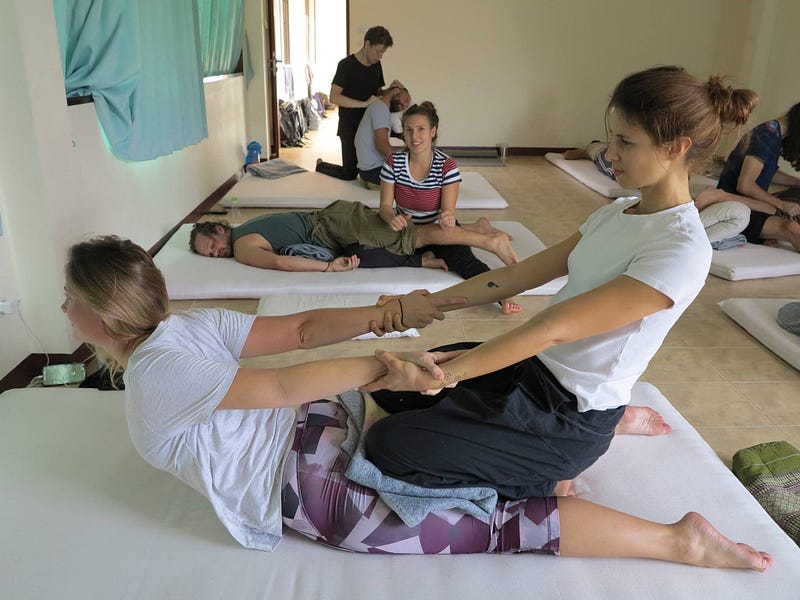
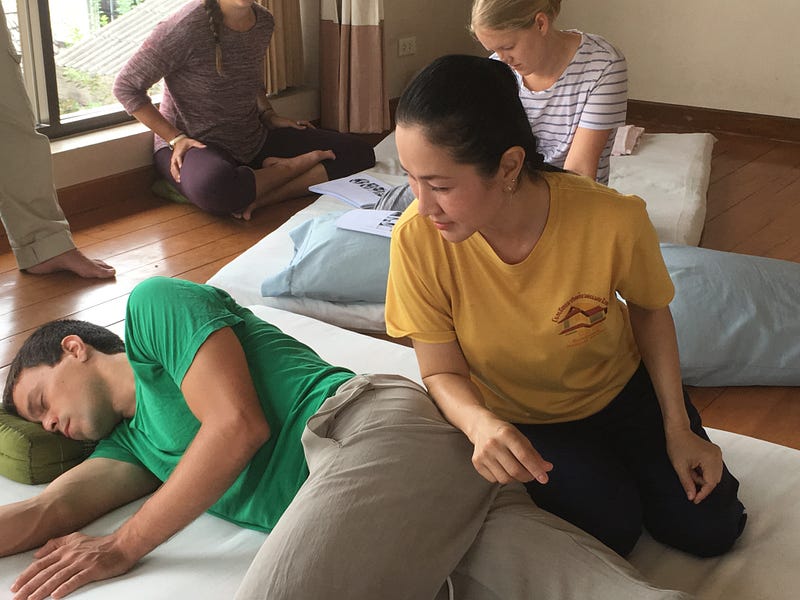
The massage usually takes place on a mat or firm mattress on the floor, with the receiver remaining fully clothed during the treatment.
The therapist is also on the mat and moves your body into various stretches and positions.
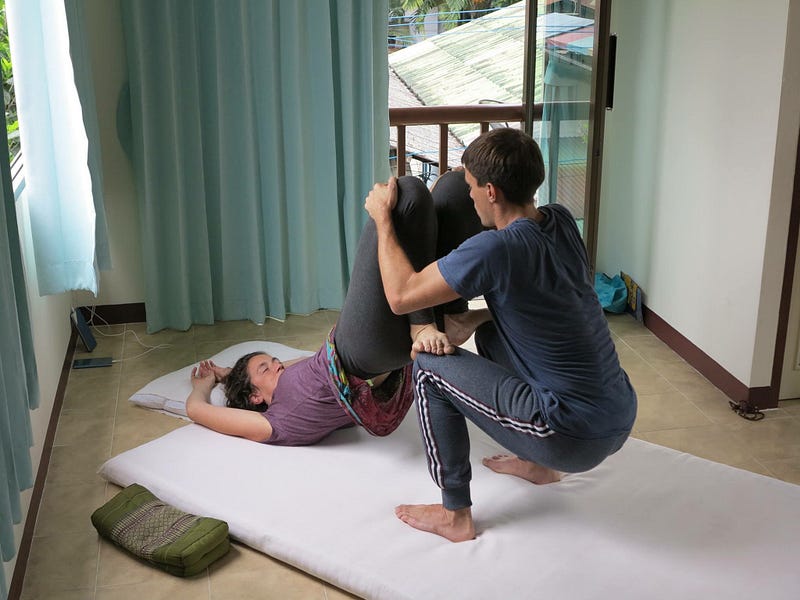
The giver can use every part of his or her body, thumbs, palms, elbows, knees, legs and feet to create a dance of movement around the body of the receiver.
Palming and thumbing is done on what is called energy lines or sen lines. These lines run across the whole body. Giving pressure to these lines can help to loosen up or relax parts of the body that are feeling tense.
There is constant body contact between the giver and receiver, and the body is compressed, pulled, stretched and rocked to relieve tension.
The receiver will have the best effect if fully relaxed and breathing deeply.
Thai massage helps to improve energy, increase flexibility and improve overall health and well-being. A full body massage session lasts about two hours.
Background
Of related skills, I had learned 25 hours of Balinese massage. This technique was with aromatherapy oils and very different from Thai massage.
But some of the techniques were similar, and good ergonomics and body posture (straight back, locked arms and elbows) are essential to all types of massage. It makes it easier to give firm pressure, while also protecting your lower back. Although I had been introduced to this before, I had not automated it. Overall, Thai massage was almost an entirely new skill.
Sunshine Massage School
In Chiang Mai, I joined Sunshine Massage School. They have beginner courses that run over two weeks, starting every Monday. Five days a week, classes go from 9 in the morning until 4 in the afternoon, with a one hour break for lunch.

A lot to learn
In two weeks we were supposed to learn over 100 different moves, and especially in the first few days, we received a lot of information.
The first time I took the course, I spent most of my energy on learning and memorising the movements.
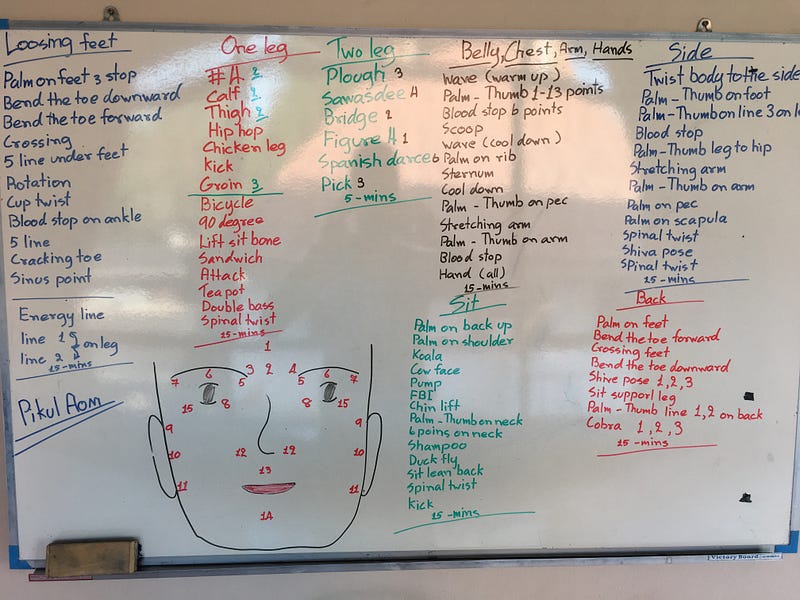
We were corrected on our postures and how we placed our bodies next to the recipient. But the main focus was on performing the techniques correctly and safely.
After the first few days, I was exhausted, as we were learning a lot of things in a short time. This can be a bit overwhelming, and you have to accept that you will not remember everything.
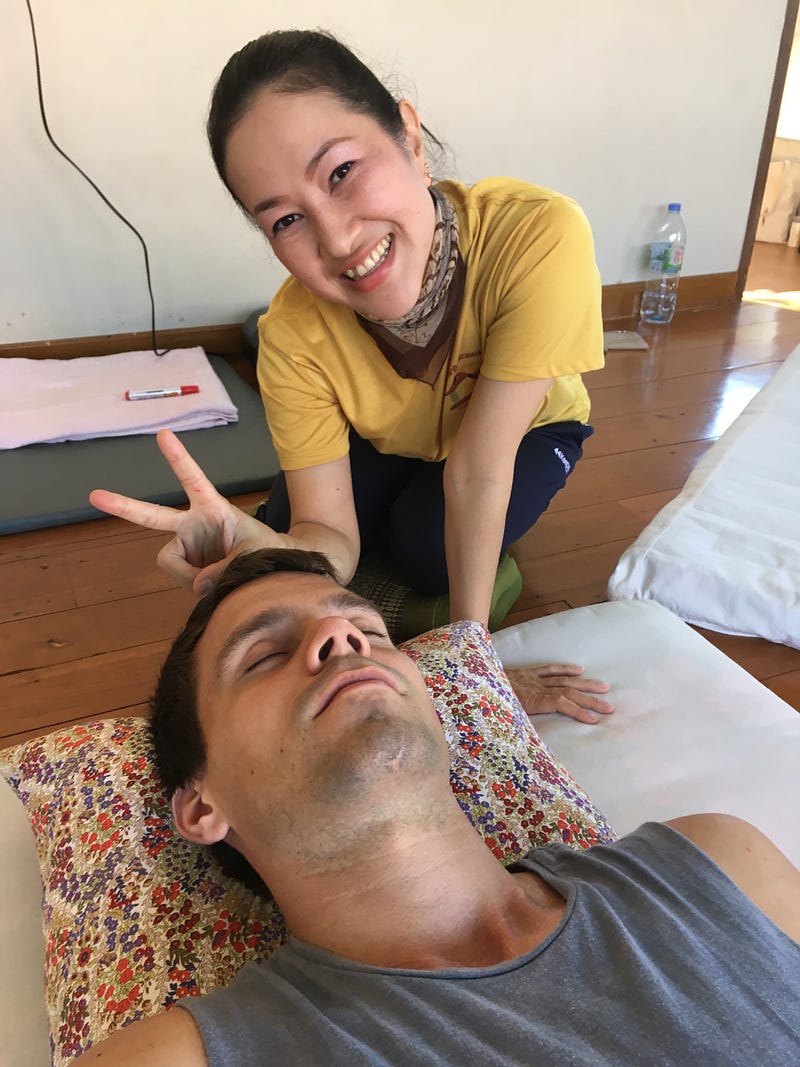
In the first couple of weeks, this meant that I often didn’t have an optimal body posture and position, as I was using most of my cognitive capacity to think about how the movement was done and trying to remember what was coming next. When you don’t have good posture and technique, it makes some of the movements and lifts heavier, which adds to your tiredness.
In class, the teacher started each session by showing the sequence, and we then got to practice and receive it. The first days had the most information, while later in the week and the second week, we got to practice all the sequences many times.
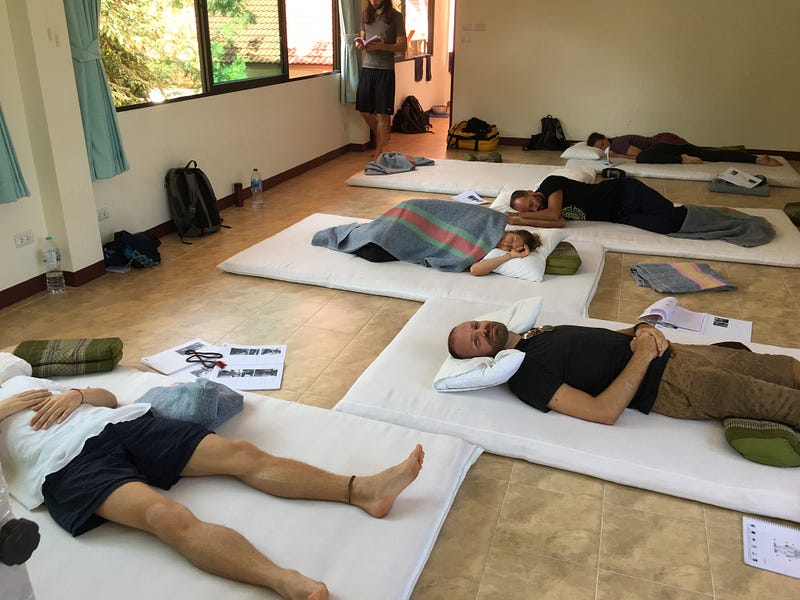
We had six hours of class per day. But about half the time we were receiving. This was relaxing, but also a valuable part of the learning where we got to feel how other people were working and give them feedback on what they were doing. So, we were not allowed to sleep during this time.
Previous experience
In the class, there was a big difference in how fast people were learning. Some were already working as massage therapists (other types of treatments), while some were completely new. The more experienced people picked up everything much faster. They are used to working with bodies, stretching and applying pressure, and good posture and body mechanics are already part of their movements.
This means that they have less new things to think about, and they can focus only on learning new techniques and applying a quality touch.
Anytime you are learning a new skill; previous experience is a critical factor to how fast you can pick it up. Similar movements that you can apply from experience means that there is less to learn, and you can focus on fewer new things. When everything in a skill is novel, it can be overwhelming and much more challenging to pick up.
Giving a massage
Before giving a massage, you wash your hands and do a small meditation to calm your mind. If you have any bad energy, you should let it go before you touch someone. All the receiver should get is the good energy you can give them. Being mindful is also vital to feel what is good or not for the receiver.
You systematically work the body. Face up — first one leg, then the other, then both legs. Then you go to the stomach, chest and finally the arms and hands (which feels amazing). The receiver then turns into the side position. And finally, you turn them over to the back and massage the legs and back.
After this, you lead them into the sitting position, before it is time to lay down for a final face and head massage.
By this time, the recipient will most likely be close to sleeping, so in the end, you wake them up by gently rocking them and doing some stretches.
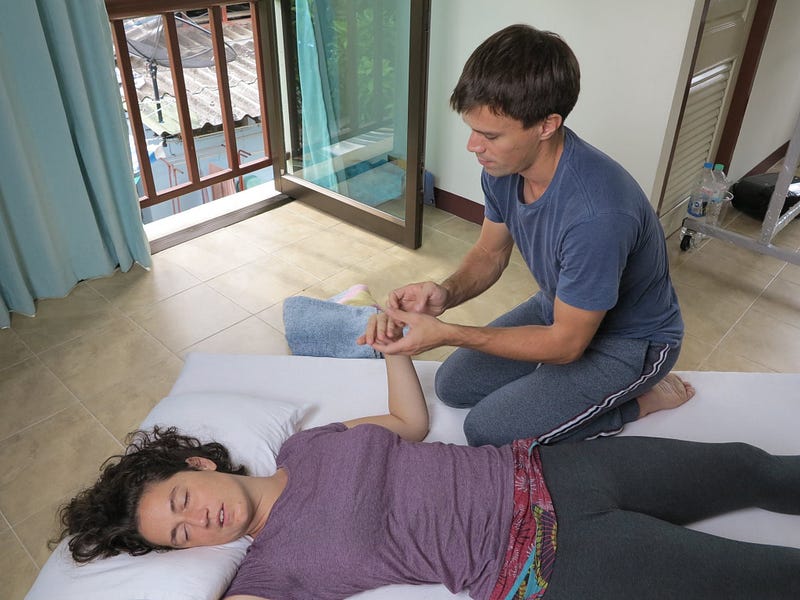
While giving a massage, you always try to keep a point of contact with the receiver. This makes them feel safe and not wondering what is happening. You must always be attentive to how the receiver is feeling. Some want only a soft touch, while others can hardly get enough.
The key is to put pressure gradually, so you don’t shock the body and make it defensive. If you push too fast, the body will be afraid of what is coming and tense up. By applying the pressure gradually, you can go much deeper and help the body open up. As long as the receiver’s body stays calm, you can probably go deeper. If they start to move or tense up, it is a sign you are getting close to their limit.
Repeating the course
I repeated the same course a second time (which is recommended by the school before moving on to more advanced classes). I was then able to focus much more on the quality of the movements, rather than just thinking about what was coming next. I noticed many details that I hadn’t in the first course. By already knowing the sequence, it was easier to see the finer details.
I was also able to focus more on working with the breath (you want to apply pressure when the receiver exhales), finding the right points to push and putting quality pressure.
At the end of the days, I was usually also a lot less tired than I had been the first time around. The more proficient you become in a skill, and the more parts (sub-skills) you automate, the more free cognitive capacity you have to focus on improving the smaller things.
In the new course, we changed teachers, each having a different style and things to focus on. Although we followed the same sequences, there were many differences in the ways the teachers were working. It shows that there are many ways of doing things. As you get more experienced, you can choose the option that feels best for you and your receiver.
Overall, I think the repeat of the course was a better experience than the first time. The movement between the different techniques had become much more fluent, and I enjoyed working more with the breath and focusing on giving a good touch.
Intuition and transitional movements
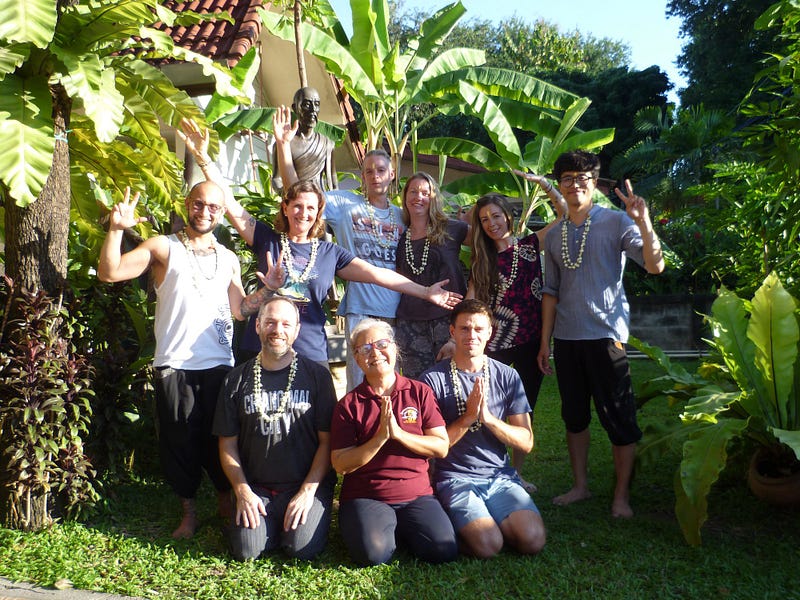
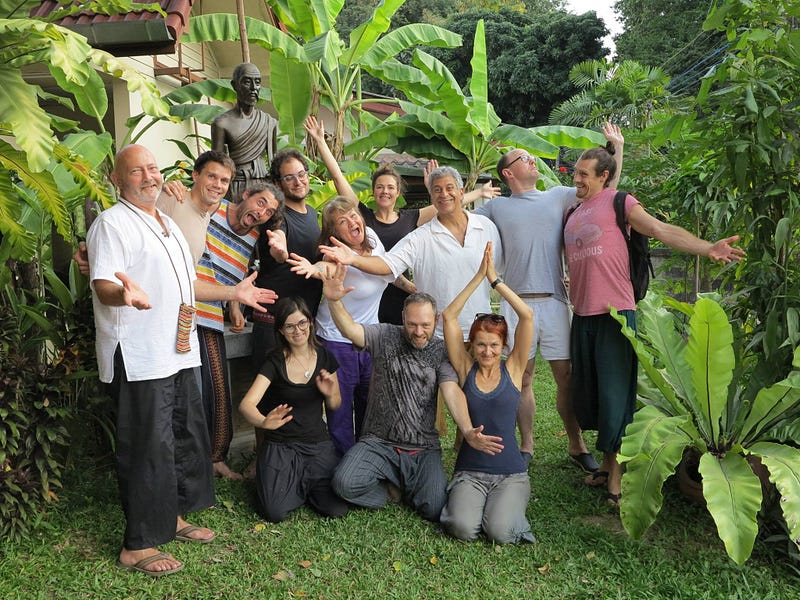
After my introductory courses, I joined a more advanced weekend class focusing on intuition and transitional movements. Many of the other students in the class were professional therapists with years of experience.
It was impressive to see the quality of their skill and movements. In this class, I was exposed to more advanced techniques. One of the fastest ways to improve an ability is to be among people with a higher level, as it can give you many insights on how to improve.
But the most impressive thing was to see how humble these people were to learn new techniques. This is one of the trademarks of someone who perform a skill at a very high level. They are always open to learning, and very good at listening to what others can teach them. They were also really good at asking good questions, another characteristic you find in good learners. This clarified why things were done in specific ways, and sometimes revealed that something could be done in several ways.
There is rarely just one ‘correct’ way to do something. You always have to take into account the body of the receiver. Are they flexible or stiff, tall or short, do they like a lot of pressure or only a soft touch?
You also have to think about your body size in comparison to the receiver. If your recipient weighs twice as much as you, you probably shouldn’t do some of the heaviest lifts. To be able to handle all these differences, it is essential to develop an intuition for what feels good for the other person. This can be acquired through practice and awareness every time you are giving.
Some of the best tips from this class were to:
- Remember that the receiver wants to be relaxed, not surprised, stressed or shocked. By using transitional techniques to open up the body, you can make sure it is relaxed before you give pressure or use a strong technique.
- Work with the breath of the clients. Compress into their body only after they have begun an exhalation, and give a little space before they start to inhale. You should also work with your breath. In many techniques, you should breathe in the same rhythm as your client. While in others (for example, lifts), you should breathe opposite to be stronger and more secure.
- If it doesn’t feel right for you, then don’t do it. It probably will not feel right for them either.
- Use distraction techniques (such as rotating the leg) to help make smooth transitions from one technique to the next. Use resting poses to give the client (and yourself) a break.
- Try to reduce or eliminate all the tension in your body as you apply pressure. You should work with proper posture (straight back, locked arms and elbows).
- Rock your body slightly when performing almost all the techniques you do in Thai massage. This gets you into a good rhythm of work, makes it easier to work with the breath, and makes it easier to perform the technique. When you apply pressure, you should sink forward into the receiver’s muscle.
Great experience
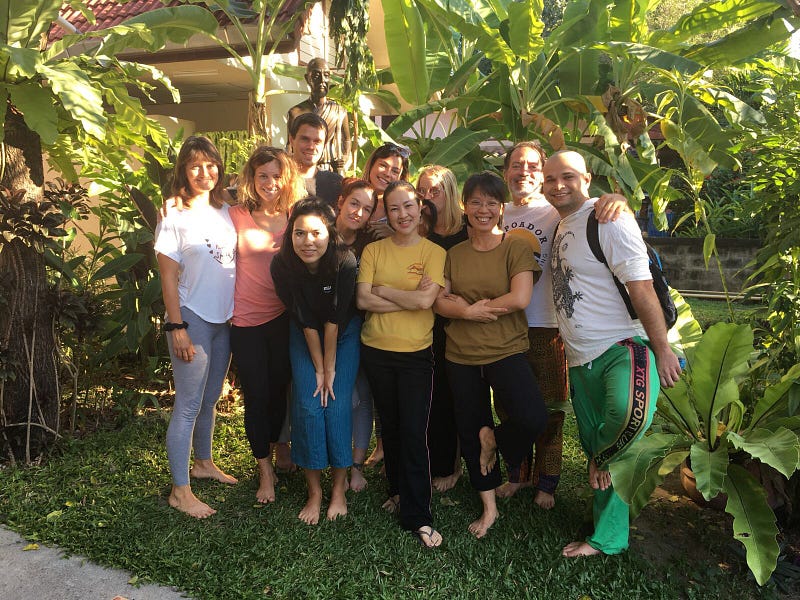
People studying Thai massage are some of the nicest I have ever met. They care a lot about others and want to make them feel better. The whole experience of receiving massages and great touch every day also brings out the best of people I think.
This was one of my favourite skills to learn. Receiving and giving a massage feels equally wonderful. And you get to see the smile on their face when the massage is over.
Receiving a Thai massage every day felt good and afterwards you have more energy than you usually do. I wish I could receive a massage like this every day of my life.
Summary
In total, I practised 100 hours of Thai massage for two months. This doesn’t include the time receiving a massage, although you can learn a lot also from this. By being attentive when you are receiving, you can remember what feels good and try to replicate it when you are giving. It is a skill you can continue to develop through your whole life, with people coming to take new classes after working for years. But even after a two weeks course, or 100 hours if you like, you can learn a lot, and make someone feel better. It is such a great skill to learn, as it contributes to both your own and someone else’s well-being.
Thanks for reading, following and sharing ! :)
My other 100hour challenges:


