
Using Time Off Benefits Without Feeling Guilty
I operated under silent rules that I could not fully use my time off benefits while getting closer and closer to burnout.

I have never used all my sick leave and vacation days in a year on a job before. Yet, I have been extremely burned out, resorting to quitting my job and blaming it on the relentless pace of American corporate and hustle culture. There’s truth to the notion that we work too much in America. Nonetheless, I find it is more helpful for me to focus on myself instead of blaming the country’s culture. I do have blind spots when it comes to scheduling adequate time off for myself. I can confront these blind spots, uncover the unconscious beliefs that are driving them, and make behavioral changes to manage stress and avoid burnout. At the end of the day, my mental health is the most important even if the culture around me is not fully supportive of that. Thus, my new goal going forward is to get into the habit of using all my time off benefits (sick leave, vacation days) annually.
The strict unconscious beliefs and culture I operated under led to my first case of burnout. Although I felt exhausted day in and day out at this job, I did not see many options to slow down and give myself rest. The company offered a low number of vacation days. I felt there was a stigma to taking too many sick days and an even bigger stigma to taking any type of personal leave related to stress or burnout. I got the unspoken message that taking this type of leave would destroy all chances of moving forward in my career. On the personal front, I felt I would have received a similar response from my family. They would have shamed me for “being weak” and questioned whether I was “just lazy.” Thus, I did not have much support in figuring out how to remedy my situation.
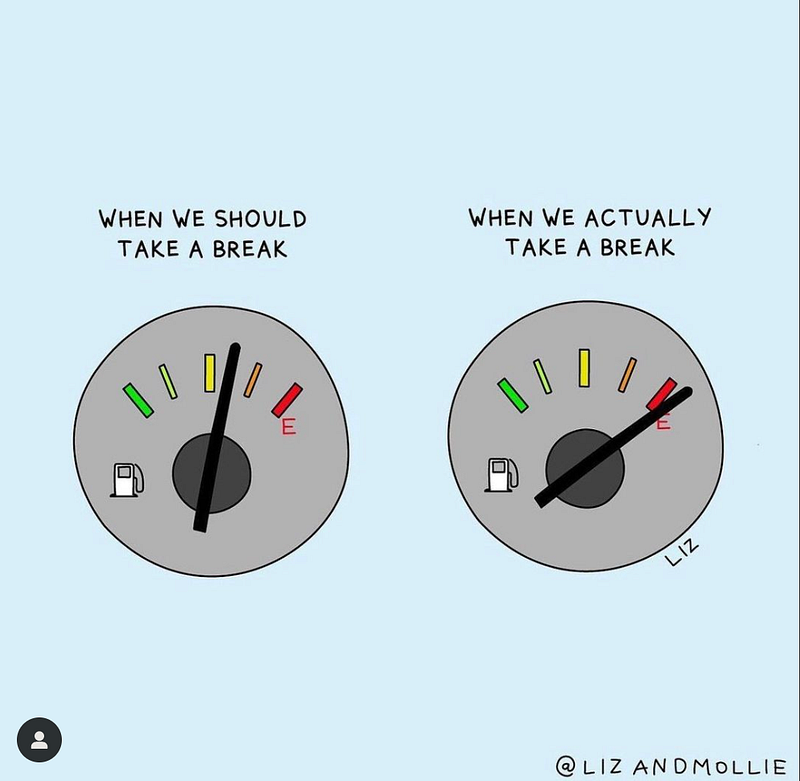
Back then, I did not know that burnout was a condition. I assumed everyone felt burned out and were forcing themselves into the office like I was. I didn’t discuss the full extent of my exhaustion with anyone. When I discussed potentially making a career move with my friends, I mentioned the part about being bored in my job and needing a change. I left out the part where I would have happily not worked at all for a few months to recover from my fatigue. Once in a while, I did manage to take a sick day but they were never enough. I did not feel recharged when I returned to work. I finally reached a point when I burned out all the way and quit my job. However, I do not want to repeat this cycle over and over. I need to find a better long-term solution to manage stress and burnout without needing to quit my job as a last resort.
One of my biggest blocks is the stress I feel when I am taking time off. Because my father projected his anxiety about being able to provide for his family onto me, I developed the belief that I must not lose the job I have and thus created silent (and arbitrary) rules about how much time off I was allowed to take. I allowed myself to take a portion of my time off benefits, never the full amount. For example, I have never used all ten sick days I am afforded in a year, nor have I ever taken all the vacation I am allotted. I have never taken unpaid time off, even when it was allowed at my company. I have my own silent rules on the length of time off I am allowed to take as well. I think taking one sick day is fine. If I take two or three sick days, I start worrying about whether I’m taking too many days off even though I have rightfully accrued this time and am entitled to use them.
These self-imposed rules created a blind spot for me. I felt guilty for taking “too much” time off, when in reality I did not use my full allotment. In the past, I never questioned these unspoken guidelines I operated under. I was thinking with tunnel vision though. Meanwhile, I continued to suffer at work as I worked through my exhaustion. Finally, my therapist helped me change my outlook; I saw that my parents’ beliefs come from a culture from a different time. The same circumstances don’t apply to me. I have higher education degrees and many transferable skills. I am entirely capable of quitting my job and finding another one. Luckily, my first experience quitting my job confirmed this way of thinking. I was able to find another job that paid even more than my previous job and with a better manager. Now, without the worry of losing my job and being perpetually unemployed, I can take some days off with less worry.
Eventually, I concluded that I can use all of the time off benefits that my company offers. I am given ten sick days per year plus a week of unpaid vacation. I should try to use these sick days every couple months, especially during times when there are no paid company holidays. I should try to use more than one sick day at a time if it means I won’t fall behind (two days each instance is optimal). I can also use sick days following travel days if I need some time to recover. Similarly, with my vacation, I should try to use all of them and not continue carrying them over year to year. Finally, I should take advantage of the unpaid time off I get even if it means I lose out on a bit of pay. The rest and relaxation I get from it is well worth it.
If I do run into a medical emergency after having exhausted all my time off, there are options I can consider such as disability insurance, Family and Medical Leave Act (FMLA) benefits, and other state programs. In other words, I have many options if I need to take time off unexpectedly. I should not let the fear of that stop me from fully enjoying my vacation benefits.
“We can expect to be uncomfortable as we venture into new territory…Much of our ability to succeed and to create the world we want directly hinges on our ability to endure the discomfort of being misunderstood and disliked as we evolve and grow on our path. Dr. Mario Martinez, author of The Mind Body Code says we must allow our worthiness to expand beyond what we previously thought was possible.
Dr. Martinez states that to go beyond our “ceilings of abundance” we must be able to endure the “turbulence at the horizons,” those points where no one in our family or tribe has gone before, the places where we are pioneers. He says we must allow our worthiness to expand to accommodate a new narrative beyond what we previously thought was possible. If we do not expand the narrative, we risk going back to the old ways, the old patterns, the toxic relationships — just to break that tension.” — Bethany Webster, Transformation Is Hard: Learn to Endure the Discomfort
Recently, I started putting my new goals into practice. I extended a vacation I originally planned by two days and ended up adding two sick days after that. I felt I needed the days to recover before returning to work. It was difficult for me to request the extra vacation days and choose to call in sick. I felt I needed to consult someone to get permission to do it before I went ahead with my decision to take time off like I was still a child who needed parental guidance. I judged how well my requests were received based on the response of my boss. Luckily, she was supportive. While taking these sick days and vacation days, I start feeling worried about whether I’ll fall behind at work or if my reputation at work will suffer. My critical inner voice starts acting up, making me feel guilty for not being productive for a few days.
In these situations, Emily Simonian, a Licensed Marriage and Family Therapist, recommends telling oneself, “Taking a break once in a while is necessary. That’s why vacation and sick days are a part of every workplace culture. Taking time off might ultimately move me forward in my career because I’ll return to the office fresh, well-rested, and mentally better than ever after stepping away from time to time.” I certainly needed to remind myself of this several times to talk back to the critical inner voice in my head. I knew that no one was going to check on my mental health except me; it was up to me to ensure I schedule enough time off for myself so I can continue working healthily in the long run. That means being proactive about scheduling time off even if it’s a challenging habit to develop in the beginning.
In actuality, sick leave policies are more generous than I previously thought. After doing some research, I found that sick leave can be used for the following situations:
- Preventative care for an employee or employee’s family member which includes boyfriend/girlfriend, parents, siblings, parents-in-law, sibling-in-law, next of kin, children (biological, adopted, or fostered), and even best friends or neighbors if they are considered and act as “family”
- An existing health condition
- An illness like flu or cold
- A medical condition
- An injury
- Pregnancy
With this in mind, I can be more lenient on myself when I feel that I need days off.
“Compulsively resolving emotional tension in relationships is a symptom of the early suppression of our individuality. An example of how women may compulsively resolve the tension in their relationships: assuming that others won’t hold up their responsibility and so automatically taking it all on themselves. An example of how not to resolve the tension: setting a boundary without feeling obligated to provide an explanation.” — Bethany Webster, Female Assertiveness: Stop Resolving the Tension
Learning to manage stress and prevent burnout is part of my journey to face the realities of American work culture and also be my authentic self. I am listening to my inner voice when it tells me what it needs and I am honoring my needs instead of suppressing or ignoring them. If I end up disappointing others with my boundaries, so be it. I have learned that while it is important to maintain a job, it is even more important to take care of my mental health. I can find another job if my current one falls through. I do not want to reach a point where I am completely burned out and am in no mood to work at all like what happened to me previously.
I can use all of my sick days, vacation days (paid and unpaid) in a year. I can add a few extra days at the end of my vacation. I can call in sick multiple days in a row. Mental health days are perfectly acceptable and encouraged! When I need a mental health day, I should just take it. In addition, I can proactively plan my vacations in anticipation of when I may need a break, instead of waiting until I am already running out of momentum to begin scheduling a break. I can look for coworkers who are good role models for me in managing time off. They take the time off regularly and give themselves generous breaks. I can emulate their example.
Several months ago, I wrote a slightly similar story on setting boundaries and managing my workload and work-life balance. I’m happy to report that I am satisfied with the results so far. I find that I have a manageable amount of work and enjoy doing it in general. I plan to maintain this approach to my work while implementing my plan to use all of my time off benefits. One step at a time, one small change at a time, I feel I am transforming my approach to work, overcoming blind spots and outdated cultural models. I am finding a path that is tailored to me and my needs as well as fitting my situation. I am finding an approach to work-life balance that works for me and is sustainable for the long term.
“You can support yourself for a life of thriving, not just surviving. You can appreciate and love yourself just for being alive. By cherishing yourself the way a loving parent would, you erase any doubts about your value. By being loyal to yourself, you give yourself non-judgmental, unconditional support and you commit to your self-development just as a devoted parent would. By being a good parent to yourself, you reverse multi-generational traumas of low self-esteem and emotional self-neglect. You might be the first in your family to see the difference in life quality that honoring one’s inner experiences can make.” — Lindsay Gibson, Recovering from Emotionally Immature Parents