
The Franklin Square Phenomenon
A Ghost Story: Part I

Among the things that Roderick “Rory” Radcliffe bequeathed me was a legacy of nightmares. Roderick had always been the clarity the world needed to expose the hidden or the rotten.
No one knew, then, what Roderick himself was hiding nor what he saw that no one else saw. His clarity, suddenly, started to blur — at first, just at the edges, and then —
Reading Roderick Radcliffe, now, seems as if I am transcribing through thinning layers of melting ice. The letters are familiar, but foggy— with words missing vowels — or sentences scattered as if an invisible hand scrambled a Scrabble board. And then the horror— as the last layer vanished, exposing a language that existed beyond all logic and reason.
I was just out of grad school and recently hired as an intern at The Philadelphia Inquirer. I write as if decades have passed, but has it only been months? Now, I’m the full-time beneficiary and the inheritor of the infamous ‘Radcliffe manuscript.’
Rory Radcliffe didn’t have friends, but as a reporter and a champion of the people, he was amazing. His fan base was legion. At first, I was terrified. Rory Radcliffe needed no sidecar — no mortal companion. The editor said, however, my resume deserved the “Radcliffe boot-camp.”
“You’re damn good,” she said. “But he can make you famous.”
He was a genius. Everyone knew that. As long as you weren’t crooked or jealous or a politician — you were safe. His reputation for being cantankerous — well, okay — grouchy, was not an act. For someone in need or in pain, however, he would jump at the chance to rescue the victim and sting the villain. But no one ever thought he was crazy!
One day I said something pompous about Hamlet not really seeing his father’s ghost. “Just some manifestation of his own intuition.” He grabbed my head and covered my mouth. So intimate with his armpit, I was rather impressed with his antiperspirant-deodorant. Old Spice Wolf Hound? This really was boot camp!
“Listen, don’t be all eyes and no sight. If I had to rely on my education for my education,” he said, “I’d be a fucking moron. Give me a reporter with a science background. Or a math background — that would be awesome for statistics, right? Give me someone with a goddamn art degree!”
That’s when I told him I could draw pretty well.
If I ever used “pretty” again instead of very, he’d punch me in the “nut sack.” Then he said, if I ever used the intensifier “very” in a sentence, he’d ask for a testicle as a sacrifice. “It’s just lazy writing.”
That same day, last summer, as the train stopped at City Hall in Camden, he asked me to draw him. He tossed me pencils and a reporter’s notebook.
By the time we arrived, he smiled. “If you can write as well as draw, well, Codpiece, you may just be on your way,” he said. “You could be useful, after all.”

With no wife or children, Rory Radcliffe was a workaholic.
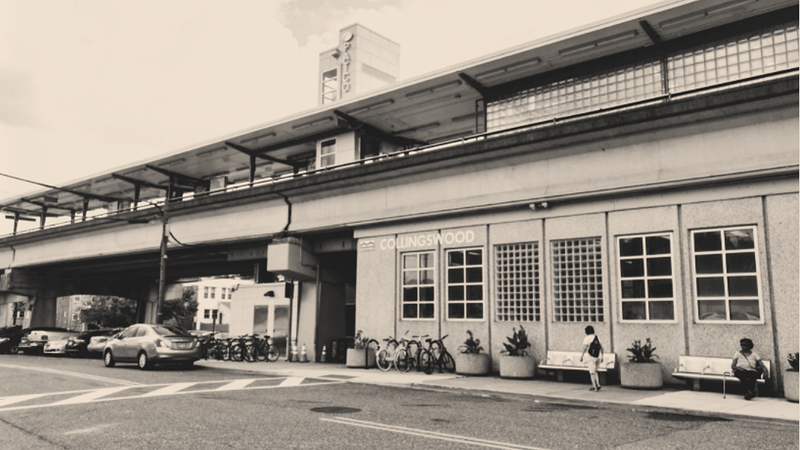
Living in the transit hub of Collingswood, New Jersey, right next to the train, he loved the sight and the sound of the train by his window. A type of white noise. It was bad for his “chi,” he admitted, but other things “far worse banged that around.”
Any questions about relationships or family, he quickly dispatched as “not relevant.” I would catch the train with Radcliffe. The old newspaper location on Broad in Philly he liked better. “That place had class,” he said. “When journalism had dignity and stature.”
I asked him about the knife he wore with a band underneath his black combat boots. That was so part of his image. I’m not sure he wore any other color than black and white. It wasn’t a knife, but a shiv. “You never know what trouble you’ll find,” he said. “And as a mountain boy, I know how to protect myself.”
“Against bears?” I asked.
“No, people. Very bad people.”
I went with Radcliffe to Kensington to cover the train cleanup at the heroin sites. I interviewed a junkie. Rory made me write 500 words about the needles and the debris and the Burger King wrappers. I not only saw my first dead body but also drew my first dead body.
With Radcliffe, I rode shotgun to Rittenhouse to report on the murder of a homeless guy who was proposing marriage to the Duck Lady statue. It was a Page One story.
For every story we covered, he asked me to draw. “See what other people are not seeing.” I knew photography, but my art much more impressed Radcliffe.
Radcliffe accompanied me for the story at Temple. Three guys jumped a university student from behind after a woman lured him to her apartment for a “good time.” He was stabbed three times but survived. All for fifty bucks! That was my first byline.
When I interviewed the student, I asked him to describe his attackers. The police were so impressed, they asked if I would like to work for them. They made copies of my work, and then started calling me “DaVinci.”
Radcliffe warned me about the cops. “We play for the same side — getting the truth,” he said, “but we each have different ways and priorities in getting the story.”
On the way back to Jersey on the train, something happened. Radcliffe seemed to have turned white. What happened? What did he see? Or did he hear something, too? Feel something?
Now, this is where it gets weird.
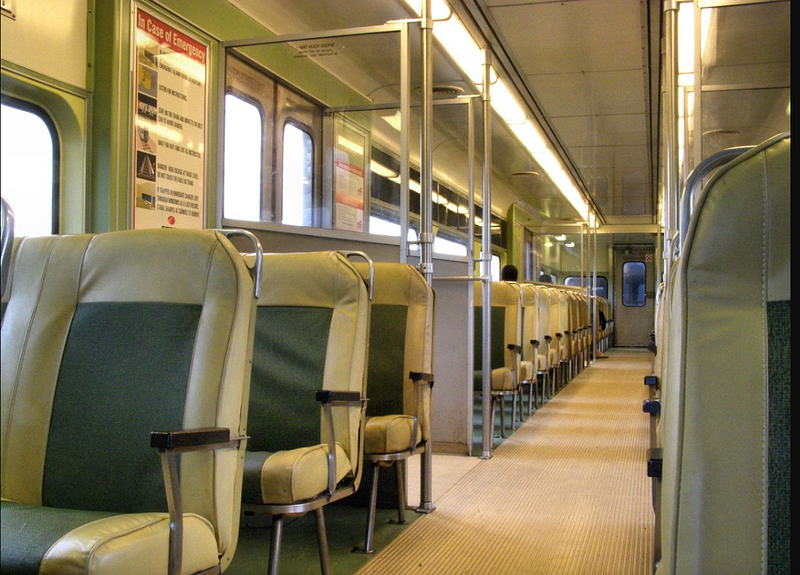
It was the Monday morning after the blood left his face. The train that morning was full. It was one of the newer cars. The train’s windows were clear — not the tarnished yellow-grime I had known since birth. We were in the “silent car.” That meant Radcliffe wanted to meditate or read, but this time, he merely gazed through the window — bewitched.
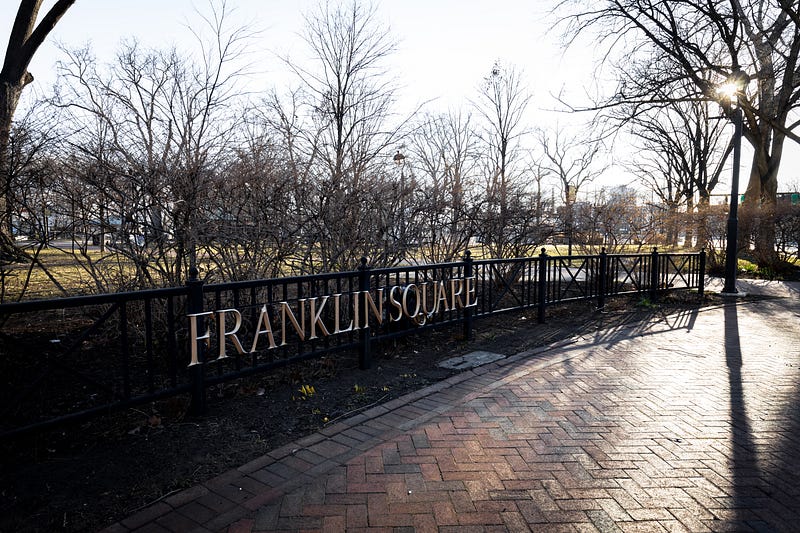
He gripped the seat so hard. Would he rip the life out of the cushion? On that curve, the train slows down. The brakes moan. Rory shot up erect, his face awash in an ashen pallor, as we entered the abandoned station of Franklin Square.
“Oh, my God!” he exclaimed. “There she is again! What is she saying?”
In that station, the train does not slow down. Why would it? It’s a ghost station. It only stops one minute later at 8th and Market. Long before I was born, the station closed. Now Franklin Square is creepy — with faded green and yellowed white tiles with just enough dull yellow light to see, but not see well. The place always creeped me out — a great locale to envision zombies or a haven of vampires. He turned. Did I see her, too?
“Who?” I asked.
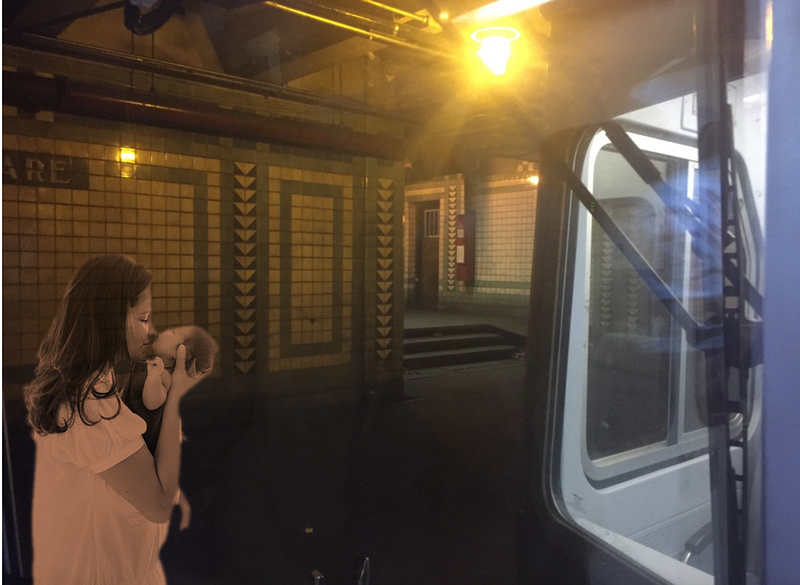
“That woman standing in the station with — with her baby,” he said.
“That’s impossible! That station has been closed since . . . !”
“September 9, 1979,” he replied instantly.
“Wow — how did you know that?”
“You’re not going to fact check?” he said. Before I could reply, he said, “But I’m telling you, I saw her. Her. She was holding her baby! A baby swaddled in a blue blanket. Six inches from the platform — I saw her like I’m seeing you! I could touch her as I could touch you! She was telling me something!”
What could I say? That I didn’t believe him? He probably dozed off, like the train’s a cradle, rocking us back to our pleasant and peaceful childhoods. “This was no dream,” he said. “You know my attention to detail. Quiz me!”
He answered all of my questions. No hesitation.
“She was there! With that baby. I swear.”
“Maybe she’ll be there tonight, or tomorrow,” I said. Anyway, I wondered, did anyone else see a woman? Maybe he was right. Did a woman find her way down there? Found some unlocked gate and stood on the tracks? But why? Suicide? I didn’t know, but it sure sounded like a great story, if true.
At the Starbucks around the corner, Radcliffe said they knew they would be late, but he couldn’t let go of them. “Not any longer.” What he described, he said, he wanted me to draw, but not show him. Was that okay? He was, like, my drill sergeant, so how could I say no?
But he did something really weird — okay — bizarre. All this time, too, he was fiddling with the shiv in his black commando boots.
“If anything happens to me,” he said, “here are my keys and my address. I have a mahogany box filled with stories, and diaries full of bizarre stuff no one would probably want to believe . . .” He told me the secret location.
Until three months later, I didn’t know how bizarre.
The sketch took about half an hour. Radcliffe said to tell everyone at work that he wasn’t feeling well. He needed the day off. “You’ll have to be Clark Kent,” he said without a smile. “Or Robin without Batman. Or Dr. Hyde without the Jekyll.”
At the Inquirer, I asked what Rory Radcliffe did for fun.
“Rory Radcliffe? Fun?” a staffer replied. “Codpiece, I don’t think Rory ever used that word in his copy or entered his brain.”
“You ever see him with anyone — a girl — a guy — a dog?”
He did own a dog once, but a neighbor ran over the dog, and then Radcliffe started quoting Buddha and lecturing about attachments. “So, no, I don’t think Rory Raddy has many attachments — except for writing and reading — and going after sex crimes. He hates that type of scum more than crooked politicians and drug dealers.”
Coworkers told me it was unusual for Rory Raddy—or Rory the Righteous — two nicknames no one dared used around him — to call out from work. What else was there for him? They’ve seen him down and out sick, and still, report — even when he was battling the demons of drink — but he was still solid.
So was his vision just delirium tremens? I passed around the picture of the woman with the baby in the blue blanket. Anyone knew who this could be? They all shook their heads. Of what Rory Radcliffe claimed he saw I made no mention.
“It’s odd, though,” — a nice copy editor said. “She seems to have the same aquiline nose as Rory.”
Another agreed. “And the same noble chin.”
By that time, the editor called me and a full-time staffer to get down to Fishtown. A woman was just convicted of killing her newborn infant after being evicted from her apartment. The weird thing was — while screaming with blood on her hands, she cried for forgiveness and mercy and that “it was the landlord who had been raping her while she tried to pay the rent for months.”
A new brewpub had opened just under her apartment. The infant was ripped open with a knife, and then tossed outside the five-story window, onto the patio of the craft beer place.
“Kinda thing that would want you to give up IPAs, right?” said the reporter who was driving. I missed Rory. The images I was drawing in my mind made me forget to answer with a clever retort. Nothing I could imagine could equal the facts on the scene.

The next day arrived. Then another two days. No Radcliffe on the train. No Radcliffe at work. No Radcliffe texts. When I passed his apartment complex on the train, I wondered, What sarcophagus was his?
The story from Fishtown carried two bylines. It was front-page, again. I recalled Radcliffe telling me to work an article like a story. Would I be allowed to return again? Or was there another gruesome story in West Philly or on Rittenhouse that I needed to cover? Where were the happy stories?
That woman has a history — I heard Radcliffe telling me, just like a character out of Les Miserables. These miserable people did not wake up one day and say, “Hey, I want to live a miserable life.” What happened to them? What forces worked upon them? He said to be a great writer, one had to go from being a one-off read, and follow up with a series of articles. “Don’t attack life with a toilet plunger,” he said. Then he took out his shiv. “Use this to slice and dice. One needs to know when it’s appropriate to use force — like against the devil or Nazis. Just saying.”
When I got home, my phone was ringing. It was Rory Radcliffe. He wanted to paint in words what he saw. He wanted me to draw with colored pencils what he told me. Was I available now? “Sure,” I said, shaking. Could he hold on while I got my shit together? Could he hold on? I still shake thinking of this.
“She is a beautiful woman — long, brown hair—almost auburn in the sunshine. Straight — but her back and shoulders are filled with curly, upside-down question marks. Her eyebrows are thin but vibrant, a touch darker than her hair. Her eyes are brown — a brown like two teaspoons of milk — no — heavy cream in coffee. And eyes large — very large — not totally circular, but when fully open, it’s the part that everyone — it’s the part that I always love. Her nose — her nose — is straight and pronounced at a perfectly symmetrical seventy-degree angle. Pronounced cheekbones. Eyelashes are dark too, but wispy like a soft wind has rustled them. Her lips are neither thin nor plump, but like two thinly sliced red peppers, and just as sweet. While not thin, she is neither large and has solid arms the color of onion powder with a dash of mustard seed and a few moles on her left arm — like slightly larger peppercorns, each a different shade of brown. She wears a flowing white gown — like gossamer — or light tulle — as a bed shirt that cuffs around her upper arms as if the elastic would leave a delicate impression. Her height — like mine — five eight — and no pants — no pajamas — and no shoes — with baby feet, always square but delicately strong to keep her frame upright with an erect carriage. Not an ounce of excess fat on her legs — and legs like her arms — but long and lovely and shapely — “
He even wanted the station background. He gave a short description of the baby’s hair: “The color of her mother’s that has been rustled by some caregiver — sticking up. His eyes are closed. The mother holds the baby close to her, the baby’s upper lip against her nose, and her lips kiss the bottom of his chin. She cradles him with that strong left arm — three fingers stretched out to keep his head upright and secure.”
One hundred dollars would be mailed to me “for my labor and time,” he said. “I value your time. Artists need to be compensated.”
“Will you be on the train tomorrow?”
Rory Radcliffe hung up. I had recorded his vivid descriptions and spent the night sketching the “The Woman Holding the Baby on the Train Platform.”
The office was right. There was a family resemblance. Was he going crazy? Was this some Freudian vision of his mother? His sister?
To the police, I made calls about the mysterious woman. Did anyone report anything? Nothing — nothing at all. Was someone missing? No — not that they were aware.
Radcliffe did not return to work. Or a week after that. The office was abuzz with stinging rumors. I didn’t mention his call to my apartment — drawing these phantom creatures. Where was he? In the mail the next day, I received a cryptic postcard from somewhere in Western Pennsylvania. It was from Rory. He had to go back home to attend a few affairs. “I’ll be back soon.”
The officer from the previous day called and gave me a news tip. PATCO was planning on refurbishing The Franklin Square Station. “More and more people are using the train,” he said, “and with all the new activity around Franklin Square, they’ve decided to open the station in a year or two,” he said. “So the person you may have seen down there may have been from PATCO or an engineer or some mechanic.”
That made sense. I contacted my editor. Could I get into the station as PATCO made the announcement public? My editor smiled. “You’re already a humper,” she said. What about Radcliffe? She was concerned. “Perhaps he should be more concerned about Codpiece taking over his terrain,” she said.
“But this stuff isn’t his territory,” I said, defending him.
Could I call him? She wrote a few digits to his home line, and said, “Not too many have this. If Rory Raddy gives you shit, tell him I’ll have his head all the way into the crapper.”
I half prayed that he wouldn’t pick up. What was up with this guy?
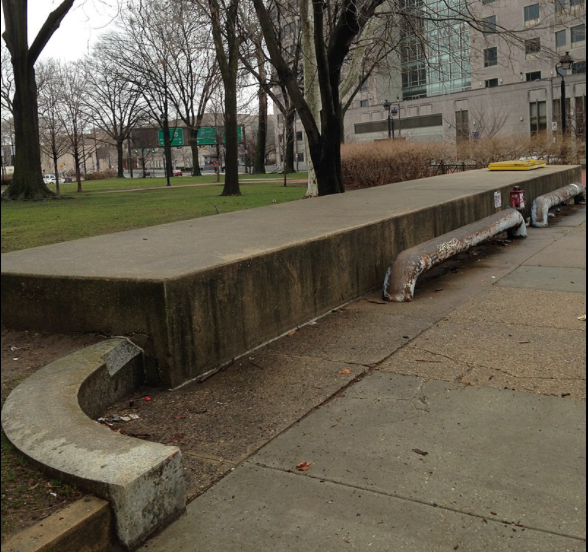
#/media/Archivo:Franklin_Square_PATCO_outside.jpg)
On Wednesday morning, I threw up before boarding the train. As always, I expected to see reliable Radcliffe as the train approached Collingswood. The usual suspects were there, but Rory only appeared in a spectral form on the bench. Should I get off the train? Call him? Cuff him by the collar? Drain the booze down the drain? But that shiv! Would he use it on me, even though I was trying to help him?
I was frightened to call. Did he know about the opening? Didn’t it sound too convenient — the sighting of the woman and the child and the reopening? Would he want to go down into the station with me?
A woman about my age sat next to me — thigh against the thigh. She was over the line. But her perfume was just fine — and everything else, too, I guess in the appearance department. It was the last seat. I tapped her on the shoulder, not realizing she was engrossed in an audiobook. I startled her. She jump-screamed — like I was some horror flick slasher. “Shit, man,” she said. “You fuckin’ scared me.”
I mumbled some apology. What did I want?
I told her about the woman and the child on the platform. Could she look and see if she saw anything? What was I smoking? I showed her my drawing. She seemed impressed. She was an art student at The University of Pennsylvania. Suddenly, I felt uncomfortable.
“Yeah,” she said. “I could help you.” She laughed. “For five bucks.”
I placed a crisp Lincoln on her lap. “You idiot,” she said. “I didn’t mean it! You expect a lap dance?”
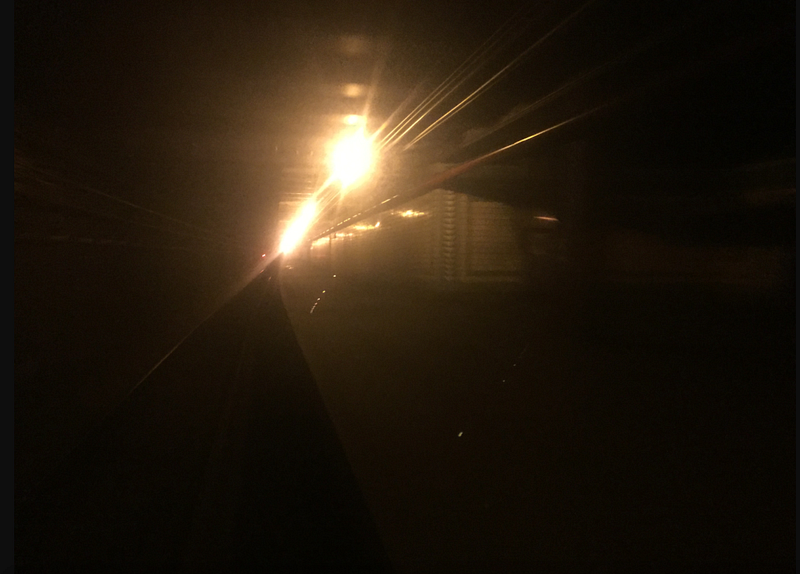
As we entered the Philly side, our eyes followed the trace of the lights along the darkening tunnel, wooden beams, and busted equipment — relics of a time lost. “You really think someone is down here?” she asked.
“No.”
“Then, like, what the holy fuck, dude?”
“But I’m a journalist, and I have heard reports,” I said. “That’s all.”
Said it sounded like something she liked to read, though. She loved horror. “But that shit doesn’t happen in real life,” she said. “Does it?”
We passed the station. “I didn’t see anything,” she said.
“I wouldn’t think so,” I said. “But it’s nice to have confirmation.”
As we passed by the station, I collapsed back into my seat. My new friend asked if I was okay. I lied. I was fine. I told her about my assignment about the Franklin Square opening. My report would go down on Friday.
“That’s the 13th,” she said. “Spooky. Dare I say prescient?”
“I don’t believe in that at all.”
“I don’t either, right, but it would make great color for your ghost story.”
At 8th and Market, she gave me back the five-dollar bill. All she said was “examine that bill before I spent it on overpriced coffee.” By the time she vanished, I saw her name and number in a penciled block script. Gwenora. Stunned, I Google searched her odd name. It was Middle English for Genevieve — like from Camelot. I missed the next three stops. I remained on the train — which was now “Out of Service” and just thought — wow. How many times did I repeat that word, just sitting there, gazing into the darkness?

I finally called Radcliffe. He was back. How did I get his number? I told him. “That means I’m in the serious crapper,” he said.
When I told him about the station and my appointment on Friday morning, he said he would join me — “the dynamic duo back together.”
“Are you okay with this?”
He said something quite weird: “For my whole life, I’m been preparing for this.” That’s just what I recall.
Even though I slept horribly for the next few days, I did work up enough courage to call Gwenano the Art Student. Was she just the type of mythical muse I needed to continue this mystical and mysterious odyssey?
She laughed. “You know, I’m more interested in how this ghost story turns out than hanging out with some penniless reporter.”
“Are you serious?” She heard the whine of the sensitive poet. “I’m just joking you ass,” she said. “When can I see you? You’re very cute, man.”
“How did you get a Middle English name?” I asked.
“Are you smart or just Google smart?” she said. “Well, my mother teaches Middle English at Penn, and she just loved the name.”
Well, I did, too.
Rory Radcliffe asked if we could drive into the city.
He had transformed. His hair was cut like a boy fresh from the barber. There were blood marks on his lip and neck from where he must have shaven with a dull razor. His pants and shirt seemed stolen from the Ritz Theatre. Brown plaid pants, black shoes, unpolished, and a wrinkled shirt with a wide lapel. Something straight from the 70s. Was that an actual tie? Was this a former occasion? Who was getting married?
I didn’t inquire. I didn’t even inquire about the dirt under his fingertips. And just where were his shiv and military boots? He carried a carry-on as if he was going on some trip. The carry-on had faded patches like some boy scout emblems — and was that a wolf badge?
He peppered me with questions about the reopening. Why couldn’t he say, “Good job, Codpiece!” Or how I wedged myself in to get us down there? Even Gwenano, I told him about — and the date. I just startled rambling — I was so scared. “You’ve heard of dating, right?” I asked. “Women — men — the natural state of things — the normal progression of time and courtship and life and death— I don’t know — but you know how all that works.”
He didn’t even look at me. “Far too well,” he said.
I had my sketchbooks and pencils and colored ones, too. Radcliffe had his slim notebook, but this wouldn’t see the light of day until it was over. I received a text from Gwenano— wishing me good luck with “the Ghost of Train Station Past.”
The suits from PATCO were there. An officer and two engineers in white construction hats, too. We all donned the hats as well and safety vests with the reflective tape. Was I a member of Ghostbusters or something? I asked Rory if he was okay, but the man was cold as stone. I told him about the blood on his lower lip and offered a tissue.
“This is just a story about the reopening of a train station,” I told him. “That’s all. This is a freshman type of story — not the Pulitzer stuff that you have composed, okay.”
“Jacob, I know.”
The doors to the station were rusty, but engineers and mechanics and surveyors and corporate types had been down there for surveys and reconnaissance.
It was eerily quiet. Our footfalls bounced off the creamed-colored tiles, coated with dust and grime. Yellow lights dangled there and here as if floating — the wires unseen in the darkness. Why did green exit signs still glow at the top of the stairs? Who was trying to get out? The dull yellow turned more orange as we entered the train platform. Here, we heard the rattling of the steel rails — the echo of many sounds — and not human sounds. These were mechanical sounds. The bright rails were the only clean thing in the station. Some vile liquid collected in the corner.
Radcliffe asked me, “Jacob, you have my key?”
I nodded. “Yes, but…what happened to my other — ?”
He walked away, just muttering, “He has the key. That’s good. That’s good. He’s good! Jacob’s very very good.”
The name — FRANKLIN SQUARE— appeared in white letters on green tiles — or what used to be green — perhaps a hunter green. I wasn’t even listening to the talking heads about increased users and cost and production and construction schedules. I was thinking: Where is she? How is Rory Raddy? Part of me really wanted to catch that beautiful woman and her newborn in a photo. What would that be worth?
Then it happened.